Welcome:
            Framing the Digital Curation
            Curriculum

       Florence
       12 December 2012


This project has been funded with support from the European Commission'
Digital agenda for Europe

   “In ancient times, the library of Alexandria
   was said to contain up to 70% of all human
  knowledge. The challenge for the digital age
   is to do even better than that – and make
             the result last longer.”
                       • Public sector responsibility for digitisation of cultural
                         heritage
                       • Calls for large investment from national governments
                         and the European Commission
                       • Digital preservation is seen as a key issue – now needs to
                         be put in practice


http://ec.europa.eu/information_society/activities/digital_libraries/doc/refgroup/final_report_cds.pdf
Context in Europe


   47 National libraries, 20,500 Public libraries, 10,000
   University libraries, 29,000 Special libraries + School
   libraries
   17,600 Museums
   25 National archives
   Audiovisual archives

   82000 staff
   2366 staff involved in digitisation
NUMERIC report, 2009
http://www.cipfastats.net/default_view.asp?content_ref=9743
Training and Education

       Professional training for the care of traditional
       collections is well established
       Training in long term management of digital assets has
       been identified as a major issue for employers and staff
       Professional development is a lifetime requirement


                                                                               Zach Klein CC BY-NC 2.0


DPC training needs report, 2004 http://www.jisc.ac.uk/uploaded_documents/finalReport.pdf
Professional Development:
                                                  is a lifetime requirement


      “Digital curation and preservation are rapidly evolving
        fields. To perform effectively, personnel working in
            these fields need to update their knowledge
                  and skills on a continuous basis.”


http://www.digitalpreservationeurope.eu/publications/professional_development.pdf
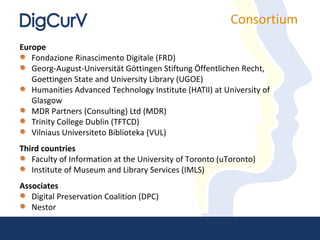
Consortium
Europe
   Fondazione Rinascimento Digitale (FRD)
   Georg-August-Universität Göttingen Stiftung Öffentlichen Recht,
   Goettingen State and University Library (UGOE)
   Humanities Advanced Technology Institute (HATII) at University of
   Glasgow
   MDR Partners (Consulting) Ltd (MDR)
   Trinity College Dublin (TFTCD)
   Vilniaus Universiteto Biblioteka (VUL)
Third countries
   Faculty of Information at the University of Toronto (uToronto)
   Institute of Museum and Library Services (IMLS)
Associates
   Digital Preservation Coalition (DPC)
   Nestor
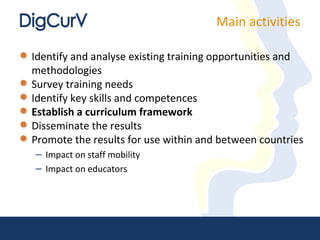
Main activities

Identify and analyse existing training opportunities and
methodologies
Survey training needs
Identify key skills and competences
Establish a curriculum framework
Disseminate the results
Promote the results for use within and between countries
– Impact on staff mobility
– Impact on educators
Main activities

Developing the network
– Relationships with learning organisations, educators, employing
  organisations, individuals
– The ripple effect – at both policy and practitioner level

Implementation in vocational education and
training for the sector
An international community of practice
– Sustained by a collaborative web-environment
– Continuing development of the framework
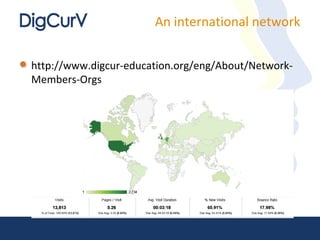
An international network


http://www.digcur-education.org/eng/About/Network-
Members-Orgs
Shape of Today’s Event


Morning
– Introduction to the idea/development of the lenses
– Responses to the lenses by four experts
– A round of CURATE: The Digital Curation Game
Afternoon
– Breakout Sessions
   • Scenarios that will give us feedback on the usefulness of the
     lenses in practice
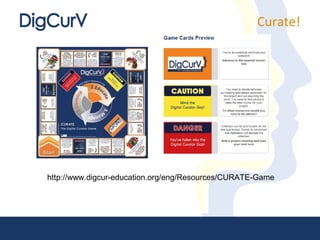
Curate!


http://www.digcur-education.org/eng/Resources/CURATE-Game
Follow us and join the network!
     www.digcur-education.org

DigCurV - Introductions and Context

  • 1.
    Welcome: Framing the Digital Curation Curriculum Florence 12 December 2012 This project has been funded with support from the European Commission'
  • 2.
    Digital agenda forEurope “In ancient times, the library of Alexandria was said to contain up to 70% of all human knowledge. The challenge for the digital age is to do even better than that – and make the result last longer.” • Public sector responsibility for digitisation of cultural heritage • Calls for large investment from national governments and the European Commission • Digital preservation is seen as a key issue – now needs to be put in practice http://ec.europa.eu/information_society/activities/digital_libraries/doc/refgroup/final_report_cds.pdf
  • 3.
    Context in Europe 47 National libraries, 20,500 Public libraries, 10,000 University libraries, 29,000 Special libraries + School libraries 17,600 Museums 25 National archives Audiovisual archives 82000 staff 2366 staff involved in digitisation NUMERIC report, 2009 http://www.cipfastats.net/default_view.asp?content_ref=9743
  • 4.
    Training and Education Professional training for the care of traditional collections is well established Training in long term management of digital assets has been identified as a major issue for employers and staff Professional development is a lifetime requirement Zach Klein CC BY-NC 2.0 DPC training needs report, 2004 http://www.jisc.ac.uk/uploaded_documents/finalReport.pdf
  • 5.
    Professional Development: is a lifetime requirement “Digital curation and preservation are rapidly evolving fields. To perform effectively, personnel working in these fields need to update their knowledge and skills on a continuous basis.” http://www.digitalpreservationeurope.eu/publications/professional_development.pdf
  • 6.
    Consortium Europe Fondazione Rinascimento Digitale (FRD) Georg-August-Universität Göttingen Stiftung Öffentlichen Recht, Goettingen State and University Library (UGOE) Humanities Advanced Technology Institute (HATII) at University of Glasgow MDR Partners (Consulting) Ltd (MDR) Trinity College Dublin (TFTCD) Vilniaus Universiteto Biblioteka (VUL) Third countries Faculty of Information at the University of Toronto (uToronto) Institute of Museum and Library Services (IMLS) Associates Digital Preservation Coalition (DPC) Nestor
  • 7.
    Main activities Identify andanalyse existing training opportunities and methodologies Survey training needs Identify key skills and competences Establish a curriculum framework Disseminate the results Promote the results for use within and between countries – Impact on staff mobility – Impact on educators
  • 8.
    Main activities Developing thenetwork – Relationships with learning organisations, educators, employing organisations, individuals – The ripple effect – at both policy and practitioner level Implementation in vocational education and training for the sector An international community of practice – Sustained by a collaborative web-environment – Continuing development of the framework
  • 9.
  • 10.
    Shape of Today’sEvent Morning – Introduction to the idea/development of the lenses – Responses to the lenses by four experts – A round of CURATE: The Digital Curation Game Afternoon – Breakout Sessions • Scenarios that will give us feedback on the usefulness of the lenses in practice
  • 11.
  • 12.
    Follow us andjoin the network! www.digcur-education.org