TEACHING
IN THE AGE OF FACEBOOK
AND OTHER SOCIAL MEDIA
LIS FACULTY AND STUDENTS’ FRIENDING
AND POKING IN THE SOCIAL SPHERE


       CAROLYN.HANK@MCGILL.CA
         Assistant Professor ▪ School of Information Studies


                             ALISE 2012 ▪ 18 JANUARY 2012 ▪ DALLAS
WHO
WHY
HOW
      2012 ALISE Research
         Grant Competition
Carolyn Hank
      PI (McGill)


Cassidy Sugimoto
      Co-PI (IUB)


  Jeff Pomerantz
    Co-PI (UNC)
Carolyn Hank
      PI (McGill)


Cassidy Sugimoto
      Co-PI (IUB)


  Jeff Pomerantz
    Co-PI (UNC)
Carolyn Hank
      PI (McGill)


Cassidy Sugimoto
      Co-PI (IUB)


                         Fred
  Jeff Pomerantz    Stutzman,
    Co-PI (UNC)       Advisor
                        (CMU)
SOCIAL NETWORK SITES (SNS)


                                        59%
                                        OF ADULT
                                     INTERNET USERS
                                       USE 1+ SNSs
                                      BASED ON 79% OF AMERICANS WHO
                                     REPORT USING THE INTERNET (N=2,255)


Data Source: Hampton et al. (2011)
Image Source: Donovan (2010)
SNS USERS ON FACEBOOK


                    92          %


Source: Hampton et al. (2011)
FACULTY USE OF FACEBOOK


                     57       %


     VISITED FACEBOOK IN
   THE PAST MONTH (N=1,920)

Source: Moran et al. (2011)
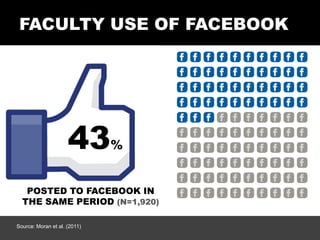
FACULTY USE OF FACEBOOK


                     43       %


   POSTED TO FACEBOOK IN
  THE SAME PERIOD (N=1,920)

Source: Moran et al. (2011)
STUDENTS
    OR
 FACULTY.
STUDENTS
  AND
FACULTY?
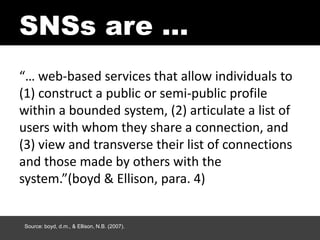
SNSs are …
“… web-based services that allow individuals to
(1) construct a public or semi-public profile
within a bounded system, (2) articulate a list of
users with whom they share a connection, and
(3) view and transverse their list of connections
and those made by others with the
system.”(boyd & Ellison, para. 4)


Source: boyd, d.m., & Ellison, N.B. (2007).
NETWORKING
SNSs are …
      “… instead, they (users) are primarily
      communicating with people who are
      already a part of their extended social
      network.” (boyd & Ellison, para. 5)


Source: boyd, d.m., & Ellison, N.B. (2007).
FRIENDS
 HIGH SCHOOL
 EXTENDED FAMILY
 CO-WORKERS
 COLLEGE FRIENDS
 IMMEDIATE FAMILY
 PEOPLE FROM VOLUNTEER GROUPS
 NEIGHBORS

 229 FACEBOOK FRIENDS REPORTED, FOR AVERAGE FACEBOOK USER IN SAMPLE


Source: Hampton et al. (2011)
FACULTY &
 STUDENT
FRIENDS (?)
DUAL RELATIONSHIPS

     TEACHER
      MENTOR
  SUPERVISOR    “… a professional tries
                to simultaneously fill
    EMPLOYER    two or more different
COLLABORATOR    roles.” Rupert & Holmes, 1997, p. 661
   COLLEAGUE
       FRIEND
GUIDANCE
  HONOR
  CODES/
CODES OF
CONDUCT


            SNS
            POLICIES
            (Metzger et al. (2010)
RESEARCH
OBJECTIVES
Describe LIS faculty and
student interactions via
Facebook


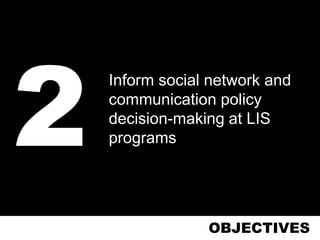
             OBJECTIVES
Inform social network and
communication policy
decision-making at LIS
programs


             OBJECTIVES
Inform future approaches
and methods for other
academic units, regardless
of discipline, to investigate
connections between
pedagogy and social
network tools, including
Facebook


               OBJECTIVES
HOW?
Develop and pilot test an
approach to studying …
… LIS faculty, students’ and
 administrators’ perceptions,
 experiences, practices, and
decision-making for managing
  communications with one
another, if at all, via Facebook;
… their expectations for such
 communications, including
issues related to disclosure
         and privacy;
… and the impact of classroom
and institutional policies, if any,
     on such interactions.
RESEARCH DESIGN

  MCGILL
     IUB   SETTINGS
    UNC
RESEARCH DESIGN
  FOCUS
 FOCUS               1:1           POLICY             WEB-BASED
                  INTERVIEWS
  GROUPS
GROUPS           INTERVIEWS       ANALYSIS             SURVEYS


FACULTY          ASSOC. DEANS/   SYLLABI              Q1: FACULTY
STUDENTS         DIRECTOR        SOCIAL MEDIA         Q2: STUDENTS
-UG                              INST’L POLICIES
-MLIS                            -SCHOOL
-PhD                             -FACULTY
                                 -UNIVERISTY

        FEB-MAR-APR 2012         MAY-JUN-JUL 2012   AUG-SEPT-OCT 2012

EXPLORATORY                 TOOLS                    DESCRIPTIVE
SOURCES
boyd, d.m., & Ellison, N.B. (2007). Social network sites: Definition, history, and
   scholarship. Journal of Computer-Mediated Communication, 13(1), article
   11. http://jcms.indiana.edu/vol13/issue1/boyd.ellison.html
Hampton et al. (2011). Social networking sites and our lives. Washington, DC:
  Pew Internet & American Life Project. http://pewinternet.org/Reports/2011/
  Technology-and-social-networks.aspx
Moran, M., Seaman, J., & Tinti-Kane, H. (2011). Teaching, learning, and
  sharing: How today’s higher education faculty use social media. Boston,
  MA: Pearson Learning Solutions. Retrieved from
  http://www.pearsonlearningsolutions.com/educators
  /pearson-social-media-survey-2011-bw.pdf
Rupert, P.A., & Holmes, D.L. (1997). Dual relationships in higher education:
  Professional and institutional guidelines. Journal of Higher Education, 68(6),
  660-678.
[Image Source] Donovan, K. (2010, January 29). Social media heart collage.
   Retrieved from http://www.flickr.com/photos/kdonovan_gaddy/4314365065/
SEE YOU
NEXT YEAR!
THANK YOU …
CAROLYN HANK
Email: carolyn.hank@mcgill.ca
Phone: (001)514.398.4684
SlideShare: http://www.slideshare.net/carolynhank/alise2012
Slideshow:


THANKS TO …
ALISE 2012 RESEARCH GRANT
                                         QUESTIONS?

(January 2012) ALISE 2012

  • 1.
    TEACHING IN THE AGEOF FACEBOOK AND OTHER SOCIAL MEDIA LIS FACULTY AND STUDENTS’ FRIENDING AND POKING IN THE SOCIAL SPHERE CAROLYN.HANK@MCGILL.CA Assistant Professor ▪ School of Information Studies ALISE 2012 ▪ 18 JANUARY 2012 ▪ DALLAS
  • 2.
    WHO WHY HOW 2012 ALISE Research Grant Competition
  • 3.
    Carolyn Hank PI (McGill) Cassidy Sugimoto Co-PI (IUB) Jeff Pomerantz Co-PI (UNC)
  • 4.
    Carolyn Hank PI (McGill) Cassidy Sugimoto Co-PI (IUB) Jeff Pomerantz Co-PI (UNC)
  • 5.
    Carolyn Hank PI (McGill) Cassidy Sugimoto Co-PI (IUB) Fred Jeff Pomerantz Stutzman, Co-PI (UNC) Advisor (CMU)
  • 6.
    SOCIAL NETWORK SITES(SNS) 59% OF ADULT INTERNET USERS USE 1+ SNSs BASED ON 79% OF AMERICANS WHO REPORT USING THE INTERNET (N=2,255) Data Source: Hampton et al. (2011) Image Source: Donovan (2010)
  • 7.
    SNS USERS ONFACEBOOK 92 % Source: Hampton et al. (2011)
  • 8.
    FACULTY USE OFFACEBOOK 57 % VISITED FACEBOOK IN THE PAST MONTH (N=1,920) Source: Moran et al. (2011)
  • 9.
    FACULTY USE OFFACEBOOK 43 % POSTED TO FACEBOOK IN THE SAME PERIOD (N=1,920) Source: Moran et al. (2011)
  • 11.
    STUDENTS OR FACULTY.
  • 12.
  • 13.
    SNSs are … “…web-based services that allow individuals to (1) construct a public or semi-public profile within a bounded system, (2) articulate a list of users with whom they share a connection, and (3) view and transverse their list of connections and those made by others with the system.”(boyd & Ellison, para. 4) Source: boyd, d.m., & Ellison, N.B. (2007).
  • 14.
  • 15.
    SNSs are … “… instead, they (users) are primarily communicating with people who are already a part of their extended social network.” (boyd & Ellison, para. 5) Source: boyd, d.m., & Ellison, N.B. (2007).
  • 16.
    FRIENDS HIGH SCHOOL EXTENDED FAMILY CO-WORKERS COLLEGE FRIENDS IMMEDIATE FAMILY PEOPLE FROM VOLUNTEER GROUPS NEIGHBORS 229 FACEBOOK FRIENDS REPORTED, FOR AVERAGE FACEBOOK USER IN SAMPLE Source: Hampton et al. (2011)
  • 17.
  • 18.
    DUAL RELATIONSHIPS TEACHER MENTOR SUPERVISOR “… a professional tries to simultaneously fill EMPLOYER two or more different COLLABORATOR roles.” Rupert & Holmes, 1997, p. 661 COLLEAGUE FRIEND
  • 19.
    GUIDANCE HONOR CODES/ CODES OF CONDUCT SNS POLICIES (Metzger et al. (2010)
  • 20.
  • 21.
    Describe LIS facultyand student interactions via Facebook OBJECTIVES
  • 22.
    Inform social networkand communication policy decision-making at LIS programs OBJECTIVES
  • 23.
    Inform future approaches andmethods for other academic units, regardless of discipline, to investigate connections between pedagogy and social network tools, including Facebook OBJECTIVES
  • 24.
    HOW? Develop and pilottest an approach to studying …
  • 25.
    … LIS faculty,students’ and administrators’ perceptions, experiences, practices, and decision-making for managing communications with one another, if at all, via Facebook;
  • 26.
    … their expectationsfor such communications, including issues related to disclosure and privacy;
  • 27.
    … and theimpact of classroom and institutional policies, if any, on such interactions.
  • 28.
    RESEARCH DESIGN MCGILL IUB SETTINGS UNC
  • 29.
    RESEARCH DESIGN FOCUS FOCUS 1:1 POLICY WEB-BASED INTERVIEWS GROUPS GROUPS INTERVIEWS ANALYSIS SURVEYS FACULTY ASSOC. DEANS/ SYLLABI Q1: FACULTY STUDENTS DIRECTOR SOCIAL MEDIA Q2: STUDENTS -UG INST’L POLICIES -MLIS -SCHOOL -PhD -FACULTY -UNIVERISTY FEB-MAR-APR 2012 MAY-JUN-JUL 2012 AUG-SEPT-OCT 2012 EXPLORATORY TOOLS DESCRIPTIVE
  • 30.
    SOURCES boyd, d.m., &Ellison, N.B. (2007). Social network sites: Definition, history, and scholarship. Journal of Computer-Mediated Communication, 13(1), article 11. http://jcms.indiana.edu/vol13/issue1/boyd.ellison.html Hampton et al. (2011). Social networking sites and our lives. Washington, DC: Pew Internet & American Life Project. http://pewinternet.org/Reports/2011/ Technology-and-social-networks.aspx Moran, M., Seaman, J., & Tinti-Kane, H. (2011). Teaching, learning, and sharing: How today’s higher education faculty use social media. Boston, MA: Pearson Learning Solutions. Retrieved from http://www.pearsonlearningsolutions.com/educators /pearson-social-media-survey-2011-bw.pdf Rupert, P.A., & Holmes, D.L. (1997). Dual relationships in higher education: Professional and institutional guidelines. Journal of Higher Education, 68(6), 660-678. [Image Source] Donovan, K. (2010, January 29). Social media heart collage. Retrieved from http://www.flickr.com/photos/kdonovan_gaddy/4314365065/
  • 31.
  • 32.
    THANK YOU … CAROLYNHANK Email: carolyn.hank@mcgill.ca Phone: (001)514.398.4684 SlideShare: http://www.slideshare.net/carolynhank/alise2012 Slideshow: THANKS TO … ALISE 2012 RESEARCH GRANT QUESTIONS?