DIGITAL CURATION

       Dr. Carolyn Hank
      carolyn.hank@mcgill.ca
    School of Information Studies
         McGill University

    GLIS 639: Intro to Museology
          28 January 2011
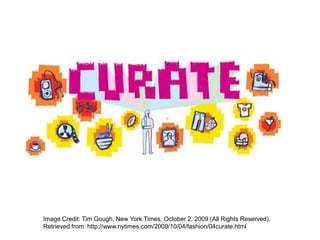
Image Credit: Tim Gough, New York Times, October 2, 2009 (All Rights Reserved).
Retrieved from: http://www.nytimes.com/2009/10/04/fashion/04curate.html
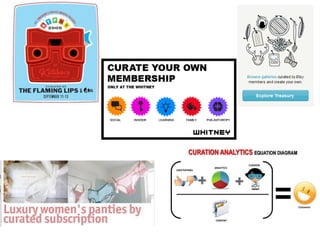
CURATE IS NOT ALONE
“ … the word archive has lost much of its traditional
meaning and associations … archivists have literally
lost control over the definition of archive.” (Hedstrom,
1991, p. 336)

“…despite the recent appropriation of „archive‟ as a
verb to mean „store‟ or „to preserve,‟ the traditional
meaning of archives as a noun is narrower.” (CLIR,
2001, p. 85)

“Traditionally, preservation and archiving have had two
distinct definitions with preservation being a necessary
component of, but not equivalent to, the totality of
archiving.” (Tibbo, 2003, p. 11)
KEEPING UP WITH DATA ROT
http://www.youtube.com/watch?v=q-2vv7Y6Rww
DISCUSSION
DEFINITIONS
DIGITAL PRESERVATION (ALA) - Short/Medium
 SHORT: “Digital preservation combines policies, strategies and
 actions that ensure access to digital content over time.”

 MEDIUM: “Digital preservation combines policies, strategies and
 actions to ensure access to reformatted and born digital content
 regardless of the challenges of media failure and technological
 change. The goal of digital preservation is the accurate rendering
 of authenticated content over time.”


     SOURCE: http://www.ala.org/ala/alcts/newslinks/digipres/index.cfm
DEFINITIONS
     DIGITAL PRESERVATION (ALA) – Long
“Digital preservation combines policies, strategies and actions to
ensure the accurate rendering of authenticated content over
time, regardless of the challenges of media failure and
technological change. Digital preservation applies to both born
digital and reformatted content.

Digital preservation policies document an organization’s
commitment to preserve digital content for future use; specify
file formats to be preserved and the level of preservation to be
provided; and ensure compliance with standards and best
practices for responsible stewardship of digital information.

Digital preservation strategies and actions address content
creation, integrity and maintenance.”
DEFINITIONS
 DIGITAL PRESERVATION (ALA) – Long
CONTENT CREATION INCLUDES:
– Clear and complete technical specifications
– Production of reliable master files
– Sufficient descriptive, administrative and structural
  metadata to ensure future access
– Detailed quality control of processes
DEFINITIONS
 DIGITAL PRESERVATION (ALA) – Long
CONTENT INTEGRITY INCLUDES:
– Documentation of all policies, strategies and procedures
– Use of persistent identifiers
– Recorded provenance and change history for all objects
– Verification mechanisms
– Attention to security requirements
– Routine audits
DEFINITIONS
 DIGITAL PRESERVATION (ALA) – Long
CONTENT MAINTENANCE INCLUDES:
– A robust computing and networking infrastructure
– Storage and synchronization of files at multiple sites
– Continuous monitoring and management of files
– Programs for refreshing, migration and emulation
– Creation and testing of disaster prevention and recovery
  plans
– Periodic review and updating of policies and procedures
DEFINITIONS
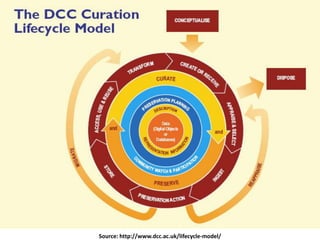
              DIGITAL CURATION (DCC)
Digital curation, broadly interpreted, is about maintaining and
adding value to a trusted body of digital information for current
and future use.

The active management and preservation of digital resources
over the life-cycle of scholarly and scientific interest, and over
time for current and future generations of users.


      “What Is Digital Curation?”http://www.dcc.ac.uk/about/what/
Source: http://www.dcc.ac.uk/lifecycle-model/
WHY THIS MATTERS
        A SAMPLE OF SELECT ISSUES
–Creating durable digital objects
–Hardware and software obsolescence
–File formats
–Rights management and other legal and ethical issues
–Metadata (minimum/optimal/practical)
–Appraisal and selection
–Quality control and “trustworthiness”
–Commitment to the long-term
–Resource allocation, costing, and staffing
–Funding for development and sustainability
Council on Library and Information Resources. (2001). The
   evidence in hand: Report of the Task Force on the Artifact in
   Library Collections. (CLIR Publication No. 103). Washington,
   DC: Author. Retrieved from
   http://www.clir.org/pubs/reports/pub103/contents.html
Hedstrom, M. (1991). Understanding electronic incunabula: A
   framework for research on electronic records. American
   Archivist, 54(3), 334-354.

Tibbo, H.R. (2003). On the nature and importance of archiving in the
    digital age. In M. Zelkowitz (Ed.), Advances in Computers:
    Information Repositories, 57 (pp. 1-67). San Diego, CA: Elsevier.


                                                 REFERENCES
QUESTIONS?


                  Dr. Carolyn Hank
                 carolyn.hank@mcgill.ca
             School of Information Studies
                          McGill University

(Jan 2011) Digital Curation (Guest Lecture)

  • 1.
    DIGITAL CURATION Dr. Carolyn Hank carolyn.hank@mcgill.ca School of Information Studies McGill University GLIS 639: Intro to Museology 28 January 2011
  • 2.
    Image Credit: TimGough, New York Times, October 2, 2009 (All Rights Reserved). Retrieved from: http://www.nytimes.com/2009/10/04/fashion/04curate.html
  • 4.
    CURATE IS NOTALONE “ … the word archive has lost much of its traditional meaning and associations … archivists have literally lost control over the definition of archive.” (Hedstrom, 1991, p. 336) “…despite the recent appropriation of „archive‟ as a verb to mean „store‟ or „to preserve,‟ the traditional meaning of archives as a noun is narrower.” (CLIR, 2001, p. 85) “Traditionally, preservation and archiving have had two distinct definitions with preservation being a necessary component of, but not equivalent to, the totality of archiving.” (Tibbo, 2003, p. 11)
  • 5.
    KEEPING UP WITHDATA ROT http://www.youtube.com/watch?v=q-2vv7Y6Rww
  • 6.
  • 7.
    DEFINITIONS DIGITAL PRESERVATION (ALA)- Short/Medium SHORT: “Digital preservation combines policies, strategies and actions that ensure access to digital content over time.” MEDIUM: “Digital preservation combines policies, strategies and actions to ensure access to reformatted and born digital content regardless of the challenges of media failure and technological change. The goal of digital preservation is the accurate rendering of authenticated content over time.” SOURCE: http://www.ala.org/ala/alcts/newslinks/digipres/index.cfm
  • 8.
    DEFINITIONS DIGITAL PRESERVATION (ALA) – Long “Digital preservation combines policies, strategies and actions to ensure the accurate rendering of authenticated content over time, regardless of the challenges of media failure and technological change. Digital preservation applies to both born digital and reformatted content. Digital preservation policies document an organization’s commitment to preserve digital content for future use; specify file formats to be preserved and the level of preservation to be provided; and ensure compliance with standards and best practices for responsible stewardship of digital information. Digital preservation strategies and actions address content creation, integrity and maintenance.”
  • 9.
    DEFINITIONS DIGITAL PRESERVATION(ALA) – Long CONTENT CREATION INCLUDES: – Clear and complete technical specifications – Production of reliable master files – Sufficient descriptive, administrative and structural metadata to ensure future access – Detailed quality control of processes
  • 10.
    DEFINITIONS DIGITAL PRESERVATION(ALA) – Long CONTENT INTEGRITY INCLUDES: – Documentation of all policies, strategies and procedures – Use of persistent identifiers – Recorded provenance and change history for all objects – Verification mechanisms – Attention to security requirements – Routine audits
  • 11.
    DEFINITIONS DIGITAL PRESERVATION(ALA) – Long CONTENT MAINTENANCE INCLUDES: – A robust computing and networking infrastructure – Storage and synchronization of files at multiple sites – Continuous monitoring and management of files – Programs for refreshing, migration and emulation – Creation and testing of disaster prevention and recovery plans – Periodic review and updating of policies and procedures
  • 12.
    DEFINITIONS DIGITAL CURATION (DCC) Digital curation, broadly interpreted, is about maintaining and adding value to a trusted body of digital information for current and future use. The active management and preservation of digital resources over the life-cycle of scholarly and scientific interest, and over time for current and future generations of users. “What Is Digital Curation?”http://www.dcc.ac.uk/about/what/
  • 13.
  • 14.
    WHY THIS MATTERS A SAMPLE OF SELECT ISSUES –Creating durable digital objects –Hardware and software obsolescence –File formats –Rights management and other legal and ethical issues –Metadata (minimum/optimal/practical) –Appraisal and selection –Quality control and “trustworthiness” –Commitment to the long-term –Resource allocation, costing, and staffing –Funding for development and sustainability
  • 15.
    Council on Libraryand Information Resources. (2001). The evidence in hand: Report of the Task Force on the Artifact in Library Collections. (CLIR Publication No. 103). Washington, DC: Author. Retrieved from http://www.clir.org/pubs/reports/pub103/contents.html Hedstrom, M. (1991). Understanding electronic incunabula: A framework for research on electronic records. American Archivist, 54(3), 334-354. Tibbo, H.R. (2003). On the nature and importance of archiving in the digital age. In M. Zelkowitz (Ed.), Advances in Computers: Information Repositories, 57 (pp. 1-67). San Diego, CA: Elsevier. REFERENCES
  • 16.
    QUESTIONS? Dr. Carolyn Hank carolyn.hank@mcgill.ca School of Information Studies McGill University