Simon Tanner
    King’s College London

Email: simon.tanner@kcl.ac.uk
   Twitter: SimonTanner
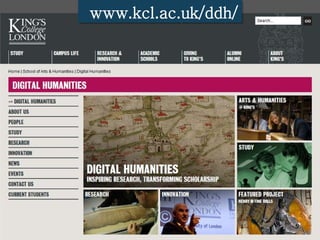
www.kcl.ac.uk/ddh/
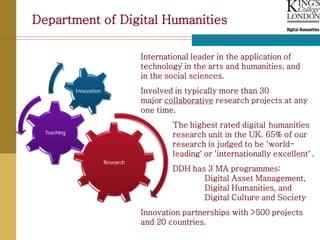
Department of Digital Humanities

                                     International leader in the application of
                                                .
                                     technology in the arts and humanities, and
                                     in the social sciences.
             Innovation              Involved in typically more than 30
                                     major collaborative research projects at any
                                     one time.
                                             The highest rated digital humanities
  Teaching                                   research unit in the UK. 65% of our
                                             research is judged to be 'world-
                                             leading' or 'internationally excellent' .
                          Research
                                             DDH has 3 MA programmes:
                                                    Digital Asset Management,
                                                    Digital Humanities, and
                                                    Digital Culture and Society
                                     Innovation partnerships with >500 projects
                                     and 20 countries.
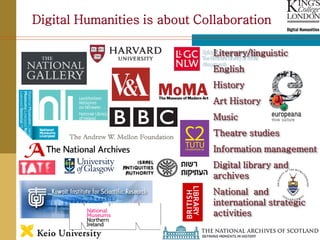
Digital Humanities is about Collaboration

                         .     Literary/linguistic
                               English
                               History
                               Art History
                               Music
                               Theatre studies
                               Information management
                               Digital library and
                               archives
                               National and
                               international strategic
                               activities
Honoring our sponsors

The research underpinning this presentation is
                        .
          funded from two sources:

              Inspiring Research, Inspiring Scholarship:
              The value & benefits of digitised resources
              www.kdcs.kcl.ac.uk/innovation/inspiring.html


              Impact of Digitised Resources
              www.kdcs.kcl.ac.uk/innovation/impact.html
Culture is the wealth of nations

“Knowledge is power... knowledge is also wealth”
                          .
                 Dr Joseph Phaahla, Deputy Minister
               South African Ministry of Arts & Culture
      International Conf of African Digital Libraries & Archives


 Culture is essential to develop information into personalised
 knowledge
 Culture is an essential underpinning for national identity
 Memory institutions are essential actors in national cultural
 identity and digitisation is re-emphasising this role
 Cultural values are an important element in economic
 advancement
Culture: Edward Said’s View

 Two distinct meanings:
    Cultural practice – the manifestation of ideas that come into being in
    aesthetic forms, whose main reason for being is to provide pleasure for
    those who consume them – e.g. novels, art, music...
    Conceptual container – culture is seen as an abstract tool for refining
    and elevating a society – it is the container for all that can be defined as
    the greatest offerings in terms of knowledge, creativity and thought that
    society can offer.


 In this mode, culture will become associated with a
 nation or a state and is a source of identity for the
 group that identifies with it.
 Said, E.W. (1994) Culture and Imperialism. 4th Ed. Vintage
National Identity – contested space?
 Anderson posits: national identity is preceded by and grows out of
 cultural resources and institutions. History, maps, museums,
 censuses, literature etc all contribute to the collective imagining of
 something called a nation.
 Benedict Anderson (2006) Imagined Communities: Reflections on the Origin and
 Spread of Nationalism


 Pickover: “cyberspace is not an uncontested domain. The digital
 medium contains an ideological base – it is a site of struggle. So,
 the real challenges are not technological or technical but social
 and political.”
 Curators/librarians/archivists are thus “agents of social change”
 Pickover, M. (2005) Negotiations, contestations and fabrications: the politics of
 archives in South Africa ten years after democracy. (from ukzn.ac.za)
 INNOVATION-PIETERMARITZBURG
The role of public repositories: My View

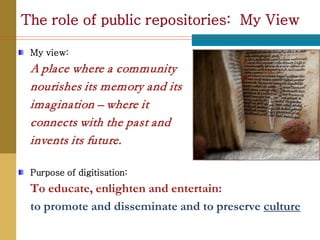
 My view:
 A place where a community
 nourishes its memory and its
 imagination – where it
 connects with the past and
 invents its future.

 Purpose of digitisation:
 To educate, enlighten and entertain:
 to promote and disseminate and to preserve culture
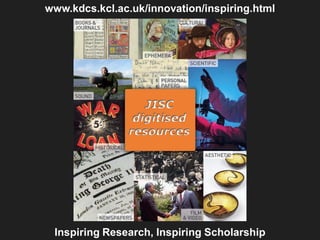
www.kdcs.kcl.ac.uk/innovation/inspiring.html


 Inspiring Research, Inspiring Scholarship
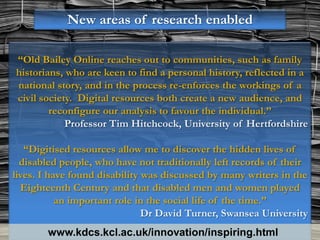
New areas of research enabled

“Old Bailey Online reaches out to communities, such as family
historians, who are keen to find a personal history, reflected in a
national story, and in the process re-enforces the workings of a
civil society. Digital resources both create a new audience, and
        reconfigure our analysis to favour the individual.”
            Professor Tim Hitchcock, University of Hertfordshire

   “Digitised resources allow me to discover the hidden lives of
  disabled people, who have not traditionally left records of their
lives. I have found disability was discussed by many writers in the
  Eighteenth Century and that disabled men and women played
           an important role in the social life of the time.”
                               Dr David Turner, Swansea University
        www.kdcs.kcl.ac.uk/innovation/inspiring.html
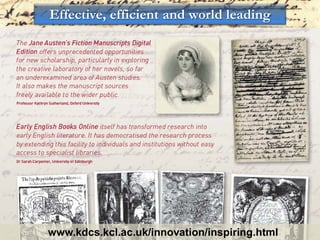
Effective, efficient and world leading


www.kdcs.kcl.ac.uk/innovation/inspiring.html
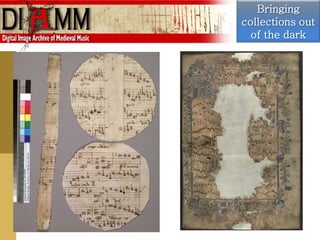
Bringing
collections out
  of the dark
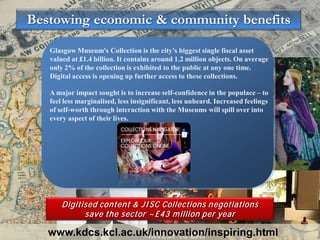
Bestowing economic & community benefits

   Glasgow Museum's Collection is the city’s biggest single fiscal asset
   valued at £1.4 billion. It contains around 1.2 million objects. On average
   only 2% of the collection is exhibited to the public at any one time.
   Digital access is opening up further access to these collections.

   A major impact sought is to increase self-confidence in the populace – to
   feel less marginalised, less insignificant, less unheard. Increased feelings
   of self-worth through interaction with the Museums will spill over into
   every aspect of their lives.


       Digitised content & JI SC Collections negotiations
             save the sector ~£43 m illion per year

   www.kdcs.kcl.ac.uk/innovation/inspiring.html
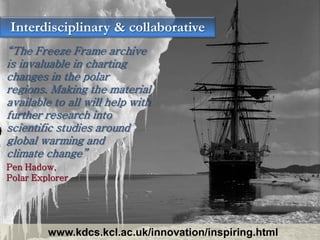
Interdisciplinary & collaborative
“The Freeze Frame archive
is invaluable in charting
changes in the polar
regions. Making the material
available to all will help with
further research into
scientific studies around
global warming and
climate change”
Pen Hadow,
Polar Explorer


         www.kdcs.kcl.ac.uk/innovation/inspiring.html
A digital library vision for the future

       What the Bodleian Library is doing now,
   in digitising large portions of our vast collections,
            is like the human genome project.

 Thousands of people can evaluate and use creatively
      the digital resources to discover new ideas
                  and make innovations.

 Many hands make light work and those many hands will
     profoundly touch Britain's future capacity for
          learning, research and innovation.

Dr Sarah Thomas, Bodleian Library, Oxford University
Digitising for our Digital Futures

    We are sitting on a goldmine of content which
    should be within a coherent UK national digital
    strategy. To support Digital Britain we need to
       deliver a critical mass of digital content.

    Access... ought to be the right of every citizen,
    every household, every child, every school and
       public library, universities and business.

           That's a vision worth delivering on.

       Dame Lynne Brindley, The British Library
Digitising for our Digital Futures??

 “You want a massive digital collection: SCAN THE STACKS!... You
       agonize over digital metadata and the purity thereof...
                      And you offer crap access.

              If I ask you to talk about your collections,
   I know that you will glow as you describe the amazing treasures
 you have. When you go for money for digitization projects, you talk
                    up the incredible cultural value...

       But then if I look at the results of those digitization projects,
                I find the shittiest websites on the planet.
It’s like a gallery spent all its money buying art and then just stuck the
    paintings in supermarket bags and leaned them against the wall.”

                Nat Torkington (@gnat) http://bit.ly/rNHMVr
    “Libraries: Where It All Went Wrong” The text of a Speech delivered to
   provoke the National and State Librarians of Australasia, November 2011
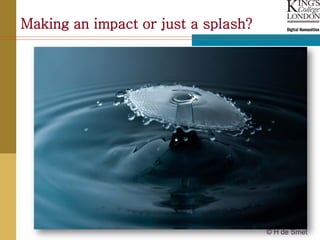
Making an impact or just a splash?


                                     © H de Smet
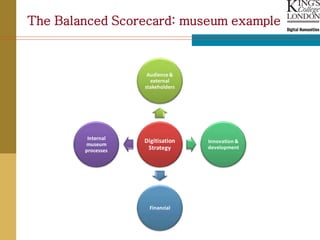
The Balanced Scorecard: museum example


                     Audience &
                      external
                    stakeholders


         Internal
                    Digitisation   Innovation &
        museum
        processes    Strategy      development


                      Financial
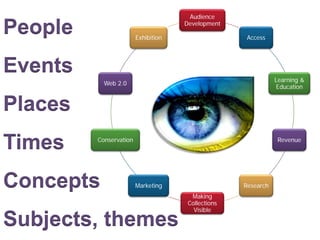
Audience

People                  Exhibition
                                     Development

                                                     Access


Events                                                         Learning &
           Web 2.0
                                                               Education


Places
Times    Conservation                                           Revenue


Concepts                Marketing                   Research
                                       Making
                                      Collections
                                        Visible

Subjects, themes
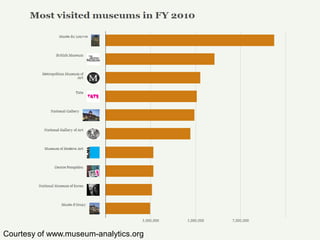
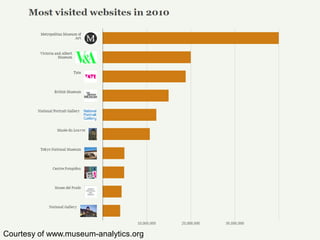
Courtesy of www.museum-analytics.org
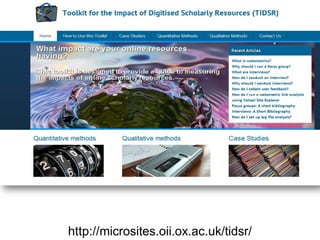
Understanding the audience: methods


     http://microsites.oii.ox.ac.uk/tidsr/
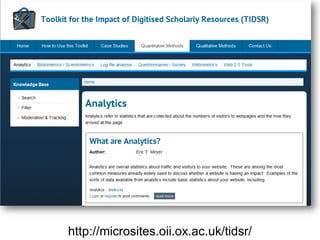
Understanding the audience: methods


     http://microsites.oii.ox.ac.uk/tidsr/

     http://microsites.oii.ox.ac.uk/tidsr/
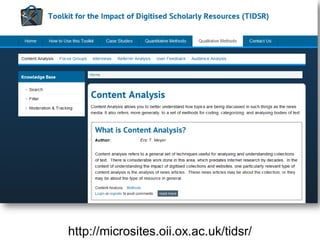
Understanding the audience: methods


     http://microsites.oii.ox.ac.uk/tidsr/
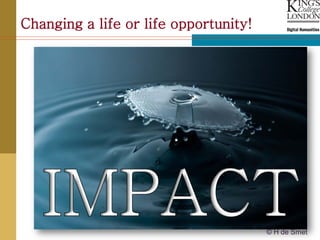
Changing a life or life opportunity!


                                       © H de Smet
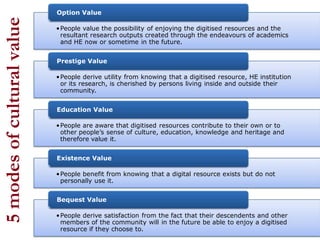
Option Value
5 modes of cultural value
                            • People value the possibility of enjoying the digitised resources and the
                              resultant research outputs created through the endeavours of academics
                              and HE now or sometime in the future.


                            Prestige Value

                            • People derive utility from knowing that a digitised resource, HE institution
                              or its research, is cherished by persons living inside and outside their
                              community.


                            Education Value

                            • People are aware that digitised resources contribute to their own or to
                              other people’s sense of culture, education, knowledge and heritage and
                              therefore value it.


                            Existence Value

                            • People benefit from knowing that a digital resource exists but do not
                              personally use it.


                            Bequest Value

                            • People derive satisfaction from the fact that their descendents and other
                              members of the community will in the future be able to enjoy a digitised
                              resource if they choose to.
Future research directions

The Arcadia Fund have provided a further $143,000
to explore methodologies for impact and value
assessment.
Factoring impact as meaning:

how has a life or life opportunity
been changed?

More information:
www.kdcs.kcl.ac.uk/innovation/impact.html
I would welcome your comments, guidance and ideas!

Results will be published freely under Open Access
Measuring life changes?

To measure change we need to know the baseline
from which change happens
To measure life changes we have to look at methods
from a wide range of Impact Assessment
practitioners:
   Health IA
   Environmental & Ecological IA
   Social IA
   Economic & Governmental IA, etc...
We also consider longitudinal studies may prove
useful.
The study will report in May 2012
www.kdcs.kcl.ac.uk/innovation/impact.html
One last thought for you to consider...
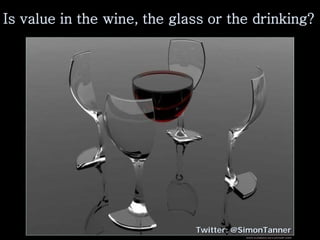
Is value in the wine, the glass or the drinking?


                             Twitter: @SimonTanner

Making an Impact: How Digitised Resources Change Lives

  • 1.
    Simon Tanner King’s College London Email: simon.tanner@kcl.ac.uk Twitter: SimonTanner
  • 2.
  • 3.
    Department of DigitalHumanities International leader in the application of . technology in the arts and humanities, and in the social sciences. Innovation Involved in typically more than 30 major collaborative research projects at any one time. The highest rated digital humanities Teaching research unit in the UK. 65% of our research is judged to be 'world- leading' or 'internationally excellent' . Research DDH has 3 MA programmes: Digital Asset Management, Digital Humanities, and Digital Culture and Society Innovation partnerships with >500 projects and 20 countries.
  • 4.
    Digital Humanities isabout Collaboration . Literary/linguistic English History Art History Music Theatre studies Information management Digital library and archives National and international strategic activities
  • 5.
    Honoring our sponsors Theresearch underpinning this presentation is . funded from two sources: Inspiring Research, Inspiring Scholarship: The value & benefits of digitised resources www.kdcs.kcl.ac.uk/innovation/inspiring.html Impact of Digitised Resources www.kdcs.kcl.ac.uk/innovation/impact.html
  • 6.
    Culture is thewealth of nations “Knowledge is power... knowledge is also wealth” . Dr Joseph Phaahla, Deputy Minister South African Ministry of Arts & Culture International Conf of African Digital Libraries & Archives Culture is essential to develop information into personalised knowledge Culture is an essential underpinning for national identity Memory institutions are essential actors in national cultural identity and digitisation is re-emphasising this role Cultural values are an important element in economic advancement
  • 7.
    Culture: Edward Said’sView Two distinct meanings: Cultural practice – the manifestation of ideas that come into being in aesthetic forms, whose main reason for being is to provide pleasure for those who consume them – e.g. novels, art, music... Conceptual container – culture is seen as an abstract tool for refining and elevating a society – it is the container for all that can be defined as the greatest offerings in terms of knowledge, creativity and thought that society can offer. In this mode, culture will become associated with a nation or a state and is a source of identity for the group that identifies with it. Said, E.W. (1994) Culture and Imperialism. 4th Ed. Vintage
  • 8.
    National Identity –contested space? Anderson posits: national identity is preceded by and grows out of cultural resources and institutions. History, maps, museums, censuses, literature etc all contribute to the collective imagining of something called a nation. Benedict Anderson (2006) Imagined Communities: Reflections on the Origin and Spread of Nationalism Pickover: “cyberspace is not an uncontested domain. The digital medium contains an ideological base – it is a site of struggle. So, the real challenges are not technological or technical but social and political.” Curators/librarians/archivists are thus “agents of social change” Pickover, M. (2005) Negotiations, contestations and fabrications: the politics of archives in South Africa ten years after democracy. (from ukzn.ac.za) INNOVATION-PIETERMARITZBURG
  • 9.
    The role ofpublic repositories: My View My view: A place where a community nourishes its memory and its imagination – where it connects with the past and invents its future. Purpose of digitisation: To educate, enlighten and entertain: to promote and disseminate and to preserve culture
  • 11.
  • 12.
    New areas ofresearch enabled “Old Bailey Online reaches out to communities, such as family historians, who are keen to find a personal history, reflected in a national story, and in the process re-enforces the workings of a civil society. Digital resources both create a new audience, and reconfigure our analysis to favour the individual.” Professor Tim Hitchcock, University of Hertfordshire “Digitised resources allow me to discover the hidden lives of disabled people, who have not traditionally left records of their lives. I have found disability was discussed by many writers in the Eighteenth Century and that disabled men and women played an important role in the social life of the time.” Dr David Turner, Swansea University www.kdcs.kcl.ac.uk/innovation/inspiring.html
  • 13.
    Effective, efficient andworld leading www.kdcs.kcl.ac.uk/innovation/inspiring.html
  • 14.
  • 15.
    Bestowing economic &community benefits Glasgow Museum's Collection is the city’s biggest single fiscal asset valued at £1.4 billion. It contains around 1.2 million objects. On average only 2% of the collection is exhibited to the public at any one time. Digital access is opening up further access to these collections. A major impact sought is to increase self-confidence in the populace – to feel less marginalised, less insignificant, less unheard. Increased feelings of self-worth through interaction with the Museums will spill over into every aspect of their lives. Digitised content & JI SC Collections negotiations save the sector ~£43 m illion per year www.kdcs.kcl.ac.uk/innovation/inspiring.html
  • 16.
    Interdisciplinary & collaborative “TheFreeze Frame archive is invaluable in charting changes in the polar regions. Making the material available to all will help with further research into scientific studies around global warming and climate change” Pen Hadow, Polar Explorer www.kdcs.kcl.ac.uk/innovation/inspiring.html
  • 17.
    A digital libraryvision for the future What the Bodleian Library is doing now, in digitising large portions of our vast collections, is like the human genome project. Thousands of people can evaluate and use creatively the digital resources to discover new ideas and make innovations. Many hands make light work and those many hands will profoundly touch Britain's future capacity for learning, research and innovation. Dr Sarah Thomas, Bodleian Library, Oxford University
  • 18.
    Digitising for ourDigital Futures We are sitting on a goldmine of content which should be within a coherent UK national digital strategy. To support Digital Britain we need to deliver a critical mass of digital content. Access... ought to be the right of every citizen, every household, every child, every school and public library, universities and business. That's a vision worth delivering on. Dame Lynne Brindley, The British Library
  • 19.
    Digitising for ourDigital Futures?? “You want a massive digital collection: SCAN THE STACKS!... You agonize over digital metadata and the purity thereof... And you offer crap access. If I ask you to talk about your collections, I know that you will glow as you describe the amazing treasures you have. When you go for money for digitization projects, you talk up the incredible cultural value... But then if I look at the results of those digitization projects, I find the shittiest websites on the planet. It’s like a gallery spent all its money buying art and then just stuck the paintings in supermarket bags and leaned them against the wall.” Nat Torkington (@gnat) http://bit.ly/rNHMVr “Libraries: Where It All Went Wrong” The text of a Speech delivered to provoke the National and State Librarians of Australasia, November 2011
  • 20.
    Making an impactor just a splash? © H de Smet
  • 21.
    The Balanced Scorecard:museum example Audience & external stakeholders Internal Digitisation Innovation & museum processes Strategy development Financial
  • 22.
    Audience People Exhibition Development Access Events Learning & Web 2.0 Education Places Times Conservation Revenue Concepts Marketing Research Making Collections Visible Subjects, themes
  • 23.
  • 24.
  • 25.
    Understanding the audience:methods http://microsites.oii.ox.ac.uk/tidsr/
  • 26.
    Understanding the audience:methods http://microsites.oii.ox.ac.uk/tidsr/ http://microsites.oii.ox.ac.uk/tidsr/
  • 27.
    Understanding the audience:methods http://microsites.oii.ox.ac.uk/tidsr/
  • 28.
    Changing a lifeor life opportunity! © H de Smet
  • 29.
    Option Value 5 modesof cultural value • People value the possibility of enjoying the digitised resources and the resultant research outputs created through the endeavours of academics and HE now or sometime in the future. Prestige Value • People derive utility from knowing that a digitised resource, HE institution or its research, is cherished by persons living inside and outside their community. Education Value • People are aware that digitised resources contribute to their own or to other people’s sense of culture, education, knowledge and heritage and therefore value it. Existence Value • People benefit from knowing that a digital resource exists but do not personally use it. Bequest Value • People derive satisfaction from the fact that their descendents and other members of the community will in the future be able to enjoy a digitised resource if they choose to.
  • 30.
    Future research directions TheArcadia Fund have provided a further $143,000 to explore methodologies for impact and value assessment. Factoring impact as meaning: how has a life or life opportunity been changed? More information: www.kdcs.kcl.ac.uk/innovation/impact.html I would welcome your comments, guidance and ideas! Results will be published freely under Open Access
  • 31.
    Measuring life changes? Tomeasure change we need to know the baseline from which change happens To measure life changes we have to look at methods from a wide range of Impact Assessment practitioners: Health IA Environmental & Ecological IA Social IA Economic & Governmental IA, etc... We also consider longitudinal studies may prove useful. The study will report in May 2012 www.kdcs.kcl.ac.uk/innovation/impact.html
  • 32.
    One last thoughtfor you to consider...
  • 33.
    Is value inthe wine, the glass or the drinking? Twitter: @SimonTanner