Simon Tanner
King’s College London
@SimonTanner
My Agenda


 Digital Humanities

 The benefits and value of digital resources & DH

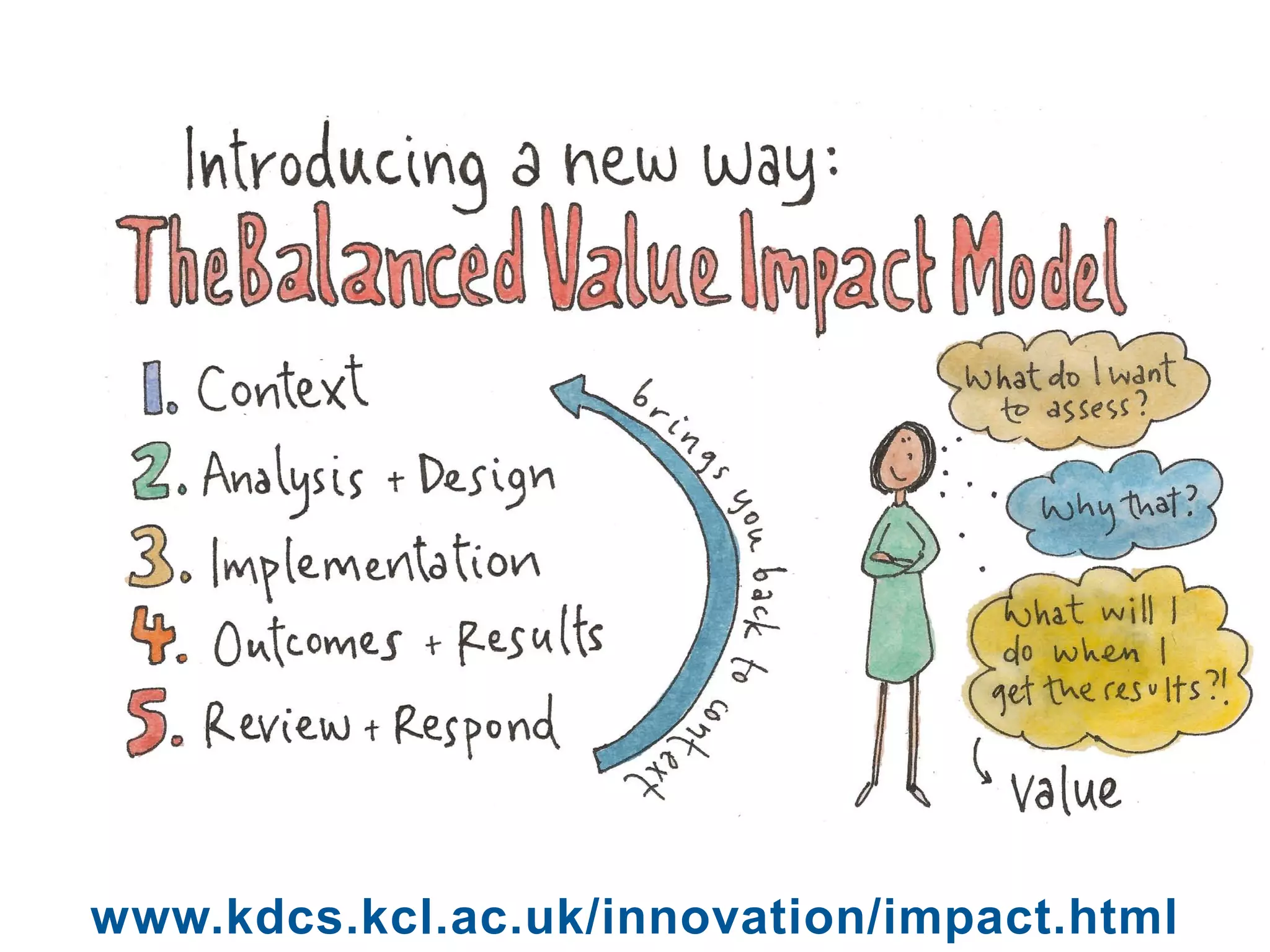
 Impact – introducing the Balanced Value Impact
 Model

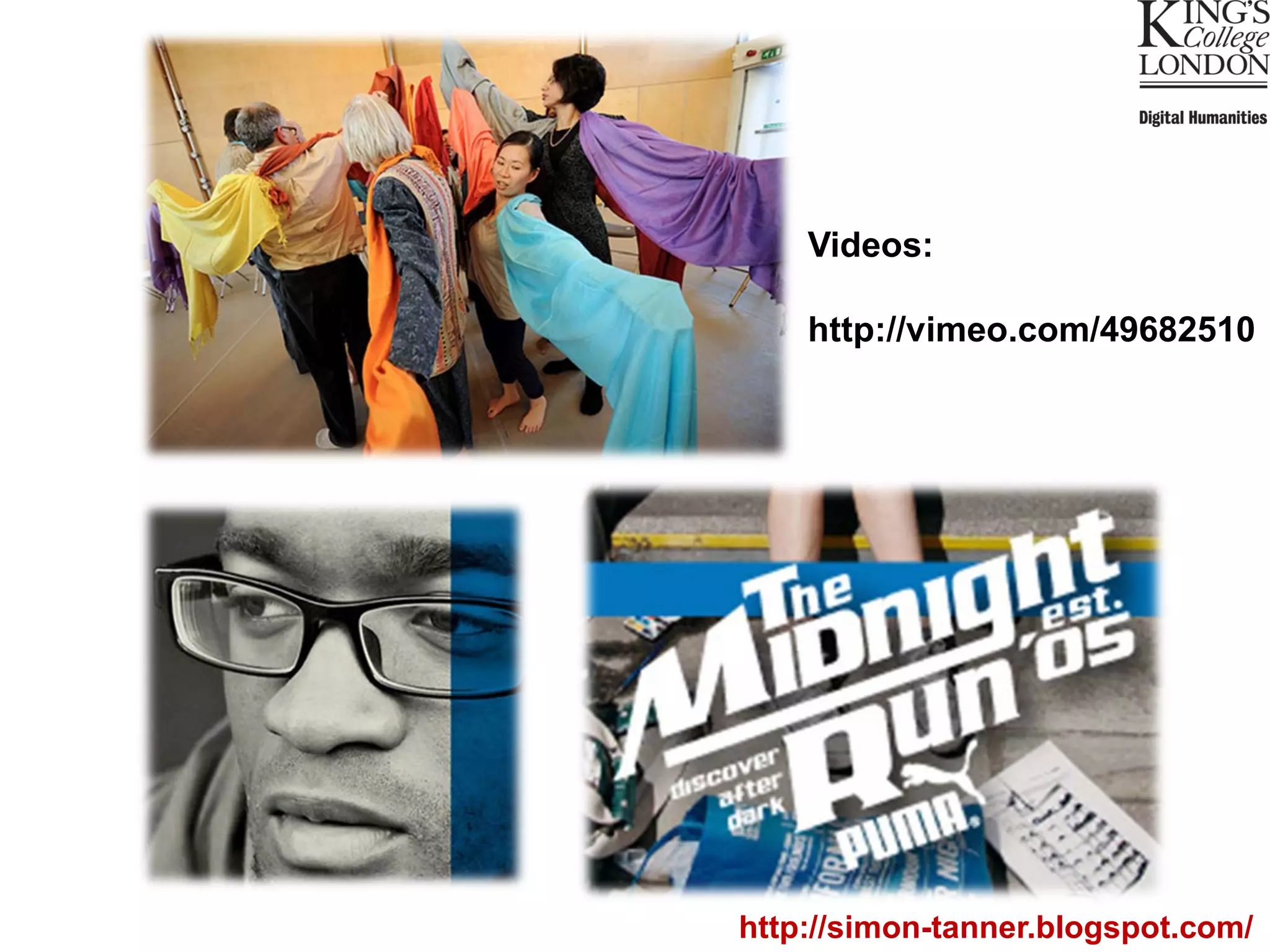
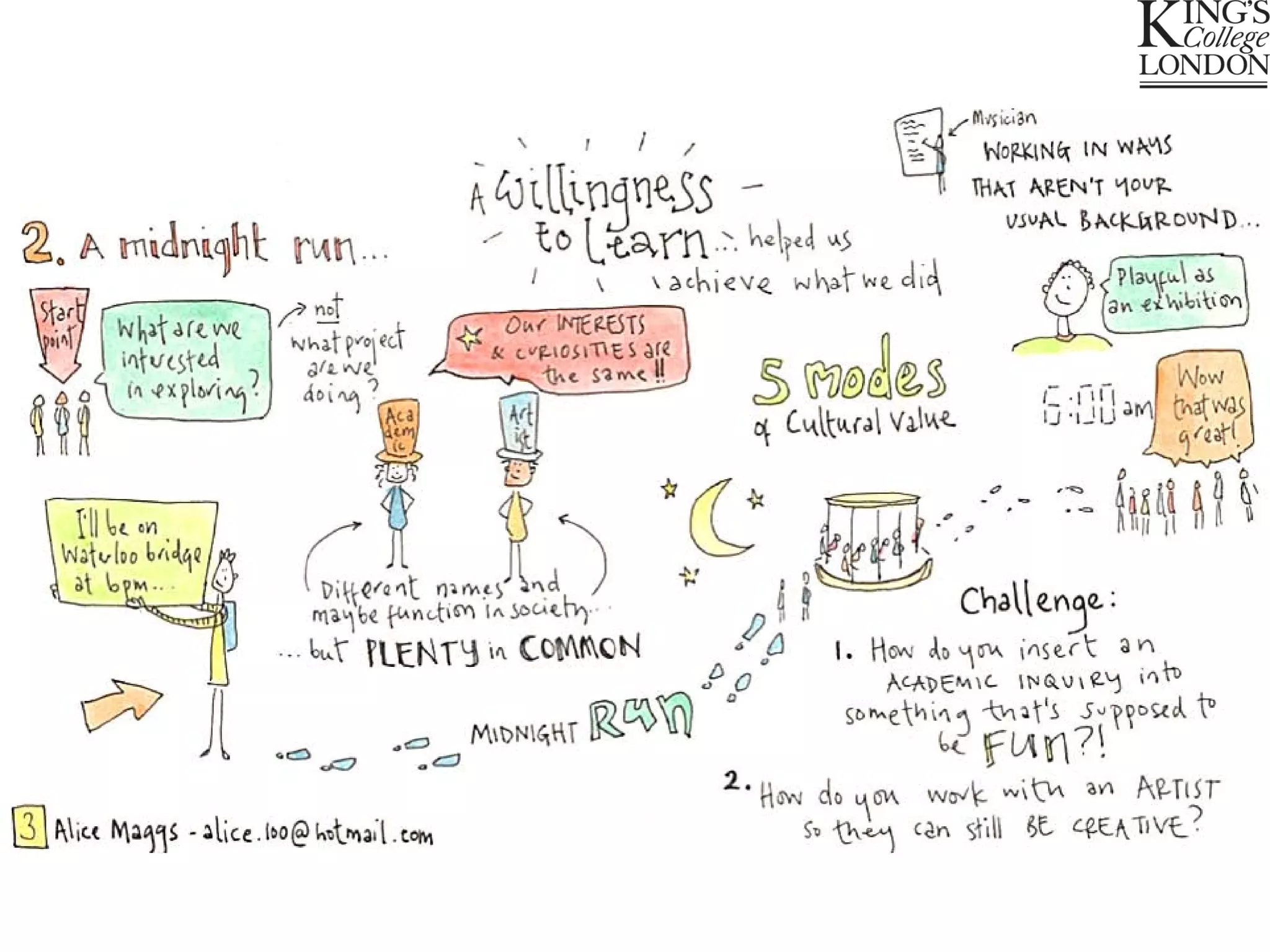
 Cultural Value – the Midnight Run

 A final thought and some challenges
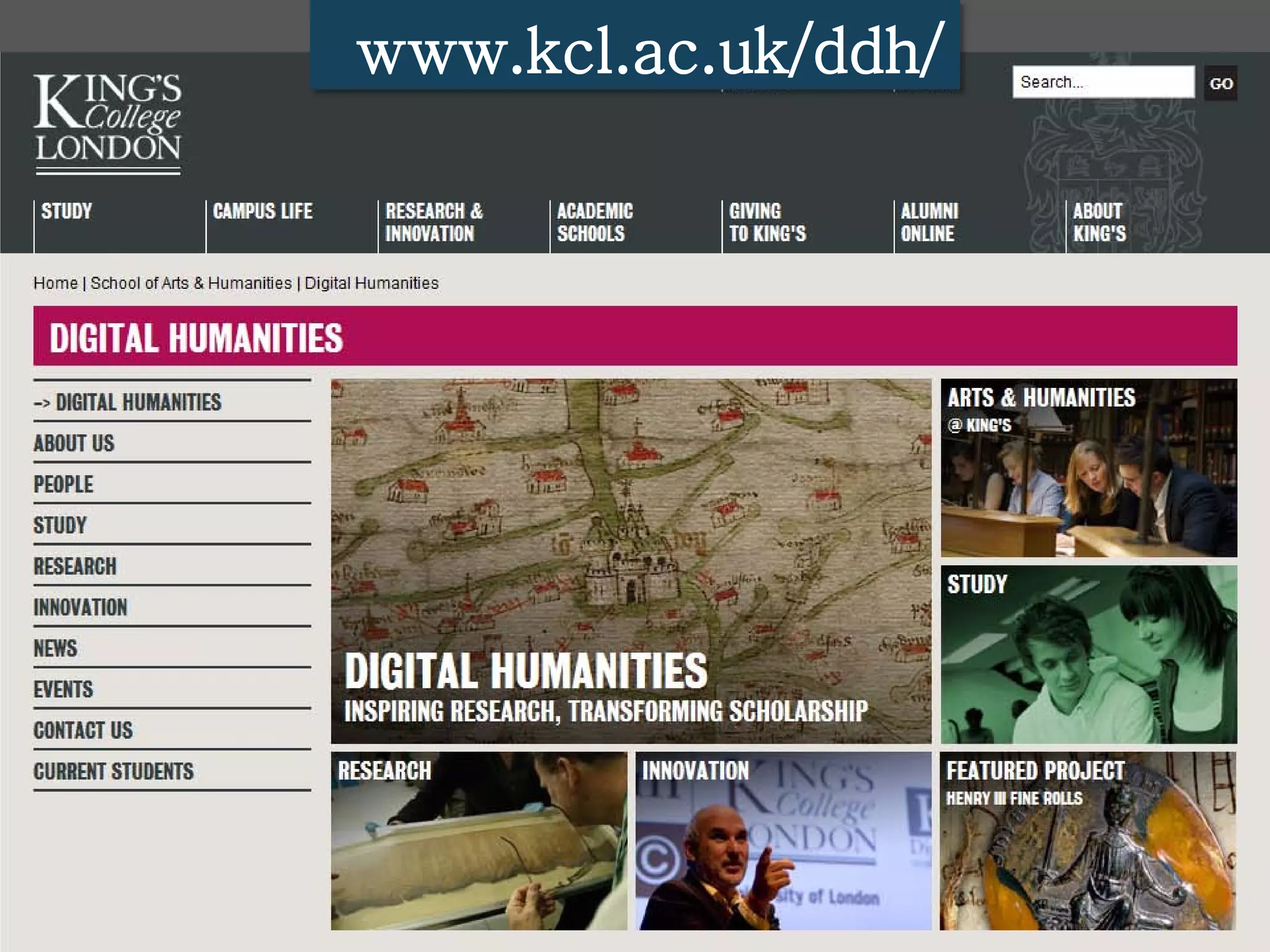
www.kcl.ac.uk/ddh/
Department of Digital Humanities

                                     International leader in the application of
                                                .
                                     technology in the arts and humanities, and
                                     in the social sciences.
             Innovation              Involved in typically more than 30
                                     major collaborative research projects at any
                                     one time.
                                             The highest rated digital humanities
  Teaching                                   research unit in the UK. 65% of our
                                             research is judged to be 'world-
                                             leading' or 'internationally excellent' .
                          Research
                                             DDH has 3 MA programmes:
                                                    Digital Asset Management,
                                                    Digital Humanities, and
                                                    Digital Culture and Society
                                     Innovation partnerships with >500 projects
                                     and 20 countries.
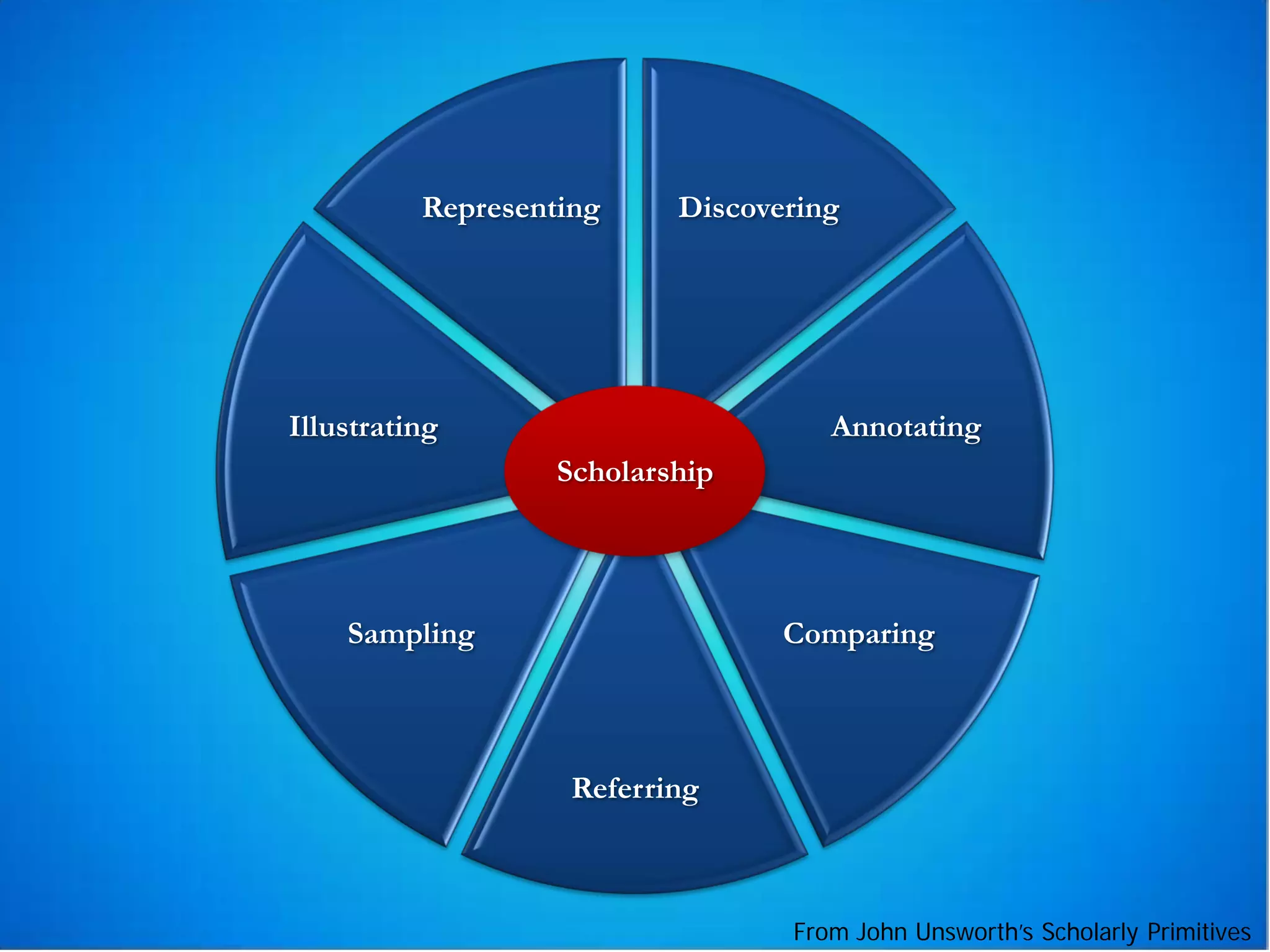
Representing     Discovering


Illustrating                         Annotating
                   Scholarship


    Sampling                      Comparing


                    Referring


                                  From John Unsworth’s Scholarly Primitives
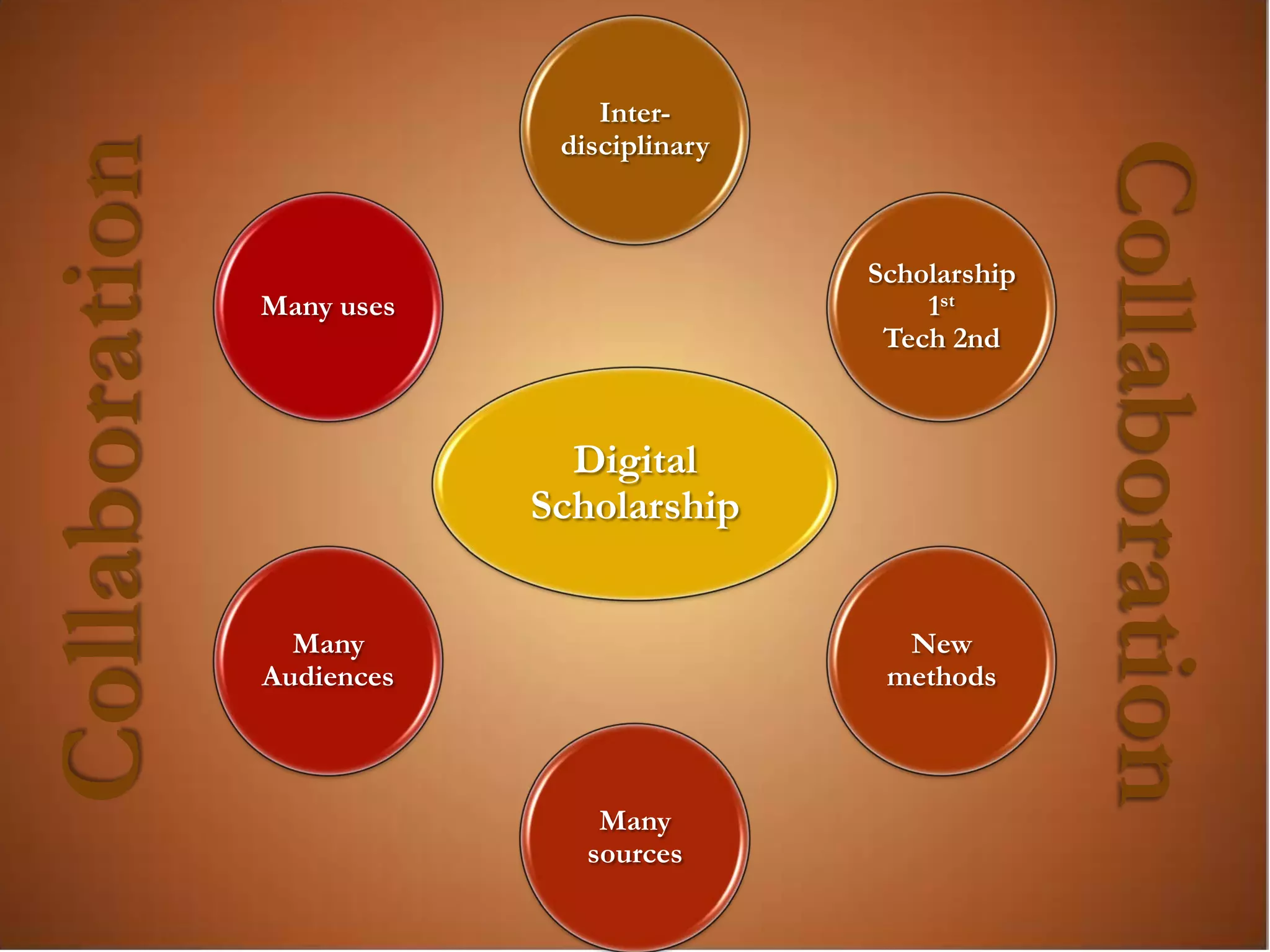
Inter-
                             disciplinary
Collaboration


                                                          Collaboration
                                            Scholarship
                Many uses                       1st
                                             Tech 2nd


                              Digital
                            Scholarship


                  Many                        New
                Audiences                    methods


                                Many
                               sources
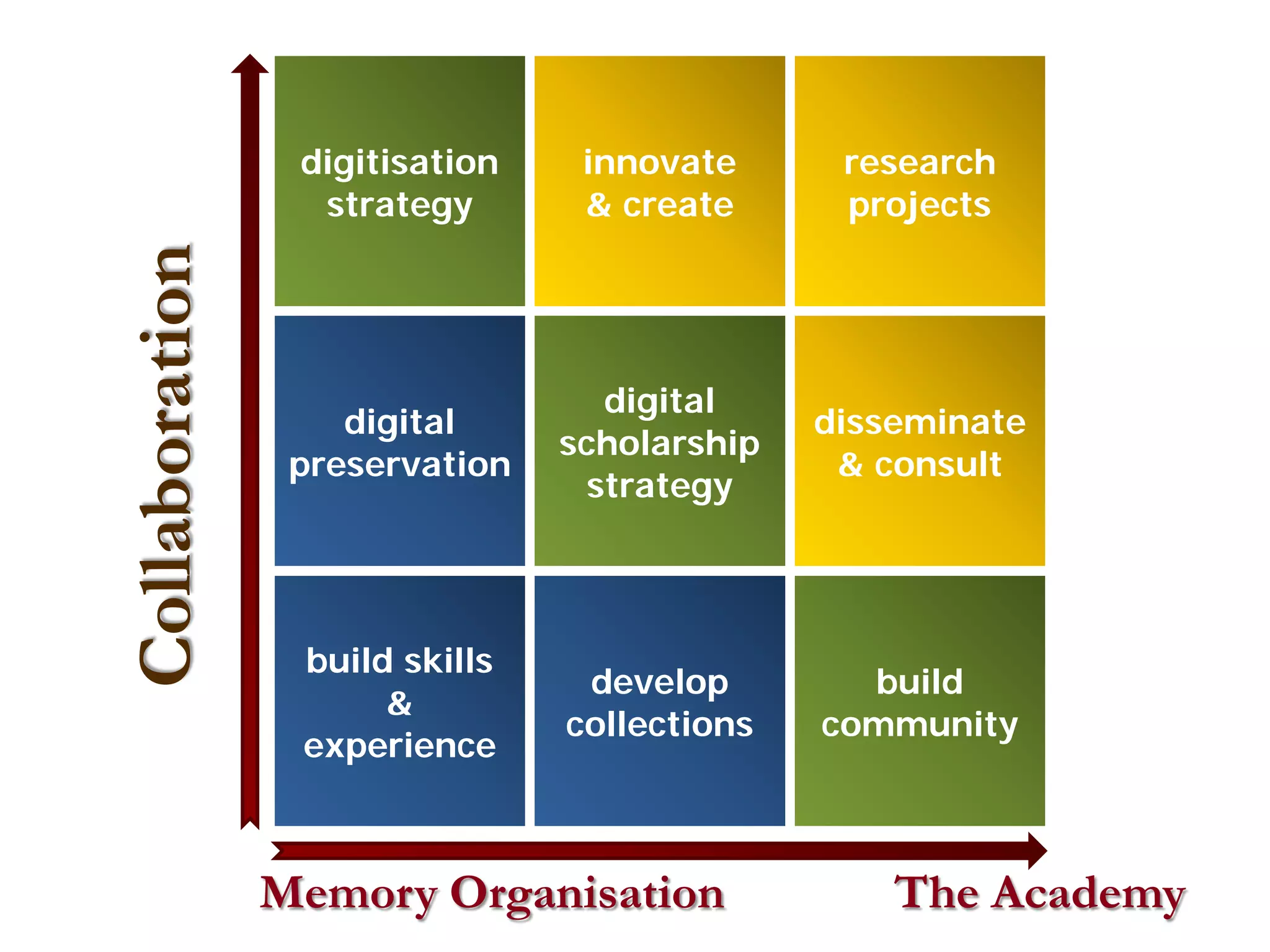
digitisation    innovate      research
                  strategy       & create      projects
Collaboration

                                   digital
                    digital                   disseminate
                                scholarship
                 preservation                  & consult
                                  strategy


                 build skills
                                 develop        build
                      &
                                collections   community
                 experience


                Memory Organisation               The Academy
Making an impact or just a splash?


                                     © H de Smet
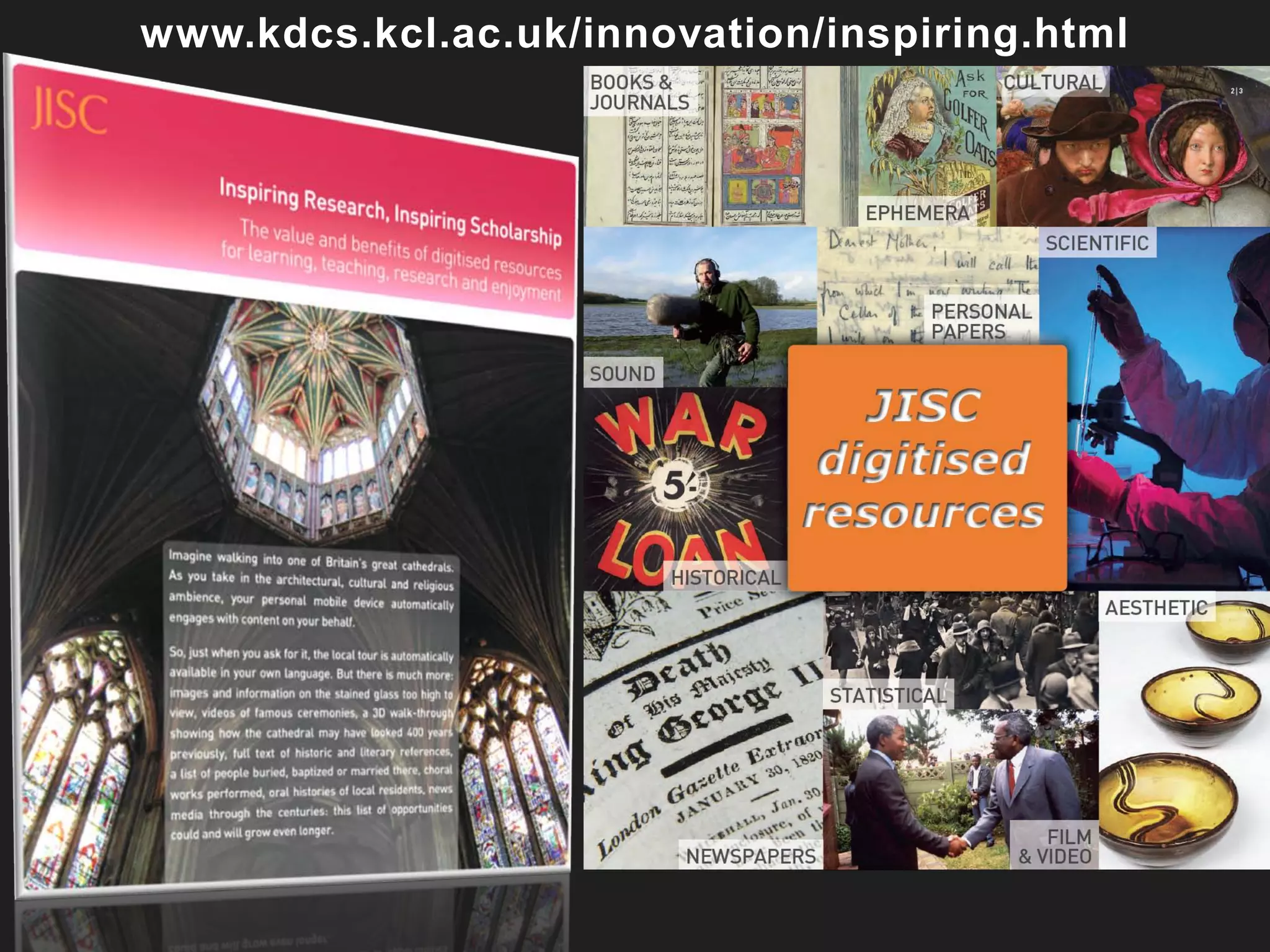
www.kdcs.kcl.ac.uk/innovation/inspiring.html
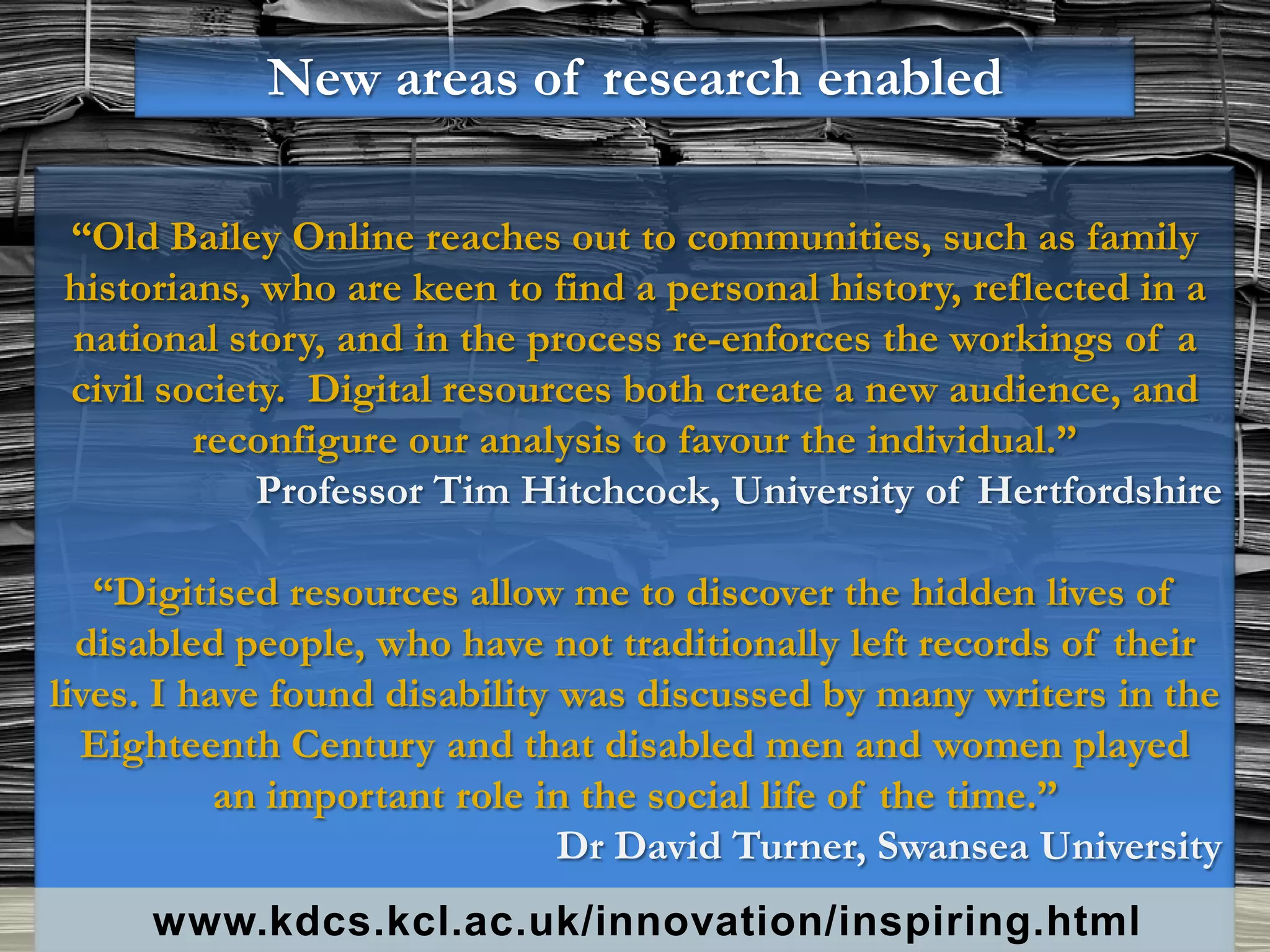
New areas of research enabled

“Old Bailey Online reaches out to communities, such as family
historians, who are keen to find a personal history, reflected in a
national story, and in the process re-enforces the workings of a
civil society. Digital resources both create a new audience, and
        reconfigure our analysis to favour the individual.”
            Professor Tim Hitchcock, University of Hertfordshire

   “Digitised resources allow me to discover the hidden lives of
  disabled people, who have not traditionally left records of their
lives. I have found disability was discussed by many writers in the
  Eighteenth Century and that disabled men and women played
           an important role in the social life of the time.”
                               Dr David Turner, Swansea University
     www.kdcs.kcl.ac.uk/innovation/inspiring.html
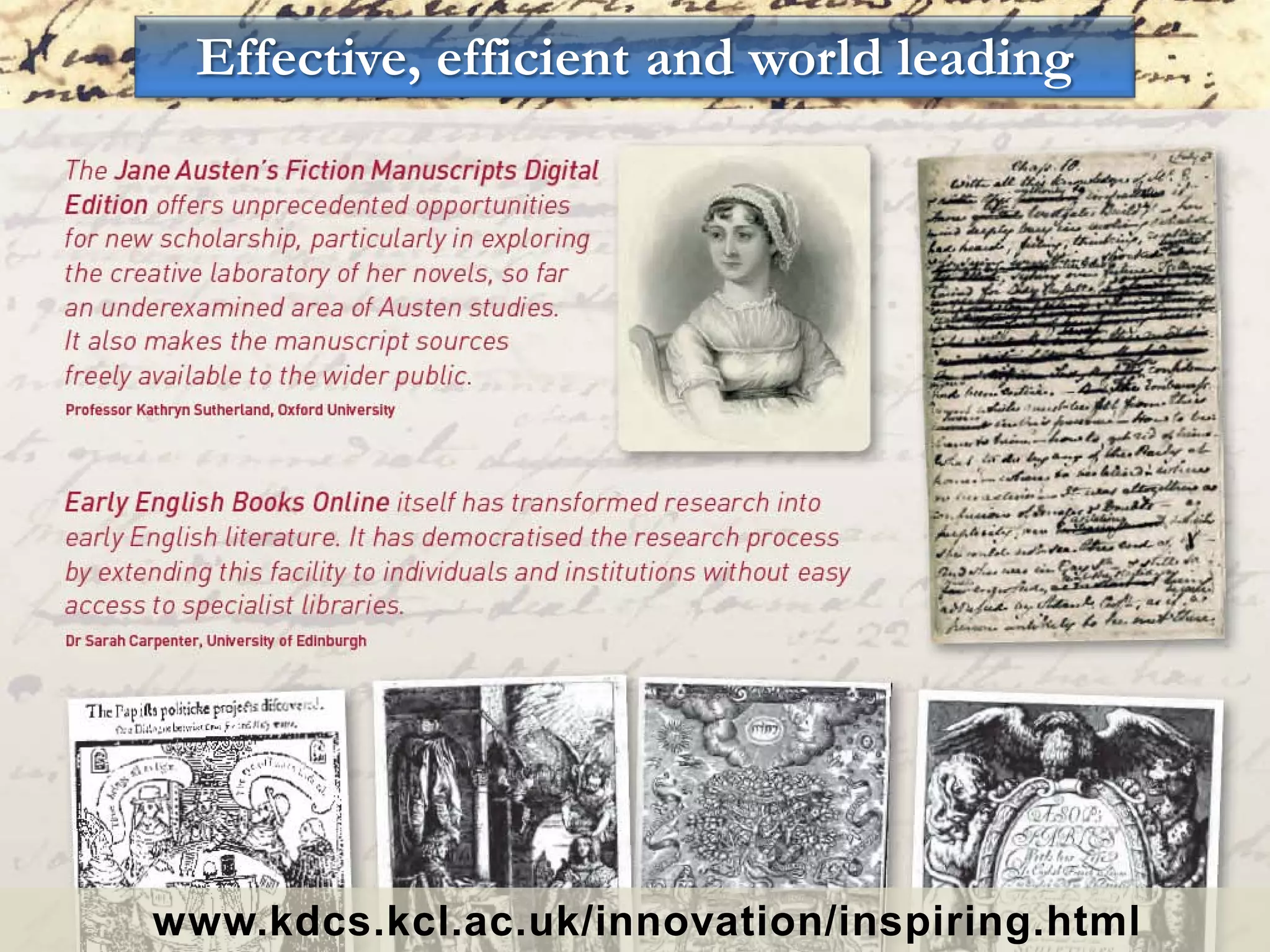
Effective, efficient and world leading


www.kdcs.kcl.ac.uk/innovation/inspiring.html
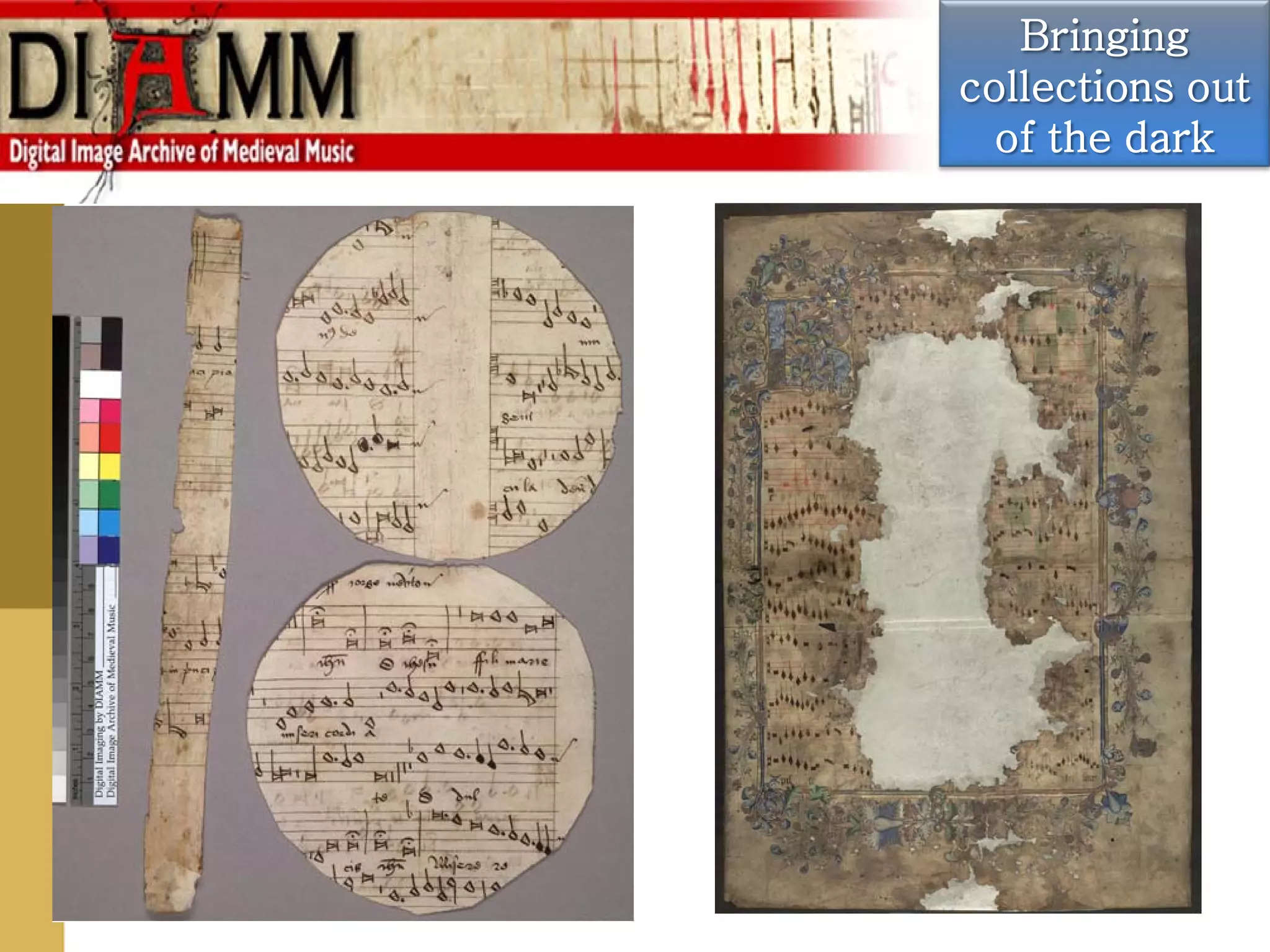
Bringing
collections out
  of the dark
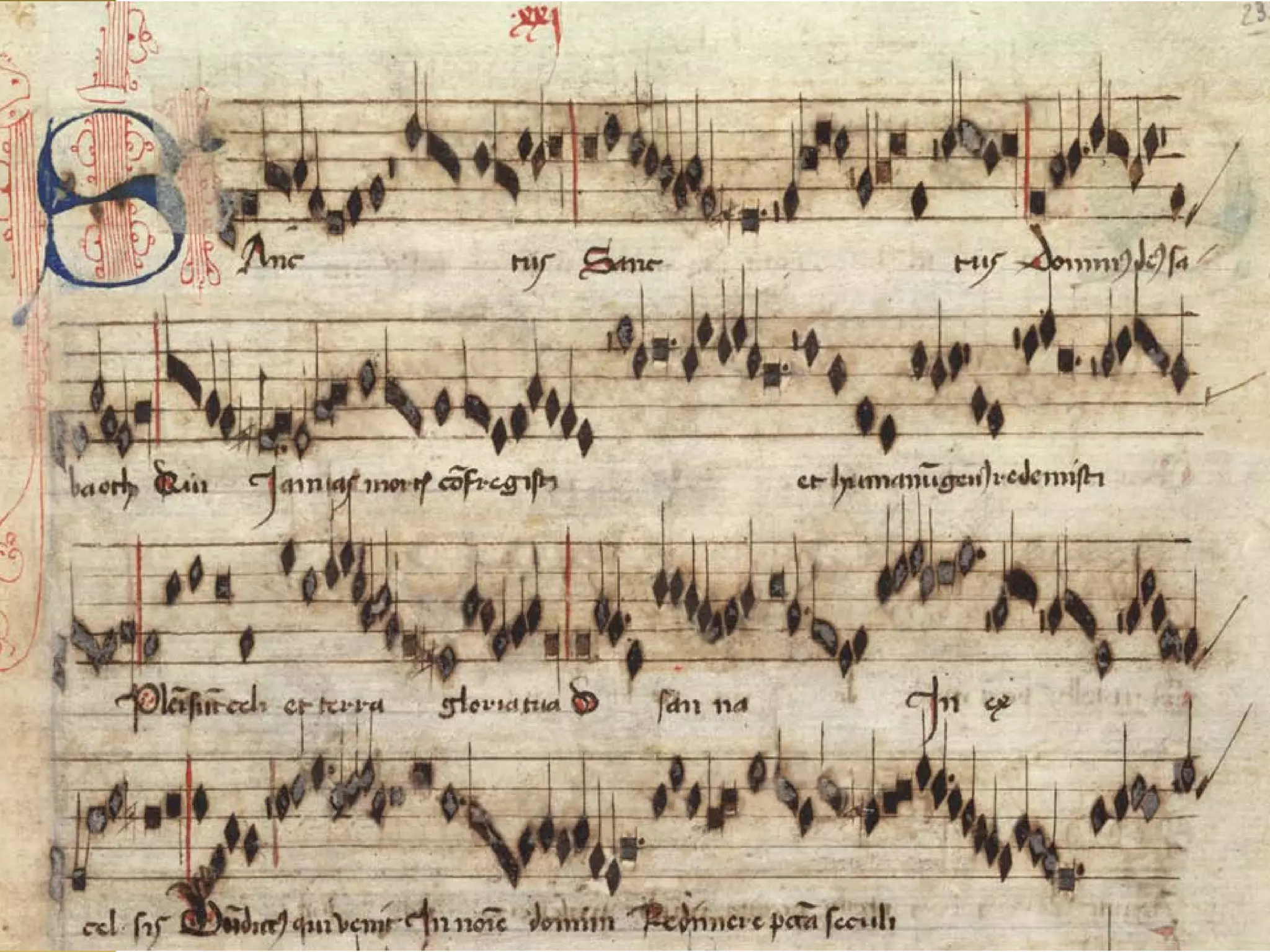
f. 23 detail
Bestowing economic & community benefits

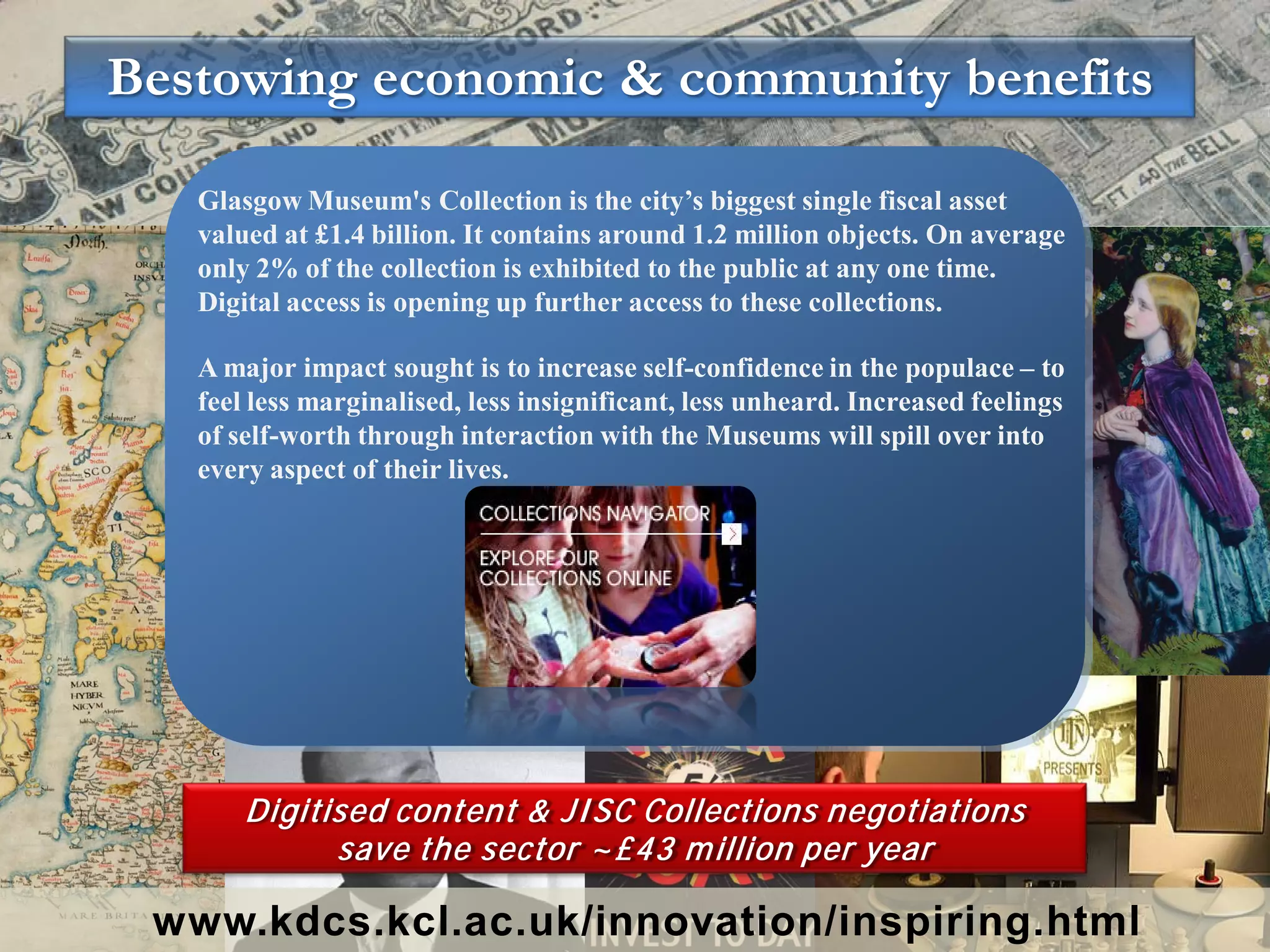
   Glasgow Museum's Collection is the city’s biggest single fiscal asset
   valued at £1.4 billion. It contains around 1.2 million objects. On average
   only 2% of the collection is exhibited to the public at any one time.
   Digital access is opening up further access to these collections.

   A major impact sought is to increase self-confidence in the populace – to
   feel less marginalised, less insignificant, less unheard. Increased feelings
   of self-worth through interaction with the Museums will spill over into
   every aspect of their lives.


       Digitised content & JI SC Collections negotiations
             save the sector ~£43 m illion per year

 www.kdcs.kcl.ac.uk/innovation/inspiring.html
Bestowing economic & community benefits

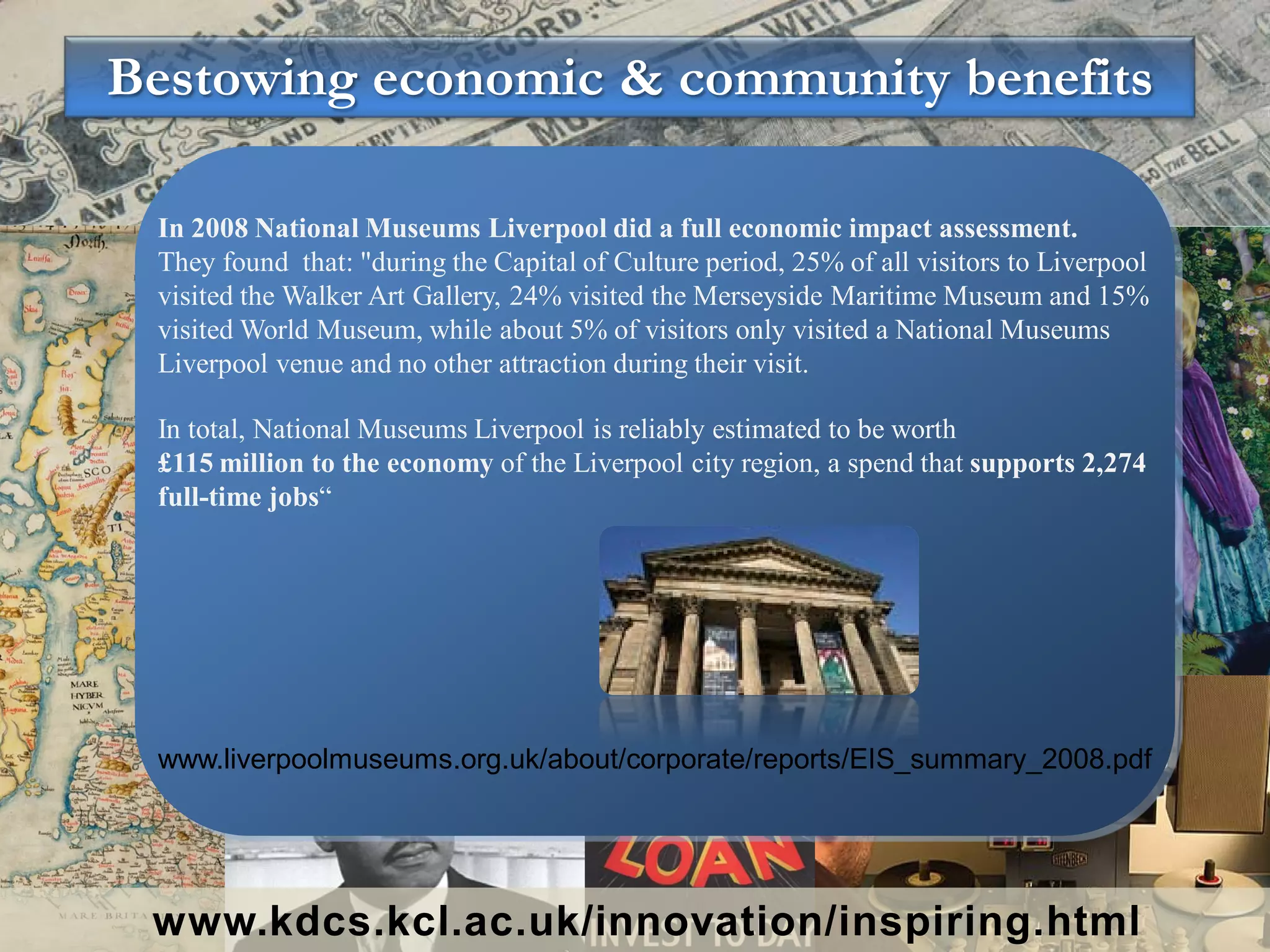
 In 2008 National Museums Liverpool did a full economic impact assessment.
 They found that: "during the Capital of Culture period, 25% of all visitors to Liverpool
 visited the Walker Art Gallery, 24% visited the Merseyside Maritime Museum and 15%
 visited World Museum, while about 5% of visitors only visited a National Museums
 Liverpool venue and no other attraction during their visit.

 In total, National Museums Liverpool is reliably estimated to be worth
 £115 million to the economy of the Liverpool city region, a spend that supports 2,274
 full-time jobs“


 www.liverpoolmuseums.org.uk/about/corporate/reports/EIS_summary_2008.pdf


 www.kdcs.kcl.ac.uk/innovation/inspiring.html
Interdisciplinary & collaborative
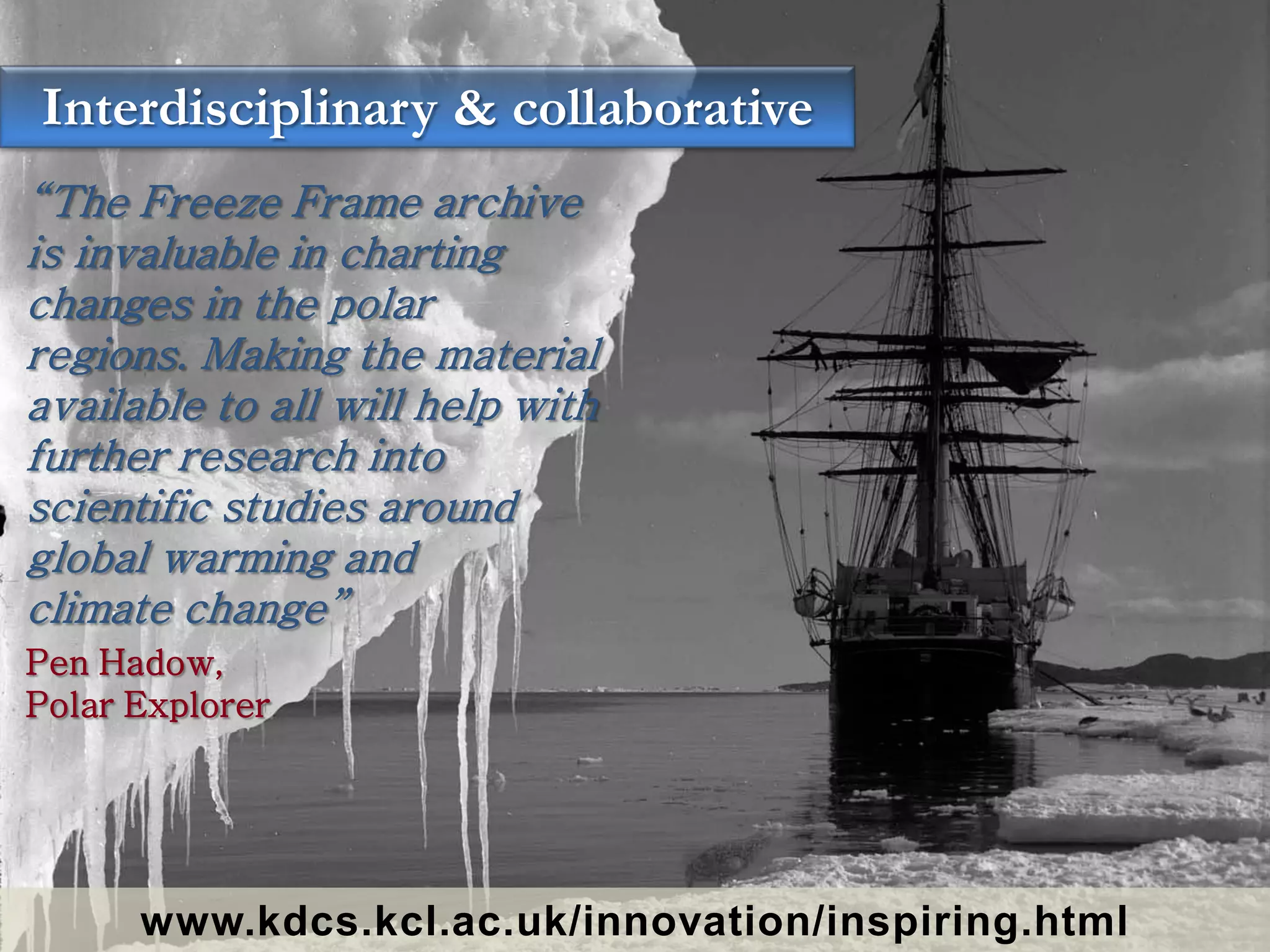
“The Freeze Frame archive
is invaluable in charting
changes in the polar
regions. Making the material
available to all will help with
further research into
scientific studies around
global warming and
climate change”
Pen Hadow,
Polar Explorer


      www.kdcs.kcl.ac.uk/innovation/inspiring.html
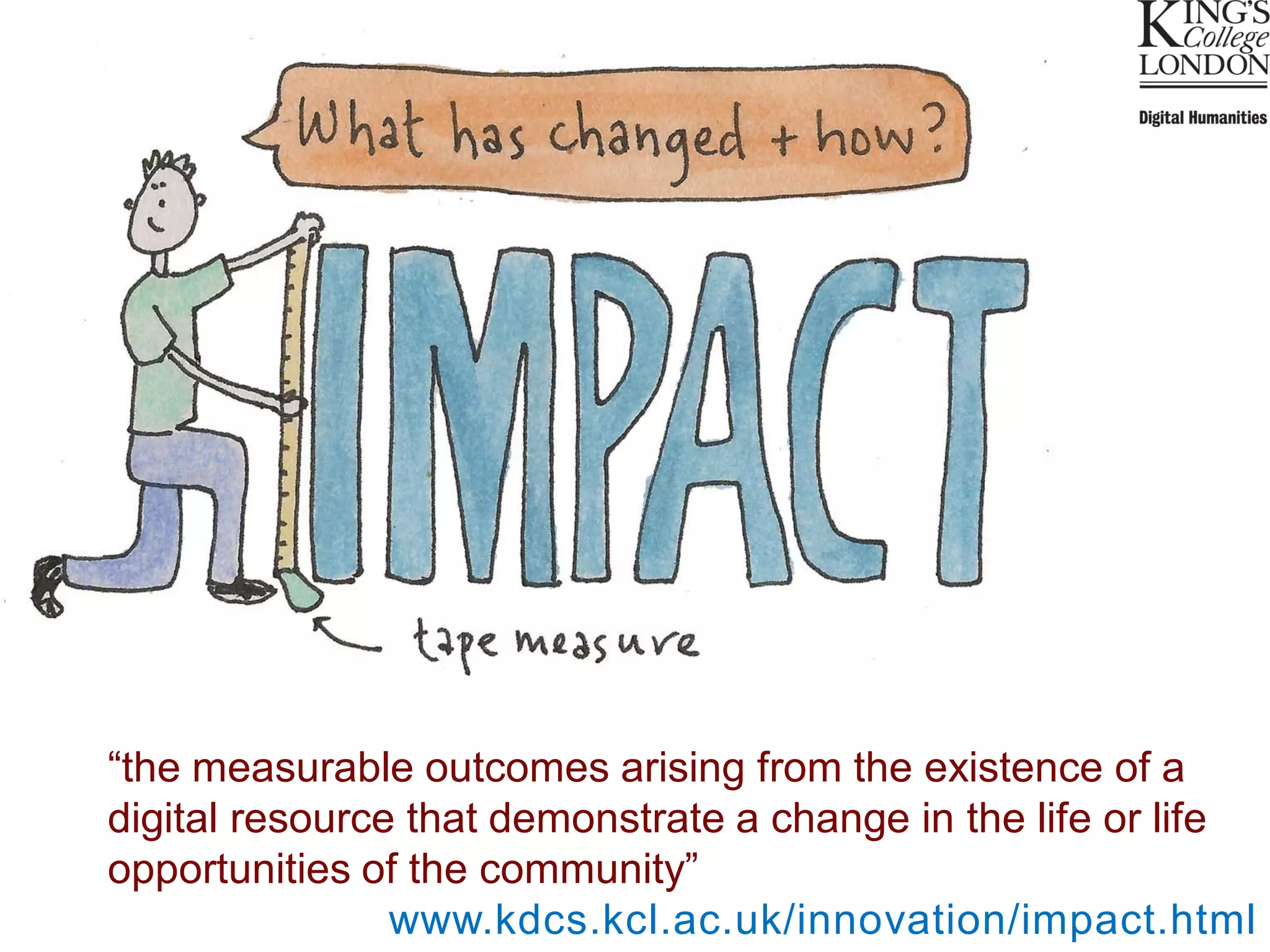
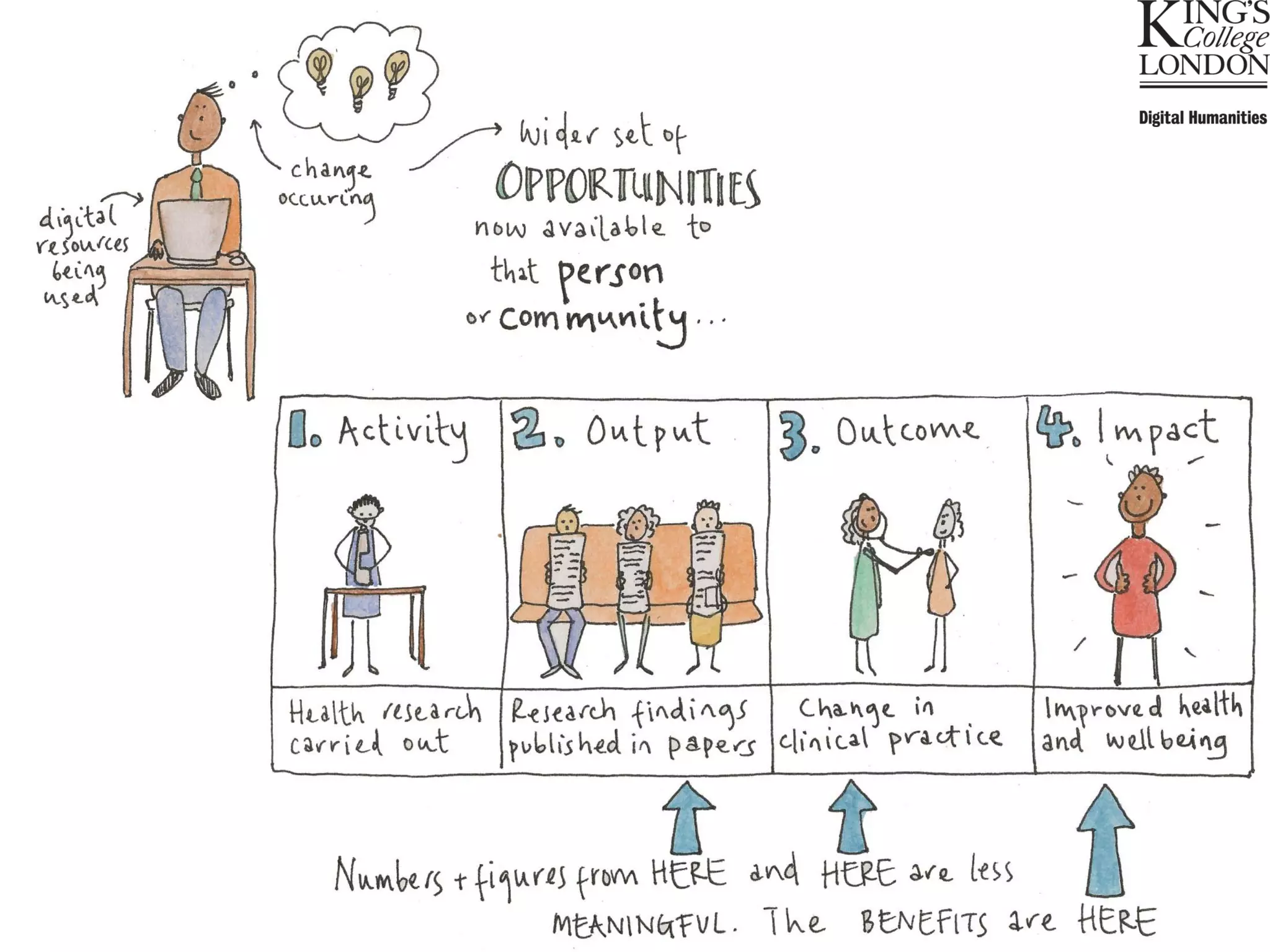
“the measurable outcomes arising from the existence of a
digital resource that demonstrate a change in the life or life
opportunities of the community”
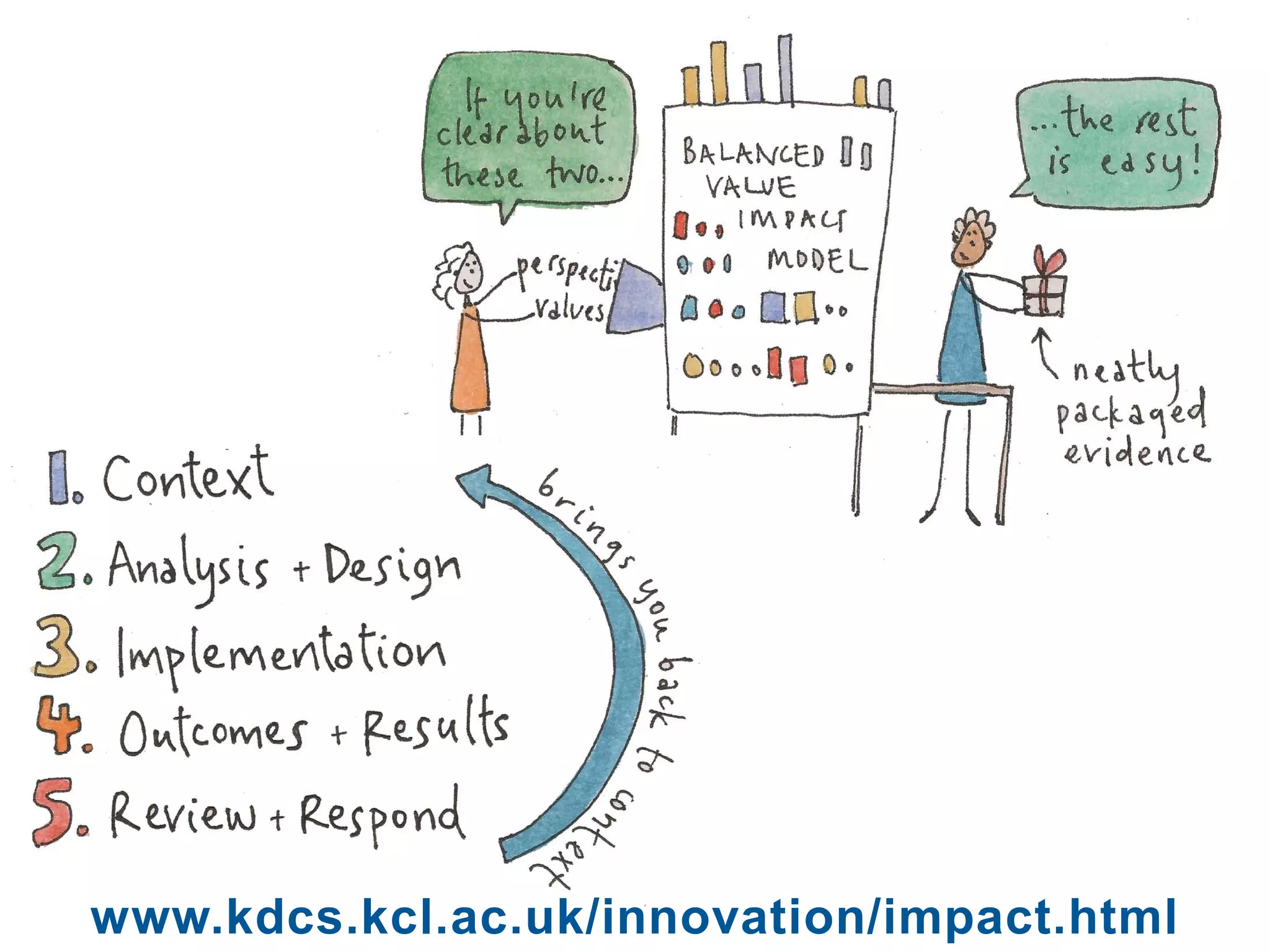
                www.kdcs.kcl.ac.uk/innovation/impact.html
www.kdcs.kcl.ac.uk/innovation/impact.html
Videos:

    http://vimeo.com/49682510


http://simon-tanner.blogspot.com/
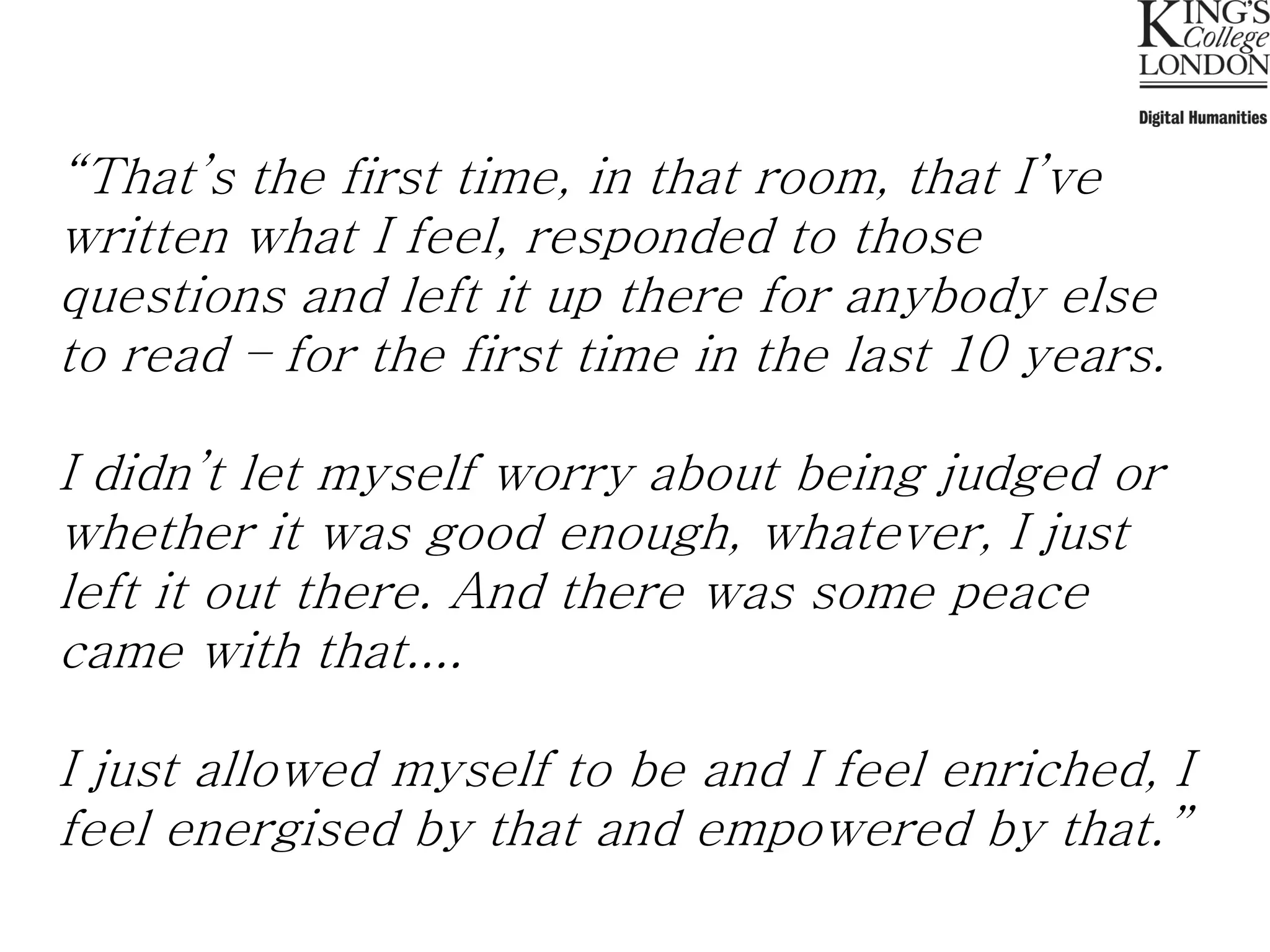
“That’s the first time, in that room, that I’ve
written what I feel, responded to those
questions and left it up there for anybody else
to read – for the first time in the last 10 years.

I didn’t let myself worry about being judged or
whether it was good enough, whatever, I just
left it out there. And there was some peace
came with that....

I just allowed myself to be and I feel enriched, I
feel energised by that and empowered by that.”
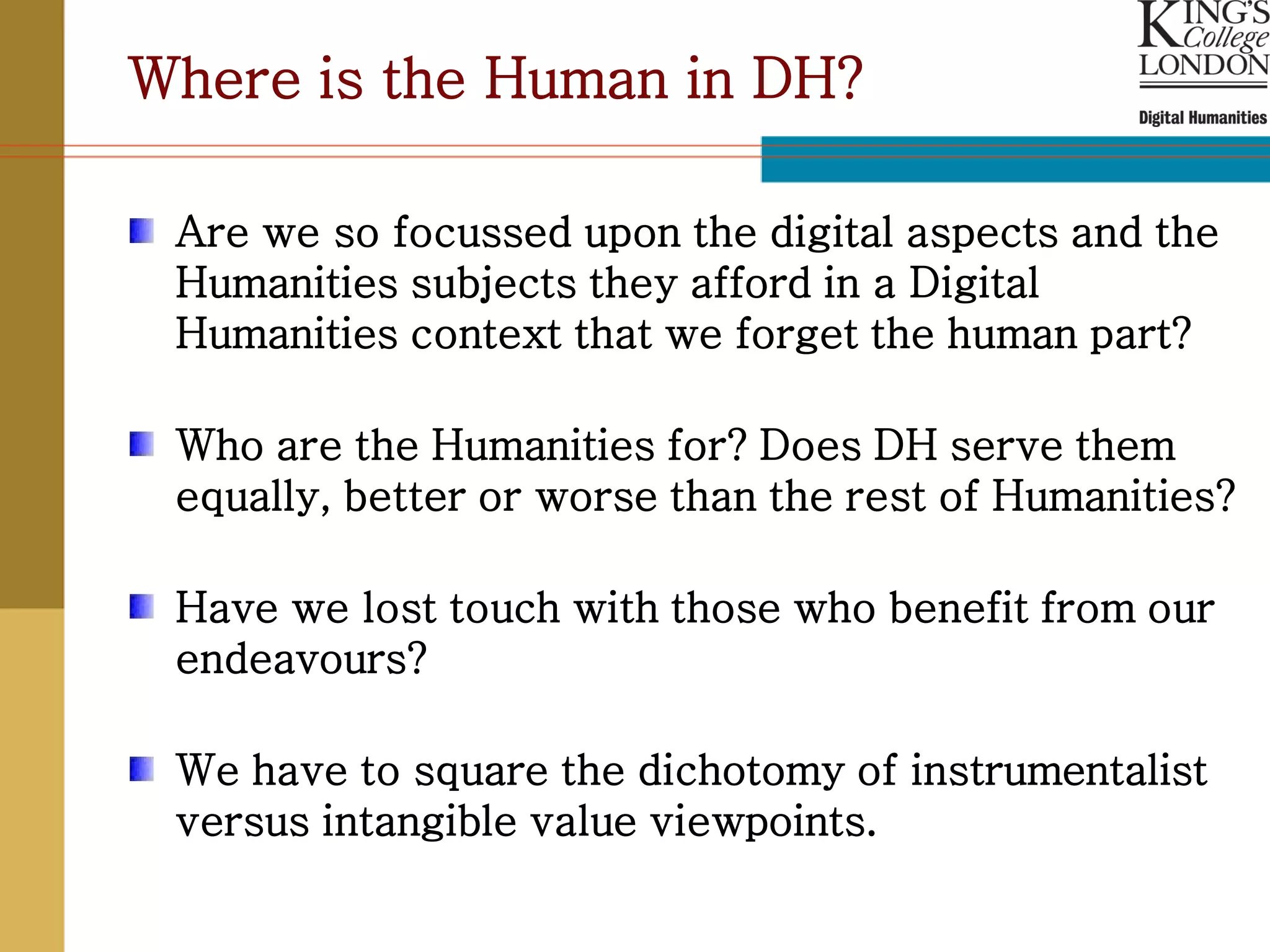
Where is the Human in DH?

 Are we so focussed upon the digital aspects and the
 Humanities subjects they afford in a Digital
 Humanities context that we forget the human part?

 Who are the Humanities for? Does DH serve them
 equally, better or worse than the rest of Humanities?

 Have we lost touch with those who benefit from our
 endeavours?

 We have to square the dichotomy of instrumentalist
 versus intangible value viewpoints.
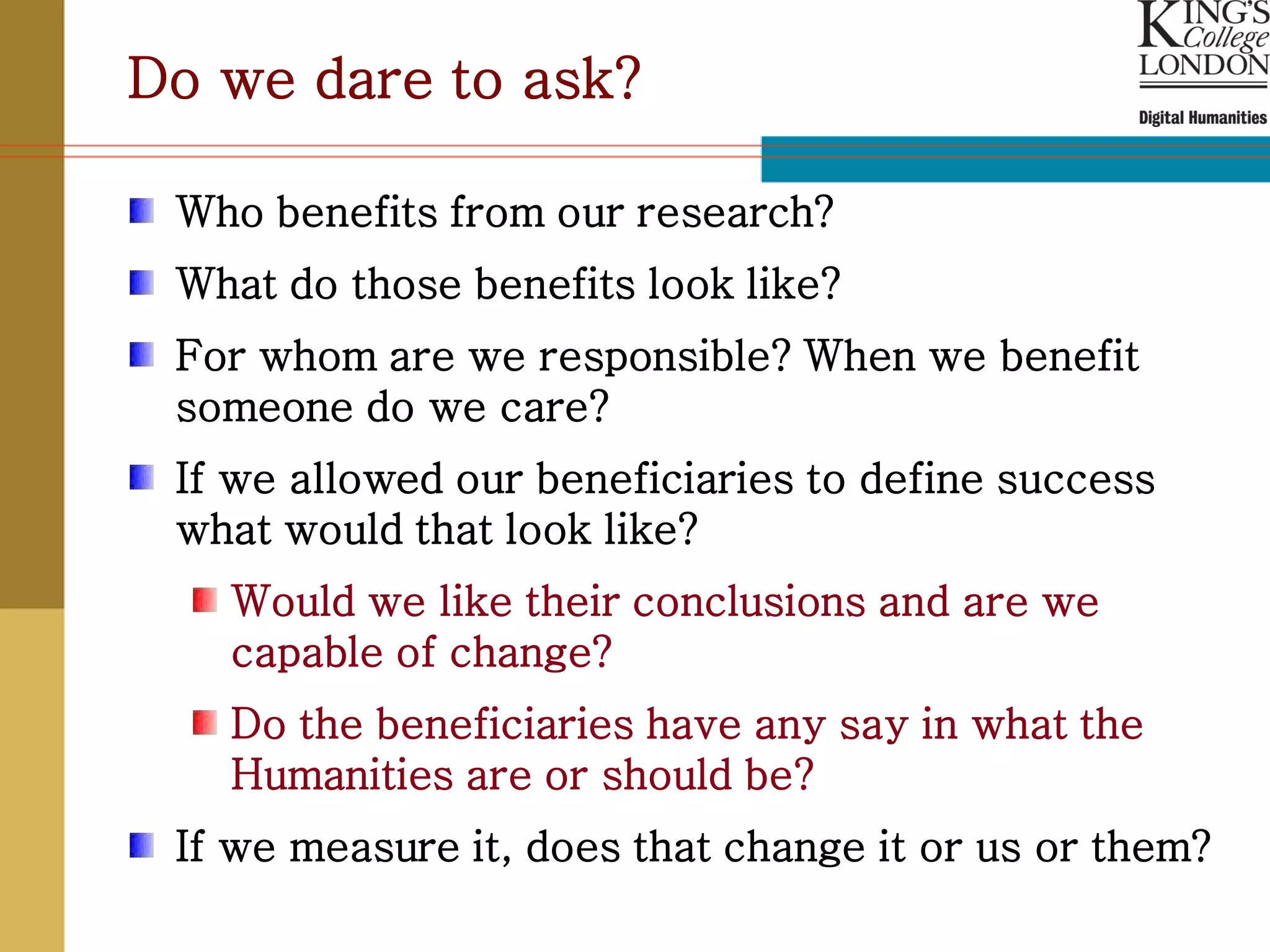
Do we dare to ask?

 Who benefits from our research?
 What do those benefits look like?
 For whom are we responsible? When we benefit
 someone do we care?
 If we allowed our beneficiaries to define success
 what would that look like?
   Would we like their conclusions and are we
   capable of change?
   Do the beneficiaries have any say in what the
   Humanities are or should be?
 If we measure it, does that change it or us or them?
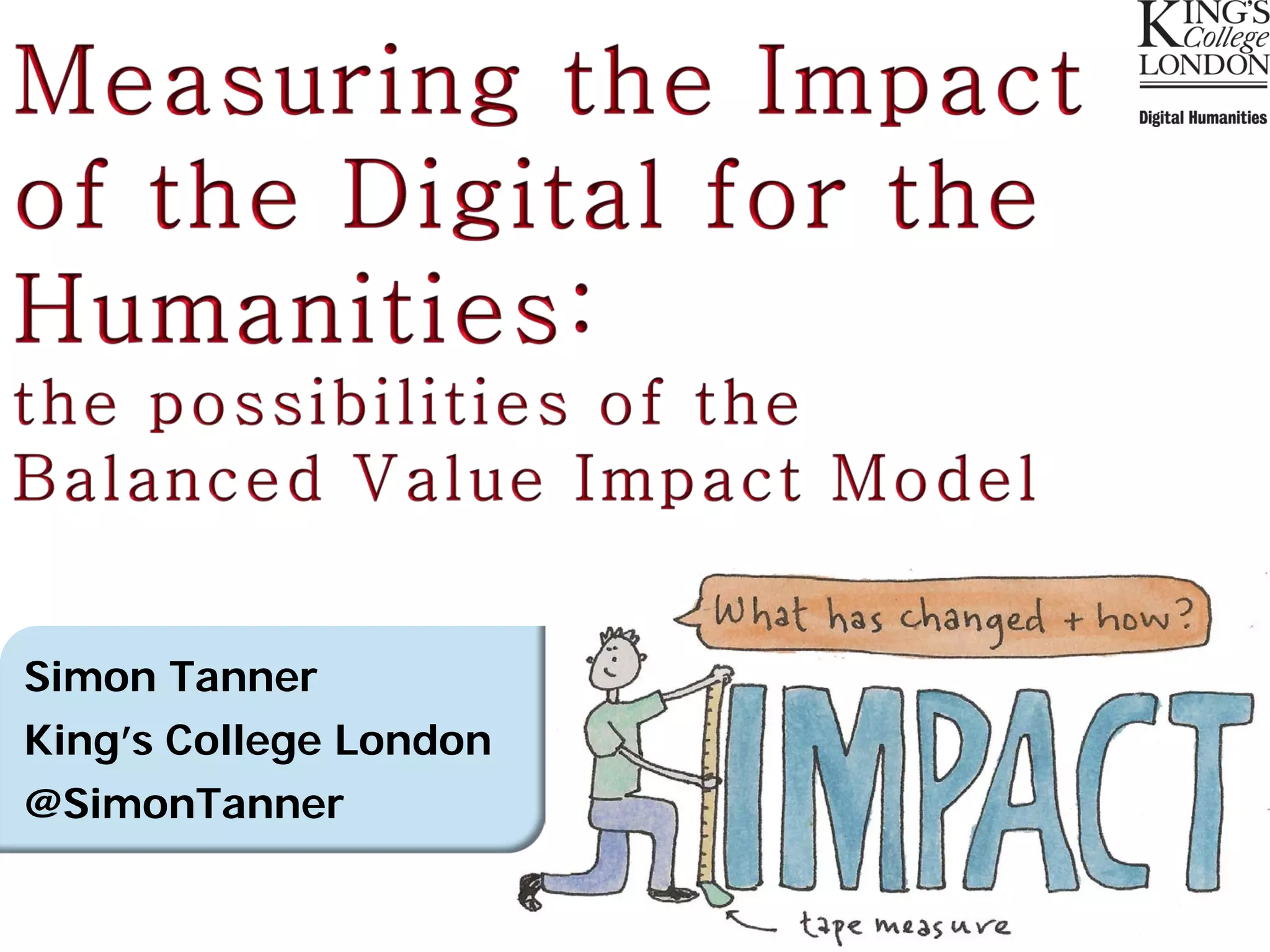
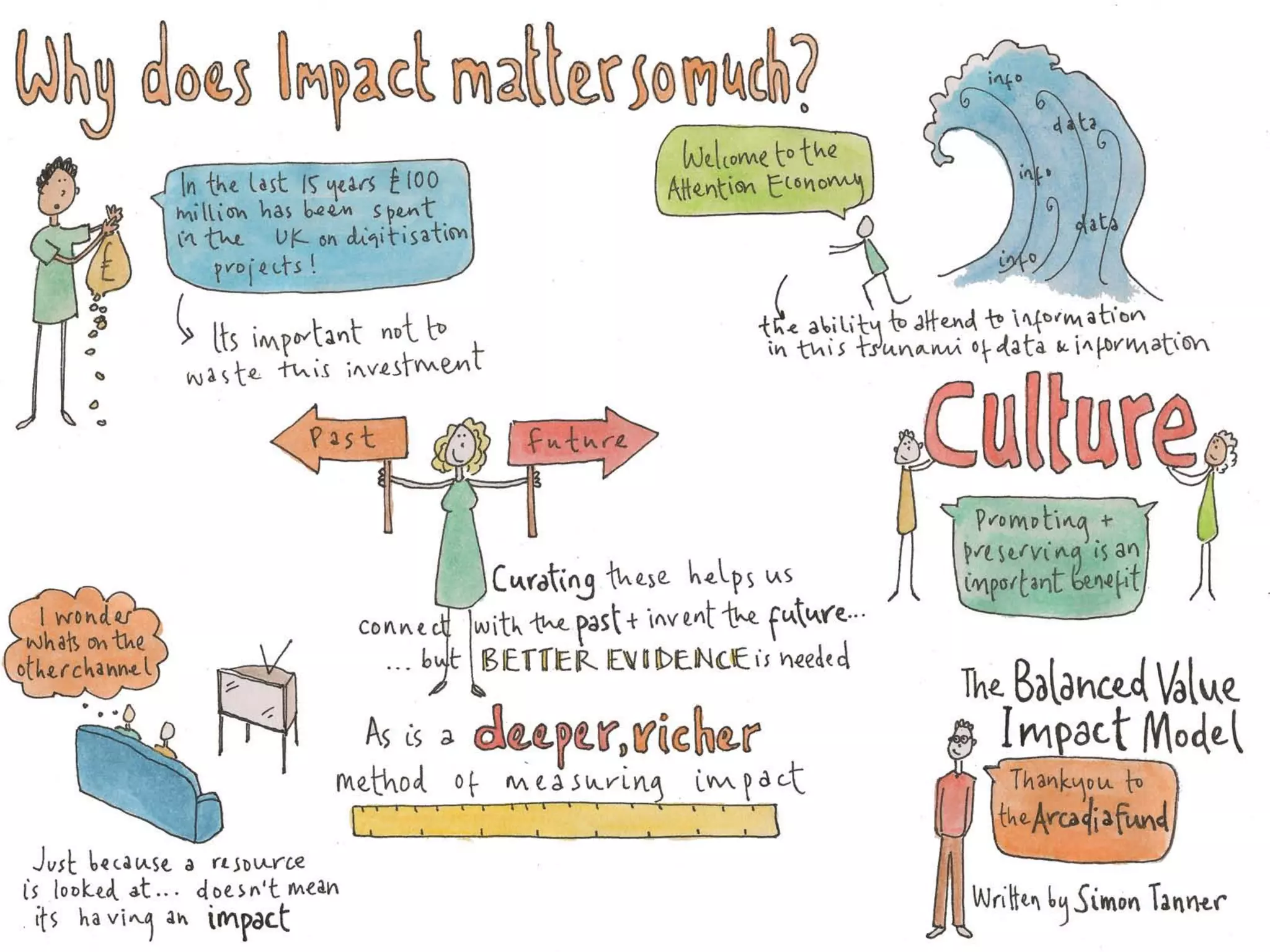
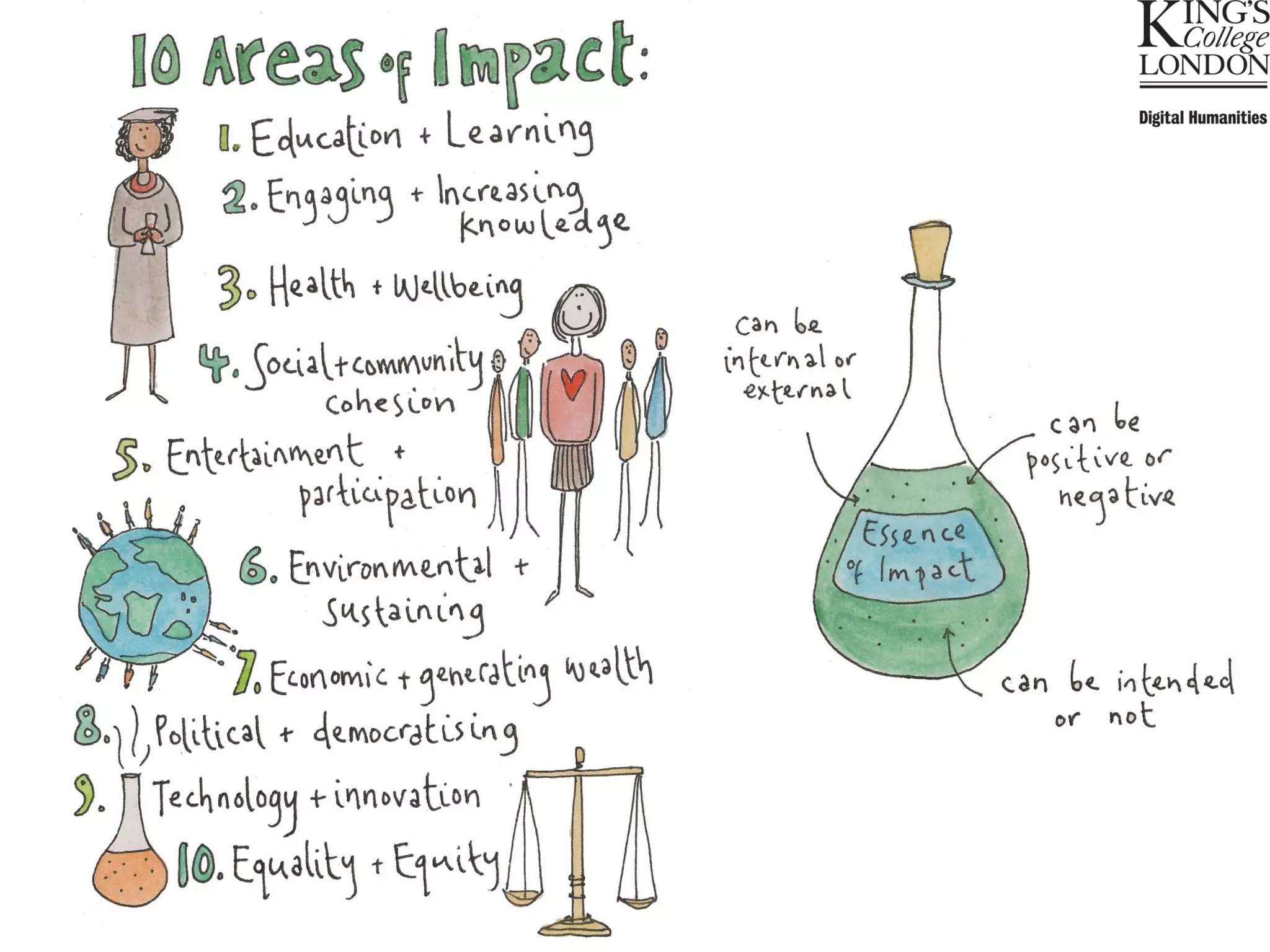
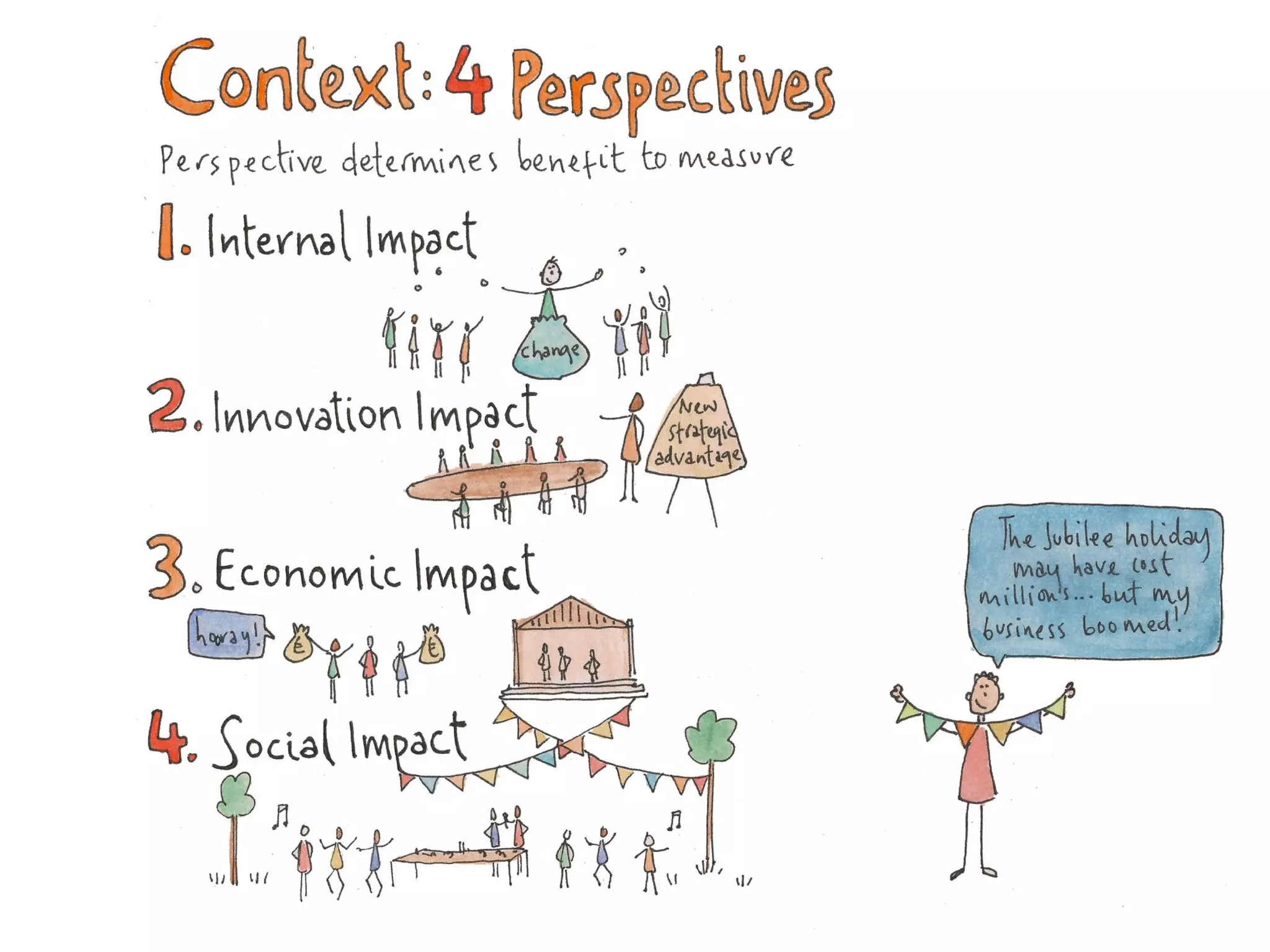
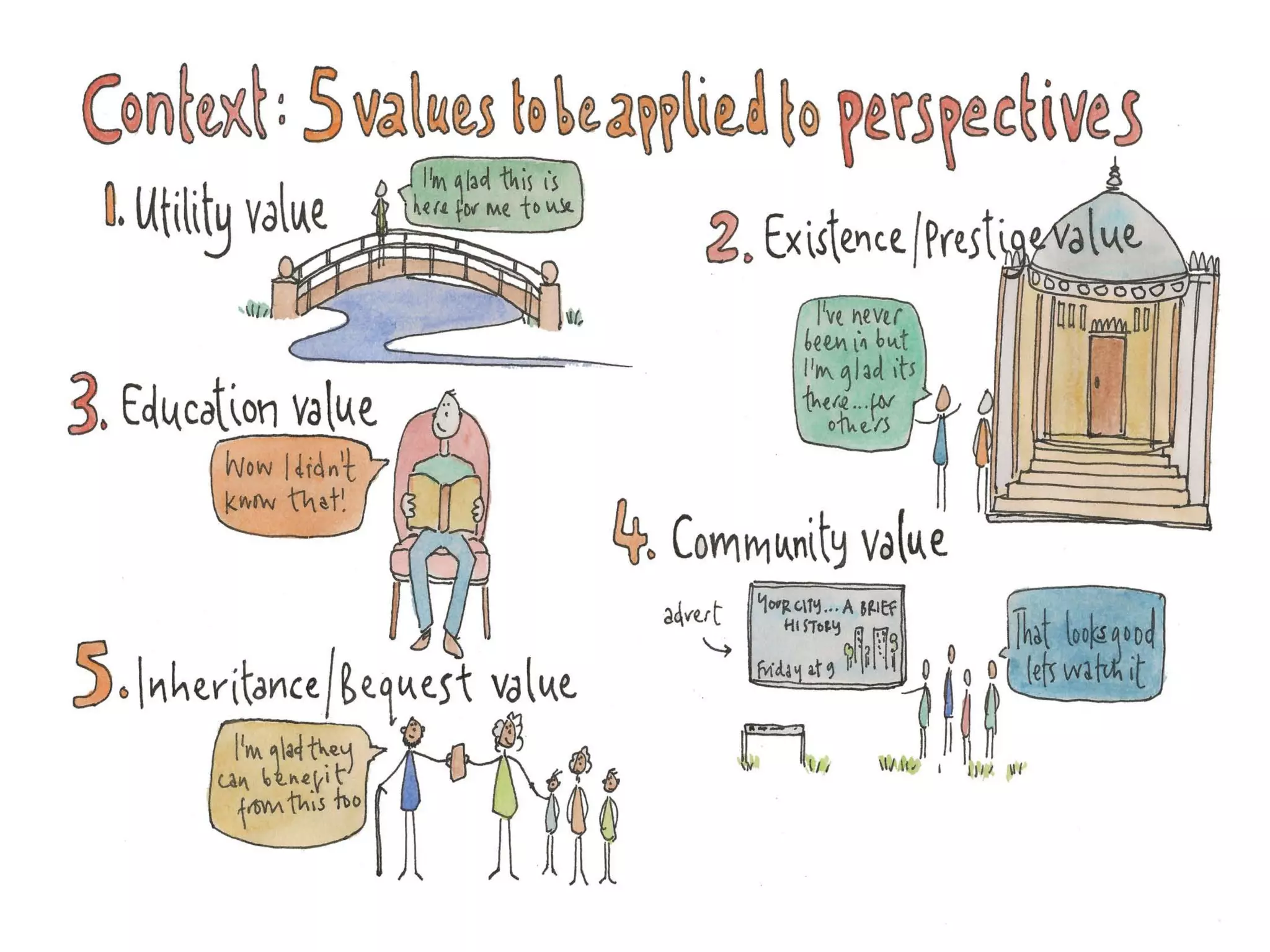
With thanks to Alice Maggs for the Impact illustrations
                alice.100@hotmail.com

Measuring the Impact of the Digital for the Humanities

  • 1.
    Simon Tanner King’s CollegeLondon @SimonTanner
  • 2.
    My Agenda DigitalHumanities The benefits and value of digital resources & DH Impact – introducing the Balanced Value Impact Model Cultural Value – the Midnight Run A final thought and some challenges
  • 3.
  • 4.
    Department of DigitalHumanities International leader in the application of . technology in the arts and humanities, and in the social sciences. Innovation Involved in typically more than 30 major collaborative research projects at any one time. The highest rated digital humanities Teaching research unit in the UK. 65% of our research is judged to be 'world- leading' or 'internationally excellent' . Research DDH has 3 MA programmes: Digital Asset Management, Digital Humanities, and Digital Culture and Society Innovation partnerships with >500 projects and 20 countries.
  • 5.
    Representing Discovering Illustrating Annotating Scholarship Sampling Comparing Referring From John Unsworth’s Scholarly Primitives
  • 6.
    Inter- disciplinary Collaboration Collaboration Scholarship Many uses 1st Tech 2nd Digital Scholarship Many New Audiences methods Many sources
  • 7.
    digitisation innovate research strategy & create projects Collaboration digital digital disseminate scholarship preservation & consult strategy build skills develop build & collections community experience Memory Organisation The Academy
  • 8.
    Making an impactor just a splash? © H de Smet
  • 9.
  • 10.
    New areas ofresearch enabled “Old Bailey Online reaches out to communities, such as family historians, who are keen to find a personal history, reflected in a national story, and in the process re-enforces the workings of a civil society. Digital resources both create a new audience, and reconfigure our analysis to favour the individual.” Professor Tim Hitchcock, University of Hertfordshire “Digitised resources allow me to discover the hidden lives of disabled people, who have not traditionally left records of their lives. I have found disability was discussed by many writers in the Eighteenth Century and that disabled men and women played an important role in the social life of the time.” Dr David Turner, Swansea University www.kdcs.kcl.ac.uk/innovation/inspiring.html
  • 11.
    Effective, efficient andworld leading www.kdcs.kcl.ac.uk/innovation/inspiring.html
  • 12.
  • 13.
  • 14.
    Bestowing economic &community benefits Glasgow Museum's Collection is the city’s biggest single fiscal asset valued at £1.4 billion. It contains around 1.2 million objects. On average only 2% of the collection is exhibited to the public at any one time. Digital access is opening up further access to these collections. A major impact sought is to increase self-confidence in the populace – to feel less marginalised, less insignificant, less unheard. Increased feelings of self-worth through interaction with the Museums will spill over into every aspect of their lives. Digitised content & JI SC Collections negotiations save the sector ~£43 m illion per year www.kdcs.kcl.ac.uk/innovation/inspiring.html
  • 15.
    Bestowing economic &community benefits In 2008 National Museums Liverpool did a full economic impact assessment. They found that: "during the Capital of Culture period, 25% of all visitors to Liverpool visited the Walker Art Gallery, 24% visited the Merseyside Maritime Museum and 15% visited World Museum, while about 5% of visitors only visited a National Museums Liverpool venue and no other attraction during their visit. In total, National Museums Liverpool is reliably estimated to be worth £115 million to the economy of the Liverpool city region, a spend that supports 2,274 full-time jobs“ www.liverpoolmuseums.org.uk/about/corporate/reports/EIS_summary_2008.pdf www.kdcs.kcl.ac.uk/innovation/inspiring.html
  • 16.
    Interdisciplinary & collaborative “TheFreeze Frame archive is invaluable in charting changes in the polar regions. Making the material available to all will help with further research into scientific studies around global warming and climate change” Pen Hadow, Polar Explorer www.kdcs.kcl.ac.uk/innovation/inspiring.html
  • 17.
    “the measurable outcomesarising from the existence of a digital resource that demonstrate a change in the life or life opportunities of the community” www.kdcs.kcl.ac.uk/innovation/impact.html
  • 21.
  • 24.
  • 25.
    Videos: http://vimeo.com/49682510 http://simon-tanner.blogspot.com/
  • 27.
    “That’s the firsttime, in that room, that I’ve written what I feel, responded to those questions and left it up there for anybody else to read – for the first time in the last 10 years. I didn’t let myself worry about being judged or whether it was good enough, whatever, I just left it out there. And there was some peace came with that.... I just allowed myself to be and I feel enriched, I feel energised by that and empowered by that.”
  • 28.
    Where is theHuman in DH? Are we so focussed upon the digital aspects and the Humanities subjects they afford in a Digital Humanities context that we forget the human part? Who are the Humanities for? Does DH serve them equally, better or worse than the rest of Humanities? Have we lost touch with those who benefit from our endeavours? We have to square the dichotomy of instrumentalist versus intangible value viewpoints.
  • 29.
    Do we dareto ask? Who benefits from our research? What do those benefits look like? For whom are we responsible? When we benefit someone do we care? If we allowed our beneficiaries to define success what would that look like? Would we like their conclusions and are we capable of change? Do the beneficiaries have any say in what the Humanities are or should be? If we measure it, does that change it or us or them?
  • 30.
    With thanks toAlice Maggs for the Impact illustrations alice.100@hotmail.com