Preparing Future Digital
       Curators

       The Carolina Digital Curation
       Curriculum (DigCCurr) Project
       Carolyn Hank

       School of Information and Library Science
       University of North Carolina at Chapel Hill
       http://www.ils.unc.edu/digccurr/

       MARAC Fall 2008, Silver Spring MD: 7 November 2008
Digital Curation Education

• Developing sustainable and evolving digital
  curation educational programs for:
  – Professional, continuing, life-long education
  – Graduate, professional education
  – Doctoral education
• Programs need to be:
  –   Integrated
  –   International
  –   Interdisciplinary
  –   Linked to practical experiences, internships, etc.
IMLS-Funded Curriculum Projects
• Common theme: Prepare students for digital curation with
  wide variety of organizations, contexts & types of resources:

• University of Illinois at Urbana-Champaign:
   – Data Curation Education Program (DCEP): 2006
   – Extending Data Curation to the Humanities (DCEP+): 2008

• University of North Carolina at Chapel Hill:
   – Preserving Access to Our Digital Future: Building an
     International Digital Curation Curriculum (DigCCurr I):
     2005
   – “Extending an International Digital Curation Curriculum to
     Doctoral Students and Practitioners (DigCCurr II): 2008
DigCCurr Project
• Preserving Access to Our Digital Future: Building an
  International Digital Curation Curriculum.
  http://www.ils.unc.edu/digccurr.

• IMLS Grant # RE-05-06-0044

• Collaboration of School of Information & Library
  Science (SILS), University of North Carolina at
  Chapel Hill (UNC-CH) & U.S. National Archives &
  Records Administration (NARA)

• Runs July 1, 2006 – June 30, 2009
DigCCurr Components/Goals
Curriculum: To prepare students for digital curation with wide
  variety of organizations, contexts & types of resources:
   –   Graduate-level curricular framework
   –   Course modules
   –   Course development
   –   Experiential components
   –   International guest speakers

Two International Symposia:
   – DigCCurr2007: April 18-20, 2007 in Chapel Hill -
     http://ils.unc.edu/digccurr2007/
   – DigCCurr2009: Practice, Promise and Prospect: April 1-3, 2009 in
     Chapel Hill - http://ils.unc.edu/digccurr2009

Carolina Digital Curation Fellowship program
Guiding Questions
• What knowledge and competencies do
  professional need in order to do digital
  curation work?
• What should students learn in the
  classroom?
• What should students learn through field
  experiences?
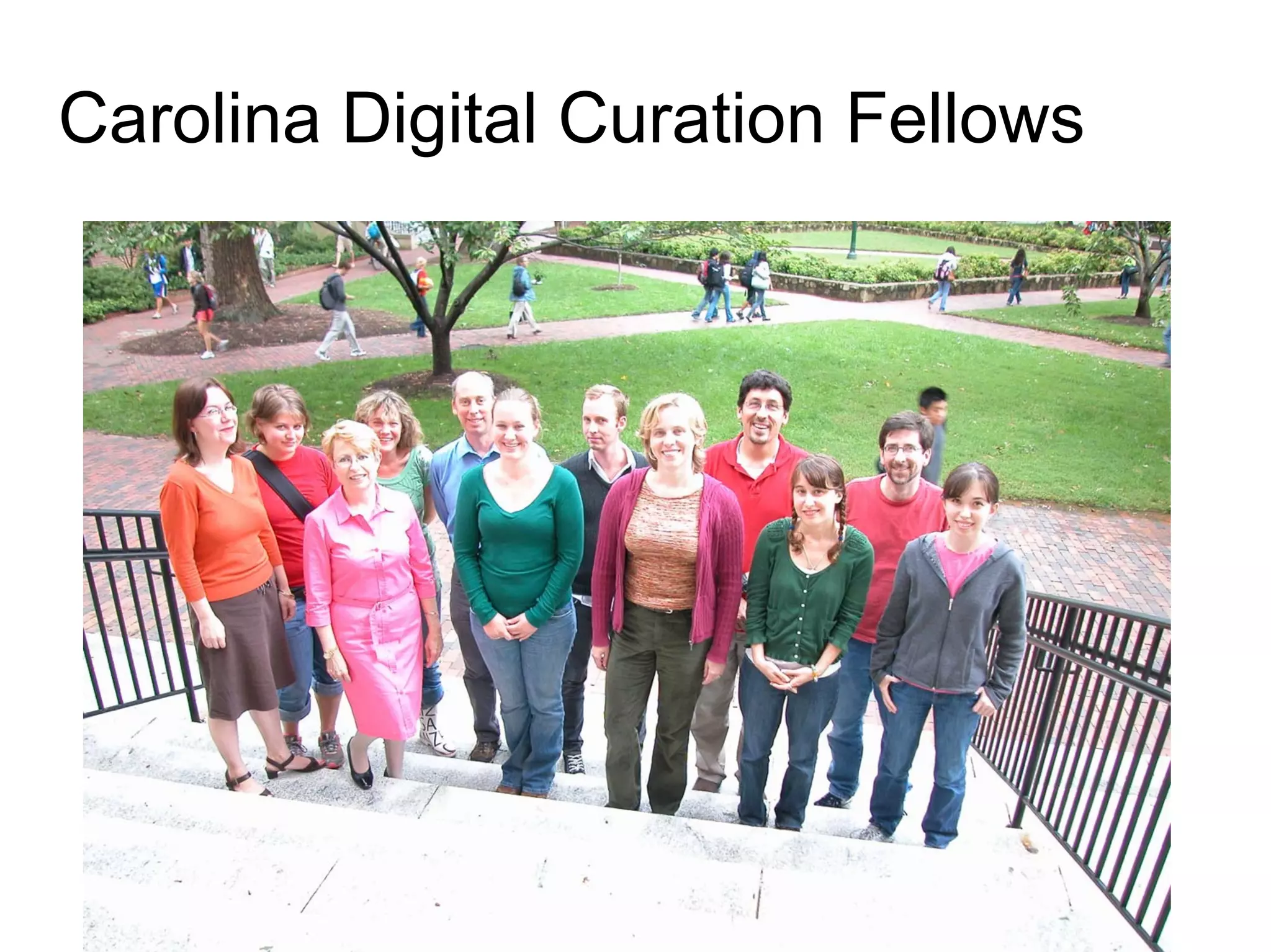
Carolina Digital Curation Fellows
• 5 Digital Curation Fellows pursuing degrees at SILS -
  began fall 2007; funded through 2009

• UNC partners providing practical experience
  opportunities: ibiblio, ITS, Odum Institute, and University
  Library

• 4 additional Fellows supported by UNC partners for
  2008-09
Carolina Digital Curation Fellows
Sources of Data
• Literature review
• Interviews from 17-member expert Advisory
  Board
• Two surveys of digital curation professionals
• Review of syllabi and materials from existing
  courses and workshops
• Review of digital curation-related job postings
• Course evaluations
• Fellowship evaluations
Guiding Principles
• Build on work of others
• Digital curation activities span entire life of
  digital resources
• Build from and for modules rather than
  entire courses
• Emphasize core, generalizable modules
• Avoid tying curriculum to specific
  institution types
Matrix of Digital Curation
    Knowledge & Competencies
• Tool for thinking about, planning for, identifying &
  organizing curriculum

• Each unit of curriculum content can address one or more
  dimensions

• Helping to address fundamental issue: core vs.
  specialized (optional) education elements
1) Mandates, Values and Principles
•   Professional ethics
•   Legal requirements
•   Standards
•   Interoperability and sustainability
    requirements
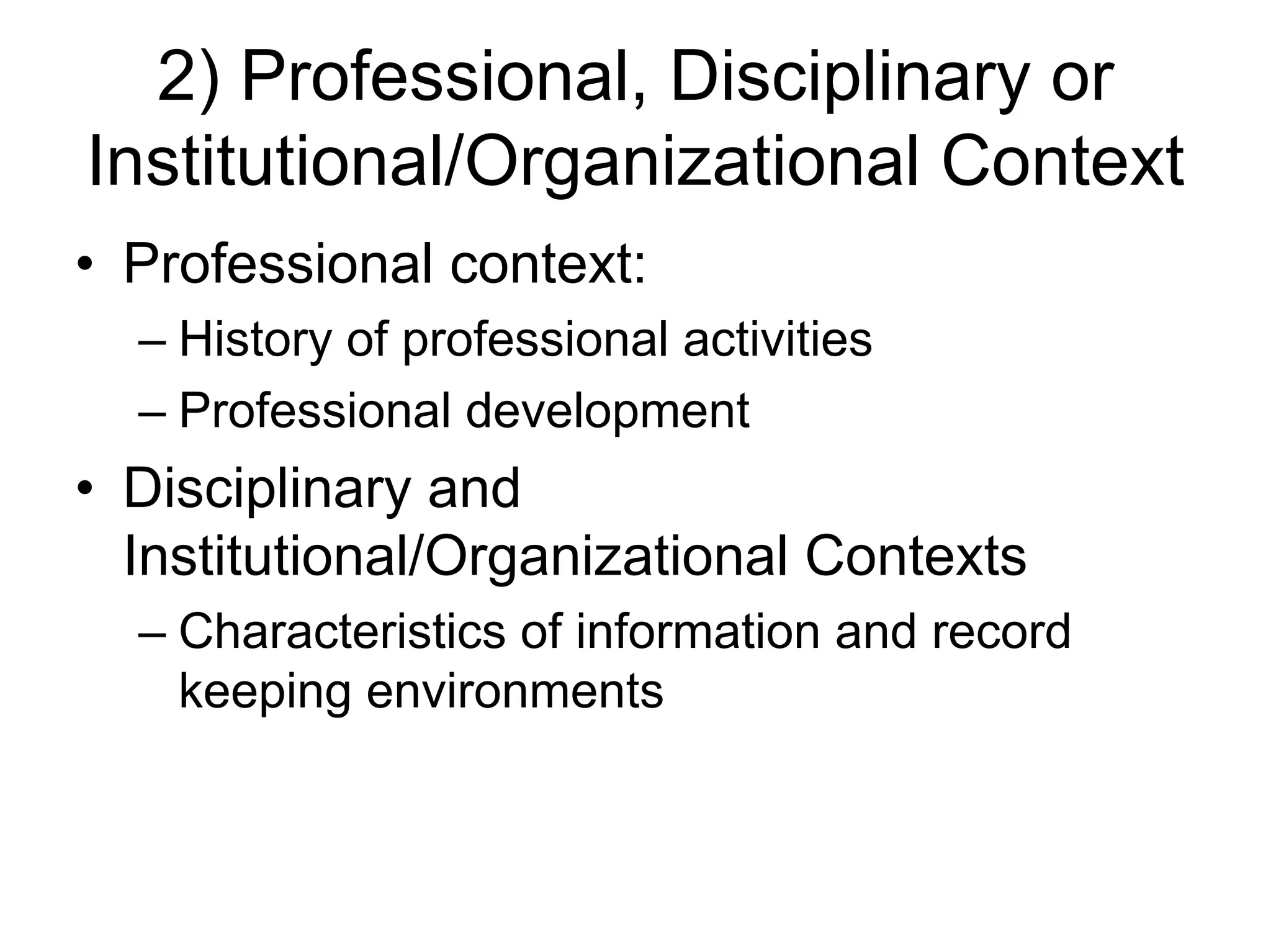
2) Professional, Disciplinary or
Institutional/Organizational Context
• Professional context:
  – History of professional activities
  – Professional development
• Disciplinary and
  Institutional/Organizational Contexts
  – Characteristics of information and record
    keeping environments
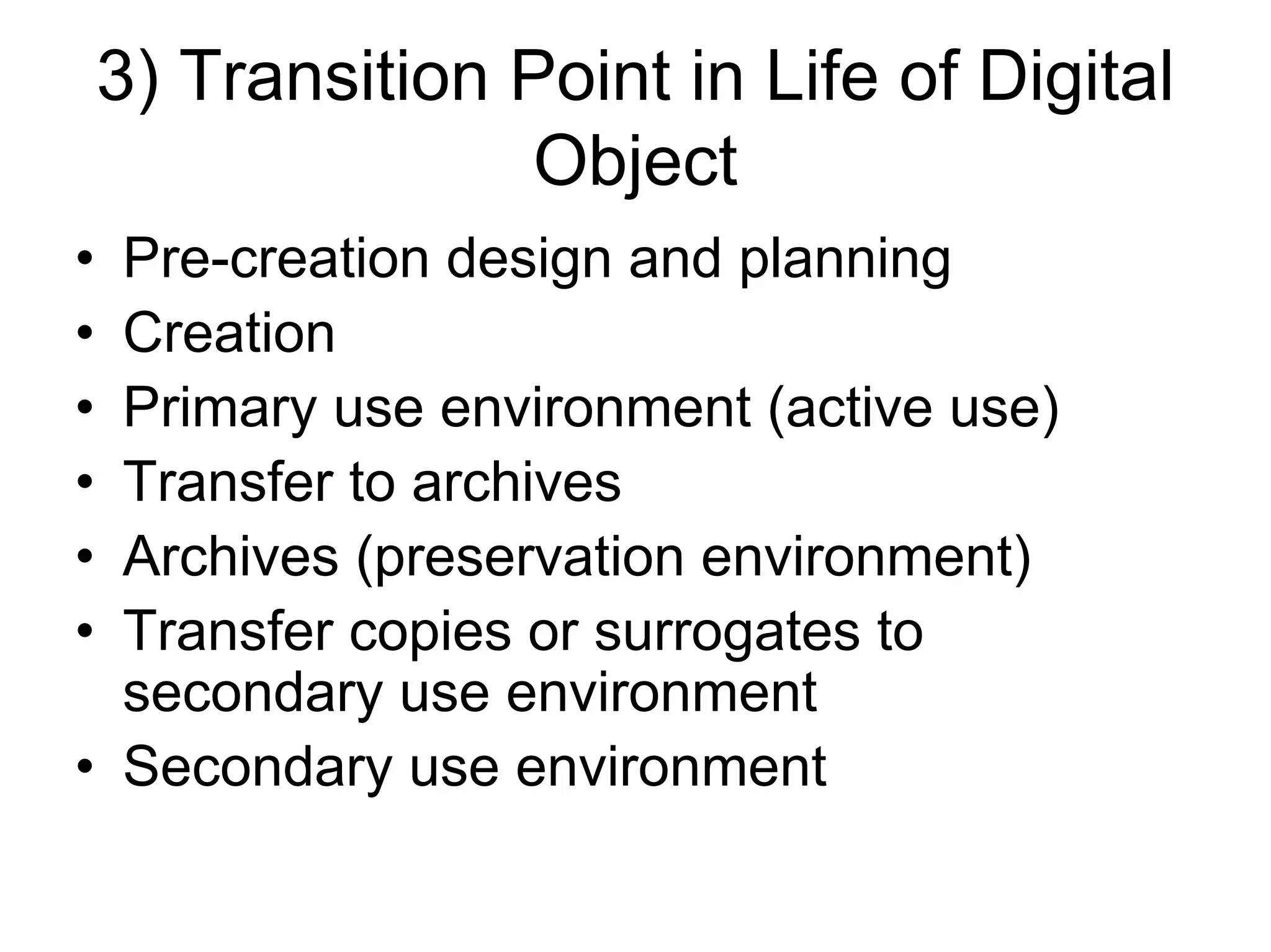
3) Transition Point in Life of Digital
                   Object
• Pre-creation design and planning
• Creation
• Primary use environment (active use)
• Transfer to archives
• Archives (preservation environment)
• Transfer copies or surrogates to
  secondary use environment
• Secondary use environment
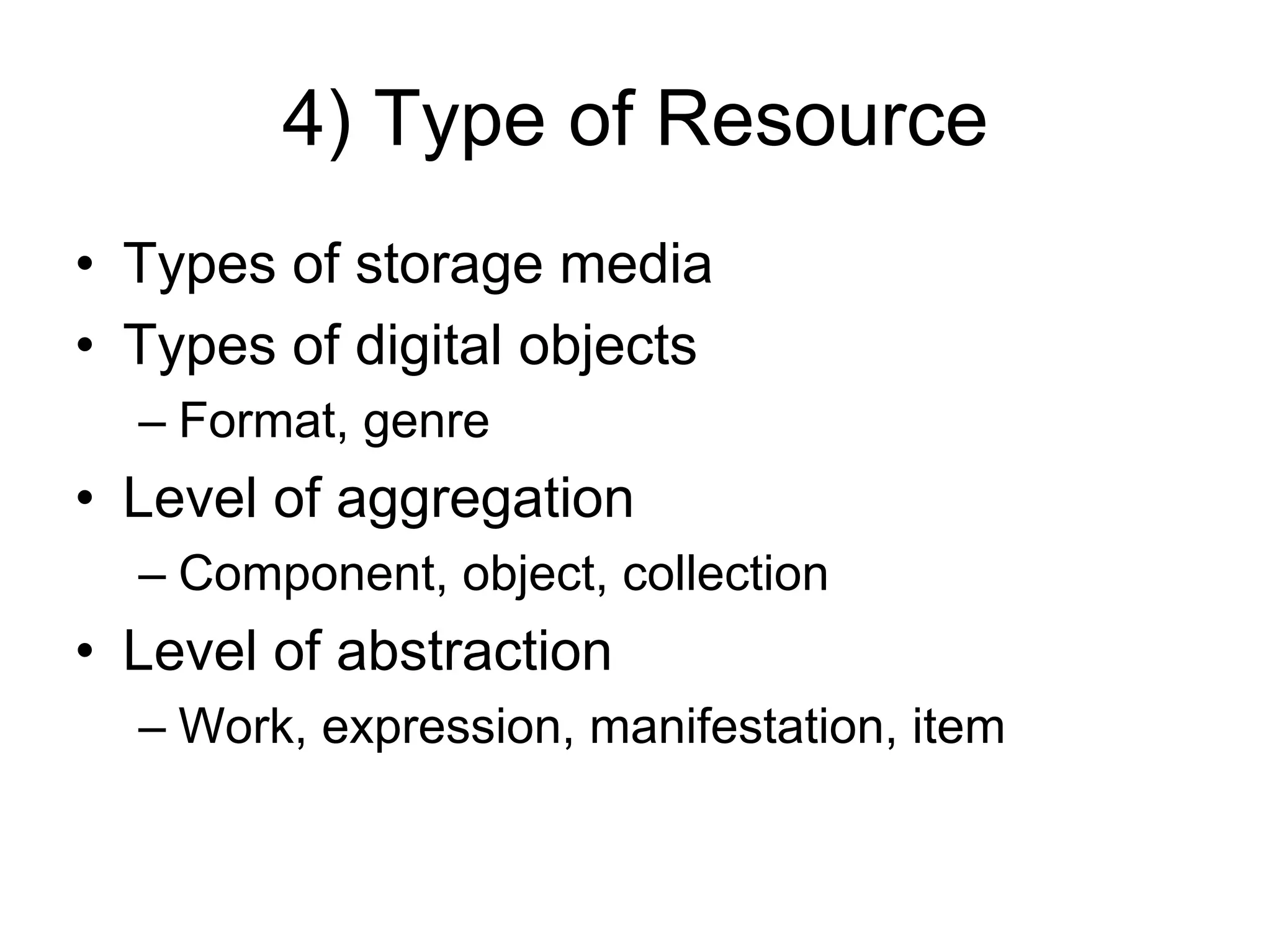
4) Type of Resource
• Types of storage media
• Types of digital objects
  – Format, genre
• Level of aggregation
  – Component, object, collection
• Level of abstraction
  – Work, expression, manifestation, item
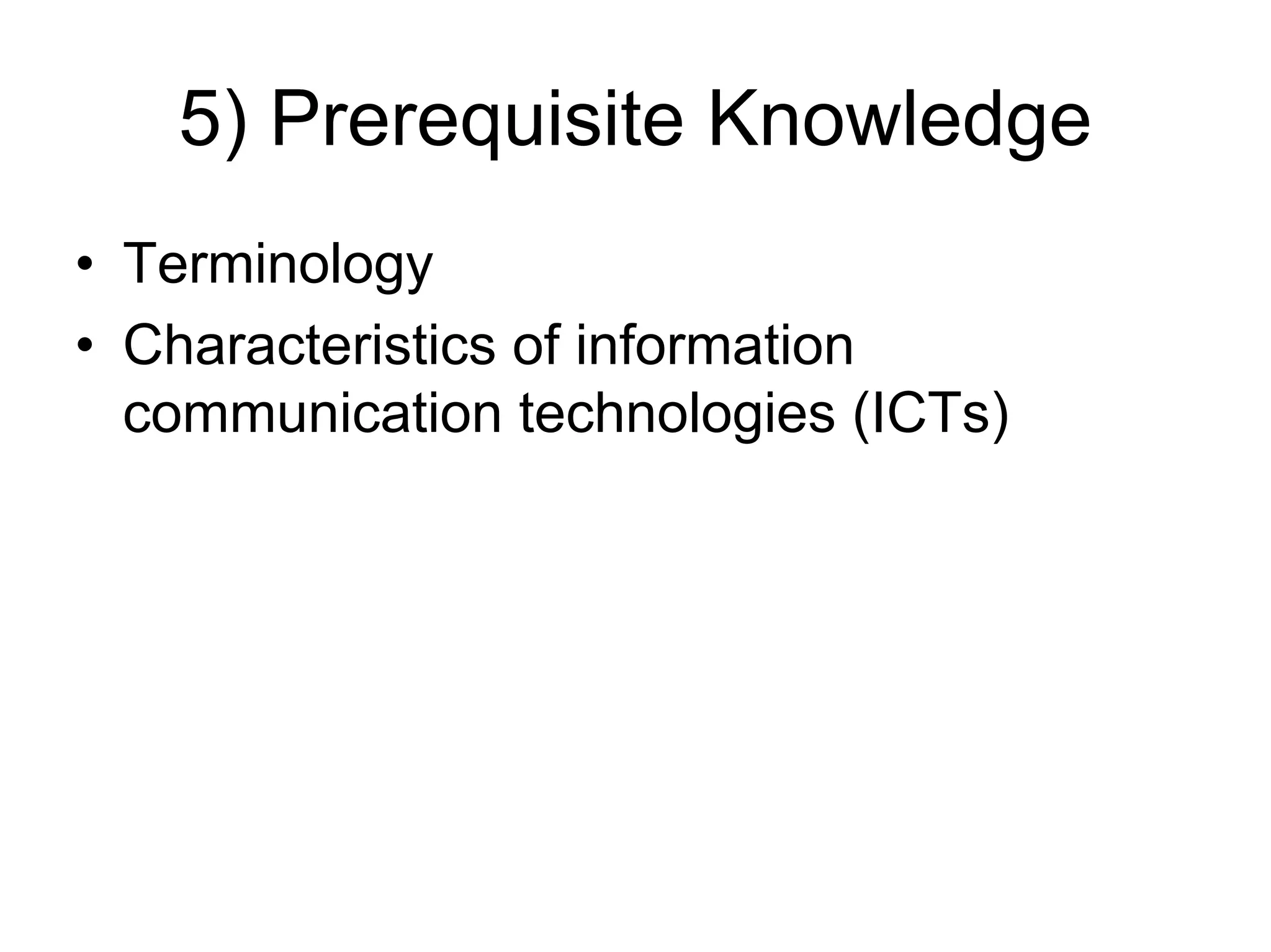
5) Prerequisite Knowledge
• Terminology
• Characteristics of information
  communication technologies (ICTs)
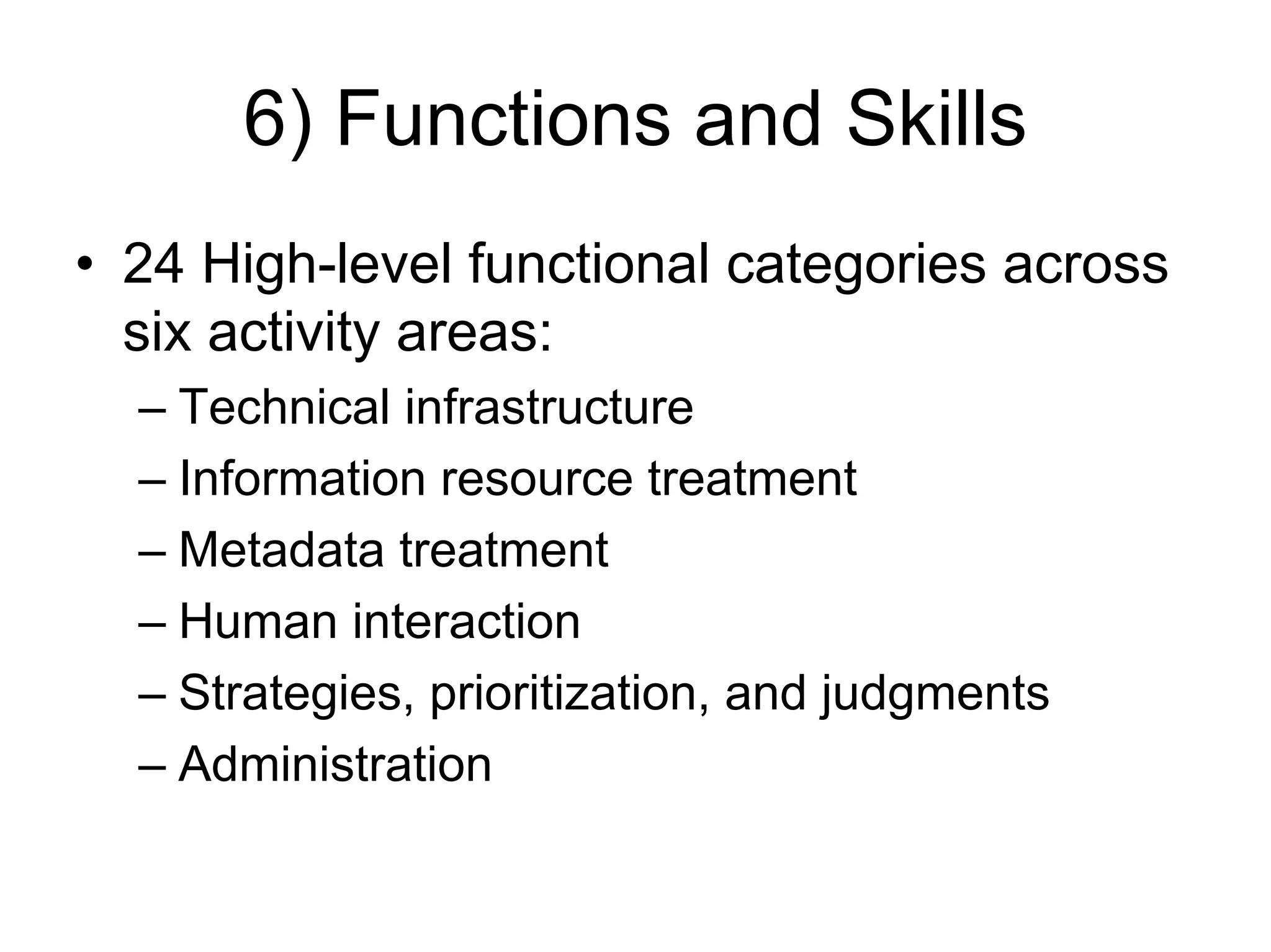
6) Functions and Skills
• 24 High-level functional categories across
  six activity areas:
  – Technical infrastructure
  – Information resource treatment
  – Metadata treatment
  – Human interaction
  – Strategies, prioritization, and judgments
  – Administration
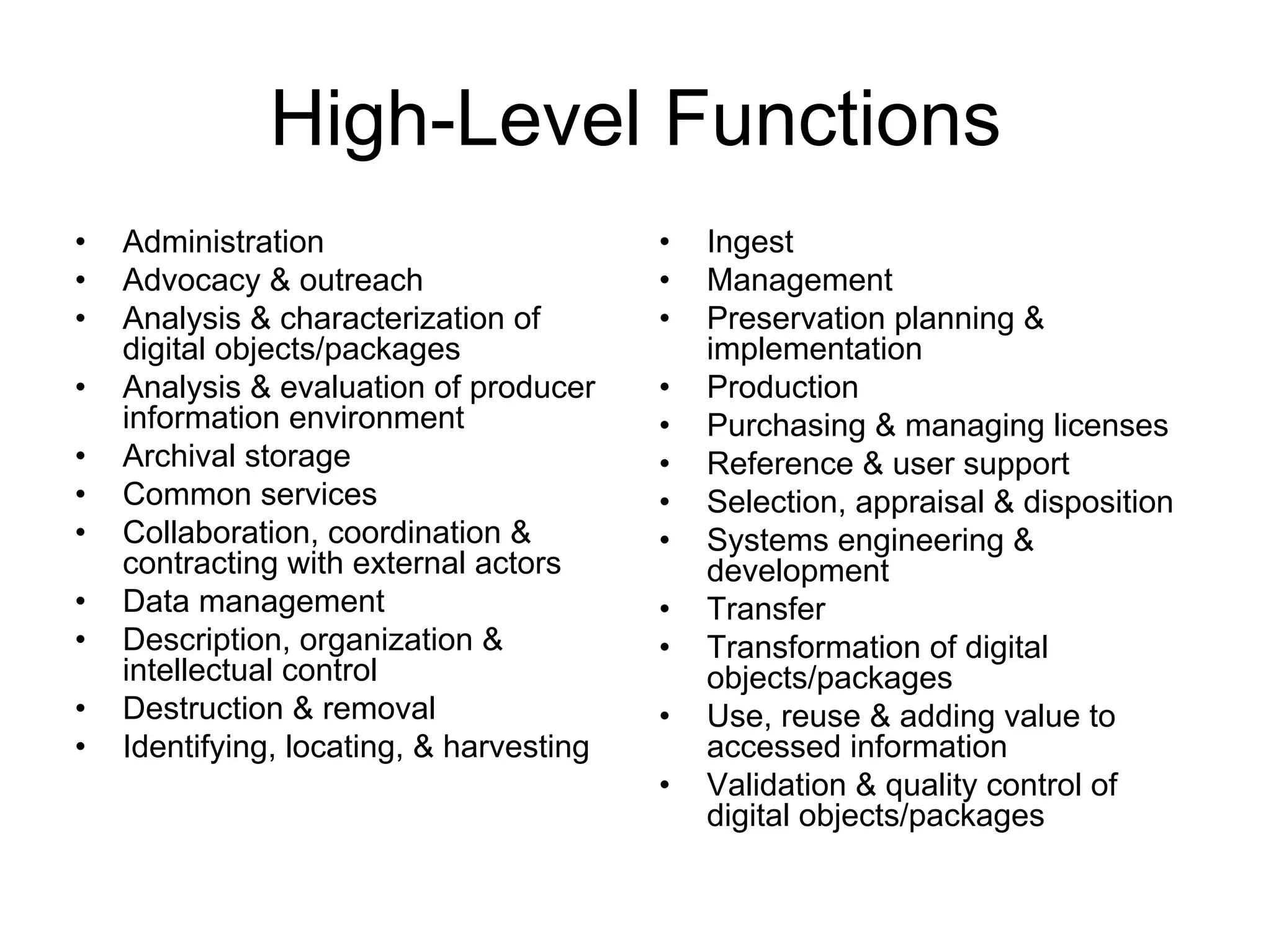
High-Level Functions
•   Administration                        •   Ingest
•   Advocacy & outreach                   •   Management
•   Analysis & characterization of        •   Preservation planning &
    digital objects/packages                  implementation
•   Analysis & evaluation of producer     •   Production
    information environment               •   Purchasing & managing licenses
•   Archival storage                      •   Reference & user support
•   Common services                       •   Selection, appraisal & disposition
•   Collaboration, coordination &         •   Systems engineering &
    contracting with external actors          development
•   Data management                       •   Transfer
•   Description, organization &           •   Transformation of digital
    intellectual control                      objects/packages
•   Destruction & removal                 •   Use, reuse & adding value to
•   Identifying, locating, & harvesting       accessed information
                                          •   Validation & quality control of
                                              digital objects/packages
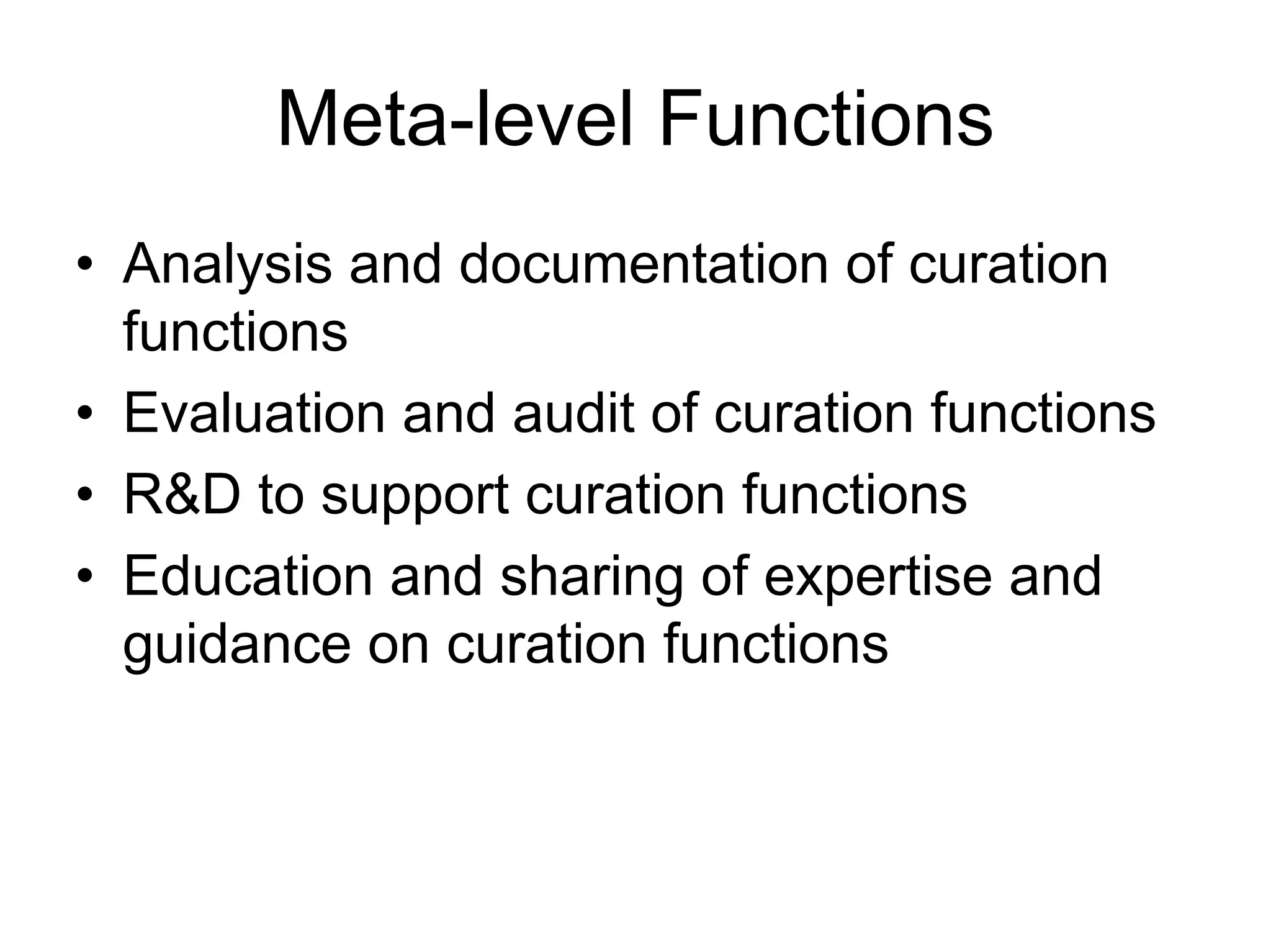
Meta-level Functions
• Analysis and documentation of curation
  functions
• Evaluation and audit of curation functions
• R&D to support curation functions
• Education and sharing of expertise and
  guidance on curation functions
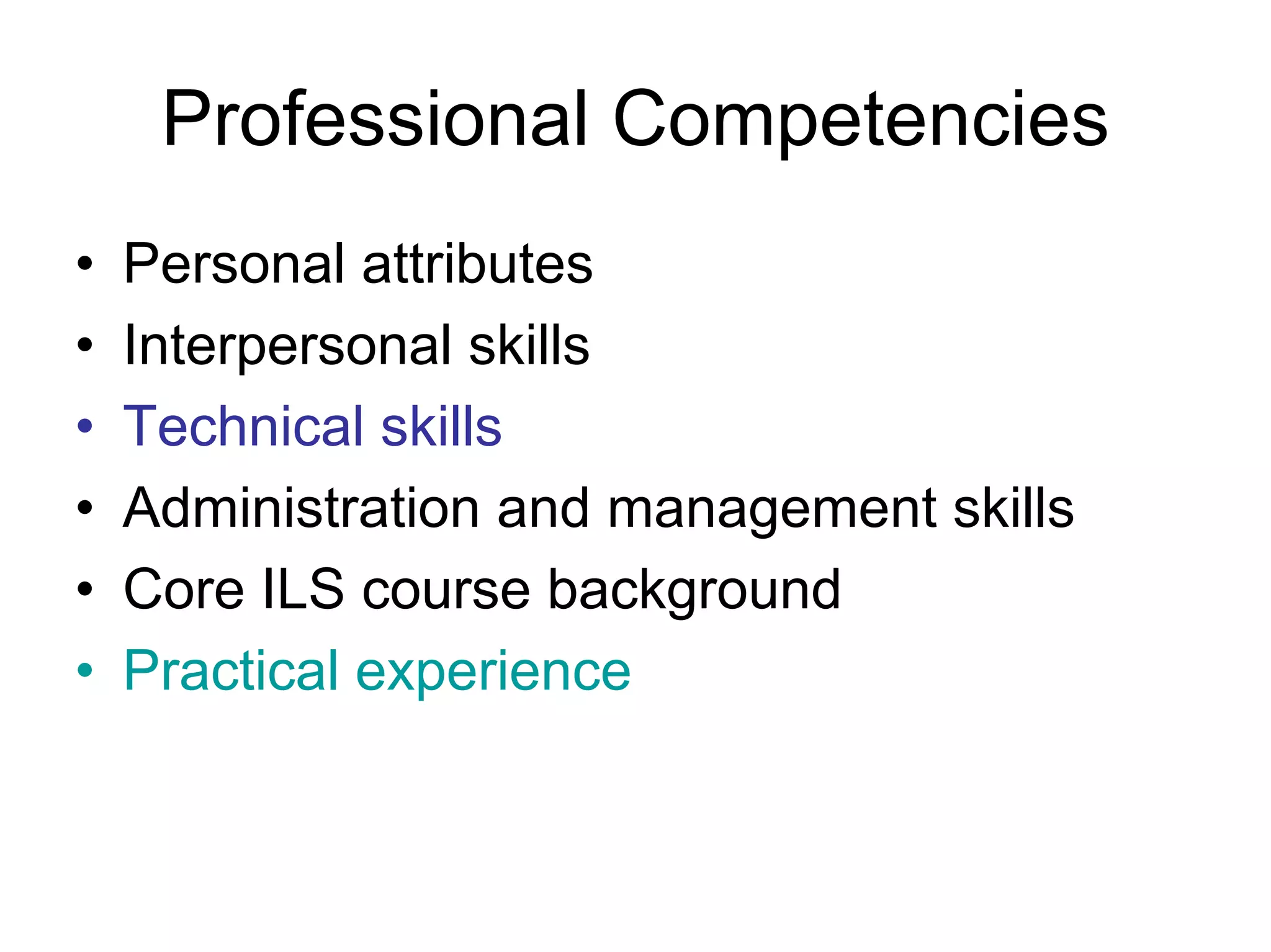
Professional Competencies
•   Personal attributes
•   Interpersonal skills
•   Technical skills
•   Administration and management skills
•   Core ILS course background
•   Practical experience
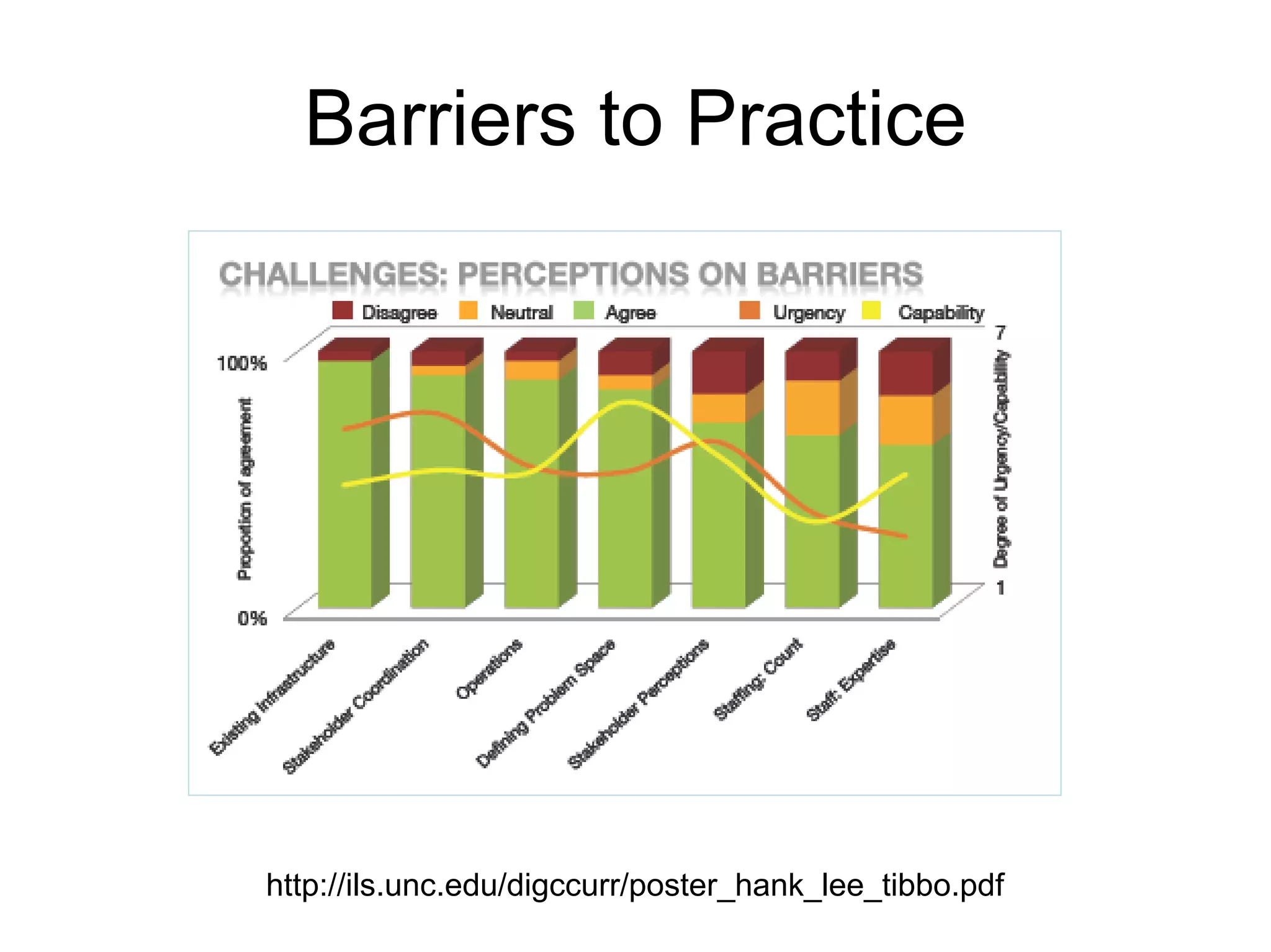
Barriers to Practice


http://ils.unc.edu/digccurr/poster_hank_lee_tibbo.pdf
DigCCurr II
• “Extending an International Digital Curation Curriculum
  to Doctoral Students and Practitioners.”
  http://www.ils.unc.edu/digccurr.

• This project is funded through IMLS Laura Bush funds.

• A collaboration of the School of Information and Library
  Science (SILS) at the University of North Carolina at
  Chapel Hill (UNC-CH) and the U.S. National Archives
  and Records Administration (NARA).

• Project to run August 1, 2008 – July 31, 2012.
DigCCurr II Key Activities
• PhD Fellowships
• Digital Curation Exchange (DCE)
• Summer Institutes
  – 1st Week-long summer workshop for
    practitioners, June 21-26, 2009 in Chapel Hill.
  – Follow-up session January 2010.
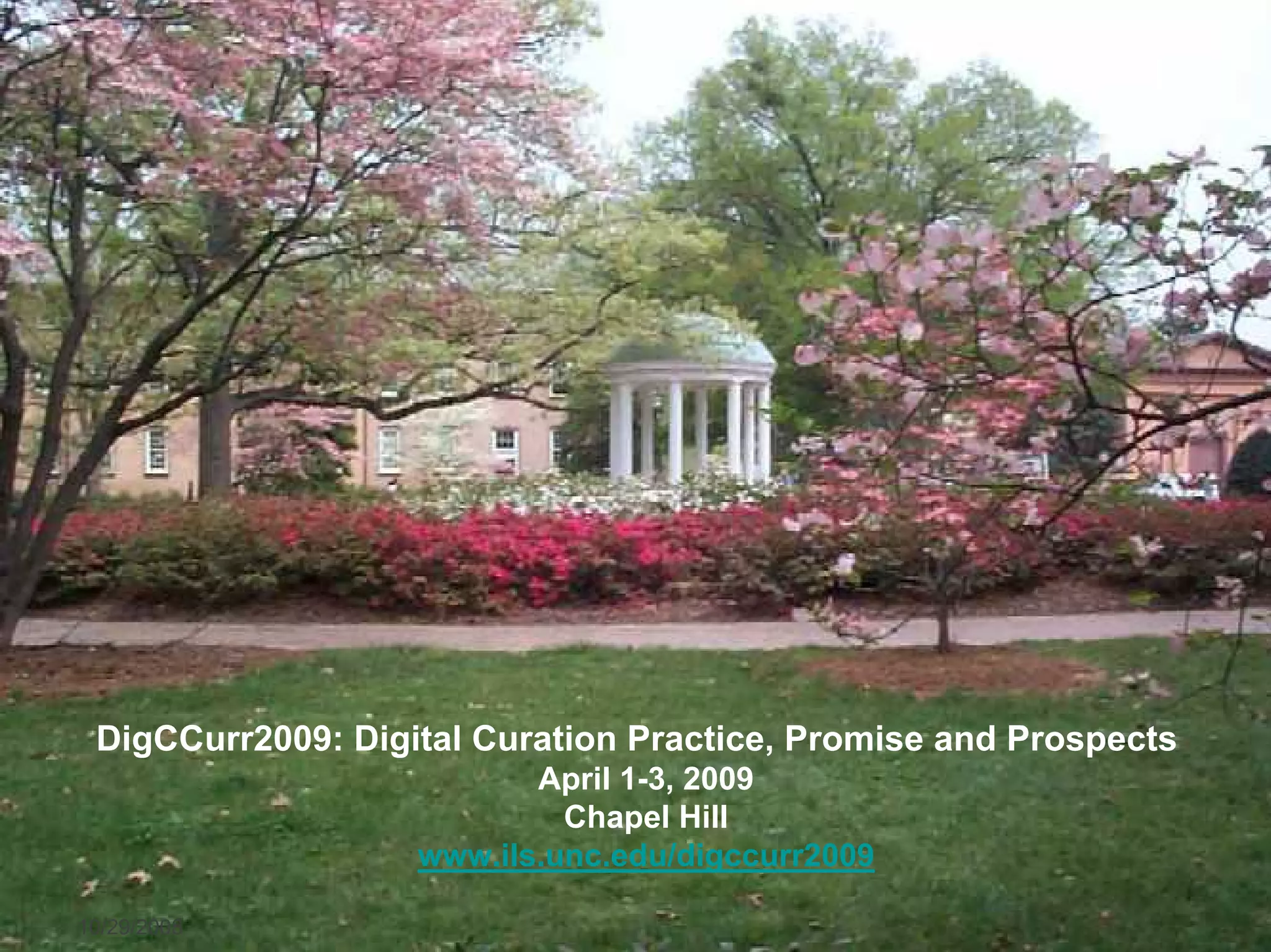
DigCCurr2009: Digital Curation Practice, Promise and Prospects
                           April 1-3, 2009
                             Chapel Hill
                    www.ils.unc.edu/digccurr2009

10/29/2008      ASIST 2008, Columbus, OH                          24

(Nov 2008) Preparing Future Digital Curators

  • 1.
    Preparing Future Digital Curators The Carolina Digital Curation Curriculum (DigCCurr) Project Carolyn Hank School of Information and Library Science University of North Carolina at Chapel Hill http://www.ils.unc.edu/digccurr/ MARAC Fall 2008, Silver Spring MD: 7 November 2008
  • 2.
    Digital Curation Education •Developing sustainable and evolving digital curation educational programs for: – Professional, continuing, life-long education – Graduate, professional education – Doctoral education • Programs need to be: – Integrated – International – Interdisciplinary – Linked to practical experiences, internships, etc.
  • 3.
    IMLS-Funded Curriculum Projects •Common theme: Prepare students for digital curation with wide variety of organizations, contexts & types of resources: • University of Illinois at Urbana-Champaign: – Data Curation Education Program (DCEP): 2006 – Extending Data Curation to the Humanities (DCEP+): 2008 • University of North Carolina at Chapel Hill: – Preserving Access to Our Digital Future: Building an International Digital Curation Curriculum (DigCCurr I): 2005 – “Extending an International Digital Curation Curriculum to Doctoral Students and Practitioners (DigCCurr II): 2008
  • 4.
    DigCCurr Project • PreservingAccess to Our Digital Future: Building an International Digital Curation Curriculum. http://www.ils.unc.edu/digccurr. • IMLS Grant # RE-05-06-0044 • Collaboration of School of Information & Library Science (SILS), University of North Carolina at Chapel Hill (UNC-CH) & U.S. National Archives & Records Administration (NARA) • Runs July 1, 2006 – June 30, 2009
  • 5.
    DigCCurr Components/Goals Curriculum: Toprepare students for digital curation with wide variety of organizations, contexts & types of resources: – Graduate-level curricular framework – Course modules – Course development – Experiential components – International guest speakers Two International Symposia: – DigCCurr2007: April 18-20, 2007 in Chapel Hill - http://ils.unc.edu/digccurr2007/ – DigCCurr2009: Practice, Promise and Prospect: April 1-3, 2009 in Chapel Hill - http://ils.unc.edu/digccurr2009 Carolina Digital Curation Fellowship program
  • 6.
    Guiding Questions • Whatknowledge and competencies do professional need in order to do digital curation work? • What should students learn in the classroom? • What should students learn through field experiences?
  • 7.
    Carolina Digital CurationFellows • 5 Digital Curation Fellows pursuing degrees at SILS - began fall 2007; funded through 2009 • UNC partners providing practical experience opportunities: ibiblio, ITS, Odum Institute, and University Library • 4 additional Fellows supported by UNC partners for 2008-09
  • 8.
  • 9.
    Sources of Data •Literature review • Interviews from 17-member expert Advisory Board • Two surveys of digital curation professionals • Review of syllabi and materials from existing courses and workshops • Review of digital curation-related job postings • Course evaluations • Fellowship evaluations
  • 10.
    Guiding Principles • Buildon work of others • Digital curation activities span entire life of digital resources • Build from and for modules rather than entire courses • Emphasize core, generalizable modules • Avoid tying curriculum to specific institution types
  • 11.
    Matrix of DigitalCuration Knowledge & Competencies • Tool for thinking about, planning for, identifying & organizing curriculum • Each unit of curriculum content can address one or more dimensions • Helping to address fundamental issue: core vs. specialized (optional) education elements
  • 12.
    1) Mandates, Valuesand Principles • Professional ethics • Legal requirements • Standards • Interoperability and sustainability requirements
  • 13.
    2) Professional, Disciplinaryor Institutional/Organizational Context • Professional context: – History of professional activities – Professional development • Disciplinary and Institutional/Organizational Contexts – Characteristics of information and record keeping environments
  • 14.
    3) Transition Pointin Life of Digital Object • Pre-creation design and planning • Creation • Primary use environment (active use) • Transfer to archives • Archives (preservation environment) • Transfer copies or surrogates to secondary use environment • Secondary use environment
  • 15.
    4) Type ofResource • Types of storage media • Types of digital objects – Format, genre • Level of aggregation – Component, object, collection • Level of abstraction – Work, expression, manifestation, item
  • 16.
    5) Prerequisite Knowledge •Terminology • Characteristics of information communication technologies (ICTs)
  • 17.
    6) Functions andSkills • 24 High-level functional categories across six activity areas: – Technical infrastructure – Information resource treatment – Metadata treatment – Human interaction – Strategies, prioritization, and judgments – Administration
  • 18.
    High-Level Functions • Administration • Ingest • Advocacy & outreach • Management • Analysis & characterization of • Preservation planning & digital objects/packages implementation • Analysis & evaluation of producer • Production information environment • Purchasing & managing licenses • Archival storage • Reference & user support • Common services • Selection, appraisal & disposition • Collaboration, coordination & • Systems engineering & contracting with external actors development • Data management • Transfer • Description, organization & • Transformation of digital intellectual control objects/packages • Destruction & removal • Use, reuse & adding value to • Identifying, locating, & harvesting accessed information • Validation & quality control of digital objects/packages
  • 19.
    Meta-level Functions • Analysisand documentation of curation functions • Evaluation and audit of curation functions • R&D to support curation functions • Education and sharing of expertise and guidance on curation functions
  • 20.
    Professional Competencies • Personal attributes • Interpersonal skills • Technical skills • Administration and management skills • Core ILS course background • Practical experience
  • 21.
  • 22.
    DigCCurr II • “Extendingan International Digital Curation Curriculum to Doctoral Students and Practitioners.” http://www.ils.unc.edu/digccurr. • This project is funded through IMLS Laura Bush funds. • A collaboration of the School of Information and Library Science (SILS) at the University of North Carolina at Chapel Hill (UNC-CH) and the U.S. National Archives and Records Administration (NARA). • Project to run August 1, 2008 – July 31, 2012.
  • 23.
    DigCCurr II KeyActivities • PhD Fellowships • Digital Curation Exchange (DCE) • Summer Institutes – 1st Week-long summer workshop for practitioners, June 21-26, 2009 in Chapel Hill. – Follow-up session January 2010.
  • 24.
    DigCCurr2009: Digital CurationPractice, Promise and Prospects April 1-3, 2009 Chapel Hill www.ils.unc.edu/digccurr2009 10/29/2008 ASIST 2008, Columbus, OH 24