Presenting by –
Chirashree Giri
2nd year M.Sc nursing
• Counseling is a process of
communicating between two or
more persons who meet to solve
a problem or take decision on
various matters.
• It is not a one way process where
in the counselor tells the client
what to do nor it is a presentation
of the counselor’s values.
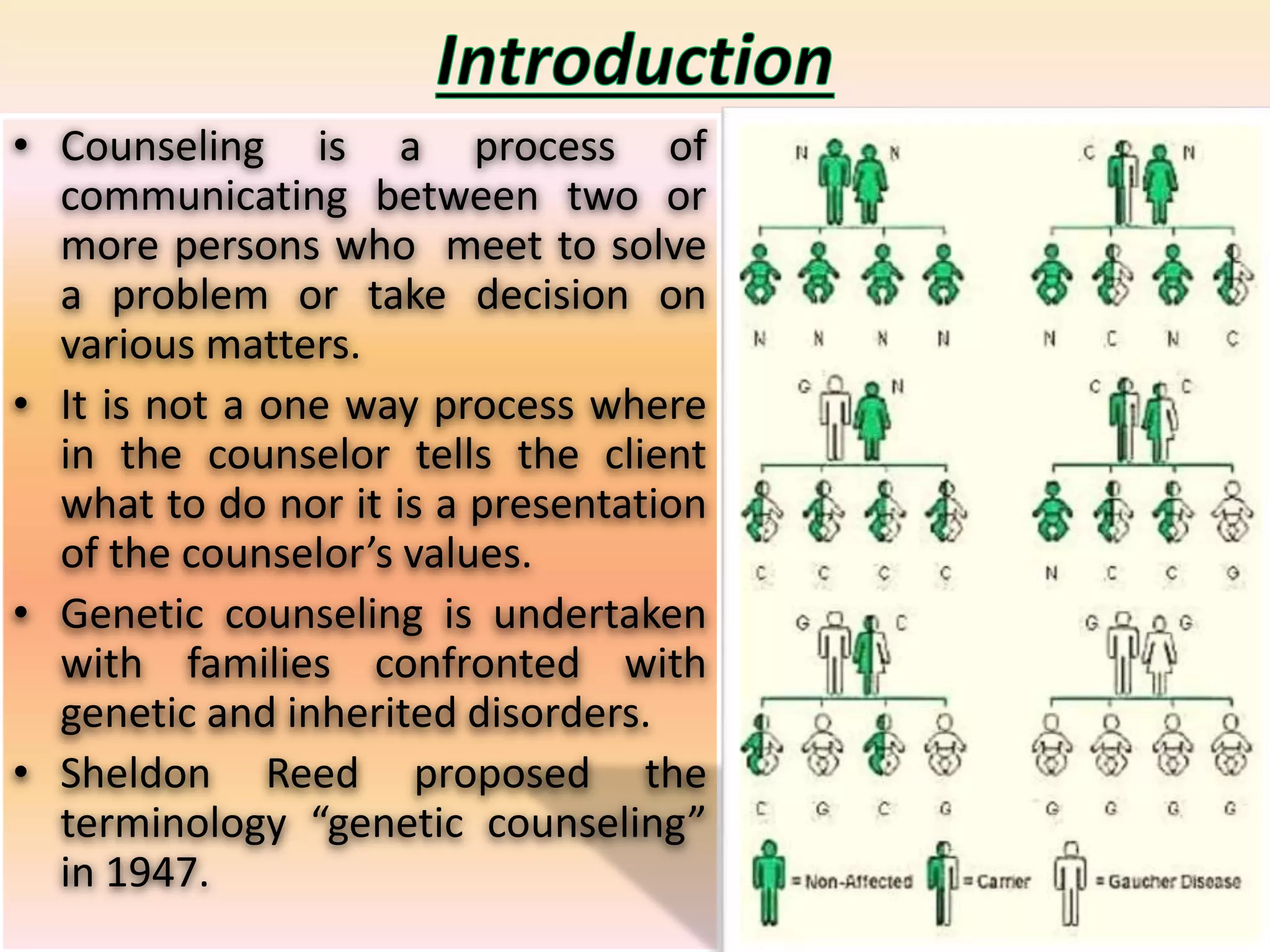
• Genetic counseling is undertaken
with families confronted with
genetic and inherited disorders.
• Sheldon Reed proposed the
terminology “genetic counseling”
in 1947.
Definition
• The American society of human genetic define
genetic counseling as a communication process,
which deals with of occurrence of a genetic
disorder in a family.
• Smith (1955) defines counseling as a process in
which the counselor assist the counselee to
make interpretations of facts relating to a
choice, plan or adjustment which he needs to
make.
Incidence
• About 3% of babies born with birth defects
each year, according to the Centers for
Disease Control and Prevention (CDC).
Purpose
• Provide concrete & accurate information about inherited
disorders.
• Reassure people who are concerned that their child may
inherit a particular disorder that the disorder will not occur.
• Allow people who are affected by inherited disease to make
informed choices about future reproduction.
• Educate people about inherited disorders & the process of
inheritance.
• Offer support by skilled health care professionals to people
who are affected by genetic disorders.
Indication
• If a standard prenatal screening test
(such as α fetoprotein test) yields an
abnormal result.
• An amniocentesis yields an unexpected
result (such as chromosomal defect in
the unborn baby).
• Either parent or close relative has an
inheritance disease or birth defect,
either parents already has children with
birth defect or genetic disorders.
• The mother has had two or more
miscarriage or a baby dies in infancy.
• The mother is 35 years of age or over.
• The partner is blood relatives.
Principles of genetic counseling:
• It is a therapeutic measure.
• It includes establishment of accurate diagnosis,
treatment of the affected individuals as well as the
prevention of the occurrence of genetic disorders.
• It requires a special aptitude of communication.
• It must be non-directive.
• The final decision is on the counselee.
• Both the parents should be counseled together as far
as possible.
• Follow up sessions are always desirable.
Process of genetic counseling:
1) Gathering family history
2) Look over medical records, medications, ultrasound
before pregnancy
3) Interactions with parents about inheritance patterns,
risk patterns
4) If parents are at high risk, options available:
1) Pre-implantation diagnosis
2) Using donor sperm or donor eggs
3) Adoption
5) If parents received severe fetal defect after conception,
options include:
1) Preparing yourself for the defected baby
2) Fetal surgery
3) Ending the pregnancy
Steps of genetic counseling
History:
1. Both present &
relevant past
history.
2. Family history
includes siblings
& relatives.
3. Obstetrical history
includes exposure to
teratogens, drugs, X-rays.
4. Any history
of abortion or
still birth.
5. Any
consanguineo
us marriage
Pedigree Charting:
at a glance this offers in a concise manner the state
of disorder in a family. Constructing a pedigree with
proper interrogation though time consuming, is
ultimately rewarding. It forms an indispensable step
towards counseling.
Estimation of Risk:
it forms one of the most important aspect of
genetic counseling. It is often called recurrence risk. To
estimate it one requires to take into account following
points:
 Mode of inheritance
 Analysis of pedigree or family tree
 Results of various tests
Transmitting information:
after completing the diagnosis, pedigree charting &
estimation of risk the next most important step is of
communicating this information to the consultants.
This important functioning involves various factors such as
 Psychology of the patient
 The emotional stress under prevailing circumstances.
 Attitude of family members towards the patients.
 Educational, social & financial background of the family.
 Gaining confidence of consultants in subsequence
meeting during follow up.
 Ethical, moral & legal implications involved in the process.
 Above all, communication skills to transmit facts in an
effective manner i.e. making them more acceptable and
palatable.
Management:
• In genetics, “treatment” implies a very limited
scope.
• It naturally aims for prevention rather than
cure.
• For most of the genetic disorders cure is
unknown.
• Treatment is therefore directed towards
minimizing the damage by early detection and
preventing further irreversible damage.
Types of genetic counseling:
1. Prospective genetic counseling: usually premarital,
specially when the couples are related, this allows
true prevention of disease.
2. Retrospective genetic counseling: there is a way a
history of either an offspring or relative being
affected. At present, this counseling is mostly using &
this is the hereditary disorder has already occurred in
the family.
3. Expanded family genetic counseling: usually given in
chromosomal abbreations occurring secondary to
balanced translocation or inversion and in X linked
conditions.
Application of genetic counseling
• Genetic counselor works with people concerned
about the risk of an inherited disease or
condition.
• These people represent several different
populations. Those are:
A. Prenatal genetic counseling
B. Pediatrics genetic counseling
C. Adult genetic counseling
D. Cancer genetic counseling
Prenatal genetic counseling
There are several different reasons
a person or couple may seek
prenatal genetic counseling.
Prenatal tests that are offered
during genetic counseling include:
Pediatrics genetic counseling
• Families or pediatricians seek
genetic counseling when a child has
features of an inherited condition.
• Any child who is born with more
than one defect, mental retardation
or dysmorphic features has an
increased chance of having a
genetic syndrome.
• A common type of mental
retardation in males for which
genetic testing is available is fragile
X-syndrome.
Adult genetic counseling
• Adults may seek genetic counseling when a
person in the family decided to be tested for
the presence of a known genetic condition.
• When an adult begins exhibiting symptoms of
an inherited condition, or
• When there is a new diagnosis of someone
with an adult-onset disorder in the family.
• In addition, the birth of a child with obvious
features of a genetic disease leads to
diagnosis of a parent who is more mildly
affected.
• Genetic counseling for adults may lead to the
consideration of pre-symptomatic genetic
testing.
Cancer genetic counseling
• A family history of early onset breast,
ovarian or colon cancer in multiple
generations of family is a common
reason a person would seek a genetic
counselor who works with people who
have cancer.
• While most cancer is not inherited, there
are some families in which a dominant
gene is present & causing the disease.
• A genetic counselor is able to discuss the
chances that the cancer in the family is
related to a dominantly inherited gene.
• The counselor can also discuss the option
of testing for the breast & ovarian cancer
genes.
Role of genetic counselor:
• Helping people to understand information about
genetic disorders.
• Providing non-directive support.
• Helping individuals & families makes decisions
with which they are comfortable, based on their
personal ethical &religious standards.
• Connecting individuals & families with
appropriate resources, such as support groups or
specific types of medical clinic locally &
nationally.
Role of nurse in genetic counseling
• Recognize or suspect genetic disorders by their physical
characteristics & clinical manifestation
• Create a genetic pedigree including cause of death &
genetic disorders
• Clear-up misconception & allay feeling of guilt.
• Assist with the diagnostic process ( history collection,
physical assessment, blood sampling, or other sample
collection)
• Enhance self –image & self-worth of parents
• Encourage interaction with family & friends
• Refer & prepare family for genetic counseling
• Check with Govt. policy for information & resources
• Recognize the issues( ethical, legal, psychosocial &
professional)
• Be aware of associated professional responsibilities for
e.g. informed consent, documentation, confidentiality.
Genetic counselling
Genetic counselling

Genetic counselling

  • 2.
    Presenting by – ChirashreeGiri 2nd year M.Sc nursing
  • 3.
    • Counseling isa process of communicating between two or more persons who meet to solve a problem or take decision on various matters. • It is not a one way process where in the counselor tells the client what to do nor it is a presentation of the counselor’s values. • Genetic counseling is undertaken with families confronted with genetic and inherited disorders. • Sheldon Reed proposed the terminology “genetic counseling” in 1947.
  • 4.
    Definition • The Americansociety of human genetic define genetic counseling as a communication process, which deals with of occurrence of a genetic disorder in a family. • Smith (1955) defines counseling as a process in which the counselor assist the counselee to make interpretations of facts relating to a choice, plan or adjustment which he needs to make.
  • 5.
    Incidence • About 3%of babies born with birth defects each year, according to the Centers for Disease Control and Prevention (CDC).
  • 6.
    Purpose • Provide concrete& accurate information about inherited disorders. • Reassure people who are concerned that their child may inherit a particular disorder that the disorder will not occur. • Allow people who are affected by inherited disease to make informed choices about future reproduction. • Educate people about inherited disorders & the process of inheritance. • Offer support by skilled health care professionals to people who are affected by genetic disorders.
  • 7.
    Indication • If astandard prenatal screening test (such as α fetoprotein test) yields an abnormal result. • An amniocentesis yields an unexpected result (such as chromosomal defect in the unborn baby). • Either parent or close relative has an inheritance disease or birth defect, either parents already has children with birth defect or genetic disorders. • The mother has had two or more miscarriage or a baby dies in infancy. • The mother is 35 years of age or over. • The partner is blood relatives.
  • 8.
    Principles of geneticcounseling: • It is a therapeutic measure. • It includes establishment of accurate diagnosis, treatment of the affected individuals as well as the prevention of the occurrence of genetic disorders. • It requires a special aptitude of communication. • It must be non-directive. • The final decision is on the counselee. • Both the parents should be counseled together as far as possible. • Follow up sessions are always desirable.
  • 9.
    Process of geneticcounseling: 1) Gathering family history 2) Look over medical records, medications, ultrasound before pregnancy 3) Interactions with parents about inheritance patterns, risk patterns 4) If parents are at high risk, options available: 1) Pre-implantation diagnosis 2) Using donor sperm or donor eggs 3) Adoption 5) If parents received severe fetal defect after conception, options include: 1) Preparing yourself for the defected baby 2) Fetal surgery 3) Ending the pregnancy
  • 10.
    Steps of geneticcounseling
  • 11.
    History: 1. Both present& relevant past history. 2. Family history includes siblings & relatives. 3. Obstetrical history includes exposure to teratogens, drugs, X-rays. 4. Any history of abortion or still birth. 5. Any consanguineo us marriage
  • 12.
    Pedigree Charting: at aglance this offers in a concise manner the state of disorder in a family. Constructing a pedigree with proper interrogation though time consuming, is ultimately rewarding. It forms an indispensable step towards counseling. Estimation of Risk: it forms one of the most important aspect of genetic counseling. It is often called recurrence risk. To estimate it one requires to take into account following points:  Mode of inheritance  Analysis of pedigree or family tree  Results of various tests
  • 13.
    Transmitting information: after completingthe diagnosis, pedigree charting & estimation of risk the next most important step is of communicating this information to the consultants. This important functioning involves various factors such as  Psychology of the patient  The emotional stress under prevailing circumstances.  Attitude of family members towards the patients.  Educational, social & financial background of the family.  Gaining confidence of consultants in subsequence meeting during follow up.  Ethical, moral & legal implications involved in the process.  Above all, communication skills to transmit facts in an effective manner i.e. making them more acceptable and palatable.
  • 14.
    Management: • In genetics,“treatment” implies a very limited scope. • It naturally aims for prevention rather than cure. • For most of the genetic disorders cure is unknown. • Treatment is therefore directed towards minimizing the damage by early detection and preventing further irreversible damage.
  • 15.
    Types of geneticcounseling: 1. Prospective genetic counseling: usually premarital, specially when the couples are related, this allows true prevention of disease. 2. Retrospective genetic counseling: there is a way a history of either an offspring or relative being affected. At present, this counseling is mostly using & this is the hereditary disorder has already occurred in the family. 3. Expanded family genetic counseling: usually given in chromosomal abbreations occurring secondary to balanced translocation or inversion and in X linked conditions.
  • 16.
    Application of geneticcounseling • Genetic counselor works with people concerned about the risk of an inherited disease or condition. • These people represent several different populations. Those are: A. Prenatal genetic counseling B. Pediatrics genetic counseling C. Adult genetic counseling D. Cancer genetic counseling
  • 17.
    Prenatal genetic counseling Thereare several different reasons a person or couple may seek prenatal genetic counseling. Prenatal tests that are offered during genetic counseling include:
  • 18.
    Pediatrics genetic counseling •Families or pediatricians seek genetic counseling when a child has features of an inherited condition. • Any child who is born with more than one defect, mental retardation or dysmorphic features has an increased chance of having a genetic syndrome. • A common type of mental retardation in males for which genetic testing is available is fragile X-syndrome.
  • 19.
    Adult genetic counseling •Adults may seek genetic counseling when a person in the family decided to be tested for the presence of a known genetic condition. • When an adult begins exhibiting symptoms of an inherited condition, or • When there is a new diagnosis of someone with an adult-onset disorder in the family. • In addition, the birth of a child with obvious features of a genetic disease leads to diagnosis of a parent who is more mildly affected. • Genetic counseling for adults may lead to the consideration of pre-symptomatic genetic testing.
  • 20.
    Cancer genetic counseling •A family history of early onset breast, ovarian or colon cancer in multiple generations of family is a common reason a person would seek a genetic counselor who works with people who have cancer. • While most cancer is not inherited, there are some families in which a dominant gene is present & causing the disease. • A genetic counselor is able to discuss the chances that the cancer in the family is related to a dominantly inherited gene. • The counselor can also discuss the option of testing for the breast & ovarian cancer genes.
  • 21.
    Role of geneticcounselor: • Helping people to understand information about genetic disorders. • Providing non-directive support. • Helping individuals & families makes decisions with which they are comfortable, based on their personal ethical &religious standards. • Connecting individuals & families with appropriate resources, such as support groups or specific types of medical clinic locally & nationally.
  • 22.
    Role of nursein genetic counseling • Recognize or suspect genetic disorders by their physical characteristics & clinical manifestation • Create a genetic pedigree including cause of death & genetic disorders • Clear-up misconception & allay feeling of guilt. • Assist with the diagnostic process ( history collection, physical assessment, blood sampling, or other sample collection) • Enhance self –image & self-worth of parents • Encourage interaction with family & friends • Refer & prepare family for genetic counseling • Check with Govt. policy for information & resources • Recognize the issues( ethical, legal, psychosocial & professional) • Be aware of associated professional responsibilities for e.g. informed consent, documentation, confidentiality.