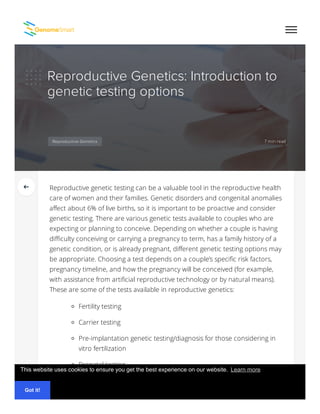
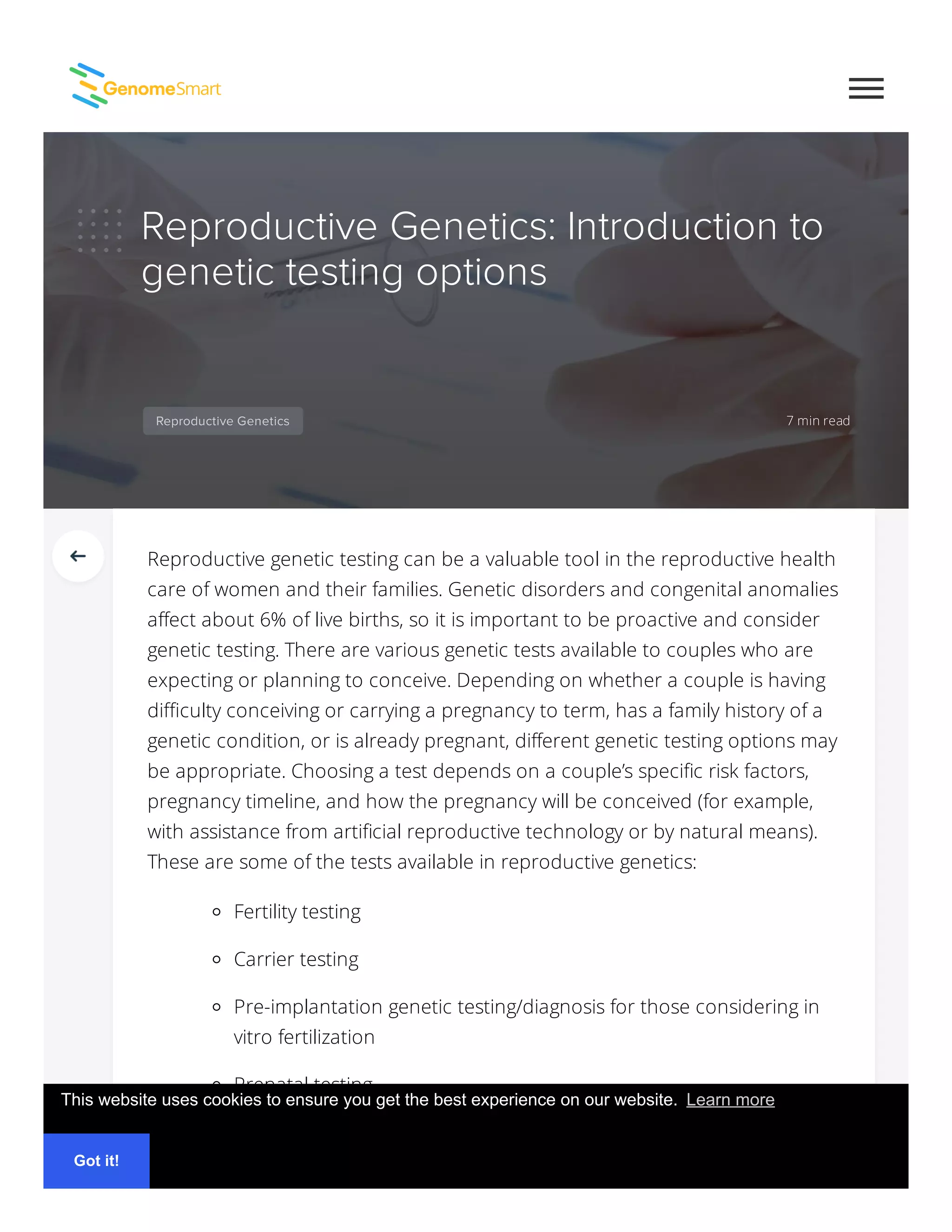
Reproductive Genetics: Introduction to
genetic testing options
7 min readReproductive Genetics
Reproductive genetic testing can be a valuable tool in the reproductive health
care of women and their families. Genetic disorders and congenital anomalies
affect about 6% of live births, so it is important to be proactive and consider
genetic testing. There are various genetic tests available to couples who are
expecting or planning to conceive. Depending on whether a couple is having
difficulty conceiving or carrying a pregnancy to term, has a family history of a
genetic condition, or is already pregnant, different genetic testing options may
be appropriate. Choosing a test depends on a couple’s specific risk factors,
pregnancy timeline, and how the pregnancy will be conceived (for example,
with assistance from artificial reproductive technology or by natural means).
These are some of the tests available in reproductive genetics:
Fertility testing
Carrier testing
Pre-implantation genetic testing/diagnosis for those considering in
vitro fertilization
Prenatal testing
Maternal serum testing, First trimester screening, Second
trimester screening, Integrated screening and sequential
This website uses cookies to ensure you get the best experience on our website.
Got it!
Learn more
Chorionic villus sampling/ amniocentesis
Non-invasive prenatal screening
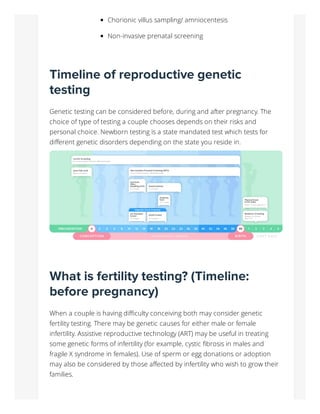
Timeline of reproductive genetic
testing
Genetic testing can be considered before, during and after pregnancy. The
choice of type of testing a couple chooses depends on their risks and
personal choice. Newborn testing is a state mandated test which tests for
different genetic disorders depending on the state you reside in. 
What is fertility testing? (Timeline:
before pregnancy)
When a couple is having difficulty conceiving both may consider genetic
fertility testing. There may be genetic causes for either male or female
infertility. Assistive reproductive technology (ART) may be useful in treating
some genetic forms of infertility (for example, cystic fibrosis in males and
fragile X syndrome in females). Use of sperm or egg donations or adoption
may also be considered by those affected by infertility who wish to grow their
families.
What is carrier testing? (Timeline:
before, during, and after pregnancy)
Carrier testing determines whether a prospective parent carries a genetic
mutation associated with an inherited disorder. Traditionally it was
recommended to those from certain ethnicities but now it is offered to all
women of reproductive age. It can test for mutations for some of the most
common genetic conditions (such as cystic fibrosis or spinal muscular
atrophy) as well as rare disorders seen mostly in certain ethnicities. Carriers
are usually not affected by the genetic condition as recessive inherited
disorders are only seen when individual has two affected genes. Technological
advances allow gene panels to test prospective parents for alterations to
hundreds of disease-associated genes simultaneously so that they may know
if future children might be at increased risk of being affected by a genetic
condition. Carrier testing can be performed at any time before or during a
pregnancy, but preconception carrier testing affords the most options to
reduce the risk of future children being affected by an inherited condition.  
What is pre-implantation genetic
screening (PGS)/ diagnosis (PGD)?
(Timeline: before pregnancy)
Genetic condition risk reduction for those considering IVF
Assisted Reproductive Technology (ART) is exactly what it sounds like – helping
people have babies with procedures such as in vitro fertilization (IVF,
colloquially referred to as “test tube babies”). Something IVF allows is pre-
implantation genetic diagnosis. If you know a genetic condition runs in your or
your partner’s families a few cells can be safely removed from an early embryo
and tested for the inherited condition. The couple may then choose to
implant embryos that are unaffected.   Even in the absence of a familial
condition, ART enables screening for chromosome-level changes that are
thought to account for many early miscarriages and some genetic conditions.
Couples may then implant embryos with the best chance of developing into a
baby. Before such screening became routine fertility clinics used to transfer
multiple embryos to increase the likelihood of a successful pregnancy, which
often resulted in twin or triplet pregnancies that can be riskier both for
mothers and infants. Now fertility clinics can obtain nearly the same rate of
successful live births transferring just a single embryo that has been screened
for chromosomal changes.   Finally, if a couple is using an anonymous sperm
or egg donor, carrier screening may provide peace of mind that the donor will
not be at an increased risk of passing on a disease-causing gene to a
biological child.
What is prenatal screening/ diagnosis?
(Timeline: during pregnancy)
Prenatal tests are tests done on a pregnant woman to understand her risks of
having a child affected by a genetic disorder. This is different from carrier
screening because it involves just the woman and is targeted to find risks for a
specific pregnancy. The tests have the potential to shed light on possible
pregnancy outcomes as well as provide reassurance about chances of a
healthy baby. Tests also give a woman an opportunity to choose whether to
continue a pregnancy in case the expected child has a birth defect or genetic
disorder. Even if she decides to continue, the test helps determine the need
for prenatal or early infant therapy for her expected child when possible and
prepare for bearing and rearing of a child with special needs.   Prenatal tests
can be screening or diagnostic. A screening test helps identify risk
(probability), whereas a diagnostic test is definitive test, (giving a yes or no
answer) typically done after a screening test. Screening is usually done by
taking a blood sample from the mother, a simple noninvasive method.
Diagnostic tests are more invasive and sample the cells from the fluid/tissue in
which the fetus grows.   Maternal blood tests are more often a part of routine
prenatal care, but as genetic testing becomes more available and affordable
prospective parents may be interested in newer types of genetic testing like
non-invasive prenatal testing (NIPT) which have benefits over the traditional
tests.  Two commonly offered diagnostic tests are chorionic villus sampling
and amniocentesis.  
Chorionic villus sampling (10-13 weeks)/amniocentesis (15-24 weeks)
Chorionic villus sampling (CVS) and amniocentesis refer to the procedures by
which a needle is used to withdraw cells for fetal diagnostic testing. CVS can
be performed earlier during a pregnancy than amniocentesis, but
amniocentesis generally carries less risks to a pregnancy and provides more
material for genetic testing. Your doctor may recommend these tests if you
have an abnormal finding on a screening test, such as a maternal serum test
(for example, the Quad screen), the non-invasive prenatal screening (NIPT), or
on an ultrasound. Screening tests (such as maternal serum screening like
QUAD screen) measure the levels of specific substances in the mother’s blood
that many indicate a trisomy (like the extra copy of chromosome 21 in Down
Syndrome) or a neural tube defect (such as spina bifida).   In the past,
amniocentesis and chromosomal karyotypes were performed in women over
35 to test for chromosomal abnormalities but today they are considered
mostly if there is a positive screening test. Testing can also be done ifthere is a
family history or previous affected child, parents know of because of which a
fetus may be at risk for a specific genetic condition. The samples taken are
tested by Chromosomal microarrays, Karyotyping or FISH techniques to look
for missing or extra pieces of DNA that can cause disease.  
Non-invasive prenatal screening (NIPS, 10+ weeks)
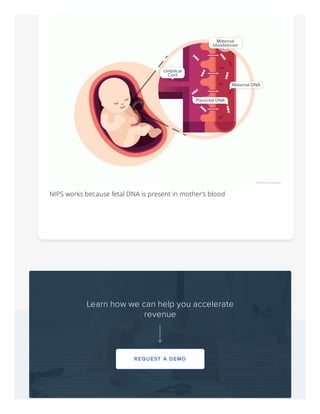
Pregnant women carry some fetal DNA in their blood. Non-invasive prenatal
screening (NIPS), sometimes referred to as cell-free DNA screening, takes
advantage of the low levels of fetal DNA in mother’s blood for genetic testing.
This technology is currently most sensitive for detecting trisomy (an extra copy
of a chromosome) such as trisomy 21 that causes Down Syndrome and
certain other chromosomal changes. Ultimately NIPS is still a screening test
and an abnormal result should be followed by diagnostic testing.  
GenomeSmart can help you navigate the different reproductive genetic
testing options to allow you to make informed decisions for the health of
yourself and your family!
Non-invasive pre-natal screening
(10+weeks)
NIPS works because fetal DNA is present in mother’s blood
Learn how we can help you accelerate
revenue
R EQUEST A DEMO
©2019
GenomeSmart, Inc.
Terms of Use Privacy Policy

Reproductive Genetics: Introduction to Genetic Testing Options

  • 1.
    Reproductive Genetics: Introductionto genetic testing options 7 min readReproductive Genetics Reproductive genetic testing can be a valuable tool in the reproductive health care of women and their families. Genetic disorders and congenital anomalies affect about 6% of live births, so it is important to be proactive and consider genetic testing. There are various genetic tests available to couples who are expecting or planning to conceive. Depending on whether a couple is having difficulty conceiving or carrying a pregnancy to term, has a family history of a genetic condition, or is already pregnant, different genetic testing options may be appropriate. Choosing a test depends on a couple’s specific risk factors, pregnancy timeline, and how the pregnancy will be conceived (for example, with assistance from artificial reproductive technology or by natural means). These are some of the tests available in reproductive genetics: Fertility testing Carrier testing Pre-implantation genetic testing/diagnosis for those considering in vitro fertilization Prenatal testing Maternal serum testing, First trimester screening, Second trimester screening, Integrated screening and sequential This website uses cookies to ensure you get the best experience on our website. Got it! Learn more
  • 2.
    Chorionic villus sampling/amniocentesis Non-invasive prenatal screening Timeline of reproductive genetic testing Genetic testing can be considered before, during and after pregnancy. The choice of type of testing a couple chooses depends on their risks and personal choice. Newborn testing is a state mandated test which tests for different genetic disorders depending on the state you reside in.  What is fertility testing? (Timeline: before pregnancy) When a couple is having difficulty conceiving both may consider genetic fertility testing. There may be genetic causes for either male or female infertility. Assistive reproductive technology (ART) may be useful in treating some genetic forms of infertility (for example, cystic fibrosis in males and fragile X syndrome in females). Use of sperm or egg donations or adoption may also be considered by those affected by infertility who wish to grow their families.
  • 3.
    What is carriertesting? (Timeline: before, during, and after pregnancy) Carrier testing determines whether a prospective parent carries a genetic mutation associated with an inherited disorder. Traditionally it was recommended to those from certain ethnicities but now it is offered to all women of reproductive age. It can test for mutations for some of the most common genetic conditions (such as cystic fibrosis or spinal muscular atrophy) as well as rare disorders seen mostly in certain ethnicities. Carriers are usually not affected by the genetic condition as recessive inherited disorders are only seen when individual has two affected genes. Technological advances allow gene panels to test prospective parents for alterations to hundreds of disease-associated genes simultaneously so that they may know if future children might be at increased risk of being affected by a genetic condition. Carrier testing can be performed at any time before or during a pregnancy, but preconception carrier testing affords the most options to reduce the risk of future children being affected by an inherited condition.   What is pre-implantation genetic screening (PGS)/ diagnosis (PGD)? (Timeline: before pregnancy) Genetic condition risk reduction for those considering IVF Assisted Reproductive Technology (ART) is exactly what it sounds like – helping people have babies with procedures such as in vitro fertilization (IVF, colloquially referred to as “test tube babies”). Something IVF allows is pre- implantation genetic diagnosis. If you know a genetic condition runs in your or your partner’s families a few cells can be safely removed from an early embryo and tested for the inherited condition. The couple may then choose to implant embryos that are unaffected.   Even in the absence of a familial condition, ART enables screening for chromosome-level changes that are thought to account for many early miscarriages and some genetic conditions.
  • 4.
    Couples may thenimplant embryos with the best chance of developing into a baby. Before such screening became routine fertility clinics used to transfer multiple embryos to increase the likelihood of a successful pregnancy, which often resulted in twin or triplet pregnancies that can be riskier both for mothers and infants. Now fertility clinics can obtain nearly the same rate of successful live births transferring just a single embryo that has been screened for chromosomal changes.   Finally, if a couple is using an anonymous sperm or egg donor, carrier screening may provide peace of mind that the donor will not be at an increased risk of passing on a disease-causing gene to a biological child. What is prenatal screening/ diagnosis? (Timeline: during pregnancy) Prenatal tests are tests done on a pregnant woman to understand her risks of having a child affected by a genetic disorder. This is different from carrier screening because it involves just the woman and is targeted to find risks for a specific pregnancy. The tests have the potential to shed light on possible pregnancy outcomes as well as provide reassurance about chances of a healthy baby. Tests also give a woman an opportunity to choose whether to continue a pregnancy in case the expected child has a birth defect or genetic disorder. Even if she decides to continue, the test helps determine the need for prenatal or early infant therapy for her expected child when possible and prepare for bearing and rearing of a child with special needs.   Prenatal tests can be screening or diagnostic. A screening test helps identify risk (probability), whereas a diagnostic test is definitive test, (giving a yes or no answer) typically done after a screening test. Screening is usually done by taking a blood sample from the mother, a simple noninvasive method. Diagnostic tests are more invasive and sample the cells from the fluid/tissue in which the fetus grows.   Maternal blood tests are more often a part of routine prenatal care, but as genetic testing becomes more available and affordable prospective parents may be interested in newer types of genetic testing like non-invasive prenatal testing (NIPT) which have benefits over the traditional tests.  Two commonly offered diagnostic tests are chorionic villus sampling and amniocentesis.  
  • 5.
    Chorionic villus sampling(10-13 weeks)/amniocentesis (15-24 weeks) Chorionic villus sampling (CVS) and amniocentesis refer to the procedures by which a needle is used to withdraw cells for fetal diagnostic testing. CVS can be performed earlier during a pregnancy than amniocentesis, but amniocentesis generally carries less risks to a pregnancy and provides more material for genetic testing. Your doctor may recommend these tests if you have an abnormal finding on a screening test, such as a maternal serum test (for example, the Quad screen), the non-invasive prenatal screening (NIPT), or on an ultrasound. Screening tests (such as maternal serum screening like QUAD screen) measure the levels of specific substances in the mother’s blood that many indicate a trisomy (like the extra copy of chromosome 21 in Down Syndrome) or a neural tube defect (such as spina bifida).   In the past, amniocentesis and chromosomal karyotypes were performed in women over 35 to test for chromosomal abnormalities but today they are considered mostly if there is a positive screening test. Testing can also be done ifthere is a family history or previous affected child, parents know of because of which a fetus may be at risk for a specific genetic condition. The samples taken are tested by Chromosomal microarrays, Karyotyping or FISH techniques to look for missing or extra pieces of DNA that can cause disease.   Non-invasive prenatal screening (NIPS, 10+ weeks) Pregnant women carry some fetal DNA in their blood. Non-invasive prenatal screening (NIPS), sometimes referred to as cell-free DNA screening, takes advantage of the low levels of fetal DNA in mother’s blood for genetic testing. This technology is currently most sensitive for detecting trisomy (an extra copy of a chromosome) such as trisomy 21 that causes Down Syndrome and certain other chromosomal changes. Ultimately NIPS is still a screening test and an abnormal result should be followed by diagnostic testing.   GenomeSmart can help you navigate the different reproductive genetic testing options to allow you to make informed decisions for the health of yourself and your family! Non-invasive pre-natal screening (10+weeks)
  • 6.
    NIPS works becausefetal DNA is present in mother’s blood Learn how we can help you accelerate revenue R EQUEST A DEMO
  • 7.