GENETIC SCREENING &
PRENATAL DIAGNOSIS


    Dr.Padmesh.V,
    Dept of Pediatrics, Dr.SMCSI Medical College, Karakonam.
Dr.Padmesh. V


 Definition:
  ‘Prenatal diagnosis is defined as the detection of
  abnormalities in the fetus, before birth’

 Congenital abnormalities account for 20-25% of perinatal
  deaths.
 Many of these genetic and other disorders can be diagnosed
  early in pregnancy.


 Prenatal diagnosis:
            1. Non invasive Techniques
            2. Invasive Techniques
 Some Disorders for which                                      Dr.Padmesh. V

  PRENATAL DIAGNOSIS is available:
 1. Congenital malformations
 2. Chromosomal disorders
 3. Non genetic Fetal disorders
            *Fetal infections, Immune hydrops, Fetal effects of maternal drugs like ITP,DM

 4. Single gene disorders
     -Multiple malformation synd
            *Holt oram, Meckel Gruber, Craniosynostosis, Orofacial digital synd

     -Hematological disorders
            *Thalassemias, Hemoglobinopathies, Hemophilia

     -Metabolic Disorders
            *Tay sach, MCL, Wilson, MPS, CAH, OTC deficiency, Smith-Lemli-Opitz synd

     -Neuromuscular disorders
            *Huntington chorea, Myotonic dystrophy, DMD, Fragile X
Dr.Padmesh. V

4. Single gene disorders: contd…
       -Renal Disoders
        *AD/AR polycystic kidney disease

      -Connective tissue dis / Skeletal dysplasia
        * Osteogenesis imperfecta, Ehlers Danlos, Achondroplasia, Marfan.

      -Skin disorders
        *Epidermolysis bullosa, Ichthyosis, Ectodermal dysplasia
INDICATIONS OF PRENATAL SCREENING :                   Dr.Padmesh. V

 1.Advanced parental age
      -Maternal age ≥35 yr         -Paternal age ≥50 yr


 2.Previous child with or family history of
      -Congenital abnormality       -Dysmorphology
      -Mental retardation           -Isolated birth defect
      -Metabolic disorder          -Chromosome abnormality
      -Single-gene disorder


 3.Consanguinity


 4.Teratogen exposure (occupational, abuse)
 PRENATAL SCREENING is done in:                  Dr.Padmesh. V


 5.Repeated pregnancy loss or infertility


 6.Pregnancy screening abnormality
     -Maternal serum α-fetoprotein
     -Maternal triple screen or variant of this test
     -Fetal ultrasonography       -Fetal karyotype

 7.Heterozygote screening based on ethnic risk
     -Sickle cell anemia    -Thalassemias
      -Tay-Sachs, Canavan, Gaucher diseases
Dr.Padmesh. V


 Prenatal diagnosis: TECHNIQUES:


        1. Non invasive Techniques

        2. Invasive Techniques
Dr.Padmesh. V

 Prenatal diagnosis: TECHNIQUES:

        1. Non invasive Techniques
               A. Fetal visualization :
              B. Screening for neural tube defects (NTDs) :
              C. Screening for fetal Down syndrome:
              D. Separation of fetal cells from the mother's blood:


        2. Invasive Techniques
              a.Fetal visualization
              b.Fetal tissue sampling
              c. Preimplantation biopsy of blastocysts obtained by
                                       in vitro fertilization
              d. Cytogenetics e. Molecular genetics
Dr.Padmesh. V
1. NON INVASIVE TECHNIQUES:
 A. Fetal visualization :
   -Ultrasound
   -Fetal echocardiography
   -Magnetic resonance imaging (MRI)
   -Radiography

 B. Screening for neural tube defects (NTDs) :
    -Measuring maternal serum alpha-fetoprotein (MSAFP)

 C. Screening for fetal Down syndrome:
   -Measuring MSAFP
   -Measuring maternal unconjugated estriol
   -Measuring maternal serum beta-human chorionic gonadotropin (HCG)

 D. Separation of fetal cells from the mother's blood:
Dr.Padmesh. V
2. INVASIVE TECHNIQUES:
a.Fetal visualization
  -Embryoscopy
  -Fetoscopy


b.Fetal tissue sampling
  -Amniocentesis
  -Chorionic villus sampling (CVS)
  -Percutaneous umbilical blood sampling (PUBS)
  -Percutaneous skin biopsy
  -Other organ biopsies, including muscle and liver biopsy
Dr.Padmesh. V
2. INVASIVE TECHNIQUES:

 c. Preimplantation biopsy of blastocysts
   obtained by in vitro fertilization

 d. Cytogenetic investigations
   -Detection of chromosomal aberrations
   -Fluorescent in situ hybridization


 e. Molecular genetic techniques
   -Linkage analysis using microsatellite markers
   -Restriction fragment length polymorphisms (RFLPs)
   -Single nucleotide polymorphisms (SNPs)
Dr.Padmesh. V


              Noninvasive
              Techniques
1.   Fetal Visualization
2.   Screening for NTD
3.   Screening for Downs
4.   Separation of fetal cells from the mother's
     blood
Dr.Padmesh. V


 1. Fetal visualization

   -Ultrasound
   -Fetal echocardiography
   -Magnetic resonance imaging (MRI)
   -Radiography
Dr.Padmesh. V
1. Fetal Visualization:
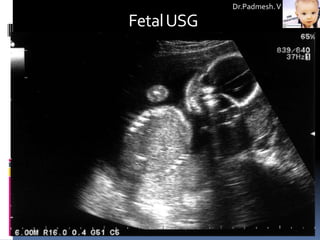
a) USG:
 Noninvasive procedure for imaging fetal anatomy.


 Harmless to both the fetus and the mother.


 Anatomical lesions, including some
  genitourinary, gastrointestinal, skeletal, and central nervous system
  abnormalities and congenital cardiopathies, can be visualized by
  ultrasound between 16-20 weeks' gestation.


 Ultrasound also is used to guide invasive sampling, such as
  amniocentesis, CVS, cordocentesis, and various fetal biopsies.
Dr.Padmesh. V

Fetal USG
Dr.Padmesh. V
1. Fetal Visualization: contd..
b) Fetal ECHO:
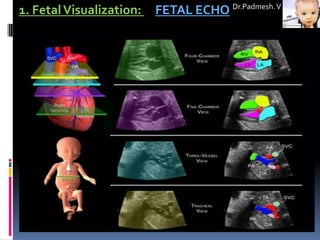
 -Fetal echocardiography can be performed at 15 weeks' gestation and beyond.
 -When this technique is used with duplex or color flow Doppler, it can identify
 a number of major structural cardiac defects and rhythm.
 -Fetal echocardiography is recommended in cases where cardiac defects are
 suspected.


c) MRI:
   Because of fetal movements, its application has been limited.


d) RADIOGRAPHY:
  -Fetal skeleton can be visualized by radiography from 10 weeks' gestation
   onward.
  -Used for the diagnosis of inherited skeletal dysplasias, particularly
   osteochondrodysplasia, in the second and third trimesters.
1. Fetal Visualization:   FETAL ECHO Dr.Padmesh. V
Dr.Padmesh. V


   2. Screening for neural tube defects:
 Screening for NTDs is recommended if the following are present:

 Ultrasound findings indicate NTDs.
 A child with NTDs is already in the family.
 A family history of NTDs exists, especially a mother with NTDs.
 The mother has type 1 diabetes mellitus during pregnancy.
 Maternal exposure to drugs, such as valproic acid, is associated with NTDs.
 Elevated level of MSAFP is present.
Dr.Padmesh. V


   2. Screening for neural tube defects:
 The developing fetus has 2 major blood proteins, albumin and alpha-
   fetoprotein (AFP), while adults have only albumin in their blood.


 AFP is produced by the yolk sac and later by the liver; it enters the amniotic
   fluid and then the maternal serum via fetal urine. Therefore MSAFP level can
   be used to determine the AFP levels from the fetus.


 In the condition of an open NTD (eg, anencephaly, spina bifida) and abdominal
   wall defects in the fetus, AFP diffuses rapidly from exposed fetal tissues into
   amniotic fluid, and the MSAFP level rises.


 The MSAFP test has the greatest sensitivity between 16-18 weeks'
   gestation, but it also can be performed between 15-22 weeks' gestation.
Dr.Padmesh. V


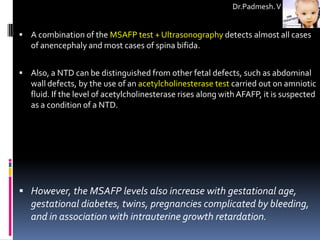
 A combination of the MSAFP test + Ultrasonography detects almost all cases
   of anencephaly and most cases of spina bifida.


 Also, a NTD can be distinguished from other fetal defects, such as abdominal
   wall defects, by the use of an acetylcholinesterase test carried out on amniotic
   fluid. If the level of acetylcholinesterase rises along with AFAFP, it is suspected
   as a condition of a NTD.


 However, the MSAFP levels also increase with gestational age,
   gestational diabetes, twins, pregnancies complicated by bleeding,
   and in association with intrauterine growth retardation.
Dr.Padmesh. V
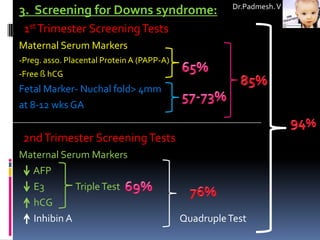
3. Screening for Downs syndrome:
 1st Trimester Screening Tests
Maternal Serum Markers
-Preg. asso. Placental Protein A (PAPP-A)
-Free ß hCG
Fetal Marker- Nuchal fold> 4mm
at 8-12 wks GA


 2nd Trimester Screening Tests
Maternal Serum Markers
  AFP
  E3        Triple Test
  hCG
  Inhibin A                                 Quadruple Test
Dr.Padmesh. V


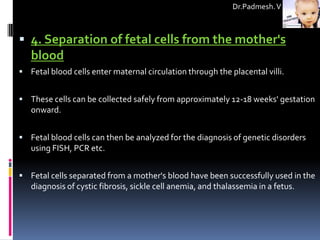
 4. Separation of fetal cells from the mother's
   blood
 Fetal blood cells enter maternal circulation through the placental villi.


 These cells can be collected safely from approximately 12-18 weeks' gestation
   onward.


 Fetal blood cells can then be analyzed for the diagnosis of genetic disorders
   using FISH, PCR etc.


 Fetal cells separated from a mother's blood have been successfully used in the
   diagnosis of cystic fibrosis, sickle cell anemia, and thalassemia in a fetus.
Dr.Padmesh. V


 Invasive
Techniques
 1. Fetal visualization:                          Dr.Padmesh. V


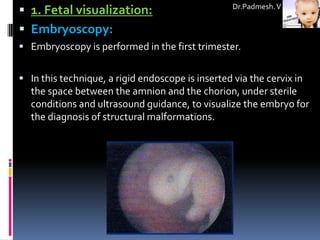
 Embryoscopy:
 Embryoscopy is performed in the first trimester.


 In this technique, a rigid endoscope is inserted via the cervix in
  the space between the amnion and the chorion, under sterile
  conditions and ultrasound guidance, to visualize the embryo for
  the diagnosis of structural malformations.
 1. Fetal visualization:                          Dr.Padmesh. V


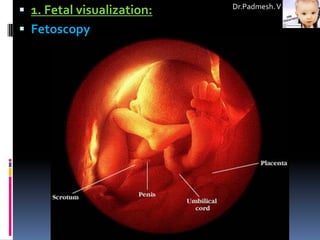
 Fetoscopy
 Fetoscopy is performed during the second trimester (after 16
  weeks’ gestation).

 In this technique, a fine-caliber endoscope is inserted into the
  amniotic cavity through a small maternal abdominal incision,
  under sterile conditions and ultrasound guidance, for the
  visualization of the embryo to detect the presence of subtle
  structural abnormalities.

 It also is used for fetal blood and tissue sampling.


 Fetoscopy is associated with a 3-5% risk of miscarriage;
 1. Fetal visualization:   Dr.Padmesh. V


 Fetoscopy
 2. Fetal tissue sampling                                 Dr.Padmesh. V

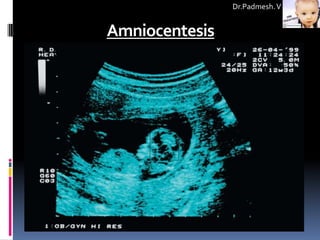
 Amniocentesis
 Amniocentesis is an invasive, well-established, safe, reliable, and accurate
   procedure performed between 14-20 weeks of pregnancy.


 It is performed under ultrasound guidance.


 A 22-gauge needle is passed through the mother's lower abdomen into the
   amniotic cavity inside the uterus, and 10-20 mL of amniotic fluid that contains
   cells from amnion, fetal skin, fetal lungs, and urinary tract epithelium are
   collected.
 2. Fetal tissue sampling                                 Dr.Padmesh. V

 Amniocentesis
        1.The Cells are grown in culture for chromosomal, biochemical, and
          molecular biologic analyses.
        2. The Supernatant amniotic fluid is used for the measurement of
           substances such as AFAFP, hormones, and enzymes.
         3. In the third trimester of pregnancy, the amniotic fluid can be
             analyzed for determination of fetal lung maturity.


 The results of cytogenetic and biochemical studies on amniotic cell cultures
   are more than 90% accurate.


 Risks with amniocentesis are rare but include 0.5-1.0% fetal loss and maternal
   Rh sensitization.
Dr.Padmesh. V


Amniocentesis
Dr.Padmesh. V
 2. Fetal tissue sampling
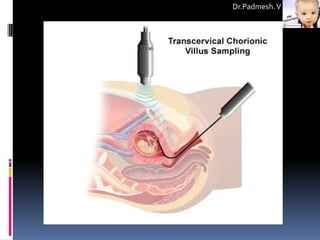
 Chorionic villus sampling
 CVS is performed very early in gestation between 9-12 weeks, ideally at 10
   weeks' gestation.


 A catheter is passed through the cervix or through the abdominal wall into
   the uterus under ultrasound guidance, and a sample of chorionic villi
   surrounding the sac is obtained.


 The villi are dissected from the decidual tissue, and chromosome analysis is
   carried out on these cells to determine the karyotype of the fetus.


 DNA can be extracted from these cells for molecular analysis.


 DNA analysis of CVS specimens is helpful for early diagnosis of
   hemoglobinopathies. Tissue culture can be initiated on these cells for further
   studies.
Dr.Padmesh. V
 2. Fetal tissue sampling
 Chorionic villus sampling
 The major advantage of CVS over amniocentesis is getting quick results and
   its use in early pregnancy.


 Abnormalities can be identified at an early stage, and decisions about
   termination of the pregnancy can be taken early.
 Abortion is also much safer at this early stage.


 Disadvantages of CVS as compared to amniocentesis are:
     -2-3% risk of causing miscarriage, and,
     -Rarely limb defects in the fetus.
     -Maternal Rh sensitization.
Dr.Padmesh. V
Dr.Padmesh. V
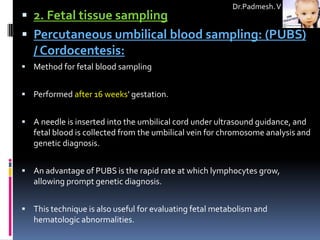
 2. Fetal tissue sampling
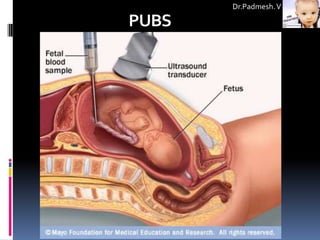
 Percutaneous umbilical blood sampling: (PUBS)
  / Cordocentesis:
 Method for fetal blood sampling


 Performed after 16 weeks' gestation.


 A needle is inserted into the umbilical cord under ultrasound guidance, and
   fetal blood is collected from the umbilical vein for chromosome analysis and
   genetic diagnosis.


 An advantage of PUBS is the rapid rate at which lymphocytes grow,
   allowing prompt genetic diagnosis.


 This technique is also useful for evaluating fetal metabolism and
   hematologic abnormalities.
Dr.Padmesh. V

PUBS
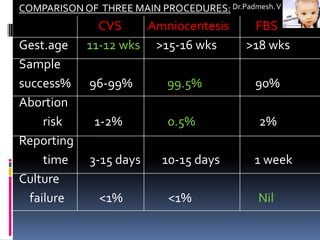
COMPARISON OF THREE MAIN PROCEDURES: Dr.Padmesh. V
              CVS    Amniocentesis          FBS
Gest.age    11-12 wks >15-16 wks           >18 wks
Sample
success%     96-99%         99.5%            90%
Abortion
     risk     1-2%          0.5%             2%
Reporting
     time    3-15 days     10-15 days       1 week
Culture
  failure      <1%          <1%              Nil
Dr.Padmesh. V
 2. Fetal tissue sampling
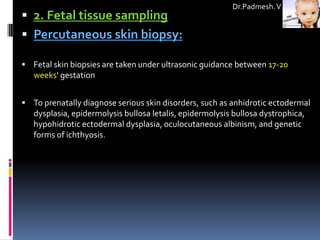
 Percutaneous skin biopsy:

 Fetal skin biopsies are taken under ultrasonic guidance between 17-20
   weeks' gestation


 To prenatally diagnose serious skin disorders, such as anhidrotic ectodermal
   dysplasia, epidermolysis bullosa letalis, epidermolysis bullosa dystrophica,
   hypohidrotic ectodermal dysplasia, oculocutaneous albinism, and genetic
   forms of ichthyosis.
Dr.Padmesh. V
 2. Fetal tissue sampling
 Other organ biopsies, including liver and muscle
  biopsy:
 Fetal liver biopsy is best performed between 17-20 weeks' gestation
  under ultrasound guidance.
 Fetal liver biopsy is needed to diagnose inborn errors of metabolism,
  such as ornithine transcarbamylase deficiency, glucose-6-
  phosphatase deficiency , glycogen storage disease type IA,
  nonketotic hyperglycemia, and carbamoyl-phosphate synthetase
  deficiency.
 Fetal muscle biopsy is carried out under ultrasound guidance at
  about 18 weeks' gestation to analyze the muscle fibers
  histochemically for prenatal diagnosis of Becker-Duchenne muscular
  dystrophy.
Dr.Padmesh. V


 Preimplantation biopsy of blastocysts obtained
  by in vitro fertilization: Newer concept..

 Techniques are being developed to test cells obtained from biopsy of
   blastocysts of pregnancies conceived through in vitro fertilization.


 These techniques will be helpful for selective transfer and implantation of
   those pregnancies into the uterus that are not affected by a specific genetic
   disorder.
Dr.Padmesh. V


Cytogenetic Investigations
Dr.Padmesh. V


 Detection of chromosomal aberrations:

 Chromosomal aberrations, such as
  deletions, duplications, translocations, and inversions diagnosed
  in affected parents or siblings, can be detected prenatally in a
  fetus by chromosomal analysis.

 This analysis can be undertaken on fetal cells obtained through
  such techniques as amniocentesis and CVS.
Dr.Padmesh. V
Dr.Padmesh. V
Dr.Padmesh. V


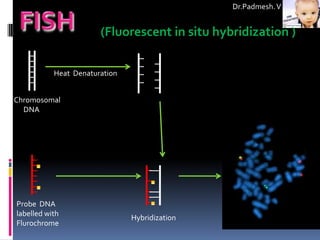
                  (Fluorescent in situ hybridization )

 FISH is a cytogenetic technique used to detect and localize the
  presence or absence of specific DNA sequences on
  chromosomes.

 FISH uses fluorescent probes that bind to only those parts of the
  chromosome with which they show a high degree of sequence
  similarity.

 Fluorescence microscopy can be used to find out where the
  fluorescent probe bound to the chromosomes.
Dr.Padmesh. V


                       (Fluorescent in situ hybridization )

           Heat Denaturation


Chromosomal
  DNA


Probe DNA
labelled with
                               Hybridization
Flurochrome
Dr.Padmesh. V


                  (Fluorescent in situ hybridization )


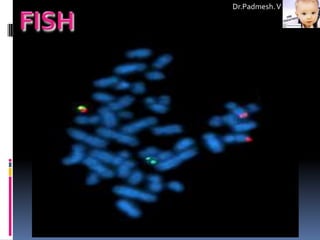
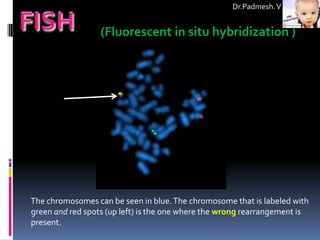
The chromosomes can be seen in blue. The chromosome that is labeled with
green and red spots (up left) is the one where the wrong rearrangement is
present.
Dr.Padmesh. V
 Benefits of Prenatal Diagnosis:
 Prenatal diagnosis determines the outcome of pregnancy.

 It is helpful for couples to decide whether to continue the pregnancy.

 It indicates possible complications that can arise at birth process.


 Prenatal diagnosis is helpful for the management of remaining weeks
   of pregnancy.


 It prepares the couple for the birth of a child with an abnormality.


 Prenatal diagnosis can be helpful for the improvement of the outcome
   of pregnancy using fetal treatment.
Dr.Padmesh. V

Genetic screening Dr.Padmesh

  • 1.
    GENETIC SCREENING & PRENATALDIAGNOSIS Dr.Padmesh.V, Dept of Pediatrics, Dr.SMCSI Medical College, Karakonam.
  • 2.
    Dr.Padmesh. V  Definition: ‘Prenatal diagnosis is defined as the detection of abnormalities in the fetus, before birth’  Congenital abnormalities account for 20-25% of perinatal deaths.  Many of these genetic and other disorders can be diagnosed early in pregnancy.  Prenatal diagnosis: 1. Non invasive Techniques 2. Invasive Techniques
  • 3.
     Some Disordersfor which Dr.Padmesh. V PRENATAL DIAGNOSIS is available:  1. Congenital malformations  2. Chromosomal disorders  3. Non genetic Fetal disorders *Fetal infections, Immune hydrops, Fetal effects of maternal drugs like ITP,DM  4. Single gene disorders -Multiple malformation synd *Holt oram, Meckel Gruber, Craniosynostosis, Orofacial digital synd -Hematological disorders *Thalassemias, Hemoglobinopathies, Hemophilia -Metabolic Disorders *Tay sach, MCL, Wilson, MPS, CAH, OTC deficiency, Smith-Lemli-Opitz synd -Neuromuscular disorders *Huntington chorea, Myotonic dystrophy, DMD, Fragile X
  • 4.
    Dr.Padmesh. V 4. Singlegene disorders: contd… -Renal Disoders *AD/AR polycystic kidney disease -Connective tissue dis / Skeletal dysplasia * Osteogenesis imperfecta, Ehlers Danlos, Achondroplasia, Marfan. -Skin disorders *Epidermolysis bullosa, Ichthyosis, Ectodermal dysplasia
  • 5.
    INDICATIONS OF PRENATALSCREENING : Dr.Padmesh. V  1.Advanced parental age -Maternal age ≥35 yr -Paternal age ≥50 yr  2.Previous child with or family history of -Congenital abnormality -Dysmorphology -Mental retardation -Isolated birth defect -Metabolic disorder -Chromosome abnormality -Single-gene disorder  3.Consanguinity  4.Teratogen exposure (occupational, abuse)
  • 6.
     PRENATAL SCREENINGis done in: Dr.Padmesh. V  5.Repeated pregnancy loss or infertility  6.Pregnancy screening abnormality -Maternal serum α-fetoprotein -Maternal triple screen or variant of this test -Fetal ultrasonography -Fetal karyotype  7.Heterozygote screening based on ethnic risk -Sickle cell anemia -Thalassemias -Tay-Sachs, Canavan, Gaucher diseases
  • 7.
    Dr.Padmesh. V  Prenataldiagnosis: TECHNIQUES: 1. Non invasive Techniques 2. Invasive Techniques
  • 8.
    Dr.Padmesh. V  Prenataldiagnosis: TECHNIQUES: 1. Non invasive Techniques A. Fetal visualization : B. Screening for neural tube defects (NTDs) : C. Screening for fetal Down syndrome: D. Separation of fetal cells from the mother's blood: 2. Invasive Techniques a.Fetal visualization b.Fetal tissue sampling c. Preimplantation biopsy of blastocysts obtained by in vitro fertilization d. Cytogenetics e. Molecular genetics
  • 9.
    Dr.Padmesh. V 1. NONINVASIVE TECHNIQUES:  A. Fetal visualization : -Ultrasound -Fetal echocardiography -Magnetic resonance imaging (MRI) -Radiography  B. Screening for neural tube defects (NTDs) : -Measuring maternal serum alpha-fetoprotein (MSAFP)  C. Screening for fetal Down syndrome: -Measuring MSAFP -Measuring maternal unconjugated estriol -Measuring maternal serum beta-human chorionic gonadotropin (HCG)  D. Separation of fetal cells from the mother's blood:
  • 10.
    Dr.Padmesh. V 2. INVASIVETECHNIQUES: a.Fetal visualization -Embryoscopy -Fetoscopy b.Fetal tissue sampling -Amniocentesis -Chorionic villus sampling (CVS) -Percutaneous umbilical blood sampling (PUBS) -Percutaneous skin biopsy -Other organ biopsies, including muscle and liver biopsy
  • 11.
    Dr.Padmesh. V 2. INVASIVETECHNIQUES: c. Preimplantation biopsy of blastocysts obtained by in vitro fertilization d. Cytogenetic investigations -Detection of chromosomal aberrations -Fluorescent in situ hybridization e. Molecular genetic techniques -Linkage analysis using microsatellite markers -Restriction fragment length polymorphisms (RFLPs) -Single nucleotide polymorphisms (SNPs)
  • 12.
    Dr.Padmesh. V Noninvasive Techniques 1. Fetal Visualization 2. Screening for NTD 3. Screening for Downs 4. Separation of fetal cells from the mother's blood
  • 13.
    Dr.Padmesh. V  1.Fetal visualization -Ultrasound -Fetal echocardiography -Magnetic resonance imaging (MRI) -Radiography
  • 14.
    Dr.Padmesh. V 1. FetalVisualization: a) USG:  Noninvasive procedure for imaging fetal anatomy.  Harmless to both the fetus and the mother.  Anatomical lesions, including some genitourinary, gastrointestinal, skeletal, and central nervous system abnormalities and congenital cardiopathies, can be visualized by ultrasound between 16-20 weeks' gestation.  Ultrasound also is used to guide invasive sampling, such as amniocentesis, CVS, cordocentesis, and various fetal biopsies.
  • 15.
  • 16.
    Dr.Padmesh. V 1. FetalVisualization: contd.. b) Fetal ECHO: -Fetal echocardiography can be performed at 15 weeks' gestation and beyond. -When this technique is used with duplex or color flow Doppler, it can identify a number of major structural cardiac defects and rhythm. -Fetal echocardiography is recommended in cases where cardiac defects are suspected. c) MRI: Because of fetal movements, its application has been limited. d) RADIOGRAPHY: -Fetal skeleton can be visualized by radiography from 10 weeks' gestation onward. -Used for the diagnosis of inherited skeletal dysplasias, particularly osteochondrodysplasia, in the second and third trimesters.
  • 17.
    1. Fetal Visualization: FETAL ECHO Dr.Padmesh. V
  • 18.
    Dr.Padmesh. V 2. Screening for neural tube defects:  Screening for NTDs is recommended if the following are present:  Ultrasound findings indicate NTDs.  A child with NTDs is already in the family.  A family history of NTDs exists, especially a mother with NTDs.  The mother has type 1 diabetes mellitus during pregnancy.  Maternal exposure to drugs, such as valproic acid, is associated with NTDs.  Elevated level of MSAFP is present.
  • 19.
    Dr.Padmesh. V 2. Screening for neural tube defects:  The developing fetus has 2 major blood proteins, albumin and alpha- fetoprotein (AFP), while adults have only albumin in their blood.  AFP is produced by the yolk sac and later by the liver; it enters the amniotic fluid and then the maternal serum via fetal urine. Therefore MSAFP level can be used to determine the AFP levels from the fetus.  In the condition of an open NTD (eg, anencephaly, spina bifida) and abdominal wall defects in the fetus, AFP diffuses rapidly from exposed fetal tissues into amniotic fluid, and the MSAFP level rises.  The MSAFP test has the greatest sensitivity between 16-18 weeks' gestation, but it also can be performed between 15-22 weeks' gestation.
  • 20.
    Dr.Padmesh. V  Acombination of the MSAFP test + Ultrasonography detects almost all cases of anencephaly and most cases of spina bifida.  Also, a NTD can be distinguished from other fetal defects, such as abdominal wall defects, by the use of an acetylcholinesterase test carried out on amniotic fluid. If the level of acetylcholinesterase rises along with AFAFP, it is suspected as a condition of a NTD.  However, the MSAFP levels also increase with gestational age, gestational diabetes, twins, pregnancies complicated by bleeding, and in association with intrauterine growth retardation.
  • 21.
    Dr.Padmesh. V 3. Screeningfor Downs syndrome: 1st Trimester Screening Tests Maternal Serum Markers -Preg. asso. Placental Protein A (PAPP-A) -Free ß hCG Fetal Marker- Nuchal fold> 4mm at 8-12 wks GA 2nd Trimester Screening Tests Maternal Serum Markers AFP E3 Triple Test hCG Inhibin A Quadruple Test
  • 22.
    Dr.Padmesh. V  4.Separation of fetal cells from the mother's blood  Fetal blood cells enter maternal circulation through the placental villi.  These cells can be collected safely from approximately 12-18 weeks' gestation onward.  Fetal blood cells can then be analyzed for the diagnosis of genetic disorders using FISH, PCR etc.  Fetal cells separated from a mother's blood have been successfully used in the diagnosis of cystic fibrosis, sickle cell anemia, and thalassemia in a fetus.
  • 23.
  • 24.
     1. Fetalvisualization: Dr.Padmesh. V  Embryoscopy:  Embryoscopy is performed in the first trimester.  In this technique, a rigid endoscope is inserted via the cervix in the space between the amnion and the chorion, under sterile conditions and ultrasound guidance, to visualize the embryo for the diagnosis of structural malformations.
  • 25.
     1. Fetalvisualization: Dr.Padmesh. V  Fetoscopy  Fetoscopy is performed during the second trimester (after 16 weeks’ gestation).  In this technique, a fine-caliber endoscope is inserted into the amniotic cavity through a small maternal abdominal incision, under sterile conditions and ultrasound guidance, for the visualization of the embryo to detect the presence of subtle structural abnormalities.  It also is used for fetal blood and tissue sampling.  Fetoscopy is associated with a 3-5% risk of miscarriage;
  • 26.
     1. Fetalvisualization: Dr.Padmesh. V  Fetoscopy
  • 27.
     2. Fetaltissue sampling Dr.Padmesh. V  Amniocentesis  Amniocentesis is an invasive, well-established, safe, reliable, and accurate procedure performed between 14-20 weeks of pregnancy.  It is performed under ultrasound guidance.  A 22-gauge needle is passed through the mother's lower abdomen into the amniotic cavity inside the uterus, and 10-20 mL of amniotic fluid that contains cells from amnion, fetal skin, fetal lungs, and urinary tract epithelium are collected.
  • 28.
     2. Fetaltissue sampling Dr.Padmesh. V  Amniocentesis 1.The Cells are grown in culture for chromosomal, biochemical, and molecular biologic analyses. 2. The Supernatant amniotic fluid is used for the measurement of substances such as AFAFP, hormones, and enzymes. 3. In the third trimester of pregnancy, the amniotic fluid can be analyzed for determination of fetal lung maturity.  The results of cytogenetic and biochemical studies on amniotic cell cultures are more than 90% accurate.  Risks with amniocentesis are rare but include 0.5-1.0% fetal loss and maternal Rh sensitization.
  • 29.
  • 30.
    Dr.Padmesh. V  2.Fetal tissue sampling  Chorionic villus sampling  CVS is performed very early in gestation between 9-12 weeks, ideally at 10 weeks' gestation.  A catheter is passed through the cervix or through the abdominal wall into the uterus under ultrasound guidance, and a sample of chorionic villi surrounding the sac is obtained.  The villi are dissected from the decidual tissue, and chromosome analysis is carried out on these cells to determine the karyotype of the fetus.  DNA can be extracted from these cells for molecular analysis.  DNA analysis of CVS specimens is helpful for early diagnosis of hemoglobinopathies. Tissue culture can be initiated on these cells for further studies.
  • 31.
    Dr.Padmesh. V  2.Fetal tissue sampling  Chorionic villus sampling  The major advantage of CVS over amniocentesis is getting quick results and its use in early pregnancy.  Abnormalities can be identified at an early stage, and decisions about termination of the pregnancy can be taken early.  Abortion is also much safer at this early stage.  Disadvantages of CVS as compared to amniocentesis are: -2-3% risk of causing miscarriage, and, -Rarely limb defects in the fetus. -Maternal Rh sensitization.
  • 32.
  • 33.
    Dr.Padmesh. V  2.Fetal tissue sampling  Percutaneous umbilical blood sampling: (PUBS) / Cordocentesis:  Method for fetal blood sampling  Performed after 16 weeks' gestation.  A needle is inserted into the umbilical cord under ultrasound guidance, and fetal blood is collected from the umbilical vein for chromosome analysis and genetic diagnosis.  An advantage of PUBS is the rapid rate at which lymphocytes grow, allowing prompt genetic diagnosis.  This technique is also useful for evaluating fetal metabolism and hematologic abnormalities.
  • 34.
  • 35.
    COMPARISON OF THREEMAIN PROCEDURES: Dr.Padmesh. V CVS Amniocentesis FBS Gest.age 11-12 wks >15-16 wks >18 wks Sample success% 96-99% 99.5% 90% Abortion risk 1-2% 0.5% 2% Reporting time 3-15 days 10-15 days 1 week Culture failure <1% <1% Nil
  • 36.
    Dr.Padmesh. V  2.Fetal tissue sampling  Percutaneous skin biopsy:  Fetal skin biopsies are taken under ultrasonic guidance between 17-20 weeks' gestation  To prenatally diagnose serious skin disorders, such as anhidrotic ectodermal dysplasia, epidermolysis bullosa letalis, epidermolysis bullosa dystrophica, hypohidrotic ectodermal dysplasia, oculocutaneous albinism, and genetic forms of ichthyosis.
  • 37.
    Dr.Padmesh. V  2.Fetal tissue sampling  Other organ biopsies, including liver and muscle biopsy:  Fetal liver biopsy is best performed between 17-20 weeks' gestation under ultrasound guidance.  Fetal liver biopsy is needed to diagnose inborn errors of metabolism, such as ornithine transcarbamylase deficiency, glucose-6- phosphatase deficiency , glycogen storage disease type IA, nonketotic hyperglycemia, and carbamoyl-phosphate synthetase deficiency.  Fetal muscle biopsy is carried out under ultrasound guidance at about 18 weeks' gestation to analyze the muscle fibers histochemically for prenatal diagnosis of Becker-Duchenne muscular dystrophy.
  • 38.
    Dr.Padmesh. V  Preimplantationbiopsy of blastocysts obtained by in vitro fertilization: Newer concept..  Techniques are being developed to test cells obtained from biopsy of blastocysts of pregnancies conceived through in vitro fertilization.  These techniques will be helpful for selective transfer and implantation of those pregnancies into the uterus that are not affected by a specific genetic disorder.
  • 39.
  • 40.
    Dr.Padmesh. V  Detectionof chromosomal aberrations:  Chromosomal aberrations, such as deletions, duplications, translocations, and inversions diagnosed in affected parents or siblings, can be detected prenatally in a fetus by chromosomal analysis.  This analysis can be undertaken on fetal cells obtained through such techniques as amniocentesis and CVS.
  • 41.
  • 42.
  • 43.
    Dr.Padmesh. V (Fluorescent in situ hybridization )  FISH is a cytogenetic technique used to detect and localize the presence or absence of specific DNA sequences on chromosomes.  FISH uses fluorescent probes that bind to only those parts of the chromosome with which they show a high degree of sequence similarity.  Fluorescence microscopy can be used to find out where the fluorescent probe bound to the chromosomes.
  • 44.
    Dr.Padmesh. V (Fluorescent in situ hybridization ) Heat Denaturation Chromosomal DNA Probe DNA labelled with Hybridization Flurochrome
  • 45.
    Dr.Padmesh. V (Fluorescent in situ hybridization ) The chromosomes can be seen in blue. The chromosome that is labeled with green and red spots (up left) is the one where the wrong rearrangement is present.
  • 46.
    Dr.Padmesh. V  Benefitsof Prenatal Diagnosis:  Prenatal diagnosis determines the outcome of pregnancy.  It is helpful for couples to decide whether to continue the pregnancy.  It indicates possible complications that can arise at birth process.  Prenatal diagnosis is helpful for the management of remaining weeks of pregnancy.  It prepares the couple for the birth of a child with an abnormality.  Prenatal diagnosis can be helpful for the improvement of the outcome of pregnancy using fetal treatment.
  • 47.

Editor's Notes

  • #45 FISH uses fluorescent probes that bind to only those parts of the chromosome with which they show a high degree of sequence similarity.