Prenatal Development & Birth
Chapter 3
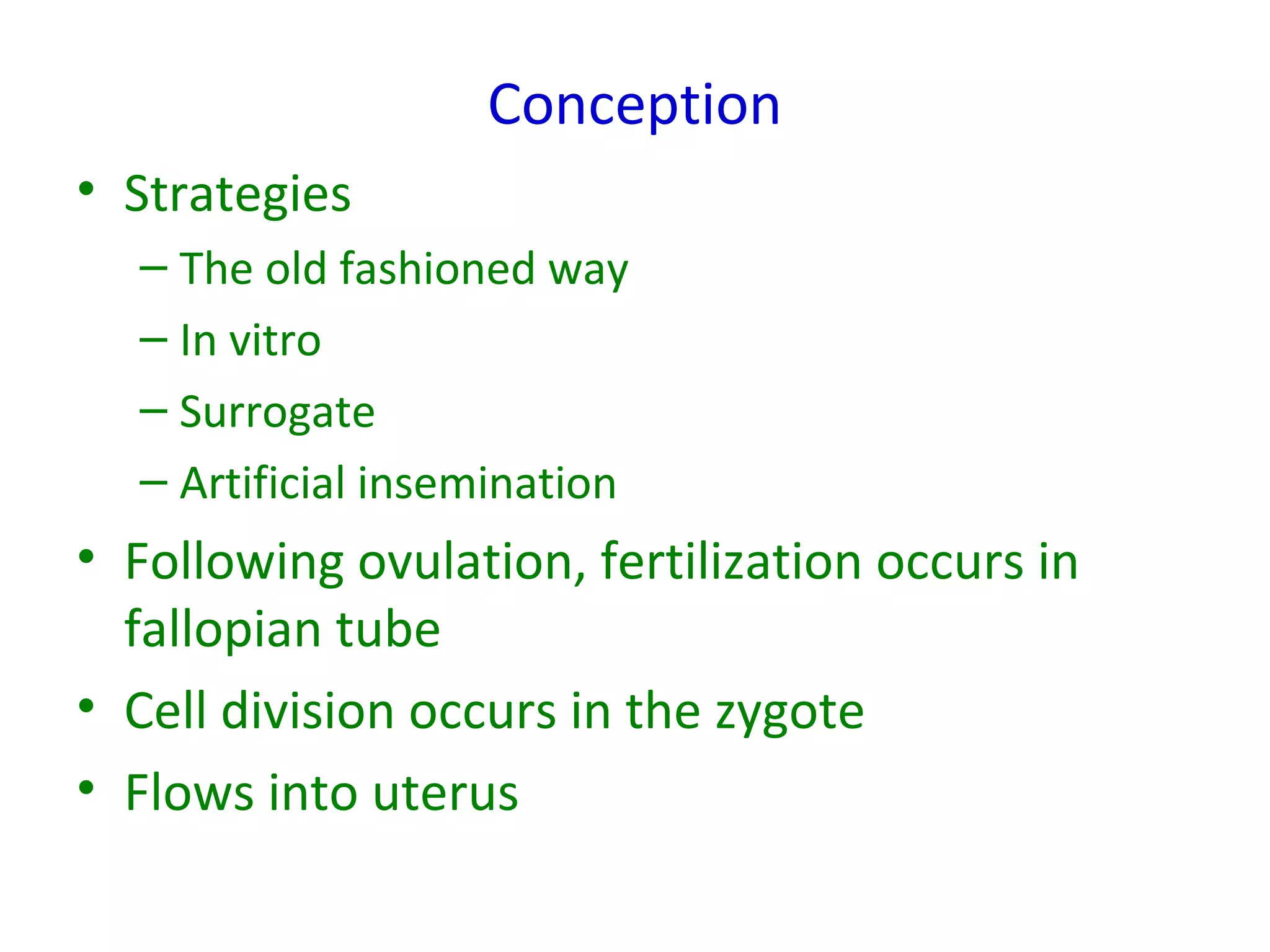
Conception
• Strategies
– The old fashioned way
– In vitro
– Surrogate
– Artificial insemination
• Following ovulation, fertilization occurs in
fallopian tube
• Cell division occurs in the zygote
• Flows into uterus
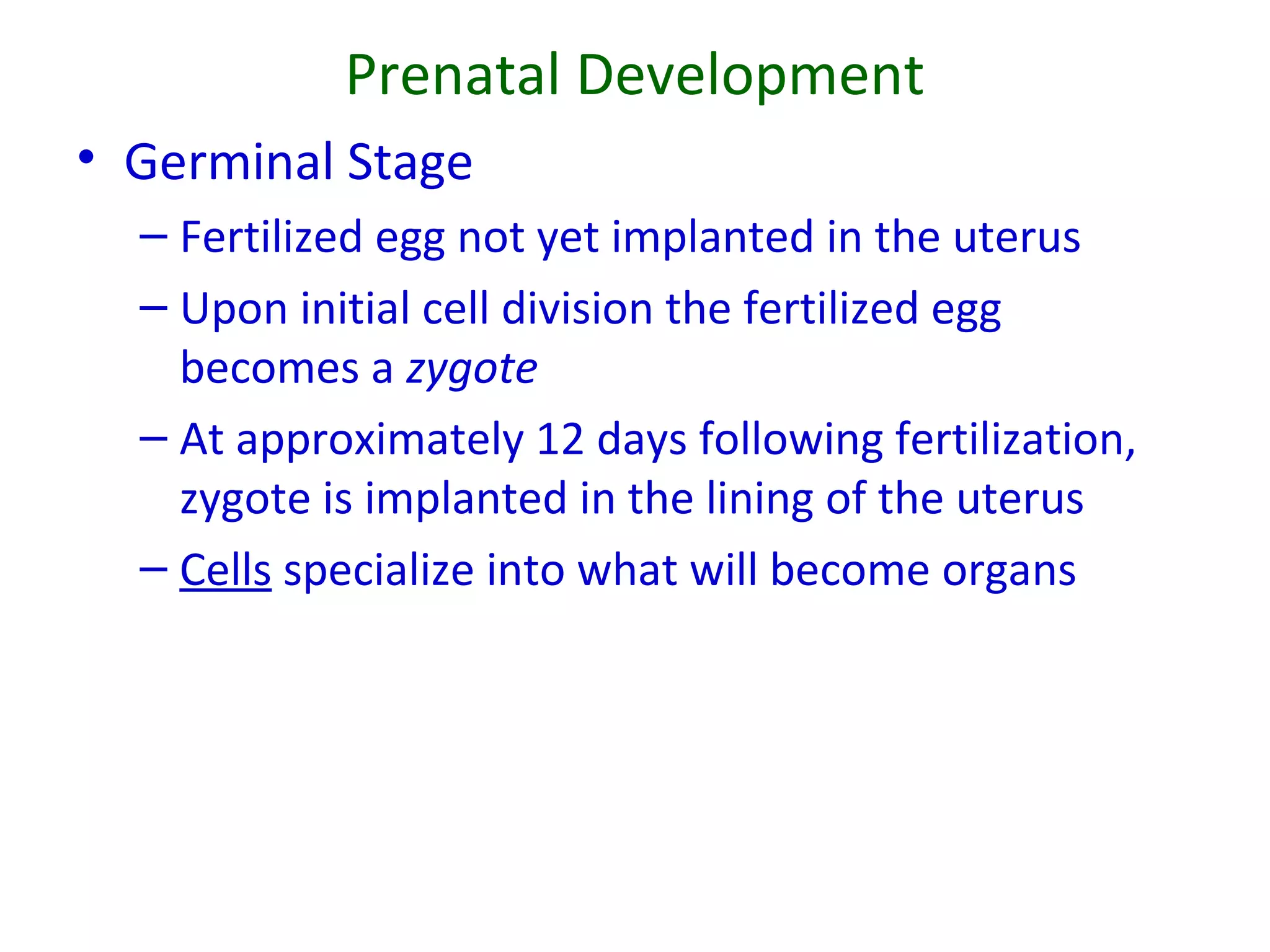
Prenatal Development
• Germinal Stage
– Fertilized egg not yet implanted in the uterus
– Upon initial cell division the fertilized egg
becomes a zygote
– At approximately 12 days following fertilization,
zygote is implanted in the lining of the uterus
– Cells specialize into what will become organs
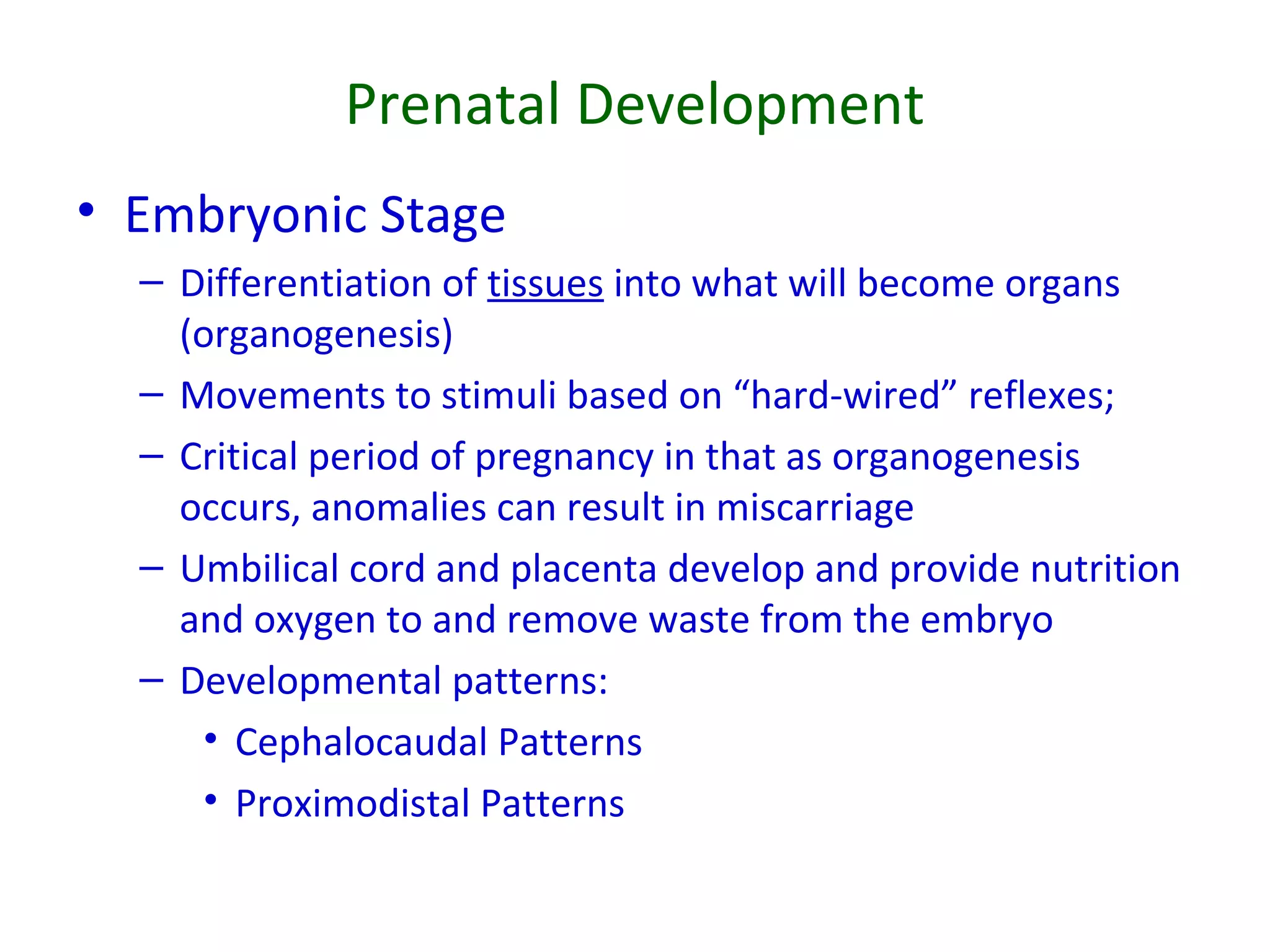
Prenatal Development
• Embryonic Stage
– Differentiation of tissues into what will become organs
(organogenesis)
– Movements to stimuli based on “hard-wired” reflexes;
– Critical period of pregnancy in that as organogenesis
occurs, anomalies can result in miscarriage
– Umbilical cord and placenta develop and provide nutrition
and oxygen to and remove waste from the embryo
– Developmental patterns:
• Cephalocaudal Patterns
• Proximodistal Patterns
Prenatal Development
• Fetal Period
– Begins approximately 8 weeks post fertilization
– Organogenesis is complete
– At approximately 3 months, genitalia can be identified
– At approximately 4 months, movements can be felt by the
mother
– At approximately 7 months fetus may be “viable” (can
survive outside the womb with nutrition and temperature
regulation support).
Brain Development during Prenatal Period and
Beyond
• Growth: brain cells develop from the neural tube
across the prenatal period and into infancy
• Migration: brain cells migrate or move from the
center of the developing brain to the periphery
• Elaboration:
– connections among the axons and dendrites of
the cells are based on genetics during the prenatal
period;
– postnatal experience (nurture) enhances and
inhibits elaboration (e.g. first 6 months of life the
infant is particularly “wired” to learn sounds of
language)
Risks during Prenatal Development
• Teratogens: Toxins that impact the developing
organism prenatally
– Nicotine—increased heart rate; low birth weight
– Alcohol—fetal alcohol syndrome (mental retardation,
physical abnormalities)
– Rubella (German measles)—can be transmitted from
pregnant mother to fetus; can result in blindness, other
physical problems, and death
– HIV—without medication can be transmitted from
pregnant mother to fetus
– Psychoactive drugs—multiple effects
Risks during Prenatal Development
• Maternal Anxiety and Stress during late
pregnancy related to:
– Attentional problems
– Reactions to novelty
• Maternal Age (extremely young and older)
• STD’s
– Herpes
– HIV/AIDS
– Syphilus
Critical Periods in Gestation
• Points at which key transitions occur tend to
be the most critical
– Attachment to the uterine wall
– Organogenesis tends to most vulnerable to major
“malformations.” (Germinal Stage)
– Chronic exposure to toxins during fetal stage
linked to delay in fetal growth and deficits in
intellectual potential (fetal stage)
Father’s Role
• Health of Sperm—toxins, radiation, drugs and
alcohol
• Supportive partner—emotional support, support for
alcohol & tobacco free pregnancy
• Support and encourage access to health care
Birth Process
• Stage 1:
– Dilation
• Early labor
– Initial irregular uterine contractions
– Dilation or Effacing of the cervix to begin the
birthing process
• Active labor
– Contractions become more regular and intense
– Go to the birthing center/hospital
– Cervix continues to efface
Birth Process
• Stage 2
– “Push” mode
– Fetus enters birth canal
– Birth occurs
• Stage 3
– Contractions continue through delivery of
placenta
Birth Process: Birthing Options
• Lamaze Method
– Focusing
– Relaxation
– Breathing
– Knowledge and understanding
– Partner and shared experience
Birth Process: Birthing Options
• Leboyer Method
– Alternative context
– Home-like atmosphere
– Neonate is placed on the mother’s chest with
umbilical cord in place
• Home birth
– Screened for potential complications
– Birthing professional present (e.g. Midwife, Nurse
Practitioner)
– Family/Partner involved
Birth Process: Birthing Options
• Drugs during labor & delivery
– Overall, minimizing use of drugs during labor and
delivery is best
– General impact on neonate and infant is short
term
– More fragile (preterm, low birth weight) infants at
greatest risk for negative outcomes with drugs
– Drugs reduce mother’s ability to “push” during
labor and delivery
Birth Process: Birthing Options
• Maternal comfort and safety is most
important in selecting birthing option
• Pregnancy complications can limit safe
options
• Prenatal health
– Emotional support
– Nutrition
– Exercise
– Prenatal health care
Neonatal Condition
• Apgar (1 minute & 5 minutes; Scores: 0, 1, or
2)
– Heart rate.
– Skin color.
– Muscle tone (judged by whether the newborn's
arms and legs are flexed or limp).
– Breathing.
– Reflex irritability (judged by whether the newborn
cries or reacts when the skin is stroked or
touched).
Neonatal Condition
• Phenylketonuria (PKU) test for neonates
• Hearing
• Antibiotic eyedrops
• Vitamin Injections
• Early breast feeding provides antibodies
• Caring, supportive, safe, and healthy
environment

Prenatal development birth

  • 1.
    Prenatal Development &Birth Chapter 3
  • 2.
    Conception • Strategies – Theold fashioned way – In vitro – Surrogate – Artificial insemination • Following ovulation, fertilization occurs in fallopian tube • Cell division occurs in the zygote • Flows into uterus
  • 3.
    Prenatal Development • GerminalStage – Fertilized egg not yet implanted in the uterus – Upon initial cell division the fertilized egg becomes a zygote – At approximately 12 days following fertilization, zygote is implanted in the lining of the uterus – Cells specialize into what will become organs
  • 4.
    Prenatal Development • EmbryonicStage – Differentiation of tissues into what will become organs (organogenesis) – Movements to stimuli based on “hard-wired” reflexes; – Critical period of pregnancy in that as organogenesis occurs, anomalies can result in miscarriage – Umbilical cord and placenta develop and provide nutrition and oxygen to and remove waste from the embryo – Developmental patterns: • Cephalocaudal Patterns • Proximodistal Patterns
  • 5.
    Prenatal Development • FetalPeriod – Begins approximately 8 weeks post fertilization – Organogenesis is complete – At approximately 3 months, genitalia can be identified – At approximately 4 months, movements can be felt by the mother – At approximately 7 months fetus may be “viable” (can survive outside the womb with nutrition and temperature regulation support).
  • 6.
    Brain Development duringPrenatal Period and Beyond • Growth: brain cells develop from the neural tube across the prenatal period and into infancy • Migration: brain cells migrate or move from the center of the developing brain to the periphery • Elaboration: – connections among the axons and dendrites of the cells are based on genetics during the prenatal period; – postnatal experience (nurture) enhances and inhibits elaboration (e.g. first 6 months of life the infant is particularly “wired” to learn sounds of language)
  • 7.
    Risks during PrenatalDevelopment • Teratogens: Toxins that impact the developing organism prenatally – Nicotine—increased heart rate; low birth weight – Alcohol—fetal alcohol syndrome (mental retardation, physical abnormalities) – Rubella (German measles)—can be transmitted from pregnant mother to fetus; can result in blindness, other physical problems, and death – HIV—without medication can be transmitted from pregnant mother to fetus – Psychoactive drugs—multiple effects
  • 8.
    Risks during PrenatalDevelopment • Maternal Anxiety and Stress during late pregnancy related to: – Attentional problems – Reactions to novelty • Maternal Age (extremely young and older) • STD’s – Herpes – HIV/AIDS – Syphilus
  • 9.
    Critical Periods inGestation • Points at which key transitions occur tend to be the most critical – Attachment to the uterine wall – Organogenesis tends to most vulnerable to major “malformations.” (Germinal Stage) – Chronic exposure to toxins during fetal stage linked to delay in fetal growth and deficits in intellectual potential (fetal stage)
  • 10.
    Father’s Role • Healthof Sperm—toxins, radiation, drugs and alcohol • Supportive partner—emotional support, support for alcohol & tobacco free pregnancy • Support and encourage access to health care
  • 11.
    Birth Process • Stage1: – Dilation • Early labor – Initial irregular uterine contractions – Dilation or Effacing of the cervix to begin the birthing process • Active labor – Contractions become more regular and intense – Go to the birthing center/hospital – Cervix continues to efface
  • 12.
    Birth Process • Stage2 – “Push” mode – Fetus enters birth canal – Birth occurs • Stage 3 – Contractions continue through delivery of placenta
  • 13.
    Birth Process: BirthingOptions • Lamaze Method – Focusing – Relaxation – Breathing – Knowledge and understanding – Partner and shared experience
  • 14.
    Birth Process: BirthingOptions • Leboyer Method – Alternative context – Home-like atmosphere – Neonate is placed on the mother’s chest with umbilical cord in place • Home birth – Screened for potential complications – Birthing professional present (e.g. Midwife, Nurse Practitioner) – Family/Partner involved
  • 15.
    Birth Process: BirthingOptions • Drugs during labor & delivery – Overall, minimizing use of drugs during labor and delivery is best – General impact on neonate and infant is short term – More fragile (preterm, low birth weight) infants at greatest risk for negative outcomes with drugs – Drugs reduce mother’s ability to “push” during labor and delivery
  • 16.
    Birth Process: BirthingOptions • Maternal comfort and safety is most important in selecting birthing option • Pregnancy complications can limit safe options • Prenatal health – Emotional support – Nutrition – Exercise – Prenatal health care
  • 17.
    Neonatal Condition • Apgar(1 minute & 5 minutes; Scores: 0, 1, or 2) – Heart rate. – Skin color. – Muscle tone (judged by whether the newborn's arms and legs are flexed or limp). – Breathing. – Reflex irritability (judged by whether the newborn cries or reacts when the skin is stroked or touched).
  • 18.
    Neonatal Condition • Phenylketonuria(PKU) test for neonates • Hearing • Antibiotic eyedrops • Vitamin Injections • Early breast feeding provides antibodies • Caring, supportive, safe, and healthy environment