Part I Prenatal Development and Birth Chapter Four From Zygote to Newborn Risk Reduction Birth
From Zygote to Newborn Prenatal development is divided into three main periods: germinal period  (0-2 weeks) embryonic period (3-8 weeks) fetal period (9 weeks-birth)
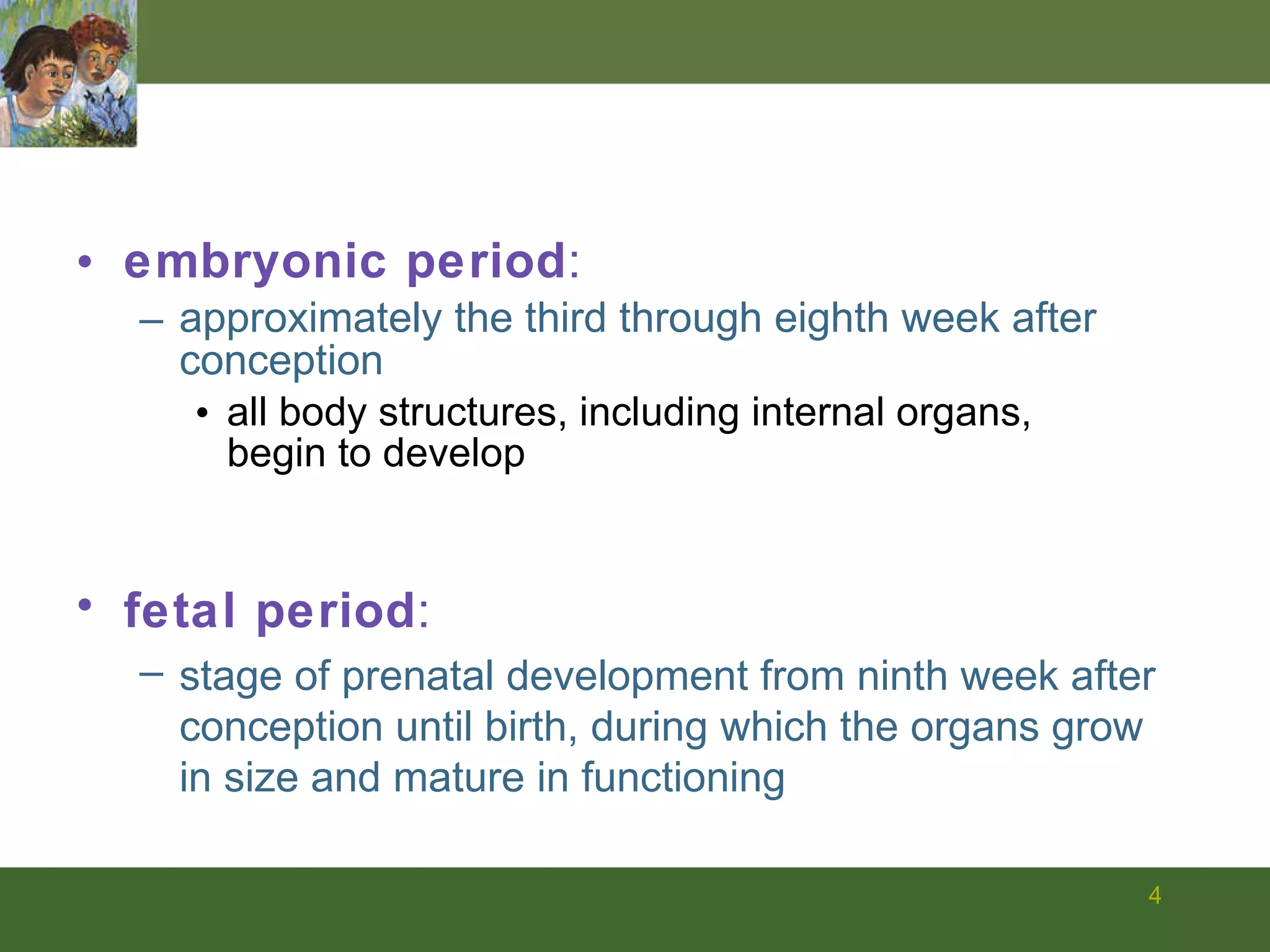
germinal period : first two weeks of prenatal development after conception Characterized by rapid cell division and the beginning of cell differentiation. Germinal: The First 14 Days
embryonic period :  approximately the third through eighth week after conception  all body structures, including internal organs, begin to develop fetal period :  stage of prenatal development from ninth week after conception until birth, during which the organs grow in size and mature in functioning
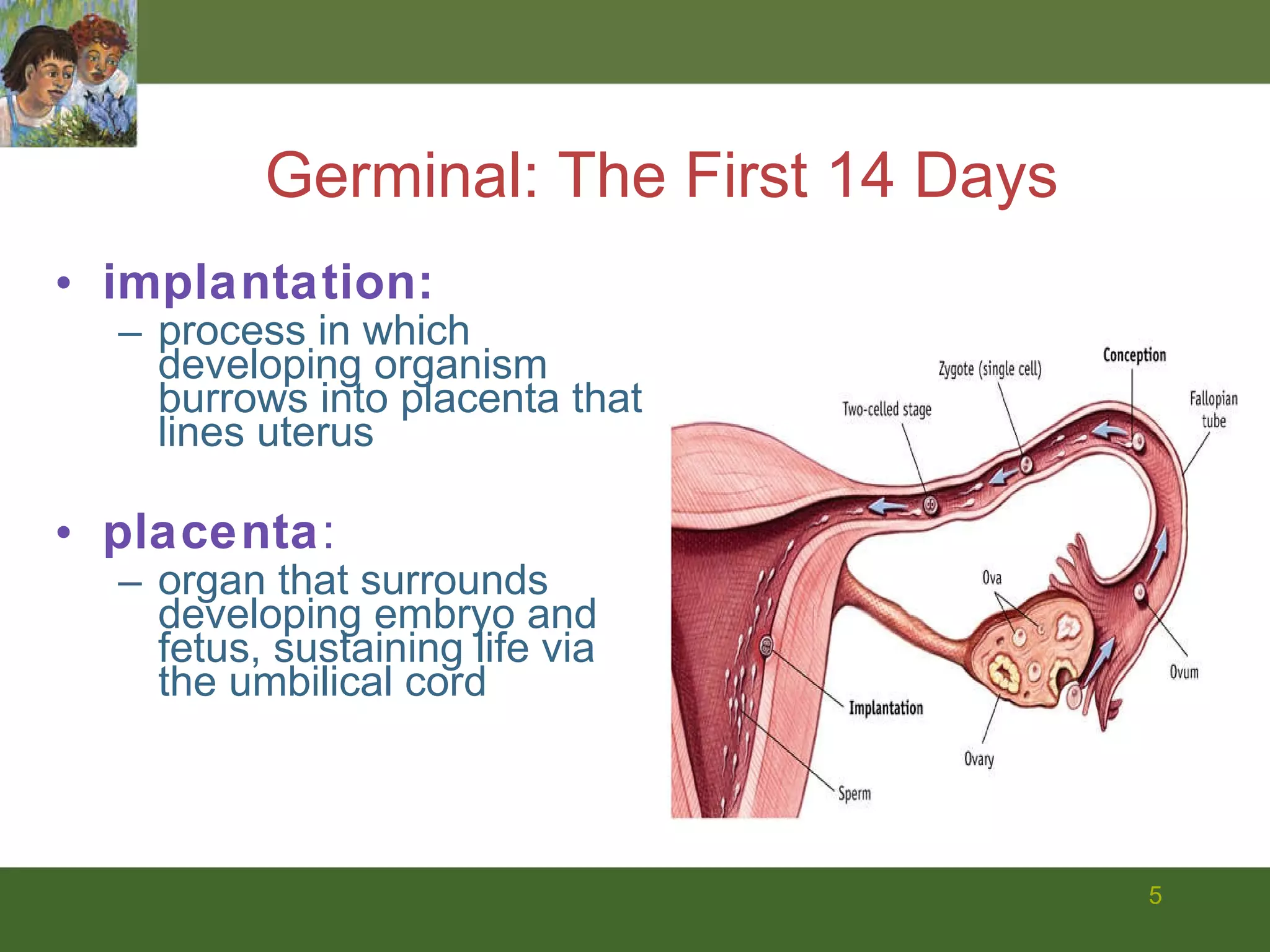
Germinal: The First 14 Days implantation:  process in which developing organism burrows into placenta that lines uterus placenta :  organ that surrounds developing embryo and fetus, sustaining life via the umbilical cord
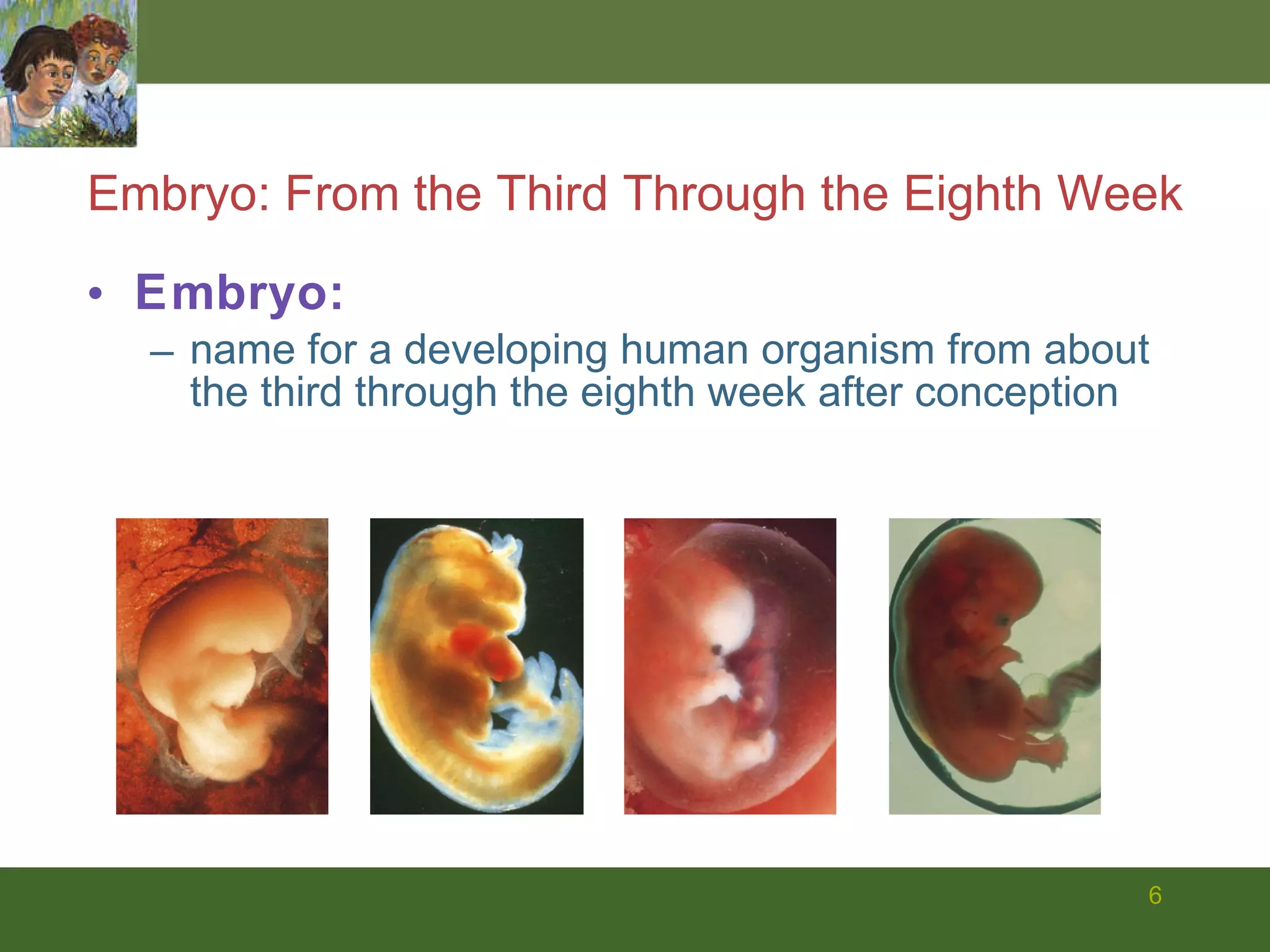
Embryo: name for a developing human organism from about the third through the eighth week after conception Embryo: From the Third Through the Eighth Week
The developing organism is called a  fetus  from the start of the ninth week after conception until birth.  during the fetal period the fetus develops from tiny, sexless creature to a 7 1/2-pound, 20-inch boy or girl Fetus: From the Ninth Week Until Birth
At the end of the third month, the fetus has all its body parts. Weighs approximately 3 ounces, and is about 3 inches long. Early prenatal growth is very rapid, but there is considerable variation from fetus to fetus, especially in body weight. The Third Month
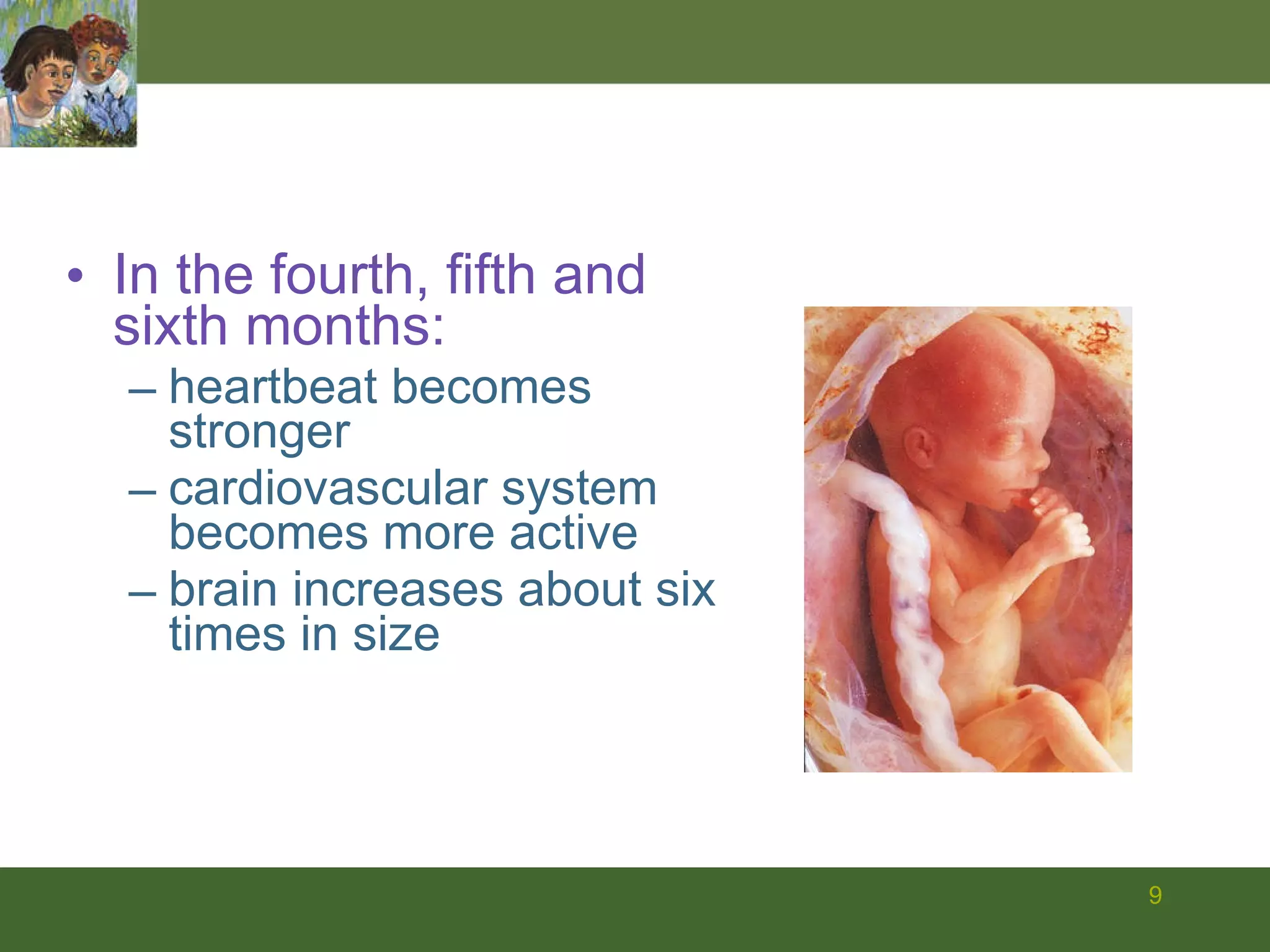
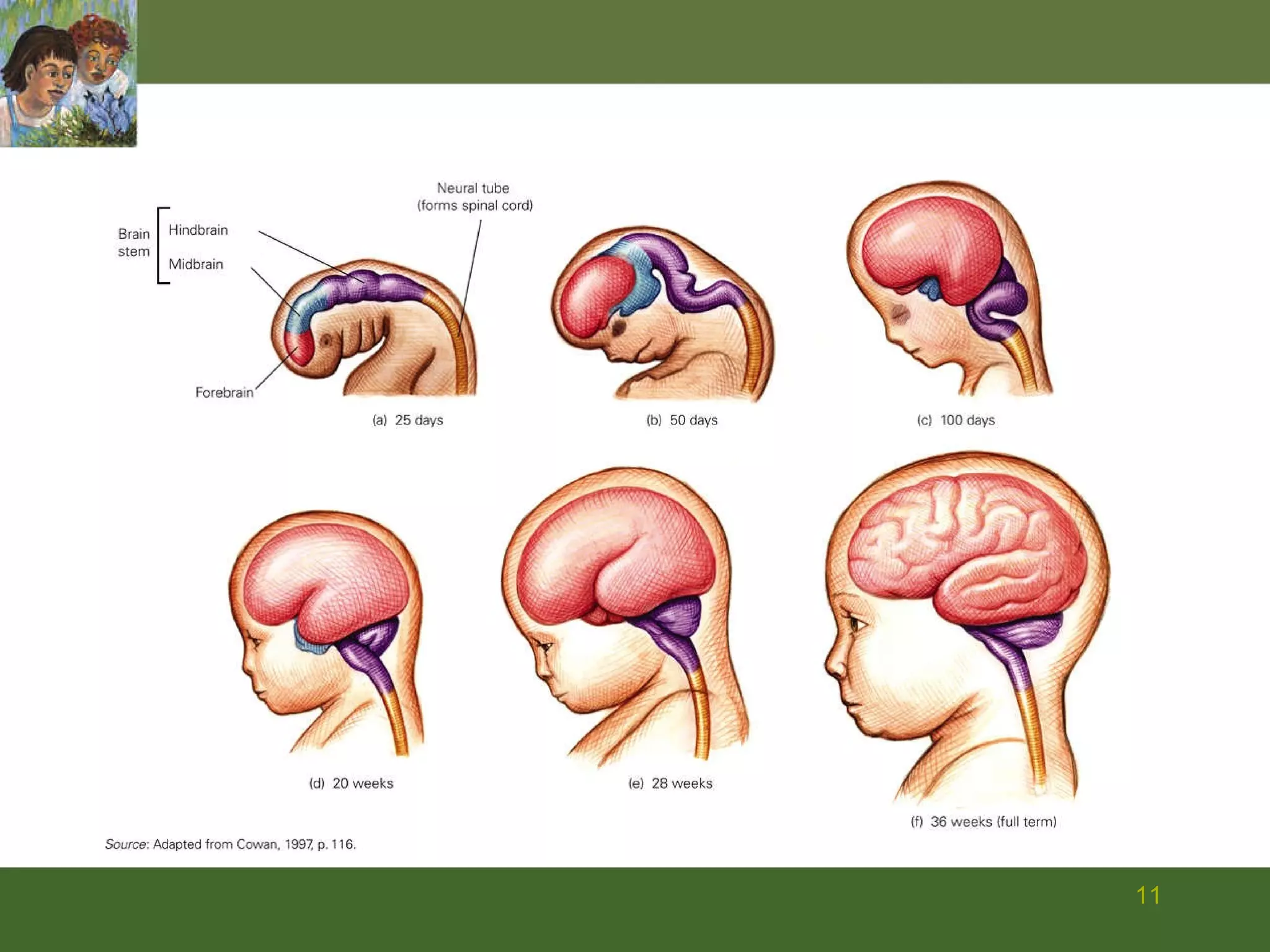
In the fourth, fifth and sixth months: heartbeat becomes stronger cardiovascular system becomes more active  brain increases about six times in size
age of viability : Age at which a fetus can survive outside the mother’s uterus if specialized medical care is available. about 22 weeks after conception In the final three months of prenatal life: brain waves indicate responsiveness. lungs expand and contract, using the amniotic fluid as a substitute for air. heart valves, arteries, and veins circulate the fetal blood.
 
Risk Reduction teratogens:  agents and conditions that can: harm the prenatal brain impairing the future child’s intellectual and emotional functioning
Once it was thought the placenta screened out all harmful substances. Doctors on an Australian military base traced an increase in blindness among newborns to rubella (German measles) contracted by pregnant women a few months earlier.  Realized that some diseases during pregnancy could harm a fetus. Determining Risk
The effort to understand what triggered such damage gave rise to: teratology:  science of risk analysis, the study of birth defects risk analysis : to determine likelihood of harm, science of weighing the potential effects of a particular: event  substance experience
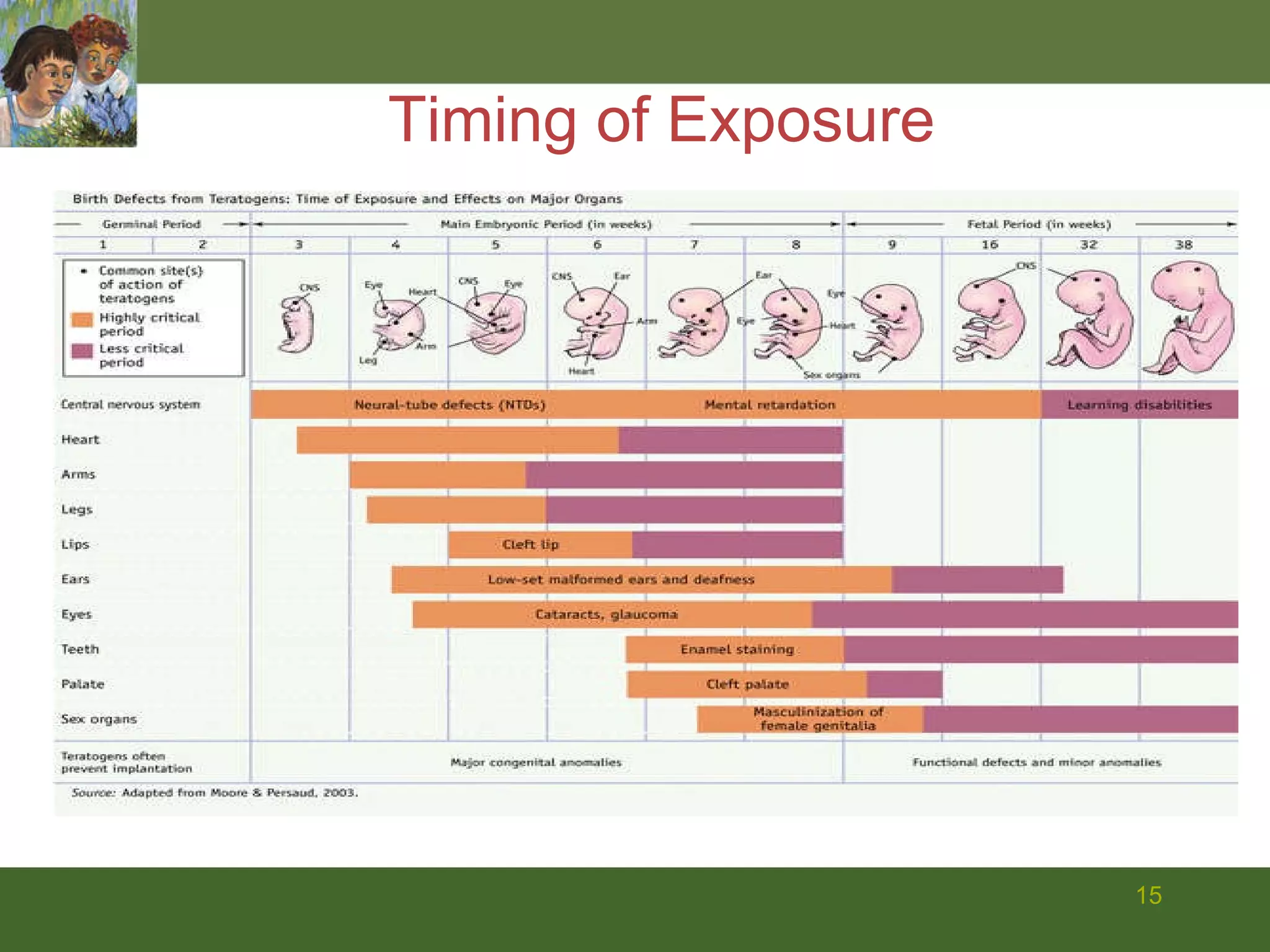
Timing of Exposure
Second important factor is the dose and/or frequency of exposure. threshold effect:  situation in which a certain teratogen is relatively harmless in small doses but harmful once exposure reaches certain level (the threshold) interaction effect:  result of a combination of teratogens Sometimes risk is greatly magnified when embryo or fetus is exposed to more than one teratogen at the same time.
Genetic Vulnerability Several lines of evidence suggest that genes may be crucial.  Dizygotic twins, exposed to same teratogens but have only half their genes in common, are born with different abnormalities.  Suggests both protective and vulnerable genes. Cleft lip, cleft palate, club foot more common in some families.  Suggests genetic vulnerability.
Protective Measures Impact of teratogens cannot be predicted before mid-pregnancy. Some pregnant women are exposed to the tetragons with no evident harm. Some defects occur even thought the woman avoids all known tetragons while pregnant.
A View From Science Alcohol in high doses is a proven teratogen. 40 years ago drinking during pregnancy was believed to be harmless.  Obstetricians noted that some patients who drank heavily while they were pregnant had babies with distorted faces. fetal alcohol syndrome (FAS)  fetal alcohol effects (FAE)
fetal alcohol syndrome (FAS) : cluster of birth defects, including:  abnormal facial characteristics  slow physical growth retarded mental development fetal alcohol effects (FAE) : condition in which child has been exposed to alcohol before birth has some signs of fetal alcohol syndrome but does not meet all the criteria
Benefits of Prenatal Care Tests done during pregnancy can diagnose problems early on, and remedies can be put in place in some instances. sonogram : image of unborn fetus (or an internal organ) produced by high-frequency sound waves (ultrasound)
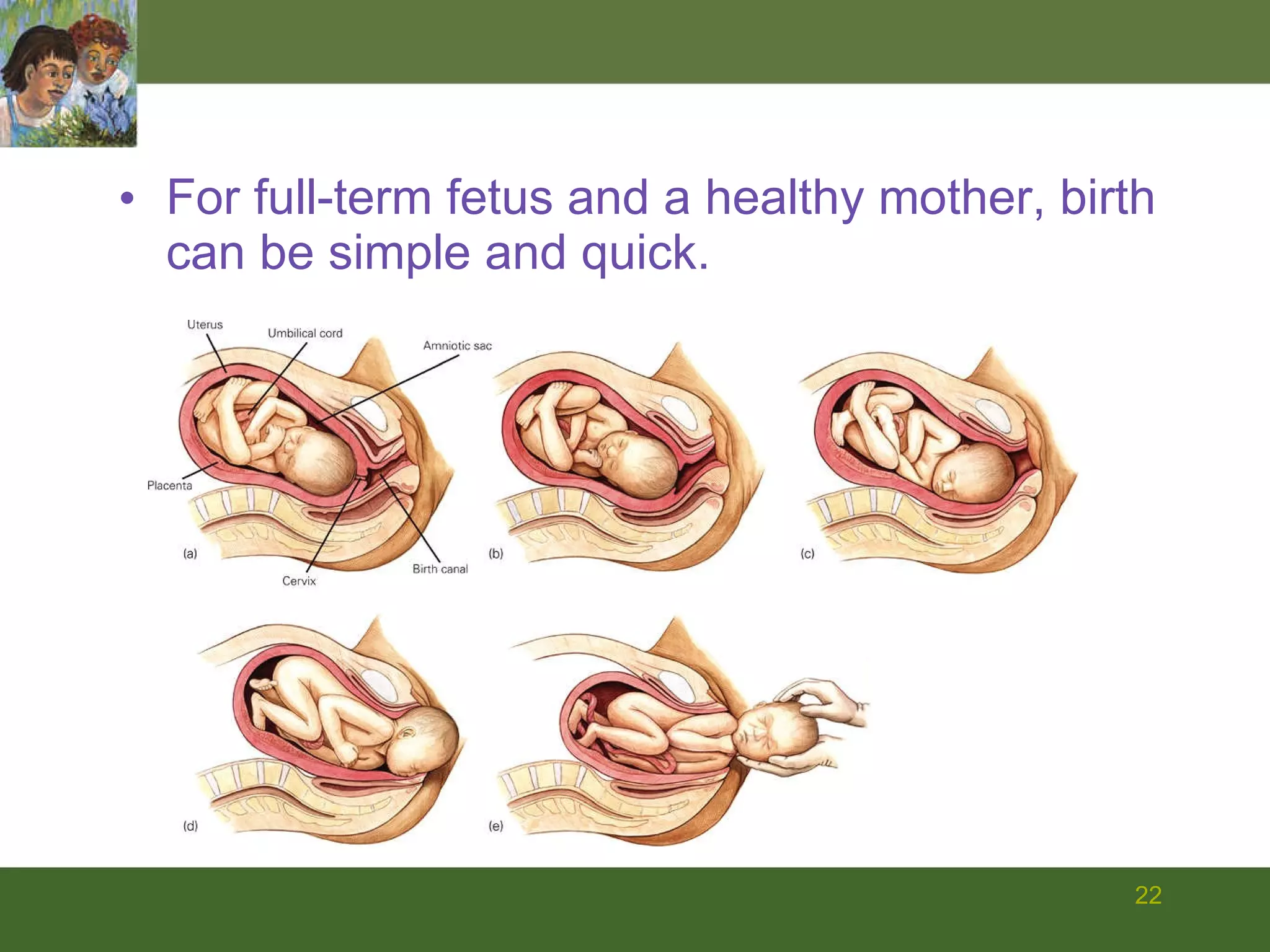
For full-term fetus and a healthy mother, birth can be simple and quick.
The Newborn’s First Minutes Most newborns begin to breathe as soon as their head emerges. first breath causes infant’s color to change eyes open wide  the tiny fingers grab  toes stretch and retract mucus in the baby’s throat is removed umbilical cord is cut to detach the placenta placenta is expelled
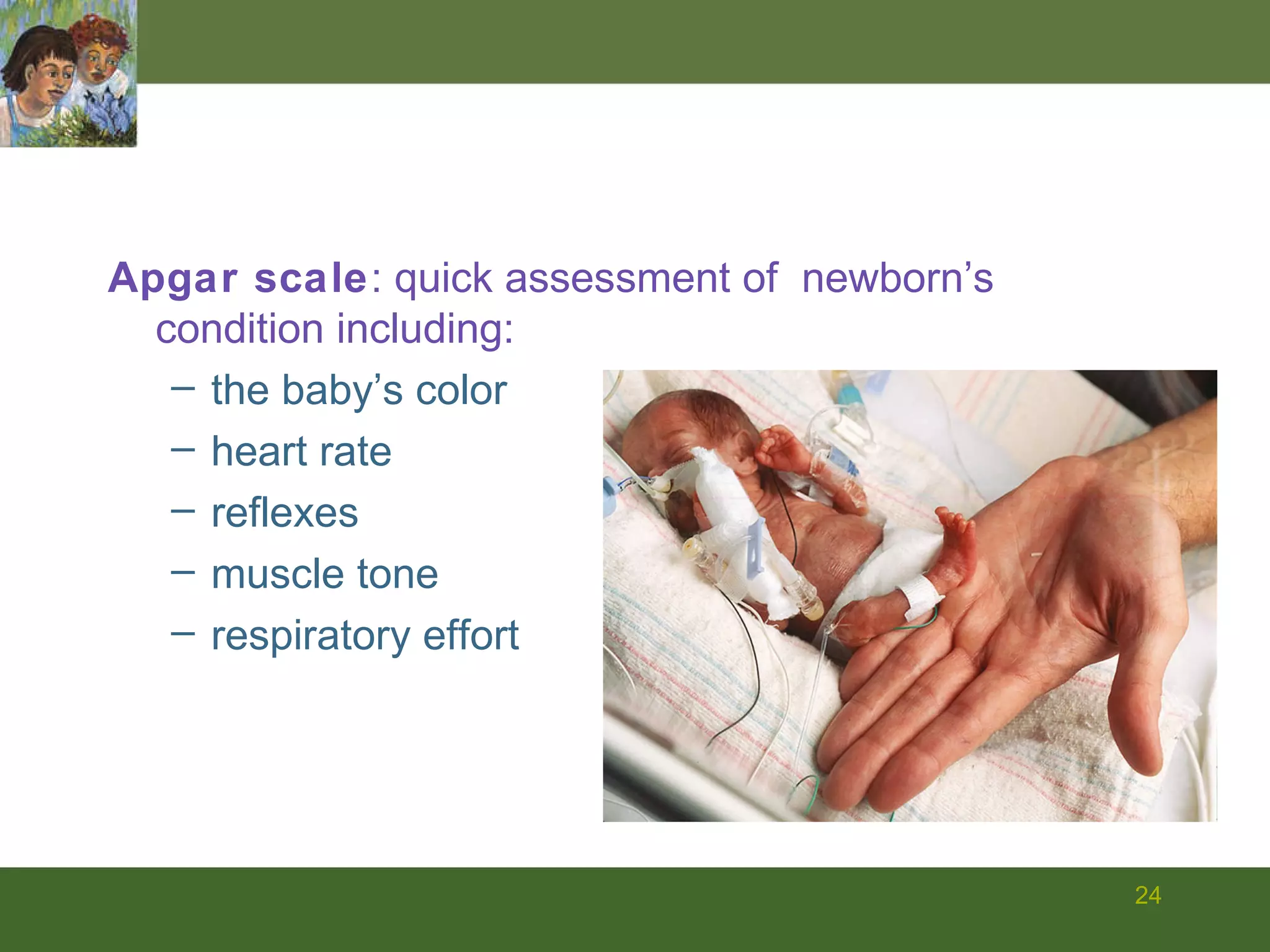
Apgar scale : quick assessment of  newborn’s condition including: the baby’s color  heart rate reflexes muscle tone respiratory effort
Medical Intervention about 31% of births in the U.S. are cesarean section, (also called c-section) incision through mother’s abdomen and uterus to allow fetus to be removed quickly, instead of being delivered through the vagina
Birth In Developing Nations In the U.S. only 1% of births take place at home.  Worldwide most births occur at home. doula - a woman who helps with the birth process - also helps with breastfeeding and newborn care.
anoxia: lack  of oxygen that can cause brain damage or death to the baby means “no oxygen”  cerebral palsy:   disorder that results from damage to brain’s motor centers People with cerebral palsy have difficulty with muscle control, so their speech and body movements are impaired. Anoxia
Average weight of a newborn is  7½ lbs. low birthweight (LBW):  a body weight at birth of less than  5½ lbs . very low birthweight (VLBW):  a body weight at birth of less than  3 lbs, 5oz . extremely low birthweight (ELBW):  a body weight at birth of less than  2 lbs, 3 oz . Low Birthweight (LBW)
preterm   birth : occurs 3 or more weeks before full 38 weeks of a typical pregnancy Preterm babies are typically (but not always) LBW because they miss final weeks of weight gain. small for dates  or  small for gestational age (SGA)-  birth weight is lower than expected given the time of conception .
Social Support The developing person is affected by quality of: medical care  education  culture  social support Fathers and other relatives, neighbors, cultures, and, clinics can reduce  risk of birth complications
Mothers, Fathers, and a Good Start Birth complications can have a lingering impact on the new family, depending partly on: sensitivity of hospital care  the home To reduce stress on an infant who has to stay in the hospital, parents are encouraged to help with early caregiving.
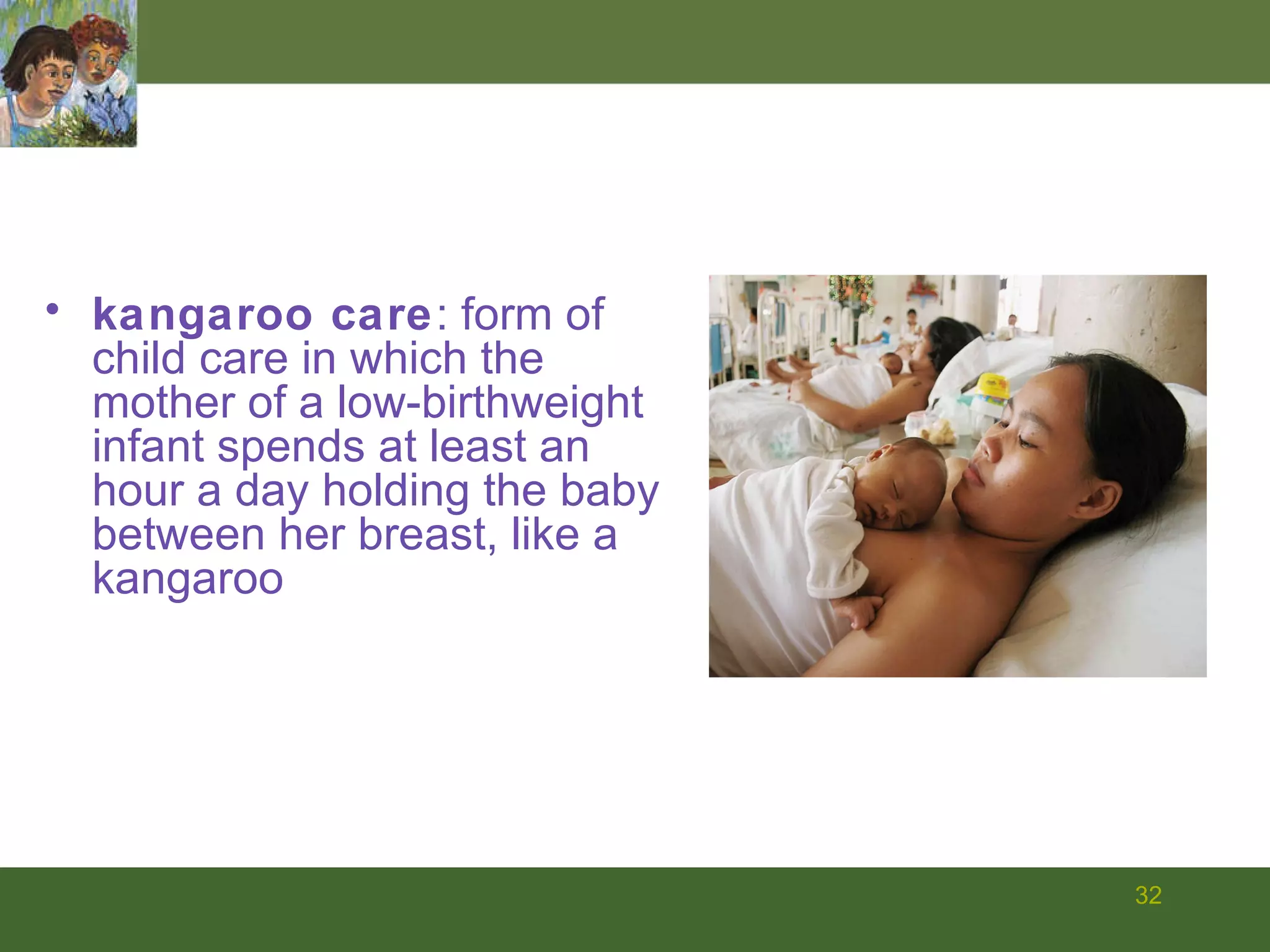
kangaroo care : form of child care in which the mother of a low-birthweight infant spends at least an hour a day holding the baby between her breast, like a kangaroo
Help from Fathers Fathers can be crucial in the effort to produce a healthy baby. Supportive father-to-be helps a mother-to-be: stay healthy well nourished drug-free
parental alliance : cooperation between a mother and a father based on mutual commitment to their children Parents agree to support each other in their shared parental roles.
new mother’s feelings of inadequacy and sadness in days and weeks after giving birth including: irritability eating disruptions  sadness feeling overwhelmed and inadequate  affects 10-15% of women Postpartum Depression
parent-infant bond:  strong, loving connection that forms as parents hold, examine, and feed  newborn cross-fostering:  newborns are removed from their biological mothers in first days of life and raised by another female or even male Bonding

Berger ca8e lecch4

  • 1.
    Part I PrenatalDevelopment and Birth Chapter Four From Zygote to Newborn Risk Reduction Birth
  • 2.
    From Zygote toNewborn Prenatal development is divided into three main periods: germinal period (0-2 weeks) embryonic period (3-8 weeks) fetal period (9 weeks-birth)
  • 3.
    germinal period :first two weeks of prenatal development after conception Characterized by rapid cell division and the beginning of cell differentiation. Germinal: The First 14 Days
  • 4.
    embryonic period : approximately the third through eighth week after conception all body structures, including internal organs, begin to develop fetal period : stage of prenatal development from ninth week after conception until birth, during which the organs grow in size and mature in functioning
  • 5.
    Germinal: The First14 Days implantation: process in which developing organism burrows into placenta that lines uterus placenta : organ that surrounds developing embryo and fetus, sustaining life via the umbilical cord
  • 6.
    Embryo: name fora developing human organism from about the third through the eighth week after conception Embryo: From the Third Through the Eighth Week
  • 7.
    The developing organismis called a fetus from the start of the ninth week after conception until birth. during the fetal period the fetus develops from tiny, sexless creature to a 7 1/2-pound, 20-inch boy or girl Fetus: From the Ninth Week Until Birth
  • 8.
    At the endof the third month, the fetus has all its body parts. Weighs approximately 3 ounces, and is about 3 inches long. Early prenatal growth is very rapid, but there is considerable variation from fetus to fetus, especially in body weight. The Third Month
  • 9.
    In the fourth,fifth and sixth months: heartbeat becomes stronger cardiovascular system becomes more active brain increases about six times in size
  • 10.
    age of viability: Age at which a fetus can survive outside the mother’s uterus if specialized medical care is available. about 22 weeks after conception In the final three months of prenatal life: brain waves indicate responsiveness. lungs expand and contract, using the amniotic fluid as a substitute for air. heart valves, arteries, and veins circulate the fetal blood.
  • 11.
  • 12.
    Risk Reduction teratogens: agents and conditions that can: harm the prenatal brain impairing the future child’s intellectual and emotional functioning
  • 13.
    Once it wasthought the placenta screened out all harmful substances. Doctors on an Australian military base traced an increase in blindness among newborns to rubella (German measles) contracted by pregnant women a few months earlier. Realized that some diseases during pregnancy could harm a fetus. Determining Risk
  • 14.
    The effort tounderstand what triggered such damage gave rise to: teratology: science of risk analysis, the study of birth defects risk analysis : to determine likelihood of harm, science of weighing the potential effects of a particular: event substance experience
  • 15.
  • 16.
    Second important factoris the dose and/or frequency of exposure. threshold effect: situation in which a certain teratogen is relatively harmless in small doses but harmful once exposure reaches certain level (the threshold) interaction effect: result of a combination of teratogens Sometimes risk is greatly magnified when embryo or fetus is exposed to more than one teratogen at the same time.
  • 17.
    Genetic Vulnerability Severallines of evidence suggest that genes may be crucial. Dizygotic twins, exposed to same teratogens but have only half their genes in common, are born with different abnormalities. Suggests both protective and vulnerable genes. Cleft lip, cleft palate, club foot more common in some families. Suggests genetic vulnerability.
  • 18.
    Protective Measures Impactof teratogens cannot be predicted before mid-pregnancy. Some pregnant women are exposed to the tetragons with no evident harm. Some defects occur even thought the woman avoids all known tetragons while pregnant.
  • 19.
    A View FromScience Alcohol in high doses is a proven teratogen. 40 years ago drinking during pregnancy was believed to be harmless. Obstetricians noted that some patients who drank heavily while they were pregnant had babies with distorted faces. fetal alcohol syndrome (FAS) fetal alcohol effects (FAE)
  • 20.
    fetal alcohol syndrome(FAS) : cluster of birth defects, including: abnormal facial characteristics slow physical growth retarded mental development fetal alcohol effects (FAE) : condition in which child has been exposed to alcohol before birth has some signs of fetal alcohol syndrome but does not meet all the criteria
  • 21.
    Benefits of PrenatalCare Tests done during pregnancy can diagnose problems early on, and remedies can be put in place in some instances. sonogram : image of unborn fetus (or an internal organ) produced by high-frequency sound waves (ultrasound)
  • 22.
    For full-term fetusand a healthy mother, birth can be simple and quick.
  • 23.
    The Newborn’s FirstMinutes Most newborns begin to breathe as soon as their head emerges. first breath causes infant’s color to change eyes open wide the tiny fingers grab toes stretch and retract mucus in the baby’s throat is removed umbilical cord is cut to detach the placenta placenta is expelled
  • 24.
    Apgar scale :quick assessment of newborn’s condition including: the baby’s color heart rate reflexes muscle tone respiratory effort
  • 25.
    Medical Intervention about31% of births in the U.S. are cesarean section, (also called c-section) incision through mother’s abdomen and uterus to allow fetus to be removed quickly, instead of being delivered through the vagina
  • 26.
    Birth In DevelopingNations In the U.S. only 1% of births take place at home. Worldwide most births occur at home. doula - a woman who helps with the birth process - also helps with breastfeeding and newborn care.
  • 27.
    anoxia: lack of oxygen that can cause brain damage or death to the baby means “no oxygen” cerebral palsy: disorder that results from damage to brain’s motor centers People with cerebral palsy have difficulty with muscle control, so their speech and body movements are impaired. Anoxia
  • 28.
    Average weight ofa newborn is 7½ lbs. low birthweight (LBW): a body weight at birth of less than 5½ lbs . very low birthweight (VLBW): a body weight at birth of less than 3 lbs, 5oz . extremely low birthweight (ELBW): a body weight at birth of less than 2 lbs, 3 oz . Low Birthweight (LBW)
  • 29.
    preterm birth : occurs 3 or more weeks before full 38 weeks of a typical pregnancy Preterm babies are typically (but not always) LBW because they miss final weeks of weight gain. small for dates or small for gestational age (SGA)- birth weight is lower than expected given the time of conception .
  • 30.
    Social Support Thedeveloping person is affected by quality of: medical care education culture social support Fathers and other relatives, neighbors, cultures, and, clinics can reduce risk of birth complications
  • 31.
    Mothers, Fathers, anda Good Start Birth complications can have a lingering impact on the new family, depending partly on: sensitivity of hospital care the home To reduce stress on an infant who has to stay in the hospital, parents are encouraged to help with early caregiving.
  • 32.
    kangaroo care :form of child care in which the mother of a low-birthweight infant spends at least an hour a day holding the baby between her breast, like a kangaroo
  • 33.
    Help from FathersFathers can be crucial in the effort to produce a healthy baby. Supportive father-to-be helps a mother-to-be: stay healthy well nourished drug-free
  • 34.
    parental alliance :cooperation between a mother and a father based on mutual commitment to their children Parents agree to support each other in their shared parental roles.
  • 35.
    new mother’s feelingsof inadequacy and sadness in days and weeks after giving birth including: irritability eating disruptions sadness feeling overwhelmed and inadequate affects 10-15% of women Postpartum Depression
  • 36.
    parent-infant bond: strong, loving connection that forms as parents hold, examine, and feed newborn cross-fostering: newborns are removed from their biological mothers in first days of life and raised by another female or even male Bonding