
PREMEDICANT
DRUGS/PREMEDICATION
UMAR TARIQ
MSC ANAESTHESIA/OTT
Introduction
Preoperative medication consists of :
 psychological
 pharmacological preparation.
How the patient should be like before
entering OT:
 free from apprehension
 sedated
 arousable
 cooperative.
Goals of preoperative
medication
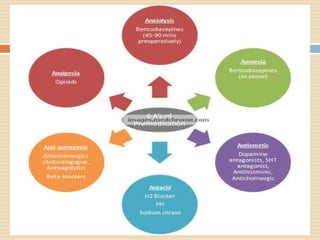
 To relieve anxiety
 Sedation
 Amnesia
 Analgesia
 Drying of airway secretions
 To decrease the chances of aspiration.
 To produce haemodynamic stability
 To prevent PONV.
 To control infection.
 Reduction of anesthetic requirements
 Facilitation of smooth induction of anesthesia
 Prophylaxis against allergic reactions.
Adminstration of
premedication :
 1-2 hr before the surgery
 night before.
Prescribed medications:
 2 hours prior to surgery
 small sip of water (<30 ml) orally
Ideal premedicant drug :
 Anxiolytic
 Analgesic
 Sedative
 Amnesic
 Safe for patient
 Painless and easy to administer
 Highly reliable and specific
 Rapid onset and rapidly cleared
 Free of side effect and interaction with other
drugs
 Should not produce undue depression of
cardiovascular, respiratory and central nervous
system
Group
of
preanesthetics
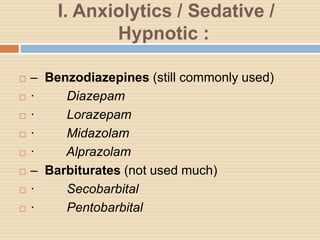
I. Anxiolytics / Sedative /
Hypnotic :
 – Benzodiazepines (still commonly used)
 · Diazepam
 · Lorazepam
 · Midazolam
 · Alprazolam
 – Barbiturates (not used much)
 · Secobarbital
 · Pentobarbital
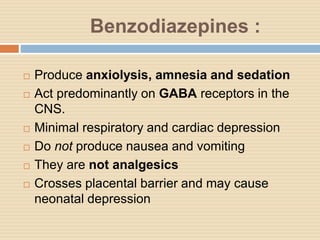
Benzodiazepines :
 Produce anxiolysis, amnesia and sedation
 Act predominantly on GABA receptors in the
CNS.
 Minimal respiratory and cardiac depression
 Do not produce nausea and vomiting
 They are not analgesics
 Crosses placental barrier and may cause
neonatal depression
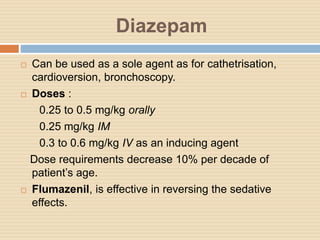
Diazepam
 Can be used as a sole agent as for cathetrisation,
cardioversion, bronchoscopy.
 Doses :
0.25 to 0.5 mg/kg orally
0.25 mg/kg IM
0.3 to 0.6 mg/kg IV as an inducing agent
Dose requirements decrease 10% per decade of
patient’s age.
 Flumazenil, is effective in reversing the sedative
effects.
Lorazepam
 A new and effective sedative/amnesic/anxioloytic
 Has stabilising effect on cardiovascular and respiratory
systems
 Twice as potent as midazolam.
 used for lengthy procedures.
 Obesity prolongs the sedative effects of Lorazepam.
 Dose for premedication :
 Oral – 50 µg/kg, not more than 4 mg (can be given 90
min before anesthesia)
 0.03–0.05 mg/kg IM
 Sedation : 0.03–0.04 mg/kg IV
Midazolam
 Water soluble benzodiazepine with painless
administration
 Amnesic effects are more potent than
sedative effects.
 choice of drug for out patient surgery and
pediatric premedication
 Capable of crossing the BBB with effects
ranging from tranquillization to full anesthesia.
 Respiratory depressant
 Hazardous in hypovolemic patients.
Midazolam
 Patients with decreased intracranial
compliance show little or no change in ICP
with midazolam
 Usual dose : 0.15 to 0.3 mg/kg IV
 Lesser dose to be used in elderly and obese
patients
 0.5 to 0.75 mg/kg orally produces anxiolysis
and degree of tranquillity within 30 min
 Pediatric dose : 0.1 mg/kg IV or IM
 Intranasal midazolam 0.3 mg/kg has quicker
onset of action than oral midazolam.
II. Opioid analgesics
 – Morphine
 – Pethidine
 – Fentanyl
They differ in duration of action ; can be given
parentally.
• administered preoperatively for sedation
• control hypertension during tracheal intubation
• analgesia
For preoperative analgesia, the use of IV
fentanyl is preferred :
• rapid onset
• short duration
 Fentanyl is also available as transdermal
patches.
Morphine
 An opium alkaloid and a standard potent
addictive analgesic /sedative/anxiolytic
 May lead to GI spasm, biliary tract spasm,
even renal tract spasm.
 Causes constipation and urinary retention
 Depresses respiration both in rate and depth
 Passes through placental barrier
 1mg of IV morphine ≈ 4 mg of oral morphine
 Dose : 1.0 – 2.5 mg IV
Morphine
 Morphine should be carefully used in :
 Extremes of ages
 Respiratory problems
 Liver and kidney pathology
 In patients with increased ICP
 Pregnancy
Fentanyl
 Potent narcotic analgesic ; 100 times more potent
than morphine
 Metabolised in liver and excreted through urine
and feces
 Respiratory depression and rigidity of respiratory
muscles which can be satisfactorily treated
with naloxone
 Less nausea and vomiting
 Cautious use in patients with COPD, head injury
and patients on MAO inhibitors
 Dose : 1-5 µg/kg IV
III. Anticholinergic drugs
Three drugs are in use as preanesthetic :
 – Atropine
 – Hyoscine
 – Glycopyrrolate
While the first two crosses the BBB,
glycopyrrolate does not cross BBB and is not
absorbed from GI tract
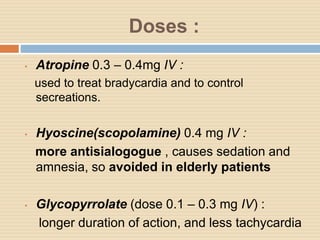
Doses :
• Atropine 0.3 – 0.4mg IV :
used to treat bradycardia and to control
secreations.
• Hyoscine(scopolamine) 0.4 mg IV :
more antisialogogue , causes sedation and
amnesia, so avoided in elderly patients
• Glycopyrrolate (dose 0.1 – 0.3 mg IV) :
longer duration of action, and less tachycardia
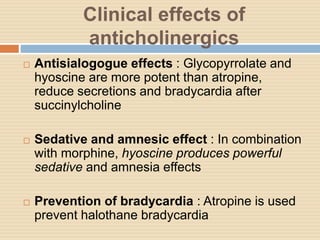
Clinical effects of
anticholinergics
 Antisialogogue effects : Glycopyrrolate and
hyoscine are more potent than atropine,
reduce secretions and bradycardia after
succinylcholine
 Sedative and amnesic effect : In combination
with morphine, hyoscine produces powerful
sedative and amnesia effects
 Prevention of bradycardia : Atropine is used
prevent halothane bradycardia
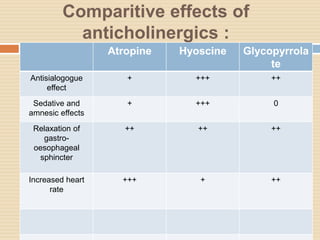
Comparitive effects of
anticholinergics :
Atropine Hyoscine Glycopyrrola
te
Antisialogogue
effect
+ +++ ++
Sedative and
amnesic effects
+ +++ 0
Relaxation of
gastro-
oesophageal
sphincter
++ ++ ++
Increased heart
rate
+++ + ++
Side effects of
anticholinergics :
 CNS toxicity : Atropine produces central
anticholinergic syndrome of the CNS, producing
restlesness, agitation, somnolence and
convulsions.
Physostigmine 1-2 mg IV reverses the effects
when given with glycopyrrolate
 Reduction in lower oesophageal sphincter
tone
 Tachycardia & Hyperthermia
 Mydriasis and cycloplegia
 Unpleasant and excessive drying of mouth
IV. Antiemetics
 – Ondansetron
 – Metoclopramide – most commonly
used
 – Phenothiazines – Promethazine
used
Antihistamnies and antiemetics enhance gastric emptying
and are used to prevent nausea, vomiting in patients which is
the single most common factor delaying recovery in patients.
Additional usage includes :
 Sedative property
Ondansetron
 Used for prevention of PONV in a dose of 4
mg IV
 In children, a dose of 0.1 mg/kg upto 4 mg may
be used in vomiting prone children
 Elimination half life is 3.5 to 4 h in adults
 Side effects include headache, constipation,
diarrhoea, sedation, a sense of flushing, warmth
and so on.
Metoclopramide
 water soluble antiemetic drug used parenterally,
orally and even rectally
 Dose : 0.15 to 0.3 mg/kg IV, effect lasts for 12h
 Increases the rate of gastric emptying, and
causes some increase in peristalsis of gut
 May be used in emergency anesthesia
 Indicated in patients with hiatus hernia, obese,
and duodenal ulcer.
 Acts both centrally and peripherally
Metoclopramide
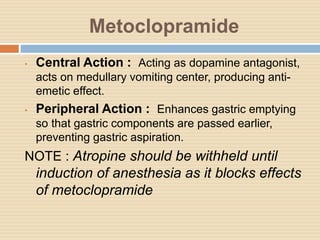
• Central Action : Acting as dopamine antagonist,
acts on medullary vomiting center, producing anti-
emetic effect.
• Peripheral Action : Enhances gastric emptying
so that gastric components are passed earlier,
preventing gastric aspiration.
NOTE : Atropine should be withheld until
induction of anesthesia as it blocks effects
of metoclopramide
V. Prevention of pulmonary
aspiration :
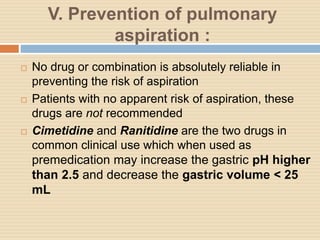
 No drug or combination is absolutely reliable in
preventing the risk of aspiration
 Patients with no apparent risk of aspiration, these
drugs are not recommended
 Cimetidine and Ranitidine are the two drugs in
common clinical use which when used as
premedication may increase the gastric pH higher
than 2.5 and decrease the gastric volume < 25
mL
Factors predisposing to
aspiration :
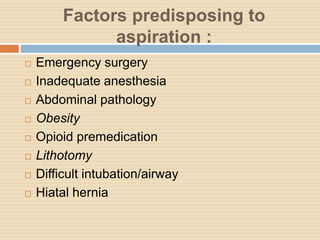
 Emergency surgery
 Inadequate anesthesia
 Abdominal pathology
 Obesity
 Opioid premedication
 Lithotomy
 Difficult intubation/airway
 Hiatal hernia
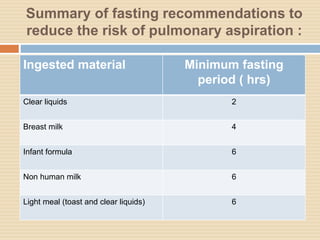
Summary of fasting recommendations to
reduce the risk of pulmonary aspiration :
Ingested material Minimum fasting
period ( hrs)
Clear liquids 2
Breast milk 4
Infant formula 6
Non human milk 6
Light meal (toast and clear liquids) 6
 Reduce the secretion of acid into the stomach
by about 70% by blocking the effect of histamine
on receptors in the stomach wall
 Used for prevention of acid aspiration
syndrome
Ranitidine seems to be better than
cimetidine due to:
 its longer duration of action
 its lower incidences of side effects and drug
interactions
 Doses : Cimetidine – 400 mg (PO)
Ranitidine – 150 mg (PO), 90 to 150
min before induction of anesthesia
 Also effective when given IV 45 to 60 min
before induction, but are unable to influence
acid already present in the stomach, which
depends on gastric emptying
 Oral sodium citrate 15-30 minutes before
induction can also be used for this purpose
Premedication in pediatric
patient :
 Includes age-specific psychological
preparation
 Topical anesthetic creams are often prescribed
for children before cannulation
B. Pharmacological preparation
for pediatric patient :
Oral premedication is preferred for patients
without IV access
1. Midazolam (0.5 – 0.75 mg/kg) in a flavored
oral preparation produces sedation.
Roohafza, honey etc can be used as effective
flavoring agents. Intranasal midazolam has
faster onset but causes nasal burning.
2. Paracetamol syrup - 5-10mg/kg
10-15mg/kg rectally produces analgesic
effects.
3. Ketamine (5 – 10 mg /kg) prescribed 20 to 30
min before induction facilitates smooth
separation from parents
4. Opiods : In the absence of an IV catheter,
transmucosal administration of fentanyl
(lollipop) is effective in producing sedation.
Preoperative Surgical Antibiotic
Prophylaxis :
 Antibiotic selection :
Cephalosporins (against skin microbes) e,g ceftriaxone,
cefotaxime, clindamycin, metronidazole
Vancomycin (anaerobic and gram-negative microbes
 Timing :
• 1 hour prior to incision
• 2 hours before incision for vancomycin
• Prior to tourniquet inflation
• Redose after two half lives (Cefazolin has half-
life of 2 hours so redose if surgical procedure >
4 hours)
Pre op Medication instruction
guideline :
Medication to be continued on day
of Surgery :
 Anti hypertensive
 Diuretics
 Cardiac medication
 Antidepressant – anti anxiety
 Thyroid, asthma medication
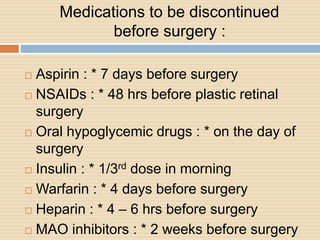
Medications to be discontinued
before surgery :
 Aspirin : * 7 days before surgery
 NSAIDs : * 48 hrs before plastic retinal
surgery
 Oral hypoglycemic drugs : * on the day of
surgery
 Insulin : * 1/3rd dose in morning
 Warfarin : * 4 days before surgery
 Heparin : * 4 – 6 hrs before surgery
 MAO inhibitors : * 2 weeks before surgery
S
Thank you

Premedicant drugs / premedication

  • 1.
  • 2.
    Introduction Preoperative medication consistsof :  psychological  pharmacological preparation. How the patient should be like before entering OT:  free from apprehension  sedated  arousable  cooperative.
  • 3.
    Goals of preoperative medication To relieve anxiety  Sedation  Amnesia  Analgesia  Drying of airway secretions  To decrease the chances of aspiration.  To produce haemodynamic stability  To prevent PONV.  To control infection.
  • 4.
     Reduction ofanesthetic requirements  Facilitation of smooth induction of anesthesia  Prophylaxis against allergic reactions.
  • 5.
    Adminstration of premedication : 1-2 hr before the surgery  night before. Prescribed medications:  2 hours prior to surgery  small sip of water (<30 ml) orally
  • 6.
    Ideal premedicant drug:  Anxiolytic  Analgesic  Sedative  Amnesic  Safe for patient  Painless and easy to administer
  • 7.
     Highly reliableand specific  Rapid onset and rapidly cleared  Free of side effect and interaction with other drugs  Should not produce undue depression of cardiovascular, respiratory and central nervous system
  • 8.
  • 10.
    I. Anxiolytics /Sedative / Hypnotic :  – Benzodiazepines (still commonly used)  · Diazepam  · Lorazepam  · Midazolam  · Alprazolam  – Barbiturates (not used much)  · Secobarbital  · Pentobarbital
  • 11.
    Benzodiazepines :  Produceanxiolysis, amnesia and sedation  Act predominantly on GABA receptors in the CNS.  Minimal respiratory and cardiac depression  Do not produce nausea and vomiting  They are not analgesics  Crosses placental barrier and may cause neonatal depression
  • 12.
    Diazepam  Can beused as a sole agent as for cathetrisation, cardioversion, bronchoscopy.  Doses : 0.25 to 0.5 mg/kg orally 0.25 mg/kg IM 0.3 to 0.6 mg/kg IV as an inducing agent Dose requirements decrease 10% per decade of patient’s age.  Flumazenil, is effective in reversing the sedative effects.
  • 13.
    Lorazepam  A newand effective sedative/amnesic/anxioloytic  Has stabilising effect on cardiovascular and respiratory systems  Twice as potent as midazolam.  used for lengthy procedures.  Obesity prolongs the sedative effects of Lorazepam.  Dose for premedication :  Oral – 50 µg/kg, not more than 4 mg (can be given 90 min before anesthesia)  0.03–0.05 mg/kg IM  Sedation : 0.03–0.04 mg/kg IV
  • 14.
    Midazolam  Water solublebenzodiazepine with painless administration  Amnesic effects are more potent than sedative effects.  choice of drug for out patient surgery and pediatric premedication  Capable of crossing the BBB with effects ranging from tranquillization to full anesthesia.  Respiratory depressant  Hazardous in hypovolemic patients.
  • 15.
    Midazolam  Patients withdecreased intracranial compliance show little or no change in ICP with midazolam  Usual dose : 0.15 to 0.3 mg/kg IV  Lesser dose to be used in elderly and obese patients  0.5 to 0.75 mg/kg orally produces anxiolysis and degree of tranquillity within 30 min  Pediatric dose : 0.1 mg/kg IV or IM  Intranasal midazolam 0.3 mg/kg has quicker onset of action than oral midazolam.
  • 16.
    II. Opioid analgesics – Morphine  – Pethidine  – Fentanyl They differ in duration of action ; can be given parentally. • administered preoperatively for sedation • control hypertension during tracheal intubation • analgesia
  • 17.
    For preoperative analgesia,the use of IV fentanyl is preferred : • rapid onset • short duration  Fentanyl is also available as transdermal patches.
  • 18.
    Morphine  An opiumalkaloid and a standard potent addictive analgesic /sedative/anxiolytic  May lead to GI spasm, biliary tract spasm, even renal tract spasm.  Causes constipation and urinary retention  Depresses respiration both in rate and depth  Passes through placental barrier  1mg of IV morphine ≈ 4 mg of oral morphine  Dose : 1.0 – 2.5 mg IV
  • 19.
    Morphine  Morphine shouldbe carefully used in :  Extremes of ages  Respiratory problems  Liver and kidney pathology  In patients with increased ICP  Pregnancy
  • 20.
    Fentanyl  Potent narcoticanalgesic ; 100 times more potent than morphine  Metabolised in liver and excreted through urine and feces  Respiratory depression and rigidity of respiratory muscles which can be satisfactorily treated with naloxone  Less nausea and vomiting  Cautious use in patients with COPD, head injury and patients on MAO inhibitors  Dose : 1-5 µg/kg IV
  • 21.
    III. Anticholinergic drugs Threedrugs are in use as preanesthetic :  – Atropine  – Hyoscine  – Glycopyrrolate While the first two crosses the BBB, glycopyrrolate does not cross BBB and is not absorbed from GI tract
  • 22.
    Doses : • Atropine0.3 – 0.4mg IV : used to treat bradycardia and to control secreations. • Hyoscine(scopolamine) 0.4 mg IV : more antisialogogue , causes sedation and amnesia, so avoided in elderly patients • Glycopyrrolate (dose 0.1 – 0.3 mg IV) : longer duration of action, and less tachycardia
  • 23.
    Clinical effects of anticholinergics Antisialogogue effects : Glycopyrrolate and hyoscine are more potent than atropine, reduce secretions and bradycardia after succinylcholine  Sedative and amnesic effect : In combination with morphine, hyoscine produces powerful sedative and amnesia effects  Prevention of bradycardia : Atropine is used prevent halothane bradycardia
  • 24.
    Comparitive effects of anticholinergics: Atropine Hyoscine Glycopyrrola te Antisialogogue effect + +++ ++ Sedative and amnesic effects + +++ 0 Relaxation of gastro- oesophageal sphincter ++ ++ ++ Increased heart rate +++ + ++
  • 25.
    Side effects of anticholinergics:  CNS toxicity : Atropine produces central anticholinergic syndrome of the CNS, producing restlesness, agitation, somnolence and convulsions. Physostigmine 1-2 mg IV reverses the effects when given with glycopyrrolate  Reduction in lower oesophageal sphincter tone  Tachycardia & Hyperthermia  Mydriasis and cycloplegia  Unpleasant and excessive drying of mouth
  • 26.
    IV. Antiemetics  –Ondansetron  – Metoclopramide – most commonly used  – Phenothiazines – Promethazine used Antihistamnies and antiemetics enhance gastric emptying and are used to prevent nausea, vomiting in patients which is the single most common factor delaying recovery in patients. Additional usage includes :  Sedative property
  • 27.
    Ondansetron  Used forprevention of PONV in a dose of 4 mg IV  In children, a dose of 0.1 mg/kg upto 4 mg may be used in vomiting prone children  Elimination half life is 3.5 to 4 h in adults  Side effects include headache, constipation, diarrhoea, sedation, a sense of flushing, warmth and so on.
  • 28.
    Metoclopramide  water solubleantiemetic drug used parenterally, orally and even rectally  Dose : 0.15 to 0.3 mg/kg IV, effect lasts for 12h  Increases the rate of gastric emptying, and causes some increase in peristalsis of gut  May be used in emergency anesthesia  Indicated in patients with hiatus hernia, obese, and duodenal ulcer.  Acts both centrally and peripherally
  • 29.
    Metoclopramide • Central Action: Acting as dopamine antagonist, acts on medullary vomiting center, producing anti- emetic effect. • Peripheral Action : Enhances gastric emptying so that gastric components are passed earlier, preventing gastric aspiration. NOTE : Atropine should be withheld until induction of anesthesia as it blocks effects of metoclopramide
  • 30.
    V. Prevention ofpulmonary aspiration :  No drug or combination is absolutely reliable in preventing the risk of aspiration  Patients with no apparent risk of aspiration, these drugs are not recommended  Cimetidine and Ranitidine are the two drugs in common clinical use which when used as premedication may increase the gastric pH higher than 2.5 and decrease the gastric volume < 25 mL
  • 31.
    Factors predisposing to aspiration:  Emergency surgery  Inadequate anesthesia  Abdominal pathology  Obesity  Opioid premedication  Lithotomy  Difficult intubation/airway  Hiatal hernia
  • 32.
    Summary of fastingrecommendations to reduce the risk of pulmonary aspiration : Ingested material Minimum fasting period ( hrs) Clear liquids 2 Breast milk 4 Infant formula 6 Non human milk 6 Light meal (toast and clear liquids) 6
  • 33.
     Reduce thesecretion of acid into the stomach by about 70% by blocking the effect of histamine on receptors in the stomach wall  Used for prevention of acid aspiration syndrome Ranitidine seems to be better than cimetidine due to:  its longer duration of action  its lower incidences of side effects and drug interactions
  • 34.
     Doses :Cimetidine – 400 mg (PO) Ranitidine – 150 mg (PO), 90 to 150 min before induction of anesthesia  Also effective when given IV 45 to 60 min before induction, but are unable to influence acid already present in the stomach, which depends on gastric emptying  Oral sodium citrate 15-30 minutes before induction can also be used for this purpose
  • 35.
    Premedication in pediatric patient:  Includes age-specific psychological preparation  Topical anesthetic creams are often prescribed for children before cannulation
  • 36.
    B. Pharmacological preparation forpediatric patient : Oral premedication is preferred for patients without IV access 1. Midazolam (0.5 – 0.75 mg/kg) in a flavored oral preparation produces sedation. Roohafza, honey etc can be used as effective flavoring agents. Intranasal midazolam has faster onset but causes nasal burning. 2. Paracetamol syrup - 5-10mg/kg 10-15mg/kg rectally produces analgesic effects.
  • 37.
    3. Ketamine (5– 10 mg /kg) prescribed 20 to 30 min before induction facilitates smooth separation from parents 4. Opiods : In the absence of an IV catheter, transmucosal administration of fentanyl (lollipop) is effective in producing sedation.
  • 38.
    Preoperative Surgical Antibiotic Prophylaxis:  Antibiotic selection : Cephalosporins (against skin microbes) e,g ceftriaxone, cefotaxime, clindamycin, metronidazole Vancomycin (anaerobic and gram-negative microbes
  • 39.
     Timing : •1 hour prior to incision • 2 hours before incision for vancomycin • Prior to tourniquet inflation • Redose after two half lives (Cefazolin has half- life of 2 hours so redose if surgical procedure > 4 hours)
  • 40.
    Pre op Medicationinstruction guideline : Medication to be continued on day of Surgery :  Anti hypertensive  Diuretics  Cardiac medication  Antidepressant – anti anxiety  Thyroid, asthma medication
  • 41.
    Medications to bediscontinued before surgery :  Aspirin : * 7 days before surgery  NSAIDs : * 48 hrs before plastic retinal surgery  Oral hypoglycemic drugs : * on the day of surgery  Insulin : * 1/3rd dose in morning  Warfarin : * 4 days before surgery  Heparin : * 4 – 6 hrs before surgery  MAO inhibitors : * 2 weeks before surgery
  • 42.

Editor's Notes

  • #13 I.M diazepam not suitable for inconsistent absorption. Injectable solution is irritant and may cause thrombosis following intravenous injection. Elimination half-life increases progressively with increasing age.
  • #14 No local reaction to i.m. Reported. (obesity) -> reflecting the larger volume of distribution and longer elimination half-time. ( 90 min ) -> With this dose, maximal anterograde amnesia lasting upto 6 hours occurs, and sedation is not excessive. Larger doses produce additional sedation without increasing amnesia.
  • #15 Midazolam has replaced lorazepam and diazepam for preoperative medication and conscious sedation. May cause fall in SVR, thus reducing pre- and after-load, hazardous. Res Dep, , so, should be used cautiously in pts with obstructive airway disease and in cases with opioids. (Amnesic effects) -> Thus, patient may stay awake, but, remain amnesic for events and conversations for several hours.
  • #16 Thus, midazolam is an acceptable alternative to barbiturates for induction of anesthesia in patients with intracranial pathology.
  • #19  (spasm) avoided in renal and biliary colic (barrier) effects fetus and prolongs childbirth (tolerance) and dose needs to be increased to obtain the same effect.
  • #26 (inc. Dead space) compensated by increased ventilation (m & c ) (miotic eye drops should be continued in patients with glaucoma)
  • #29 (E. A. ) for hastening the emptying of somach
  • #31 (RELIABLe) and none eliminates the need for protecting the airway ( < 25 ml ) which is theoretically desirable to lower the incidence and severity of acid aspiration syndrome.
  • #35 These are theoretically desirable to lower the incidence and severity of acid aspiration syndrome.
  • #39 Surgical antibiotic prophylaxis has become an outcome measure on which hospital and anesthesia performance are measured
  • #41 Patients on alcohol dependence should receive diazepam group of drugs to prevent withdrawal symptoms (withdrawal diuretics) -> hypervolemia, pulmonary oedema, cardiac failure. Continue steroid therapy for pts at risk of adrenal supression
  • #42 MAO inhibitors produce severe interaction with sedatives, hypnotics, narcotic analgesics and anesthetics, so ,discontinue to bring mao level in the brain normal at that time. Insulin -> include glucose to provide energy, to include insulin to provide catabolism and reduce customary dose in the morning to decrease the risk of hypoglycemia.