Brancusi A
Modern
Sculptor
Presented By:
bruceblackart.com
Constantin Brâncuşi, or Brancusi, (February 19, 1876 – March 16,
  1957), was an internationally renowned Romanian sculptor,
  born in Hobiţa, Gorj. His sculptures blend simplicity and
  sophistication that led the way for modernist sculptors.
   At 13 he went to Craiova where he
    worked at a grocery store for
    several years. When he was 18,
    impressed by Brâncuşi's talent for
    carving, his employer financed his
    education at the Craiova School of
    Crafts (Şcoala de Meserii). There
    he indulged his love for
    woodworking, taught himself to
    read and write, and graduated
    with honors in 1898. He then
    enrolled in the Bucharest School of
    Fine Arts,where he received
    academic training in sculpture. He
    worked hard, and quickly
    distinguished himself as talented.
   In 1903 Brancusi traveled to Munich and from
    there to Paris. In Paris, he was welcomed by the
    community of artists and intellectuals brimming
    with new ideas.
   He worked for two years in the workshop of
    Antonin Mercié of the École des Beaux-Arts,
    and was invited to enter the workshop of
    Auguste Rodin.
    Even though he admired the eminent Rodin he
    left the Rodin studio after only two months,
    saying, "Nothing can grow under big trees."
 Afterleaving Rodin's workshop, Brâncuşi
  began developing the revolutionary style
  for which he is known.

 Hisfirst commissioned work, "The
  Prayer", was part of a gravestone
  memorial. It depicts a young woman
  crossing herself as she kneels.

 With this work, Brancusi moved toward
  abstraction saying, he was interested "not
  the outer form but the idea, the essence of
  things.“



   He began doing more carving, rather than the method
    popular with his contemporaries, that of modeling in clay or
    plaster which would be cast in metal, and by 1908 he worked
    almost exclusively by carving.
The Kiss   Maiastra
 In 1920 he added to his growing fame with the
  entry of "Princess X" in the Salon. The phallic
  shape of the piece scandalized the Salon, and
  despite Brâncuşi's explanation that it was an
  anonymous portrait, removed it from the
  exhibition. Around this time he began crafting
  the bases for his sculptures with much care and
  originality because he considered them
  important to the works themselves.
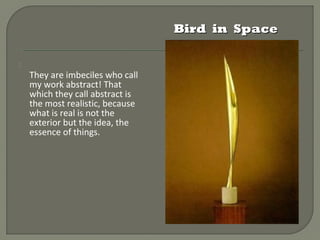
 He began working on the group of sculptures
  that are known as "Bird in Space" — simple
  shapes representing a bird in flight. The works
  are based on his earlier "Maiastra" series. In
  Romanian folklore the Maiastra is a beautiful
  golden bird who foretells the future and cures
  the blind. Over the following 20 years, Brâncuşi
  would make 20-some versions of "Bird in Space"
  out of marble or bronze.
Bird in Space


    They are imbeciles who
    call my work abstract!
    That which they call
    abstract is the most
    realistic, because what is
    real is not the exterior but
    the idea, the essence of
    things.
 World-wide     fame in 1933 brought him the
  commission for the building of a meditation
  temple in India for Maharajah of Indore.
  Ufortunately, when Brâncuşi went to India in
  1937 to complete the plans and begin
  construction, the Mahrajah was away and
  lost interest in the project when he returned.
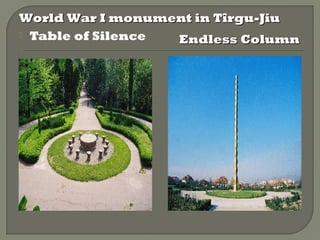
 In 1938, he finished the World War I
  monument in Tîrgu-Jiu where he had spent
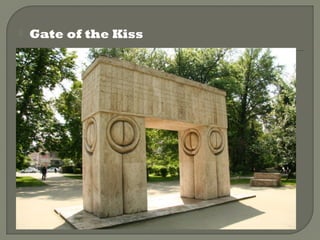
  much of his childhood. "Table of
  Silence", "Gate of the Kiss", and
  "Endless Column” commemorate the
  courage and sacrifice of Romanian civilians
  who in 1916 fought off a German invasion.
  The restoration of this ensemble was
  spearheaded by the World Monuments Fund
  and was completed in 2004.
World War I monument in Tîrgu-Jiu
 Table of Silence Endless Column
 Gate   of the Kiss
 The Târgu Jiu ensemble marks the apex of his
  artistic career. In his remaining 19 years he
  created less than 15 pieces, mostly reworking
  earlier themes, and while his fame grew he
  withdrew. In 1956 Life magazine reported,
  "Wearing white pajamas and a yellow
  gnomelike cap, Brâncuşi today hobbles about
  his studio tenderly caring for and communing
  with the silent host of fish birds, heads, and
  endless columns which he created."
 Brâncuşi was cared for in his later years by a
  Romanian refugee couple. He became a
  French citizen in 1952 in order to make the
  caregivers his heirs, and to bequeath his studio
  and its contents to the Musée National d'Art
  Moderne in Paris.
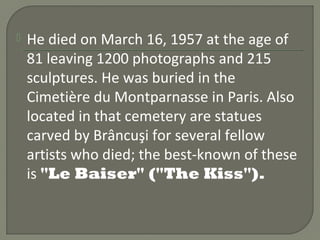
 Hedied on March 16, 1957 at the
 age of 81 leaving 1200 photographs
 and 215 sculptures. He was buried in
 the Cimetière du Montparnasse in
 Paris. Also located in that cemetery
 are statues carved by Brâncuşi for
 several fellow artists who died; the
 best-known of these is "Le Baiser"
 ("The Kiss").
The statue - The Kiss
 His works are housed in the Museum of Modern
  Art (New York) and in the National Museum of
  Art of Romania (Bucharest), as well as in other
  major museums around the world. The
  Philadelphia Museum of Art currently has the
  largest collection of Brancusi sculptures in the
  United States.
 A reconstruction of Brancusi's onetime studio in
  Paris is open to the public. It is close to the
  Pompidou Centre, in the rue Rambuteau. He
  bequeathed part of his collection to the French
  state on condition that his workshop be rebuilt
  as it was on the day he died.
 Brâncuşi was elected post-mortem to the
  Romanian Academy in 1990.
 In 2002, a sculpture by Brâncuşi named
  "Danaide" sold for $18.1 million, the highest that
  a sculpture piece had ever sold for at auction.
  In May 2005, a piece from the "Bird in Space"
  series broke that record, selling for $27.5 million
  in a Christie's auction.
Mademoiselle Pogany"


“When you see a fish you don't think of its scales, do you?
You think of its speed, its floating, flashing body seen
through the water... If I made fins and eyes and scales, I
would arrest its movement, give a pattern or shape of
reality. I want just the flash of its spirit.” -Brancusi
Bust of a boy   La Sagesse de la Terre
Le Coq


         Newborn
Socrates
                                  A Muse


 Don't look for obscure formulas or mystery in my work.
 It is pure joy that I offer you. Look at my sculptures
 until you see them. Those closest to God have seen
 them.
  -Brancusi
Madame L.R   Torso of Young Man
A reconstruction of Brancusi's studio
 in Paris


“Create like a god, command like a king, work like a
slave.” -Brancusi
End of Slide Show

   Presented by: Bruce Black Art.com

Brancusi

  • 1.
  • 2.
    Constantin Brâncuşi, orBrancusi, (February 19, 1876 – March 16, 1957), was an internationally renowned Romanian sculptor, born in Hobiţa, Gorj. His sculptures blend simplicity and sophistication that led the way for modernist sculptors.
  • 3.
    At 13 he went to Craiova where he worked at a grocery store for several years. When he was 18, impressed by Brâncuşi's talent for carving, his employer financed his education at the Craiova School of Crafts (Şcoala de Meserii). There he indulged his love for woodworking, taught himself to read and write, and graduated with honors in 1898. He then enrolled in the Bucharest School of Fine Arts,where he received academic training in sculpture. He worked hard, and quickly distinguished himself as talented.
  • 4.
    In 1903 Brancusi traveled to Munich and from there to Paris. In Paris, he was welcomed by the community of artists and intellectuals brimming with new ideas.  He worked for two years in the workshop of Antonin Mercié of the École des Beaux-Arts, and was invited to enter the workshop of Auguste Rodin.  Even though he admired the eminent Rodin he left the Rodin studio after only two months, saying, "Nothing can grow under big trees."
  • 5.
     Afterleaving Rodin'sworkshop, Brâncuşi began developing the revolutionary style for which he is known.  Hisfirst commissioned work, "The Prayer", was part of a gravestone memorial. It depicts a young woman crossing herself as she kneels.  With this work, Brancusi moved toward abstraction saying, he was interested "not the outer form but the idea, the essence of things.“
  • 6.
      He began doing more carving, rather than the method popular with his contemporaries, that of modeling in clay or plaster which would be cast in metal, and by 1908 he worked almost exclusively by carving.
  • 7.
    The Kiss Maiastra
  • 8.
     In 1920he added to his growing fame with the entry of "Princess X" in the Salon. The phallic shape of the piece scandalized the Salon, and despite Brâncuşi's explanation that it was an anonymous portrait, removed it from the exhibition. Around this time he began crafting the bases for his sculptures with much care and originality because he considered them important to the works themselves.  He began working on the group of sculptures that are known as "Bird in Space" — simple shapes representing a bird in flight. The works are based on his earlier "Maiastra" series. In Romanian folklore the Maiastra is a beautiful golden bird who foretells the future and cures the blind. Over the following 20 years, Brâncuşi would make 20-some versions of "Bird in Space" out of marble or bronze.
  • 9.
    Bird in Space  They are imbeciles who call my work abstract! That which they call abstract is the most realistic, because what is real is not the exterior but the idea, the essence of things.
  • 10.
     World-wide fame in 1933 brought him the commission for the building of a meditation temple in India for Maharajah of Indore. Ufortunately, when Brâncuşi went to India in 1937 to complete the plans and begin construction, the Mahrajah was away and lost interest in the project when he returned.  In 1938, he finished the World War I monument in Tîrgu-Jiu where he had spent much of his childhood. "Table of Silence", "Gate of the Kiss", and "Endless Column” commemorate the courage and sacrifice of Romanian civilians who in 1916 fought off a German invasion. The restoration of this ensemble was spearheaded by the World Monuments Fund and was completed in 2004.
  • 11.
    World War Imonument in Tîrgu-Jiu  Table of Silence Endless Column
  • 12.
     Gate of the Kiss
  • 13.
     The TârguJiu ensemble marks the apex of his artistic career. In his remaining 19 years he created less than 15 pieces, mostly reworking earlier themes, and while his fame grew he withdrew. In 1956 Life magazine reported, "Wearing white pajamas and a yellow gnomelike cap, Brâncuşi today hobbles about his studio tenderly caring for and communing with the silent host of fish birds, heads, and endless columns which he created."  Brâncuşi was cared for in his later years by a Romanian refugee couple. He became a French citizen in 1952 in order to make the caregivers his heirs, and to bequeath his studio and its contents to the Musée National d'Art Moderne in Paris.
  • 14.
     Hedied onMarch 16, 1957 at the age of 81 leaving 1200 photographs and 215 sculptures. He was buried in the Cimetière du Montparnasse in Paris. Also located in that cemetery are statues carved by Brâncuşi for several fellow artists who died; the best-known of these is "Le Baiser" ("The Kiss").
  • 15.
    The statue -The Kiss
  • 16.
     His worksare housed in the Museum of Modern Art (New York) and in the National Museum of Art of Romania (Bucharest), as well as in other major museums around the world. The Philadelphia Museum of Art currently has the largest collection of Brancusi sculptures in the United States.  A reconstruction of Brancusi's onetime studio in Paris is open to the public. It is close to the Pompidou Centre, in the rue Rambuteau. He bequeathed part of his collection to the French state on condition that his workshop be rebuilt as it was on the day he died.  Brâncuşi was elected post-mortem to the Romanian Academy in 1990.  In 2002, a sculpture by Brâncuşi named "Danaide" sold for $18.1 million, the highest that a sculpture piece had ever sold for at auction. In May 2005, a piece from the "Bird in Space" series broke that record, selling for $27.5 million in a Christie's auction.
  • 17.
    Mademoiselle Pogany" “When yousee a fish you don't think of its scales, do you? You think of its speed, its floating, flashing body seen through the water... If I made fins and eyes and scales, I would arrest its movement, give a pattern or shape of reality. I want just the flash of its spirit.” -Brancusi
  • 18.
    Bust of aboy La Sagesse de la Terre
  • 19.
    Le Coq Newborn
  • 20.
    Socrates A Muse Don't look for obscure formulas or mystery in my work. It is pure joy that I offer you. Look at my sculptures until you see them. Those closest to God have seen them. -Brancusi
  • 21.
    Madame L.R Torso of Young Man
  • 22.
    A reconstruction ofBrancusi's studio in Paris “Create like a god, command like a king, work like a slave.” -Brancusi
  • 23.
    End of SlideShow  Presented by: Bruce Black Art.com