1
PREFORMULATION STUDIES :
PHYSICOCHEMICAL
CHATEACTERIZATION OF NEW
DRUG MOLECULES
Mrs. Chaudhari J. V.
Assistant Professor
Department of Pharmaceutics
SJVPM’s
Rasiklal M. Dhariwal Pharmaceutical Education
& Research,
Chinchwad, Pune-19
CONTENTS
2
1 Introduction
2 Major area of preformulation
research
a) Organoleptic characters
b) Bulk characterization
c) Solubility characters
d) Stability characters
3 Conclusion
4 Reference
CONTENTS
3
Preformulation
.
Preformulation is the first step in the rational development of
dosages form of a drug substance/new chemical entity.
It can be defined as an investigation of physical and
chemical properties of the drug substances alone and when
combined with excipients, in order to develop a stable, safe,
effective and affordable dosage form.
Objectives
4
• To develop the elegant dosage forms (stable, safe, effective
and affordable).
• It is important to have an understanding of the physical
description of a drug substance before dosage form
development.
• It is first step in rational development of a dosage form of a
drug substance before dosage form development.
• It generates useful information to the formulator to design an
optimum drug delivery system.
Goals
5
 To establish the physico-chemical parameters of
new drug substance.
 To establish the physical characteristics.
 To establish the kinetic rate profile.
 To establish the compatibility with the common
excipient.
 To choose the correct form of drug substance
Major Area of Preformulation
Research
6
1. ORGANOLEPTIC CHARACTERS
2. BULK
CHARACTERS
3. SOLUBILITY
ANALYSIS
4. STABILITY
ANALYSIS
Solid state
characteristics
Ionization constant-
PKa
Stability in toxicology
formulations
Powder flow
properties
pH solubility profile Solution stability
Densities Common ion effect pH rate profile
Crystalinty and
polymorphism
Thermal effects Solid state stability
Hygroscopicity Solubilization Bulk stability
Fine particle
characterization
Partition co-efficient Compatibility
Dissolution
ORGANOLEPTIC CHARACTERS
7
❖ Colour, odour, taste of the new drug must
be recorded
COLOUR ODOUR TASTE
❑Off-white ❑pungent ❑Acidic
❑Cream yellow ❑sulphurous ❑Bitter
❑tan ❑Fruity ❑Bland
❑shiny ❑Aromatic ❑Intense
❑Odourless ❑Sweet
❑Tasteless
BULK CHARACTERIZATION
Crystallinity
8
• Crystalhabit & internal structure
of drug can affect bulk and
physicochemical property of molecule.
• Crystal habit is description of outer appearance of
crystal.
• Internal structure is molecular arrangement within
the solid.
• Change with internal structure usually alters crystal
habit.
Eg. Conversion of sodium salt to its free acid form
produce both change in internal structure & crystal
habit.
Different shapes of
crystals
9
Different shapes of
crystals
10
 Depending on internal structure compounds is classified
as
1. Crystalline
2. Amorphous
 Crystalline compounds are characterized by
repetitious pacing of constituent atom or molecule in
three dimensional array.
 In amorphous form atom or molecule are randomly
placed.
 Solubility & dissolution rate are greater for amorphous
form than crystalline, as amorphous form has higher
thermodynamic energy.
Eg. Amorphous form of Novobiocin is
well absorbed whereas crystalline
form results in poor absorption.
11
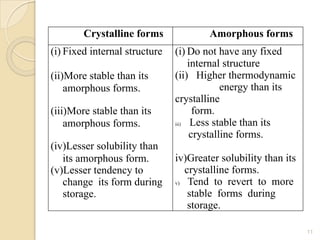
Crystalline forms Amorphous forms
(i) Fixed internal structure
(ii)More stable than its
amorphous forms.
(iii)More stable than its
amorphous forms.
(iv)Lesser solubility than
its amorphous form.
(v)Lesser tendency to
change its form during
storage.
(i) Do not have any fixed
internal structure
(ii) Higher thermodynamic
energy than its
crystalline
form.
iii) Less stable than its
crystalline forms.
iv)Greater solubility than its
crystalline forms.
v) Tend to revert to more
stable forms during
storage.
Polymorphism
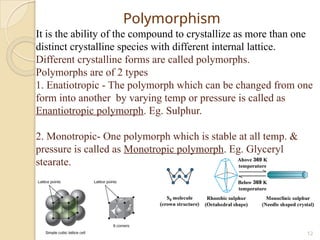
It is the ability of the compound to crystallize as more than one
distinct crystalline species with different internal lattice.
Different crystalline forms are called polymorphs.
Polymorphs are of 2 types
1. Enatiotropic - The polymorph which can be changed from one
form into another by varying temp or pressure is called as
Enantiotropic polymorph. Eg. Sulphur.
2. Monotropic- One polymorph which is stable at all temp. &
pressure is called as Monotropic polymorph. Eg. Glyceryl
stearate.
12
Polymorphism
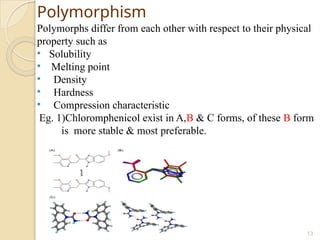
Polymorphs differ from each other with respect to their physical
property such as
• Solubility
• Melting point
• Density
• Hardness
• Compression characteristic
Eg. 1)Chloromphenicol exist in A,B & C forms, of these B form
is more stable & most preferable.
13
Analytical methods for the characterization of solid
forms
• Optical crystallography
• Hot stage microscopy
• Thermal analysis (Differential Scanning Calorimetry (DSC),
Differential Thermal Analysis DTA )
• X-ray diffraction
• Infrared (IR) spectroscopy
• Proton magnetic resonance (PMR)
• Nuclear magnetic resonance (NMR)
• Scanning electron microscopy (SEM)
• Microcolorimetry
• Melting point determination
14
HYGROSCOPICITY
15
• Many drug substances, particularly water –soluble salt forms,
have a tendency to adsorb atmospheric moisture.
• Adsorption and moisture content depend upon the
• atmospheric humidity,
• temperature,
• surface area,
• exposure and
• the mechanism of moisture uptake.
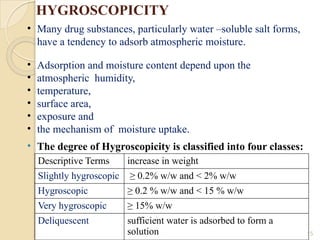
• The degree of Hygroscopicity is classified into four classes:
Descriptive Terms increase in weight
Slightly hygroscopic ≥ 0.2% w/w and < 2% w/w
Hygroscopic ≥ 0.2 % w/w and < 15 % w/w
Very hygroscopic ≥ 15% w/w
Deliquescent sufficient water is adsorbed to form a
solution
Hygroscopicity is tested by:
16
Samples are exposed to the moisture
exposed to controlled relative humidity
environments moisture uptake is monitored at
different time points
Analytical methods which is used are :
✔ Gravimetry
✔ Karl Fischer Titration
✔ Gas chromatography
PARTICLE SIZE
17
Particle size is characterized using these terms :
• Very coarse(#10/44), Coarse(#22/60), Moderately
coarse(#44/85),Fine(#85),Very fine(#120)
• Particle size can influence variety of important factors :
• Dissolution rate
• Suspendability
• Uniform distribution
• Penetrability
• Lack of grittiness
Methods to Determine Particle
Size
18
 Sieving (5µ-150µ)
 Microscopy(0.2µ-100µ)
 Sedimentation rate method(1µ-200µ)
 Light energy diffraction(0.5µ-500µ)
 Laser holography(1.4µ-100µ)
POWDER FLOW PROPERTIES
19
⮚ Powder flow properties can be affected by change in particle
size, shape & density.
⮚ The flow properties depends upon following-
1. Force of friction.
2. Cohesion between one particle to another.
⮚ Fine particle posses poor flow by filling void spaces between
larger particles causing packing & densification of particles.
⮚ By using glident we can alter the flow properties.
e.g. Talc
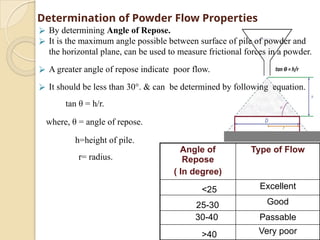
Determination of Powder Flow Properties
20
⮚ By determining Angle of Repose.
⮚ It is the maximum angle possible between surface of pile of powder and
the horizontal plane, can be used to measure frictional forces in a powder.
⮚ A greater angle of repose indicate poor flow.
⮚ It should be less than 30°. & can be determined by following equation.
tan θ = h/r.
where, θ = angle of repose.
h=height of pile.
r= radius.
Angle of
Repose
( In degree)
Type of Flow
<25 Excellent
25-30 Good
30-40 Passable
>40 Very poor
Determination of Powder Flow
Properties
21
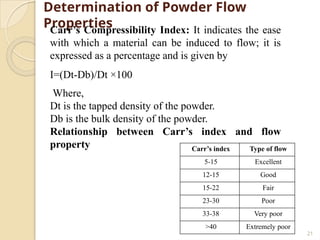
Carr’s Compressibility Index: It indicates the ease
with which a material can be induced to flow; it is
expressed as a percentage and is given by
I=(Dt-Db)/Dt ×100
Where,
Dt is the tapped density of the powder.
Db is the bulk density of the powder.
Relationship between Carr’s index and flow
property Carr’s index Type of flow
5-15 Excellent
12-15 Good
15-22 Fair
23-30 Poor
33-38 Very poor
>40 Extremely poor
Determination of Powder Flow
Properties
22
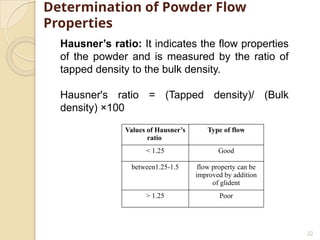
Hausner’s ratio: It indicates the flow properties
of the powder and is measured by the ratio of
tapped density to the bulk density.
Hausner's ratio = (Tapped density)/ (Bulk
density) ×100
Values of Hausner’s
ratio
Type of flow
< 1.25 Good
between1.25-1.5 flow property can be
improved by addition
of glident
> 1.25 Poor
SOLUBILITY STUDIES
23
1.Solution phase equilibrium with solid phase at a stated temperature
and pressure .
2.Determines amount of drug dissolved, amount of drug
available for absorption.
3.Solubility reduction is carried out in certain conditions:
❖Enhancement of chemical stability.
❖taste masking products.
❖Production of sustained release products.
pKa
determination
24
 pKa is the dissociation constant of a drug
 The un-ionized drug is lipid soluble thus permeates through lipid
membrane.
 The ionized substance is lipid insoluble therefore permeation is slow
 Degree of ionization depends on pH
Henderson-Hasselbalch equation
 For basic
compounds:
 For acidic
compounds:
[ionized]
[un −
ionized]
pH = pKa +
pH = pKa + [un − ionized]
[ionized]
10( pH − pKa )
%ionized =
1 +10( pH − pKa )
 Determined by uv spectroscopy, potentiometric titration, titrimetric
method
SOLUBILIZATION
⚫“Solubilization is defined as the spontaneous
passage of poorly water soluble solute molecules
into an aqueous solution of a soap or detergent in
which a thermodynamically stable solution is formed ”.
25
⮚ Addition of Surfactant
⮚ Addition of co-solvent
⮚ pH change method
⮚ Reduction of particle size
⮚ Temperature change method
⮚ Hydotrophy
⮚ Complexation
General Method of
Increasing the
Solubility
26
Partition Coefficient
27
• The ratio of a compound’s unionized species concentrations
in a mixture of two immiscible phases is known as the
partition coefficient.
This phenomenon is also commonly referred to as “P.”
To calculate the two-phase system’s partition coefficient, the
two phases must be in equilibrium with one another.
The solubility of each unionized species in this mixture is
quantified by this ratio.
Understanding the definitions of solutes, solvents, solutions,
and solubility is thus required to calculate a partition
coefficient.
• A solution is a homogeneous mixture of a solute and a solvent.
• The solute is the substance that dissolves in the solvent.
• Solubility refers to the degree to which a solute dissolves in a solvent.
Partition Coefficient
28
A partition coefficient is the ratio of
the concentration of a substance in
one medium or phase (C1) to the
concentration in a second phase
(C2) when the two concentrations
are at equilibrium; that is, partition
coefficient = (C1/C2)equil.
This also serves as a gauge of the solute’s hydrophobicity
or lipophilicity, respectively. Further this phenomenon is
crucial in figuring out how drugs are distributed throughout
our bodies.
29
Distribution coefficient
 The octanol-water system is widely accepted to explain these phenomenon.
 Buccal membrane: butanol-pentanol system
 Blood-Brain barrier: chloroform-cyclohexane
 Determined by SHAKE FLASK METHOD
The distribution coefficient measures the ratio of a compound’s ionized
and non-ionized species in a solution of two immiscible phases.
30
Distribution coefficient
 The organic solvent and an aqueous ammonia solution are shaken in a
separating funnel.
 Since the ammonia is soluble in both solvents, a dynamic equilibrium is
created when the mixture is allowed to settle.
 At this point, ammonia molecules are transitioning from the organic
layer to the aqueous layer at the same rate as they are doing the reverse:
The distribution coefficient has a significant impact on the drug’s ADME
properties in the context of pharmacokinetics, which refers to how the
body assimilates, metabolizes, and excretes a drug.
Therefore, a compound’s hydrophobicity (as determined by its distribution
coefficient) is a key factor in determining how drug-like it is.
STABILITY ANALYSIS
31
1. Solution stability
2. Solid state stability
SOLUTION STABILITY
▪ The decomposition of drug occurs through hydrolysis,
oxidation,
photolysis.
⮚ Hydrolysis (anaesthetics, vitamins etc )
a) Ester hydrolysis RCOOH+ ROH
acid alcohol
R’-COOR + H+
+ OH-
ester
b) Amide hydrolysis
RCONHR’ + H+
+ OH-
amide
RCOOH + H2N-R’
acid
amine
⮚Oxidation
 used to evaluate the stability of pharmaceutical preparations
 Eg : steroids, vitamins, antibiotics, epinephrine
 Autoxidation
Materials + molecular oxygen
homolytic fission
Free radicals are produced.
 Oxygen sensitivity is measured by bubbling air through the
compound or adding hydrogen peroxide.
32
⮚ Photolysis
pharmaceutical compounds
exposure to uv light
absorbs the radiant energy
undergoes degradative reactions
SOLID-STATE STABILITY
 1o
objective: identification of stable storage conditions.
identification of compatible excipients.
 Solid-state stability depends on the temperature , light, humidity,
polymorphic changes, oxidation.
33
Drug- excipient compatibility
34
 Compatibility test play a very important role in the preformulation
studies of oral dosage forms
 An incompatibility in the dosage form can result in any of the
following changes:
⮚ Changes in organoleptic properties
⮚ Changes in dissolution performance
⮚ Physical form conversion
⮚ An decrease in potency
METHOD
35
Drug + Excipients
(1:1)
Powder samples dispersed into glass ampoules
1 ampoule 1 ampoule (sample + water)
stored at a particular temperature (500
C) and analysed
 In emulsions the studies include measuring the critical micelle
concentration of the formulations
 For oral use preparations compatibility of the ingredients
(ethanol, glycerine, syrup, sucrose, buffers and preservatives)
36
REFERENCE
37
 Leon Lachman, Liberman. The theory and practice of
Industrial pharmacy, Edn 4. CBS publishing house, New
Delhi.2013 p:217-307.
 Brahmankar D.M, Jaiswal BS. Biopharmaceutics and
pharmacokinetics a Treatise, Edn 2. Vallabh
Prakashan, Nagpur. 2009; p: 37-45.

PREFORMULATION UNIT I THIRD YEAR B PHARM

  • 1.
    1 PREFORMULATION STUDIES : PHYSICOCHEMICAL CHATEACTERIZATIONOF NEW DRUG MOLECULES Mrs. Chaudhari J. V. Assistant Professor Department of Pharmaceutics SJVPM’s Rasiklal M. Dhariwal Pharmaceutical Education & Research, Chinchwad, Pune-19
  • 2.
    CONTENTS 2 1 Introduction 2 Majorarea of preformulation research a) Organoleptic characters b) Bulk characterization c) Solubility characters d) Stability characters 3 Conclusion 4 Reference
  • 3.
    CONTENTS 3 Preformulation . Preformulation is thefirst step in the rational development of dosages form of a drug substance/new chemical entity. It can be defined as an investigation of physical and chemical properties of the drug substances alone and when combined with excipients, in order to develop a stable, safe, effective and affordable dosage form.
  • 4.
    Objectives 4 • To developthe elegant dosage forms (stable, safe, effective and affordable). • It is important to have an understanding of the physical description of a drug substance before dosage form development. • It is first step in rational development of a dosage form of a drug substance before dosage form development. • It generates useful information to the formulator to design an optimum drug delivery system.
  • 5.
    Goals 5  To establishthe physico-chemical parameters of new drug substance.  To establish the physical characteristics.  To establish the kinetic rate profile.  To establish the compatibility with the common excipient.  To choose the correct form of drug substance
  • 6.
    Major Area ofPreformulation Research 6 1. ORGANOLEPTIC CHARACTERS 2. BULK CHARACTERS 3. SOLUBILITY ANALYSIS 4. STABILITY ANALYSIS Solid state characteristics Ionization constant- PKa Stability in toxicology formulations Powder flow properties pH solubility profile Solution stability Densities Common ion effect pH rate profile Crystalinty and polymorphism Thermal effects Solid state stability Hygroscopicity Solubilization Bulk stability Fine particle characterization Partition co-efficient Compatibility Dissolution
  • 7.
    ORGANOLEPTIC CHARACTERS 7 ❖ Colour,odour, taste of the new drug must be recorded COLOUR ODOUR TASTE ❑Off-white ❑pungent ❑Acidic ❑Cream yellow ❑sulphurous ❑Bitter ❑tan ❑Fruity ❑Bland ❑shiny ❑Aromatic ❑Intense ❑Odourless ❑Sweet ❑Tasteless
  • 8.
    BULK CHARACTERIZATION Crystallinity 8 • Crystalhabit& internal structure of drug can affect bulk and physicochemical property of molecule. • Crystal habit is description of outer appearance of crystal. • Internal structure is molecular arrangement within the solid. • Change with internal structure usually alters crystal habit. Eg. Conversion of sodium salt to its free acid form produce both change in internal structure & crystal habit.
  • 9.
  • 10.
    Different shapes of crystals 10 Depending on internal structure compounds is classified as 1. Crystalline 2. Amorphous  Crystalline compounds are characterized by repetitious pacing of constituent atom or molecule in three dimensional array.  In amorphous form atom or molecule are randomly placed.  Solubility & dissolution rate are greater for amorphous form than crystalline, as amorphous form has higher thermodynamic energy. Eg. Amorphous form of Novobiocin is well absorbed whereas crystalline form results in poor absorption.
  • 11.
    11 Crystalline forms Amorphousforms (i) Fixed internal structure (ii)More stable than its amorphous forms. (iii)More stable than its amorphous forms. (iv)Lesser solubility than its amorphous form. (v)Lesser tendency to change its form during storage. (i) Do not have any fixed internal structure (ii) Higher thermodynamic energy than its crystalline form. iii) Less stable than its crystalline forms. iv)Greater solubility than its crystalline forms. v) Tend to revert to more stable forms during storage.
  • 12.
    Polymorphism It is theability of the compound to crystallize as more than one distinct crystalline species with different internal lattice. Different crystalline forms are called polymorphs. Polymorphs are of 2 types 1. Enatiotropic - The polymorph which can be changed from one form into another by varying temp or pressure is called as Enantiotropic polymorph. Eg. Sulphur. 2. Monotropic- One polymorph which is stable at all temp. & pressure is called as Monotropic polymorph. Eg. Glyceryl stearate. 12
  • 13.
    Polymorphism Polymorphs differ fromeach other with respect to their physical property such as • Solubility • Melting point • Density • Hardness • Compression characteristic Eg. 1)Chloromphenicol exist in A,B & C forms, of these B form is more stable & most preferable. 13
  • 14.
    Analytical methods forthe characterization of solid forms • Optical crystallography • Hot stage microscopy • Thermal analysis (Differential Scanning Calorimetry (DSC), Differential Thermal Analysis DTA ) • X-ray diffraction • Infrared (IR) spectroscopy • Proton magnetic resonance (PMR) • Nuclear magnetic resonance (NMR) • Scanning electron microscopy (SEM) • Microcolorimetry • Melting point determination 14
  • 15.
    HYGROSCOPICITY 15 • Many drugsubstances, particularly water –soluble salt forms, have a tendency to adsorb atmospheric moisture. • Adsorption and moisture content depend upon the • atmospheric humidity, • temperature, • surface area, • exposure and • the mechanism of moisture uptake. • The degree of Hygroscopicity is classified into four classes: Descriptive Terms increase in weight Slightly hygroscopic ≥ 0.2% w/w and < 2% w/w Hygroscopic ≥ 0.2 % w/w and < 15 % w/w Very hygroscopic ≥ 15% w/w Deliquescent sufficient water is adsorbed to form a solution
  • 16.
    Hygroscopicity is testedby: 16 Samples are exposed to the moisture exposed to controlled relative humidity environments moisture uptake is monitored at different time points Analytical methods which is used are : ✔ Gravimetry ✔ Karl Fischer Titration ✔ Gas chromatography
  • 17.
    PARTICLE SIZE 17 Particle sizeis characterized using these terms : • Very coarse(#10/44), Coarse(#22/60), Moderately coarse(#44/85),Fine(#85),Very fine(#120) • Particle size can influence variety of important factors : • Dissolution rate • Suspendability • Uniform distribution • Penetrability • Lack of grittiness
  • 18.
    Methods to DetermineParticle Size 18  Sieving (5µ-150µ)  Microscopy(0.2µ-100µ)  Sedimentation rate method(1µ-200µ)  Light energy diffraction(0.5µ-500µ)  Laser holography(1.4µ-100µ)
  • 19.
    POWDER FLOW PROPERTIES 19 ⮚Powder flow properties can be affected by change in particle size, shape & density. ⮚ The flow properties depends upon following- 1. Force of friction. 2. Cohesion between one particle to another. ⮚ Fine particle posses poor flow by filling void spaces between larger particles causing packing & densification of particles. ⮚ By using glident we can alter the flow properties. e.g. Talc
  • 20.
    Determination of PowderFlow Properties 20 ⮚ By determining Angle of Repose. ⮚ It is the maximum angle possible between surface of pile of powder and the horizontal plane, can be used to measure frictional forces in a powder. ⮚ A greater angle of repose indicate poor flow. ⮚ It should be less than 30°. & can be determined by following equation. tan θ = h/r. where, θ = angle of repose. h=height of pile. r= radius. Angle of Repose ( In degree) Type of Flow <25 Excellent 25-30 Good 30-40 Passable >40 Very poor
  • 21.
    Determination of PowderFlow Properties 21 Carr’s Compressibility Index: It indicates the ease with which a material can be induced to flow; it is expressed as a percentage and is given by I=(Dt-Db)/Dt ×100 Where, Dt is the tapped density of the powder. Db is the bulk density of the powder. Relationship between Carr’s index and flow property Carr’s index Type of flow 5-15 Excellent 12-15 Good 15-22 Fair 23-30 Poor 33-38 Very poor >40 Extremely poor
  • 22.
    Determination of PowderFlow Properties 22 Hausner’s ratio: It indicates the flow properties of the powder and is measured by the ratio of tapped density to the bulk density. Hausner's ratio = (Tapped density)/ (Bulk density) ×100 Values of Hausner’s ratio Type of flow < 1.25 Good between1.25-1.5 flow property can be improved by addition of glident > 1.25 Poor
  • 23.
    SOLUBILITY STUDIES 23 1.Solution phaseequilibrium with solid phase at a stated temperature and pressure . 2.Determines amount of drug dissolved, amount of drug available for absorption. 3.Solubility reduction is carried out in certain conditions: ❖Enhancement of chemical stability. ❖taste masking products. ❖Production of sustained release products.
  • 24.
    pKa determination 24  pKa isthe dissociation constant of a drug  The un-ionized drug is lipid soluble thus permeates through lipid membrane.  The ionized substance is lipid insoluble therefore permeation is slow  Degree of ionization depends on pH Henderson-Hasselbalch equation  For basic compounds:  For acidic compounds: [ionized] [un − ionized] pH = pKa + pH = pKa + [un − ionized] [ionized] 10( pH − pKa ) %ionized = 1 +10( pH − pKa )  Determined by uv spectroscopy, potentiometric titration, titrimetric method
  • 25.
    SOLUBILIZATION ⚫“Solubilization is definedas the spontaneous passage of poorly water soluble solute molecules into an aqueous solution of a soap or detergent in which a thermodynamically stable solution is formed ”. 25
  • 26.
    ⮚ Addition ofSurfactant ⮚ Addition of co-solvent ⮚ pH change method ⮚ Reduction of particle size ⮚ Temperature change method ⮚ Hydotrophy ⮚ Complexation General Method of Increasing the Solubility 26
  • 27.
    Partition Coefficient 27 • Theratio of a compound’s unionized species concentrations in a mixture of two immiscible phases is known as the partition coefficient. This phenomenon is also commonly referred to as “P.” To calculate the two-phase system’s partition coefficient, the two phases must be in equilibrium with one another. The solubility of each unionized species in this mixture is quantified by this ratio. Understanding the definitions of solutes, solvents, solutions, and solubility is thus required to calculate a partition coefficient. • A solution is a homogeneous mixture of a solute and a solvent. • The solute is the substance that dissolves in the solvent. • Solubility refers to the degree to which a solute dissolves in a solvent.
  • 28.
    Partition Coefficient 28 A partitioncoefficient is the ratio of the concentration of a substance in one medium or phase (C1) to the concentration in a second phase (C2) when the two concentrations are at equilibrium; that is, partition coefficient = (C1/C2)equil. This also serves as a gauge of the solute’s hydrophobicity or lipophilicity, respectively. Further this phenomenon is crucial in figuring out how drugs are distributed throughout our bodies.
  • 29.
    29 Distribution coefficient  Theoctanol-water system is widely accepted to explain these phenomenon.  Buccal membrane: butanol-pentanol system  Blood-Brain barrier: chloroform-cyclohexane  Determined by SHAKE FLASK METHOD The distribution coefficient measures the ratio of a compound’s ionized and non-ionized species in a solution of two immiscible phases.
  • 30.
    30 Distribution coefficient  Theorganic solvent and an aqueous ammonia solution are shaken in a separating funnel.  Since the ammonia is soluble in both solvents, a dynamic equilibrium is created when the mixture is allowed to settle.  At this point, ammonia molecules are transitioning from the organic layer to the aqueous layer at the same rate as they are doing the reverse: The distribution coefficient has a significant impact on the drug’s ADME properties in the context of pharmacokinetics, which refers to how the body assimilates, metabolizes, and excretes a drug. Therefore, a compound’s hydrophobicity (as determined by its distribution coefficient) is a key factor in determining how drug-like it is.
  • 31.
    STABILITY ANALYSIS 31 1. Solutionstability 2. Solid state stability SOLUTION STABILITY ▪ The decomposition of drug occurs through hydrolysis, oxidation, photolysis. ⮚ Hydrolysis (anaesthetics, vitamins etc ) a) Ester hydrolysis RCOOH+ ROH acid alcohol R’-COOR + H+ + OH- ester b) Amide hydrolysis RCONHR’ + H+ + OH- amide RCOOH + H2N-R’ acid amine
  • 32.
    ⮚Oxidation  used toevaluate the stability of pharmaceutical preparations  Eg : steroids, vitamins, antibiotics, epinephrine  Autoxidation Materials + molecular oxygen homolytic fission Free radicals are produced.  Oxygen sensitivity is measured by bubbling air through the compound or adding hydrogen peroxide. 32
  • 33.
    ⮚ Photolysis pharmaceutical compounds exposureto uv light absorbs the radiant energy undergoes degradative reactions SOLID-STATE STABILITY  1o objective: identification of stable storage conditions. identification of compatible excipients.  Solid-state stability depends on the temperature , light, humidity, polymorphic changes, oxidation. 33
  • 34.
    Drug- excipient compatibility 34 Compatibility test play a very important role in the preformulation studies of oral dosage forms  An incompatibility in the dosage form can result in any of the following changes: ⮚ Changes in organoleptic properties ⮚ Changes in dissolution performance ⮚ Physical form conversion ⮚ An decrease in potency
  • 35.
    METHOD 35 Drug + Excipients (1:1) Powdersamples dispersed into glass ampoules 1 ampoule 1 ampoule (sample + water) stored at a particular temperature (500 C) and analysed  In emulsions the studies include measuring the critical micelle concentration of the formulations  For oral use preparations compatibility of the ingredients (ethanol, glycerine, syrup, sucrose, buffers and preservatives)
  • 36.
  • 37.
    REFERENCE 37  Leon Lachman,Liberman. The theory and practice of Industrial pharmacy, Edn 4. CBS publishing house, New Delhi.2013 p:217-307.  Brahmankar D.M, Jaiswal BS. Biopharmaceutics and pharmacokinetics a Treatise, Edn 2. Vallabh Prakashan, Nagpur. 2009; p: 37-45.