ABSTRACT
Preformulation studies helpsin selecting the optimized molecule for formulation
development. In order to initiate safe, efficacious and robust formulation
development, important physico- chemical properties of a new drug entity need
to be determined early in the discovery process. It includes the fundamental,
physical and chemical properties of the drug molecule and other derived
products of the drugs powder are determined. These preformulation
investigations may merely confirm that there are no significant barriers to the
compound’s development.
4.
DEFINITION
It is definedas the phase of research and development in which
Preformulation studies characterize physical and chemical properties of a
drug molecules in order to develop safe, effective and stable dosage
form.
5.
GOALS AND OBJECTIVESOF
PREFORMULATION
• To establish the physico-chemical parameters of a new drug entity
• To determine its kinetics and stability
• To establish its compatibility with common excipients
6.
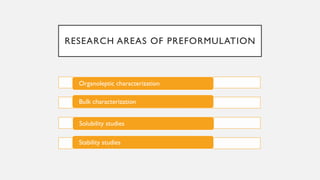
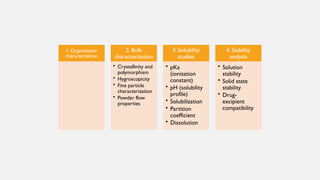
RESEARCH AREAS OFPREFORMULATION
Organoleptic characterization
Bulk characterization
Solubility studies
Stability studies
ORGANOLEPTIC
CHARACTERISTICS
• It includesgeneral appearance, color, odour and taste of drug
substances.
• The aspects that can be experienced through ones senses like taste,
smell, sight and touch.
9.
BULK CHARACTERISTICS
Crystallinity andpolymorphism
• Crystallinity refers to the outer appearance and internal structure of the drug
molecule and can affect its physicochemical properties.
• Polymorphism is the ability of a compound to crystallize in different shapes
with different internal structure.
• Types of polymorphs are: monotrophs and enantiotrophs.
• There are different methods to identify polymorphism.
10.
• Analytical methodsfor the determination of polymorphs are:
1. Microscopy
2. Hot stage microscopy
3. X ray diffraction study
4. Differential Scanning Calorimetry
5. Scanning electron microscopy
6. Infrared Spectroscopy
11.
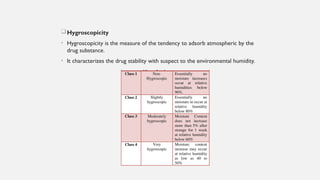
Hygroscopicity
• Hygroscopicity isthe measure of the tendency to adsorb atmospheric by the
drug substance.
• It characterizes the drug stability with suspect to the environmental humidity.
12.
Fine particle characterization
•The size of the drug particle can influence it’s dissolution rate, suspendability
and other properties.
• It becomes important to clarify the drug substances as very coarse, coarse,
moderately coarse, fine, very fine, etc.
• Particle size can influence variety of factors:
_ Dissolution rate
_ Suspendability
_ Uniform distribution
_ Penetrability
_ Lack of grittiness
13.
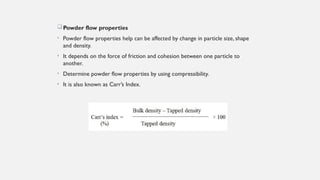
Powder flow properties
•Powder flow properties help can be affected by change in particle size, shape
and density.
• It depends on the force of friction and cohesion between one particle to
another.
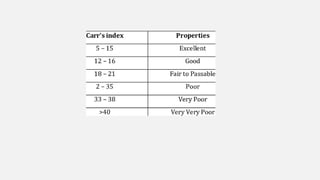
• Determine powder flow properties by using compressibility.
• It is also known as Carr’s Index.
15.
SOLUBILITY STUDIES
pKa (Ionizationconstant)
• It is the measurement of the acidity of the compound.
• Degree of ionization depends on pH.
• It is calculated using Henderson- hasselbalch equation,
16.
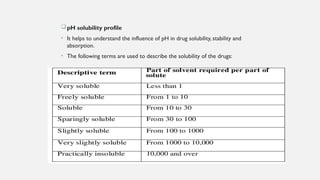
pH solubility profile
•It helps to understand the influence of pH in drug solubility, stability and
absorption.
• The following terms are used to describe the solubility of the drugs:
17.
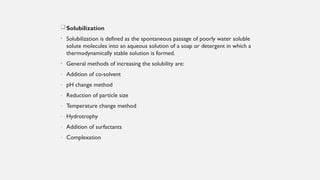
Solubilization
• Solubilization isdefined as the spontaneous passage of poorly water soluble
solute molecules into an aqueous solution of a soap or detergent in which a
thermodynamically stable solution is formed.
• General methods of increasing the solubility are:
- Addition of co-solvent
- pH change method
- Reduction of particle size
- Temperature change method
- Hydrotrophy
- Addition of surfactants
- Complexation
18.
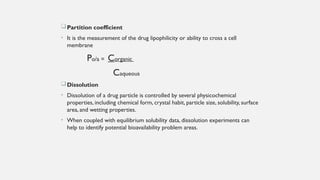
Partition coefficient
• Itis the measurement of the drug lipophilicity or ability to cross a cell
membrane
Po/a = Corganic
Caqueous
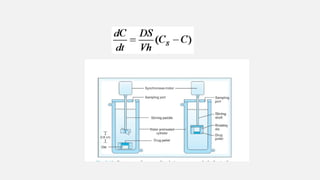
Dissolution
• Dissolution of a drug particle is controlled by several physicochemical
properties, including chemical form, crystal habit, particle size, solubility, surface
area, and wetting properties.
• When coupled with equilibrium solubility data, dissolution experiments can
help to identify potential bioavailability problem areas.
Solid state stability
•The primary objectives of this investigation are identification of stable storage
conditions for drug in the solid state and identification of compatible
excipients for a formulation.
• In general solod state stability evaluated by using IR spectroscopy, UV
spectroscopy, samples HPLC analysis, polymorph evaluation by DSC etc.
22.
Drug excipient compatibility
•The successful formulation of a stable and effective dosage form depends not
only on the active pharmaceutical ingredient but also on the careful selection of
excipients.
• An incompatibility in the dosage form can result in any of the following changes:
Changes in organoleptic properties
Changes in dissolution performance
Physical form conversion
An decrease in potency
An increase in degradation products.






![PERI-PROSTHETIC FRACTURE NAIL-PLATE CONSTRUCT [NPC].pptx](https://cdn.slidesharecdn.com/ss_thumbnails/drarunkumardrmohamedashrafperiprostheticfrasturenail-plateconstructnpc-260209164459-7e9d15a1-thumbnail.jpg?width=640&height=640&fit=bounds)


