PROCESS VALIDATION
PREPARED BY
PRAJJWAL SHRESTHA
PRITY NEUPANE
RAJENDRA AYER
Semisolid
Introduction
 Semisolids are the topical dosage
form used for the therapeutic,
protective or cosmetic function.
SCOPE
 Covers process validation of
manufacturing of semi solid dosage
form
APPROACH
 Prospective Validation Approach
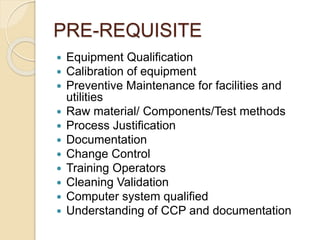
PRE-REQUISITE
 Equipment Qualification
 Calibration of equipment
 Preventive Maintenance for facilities and
utilities
 Raw material/ Components/Test methods
 Process Justification
 Documentation
 Change Control
 Training Operators
 Cleaning Validation
 Computer system qualified
 Understanding of CCP and documentation
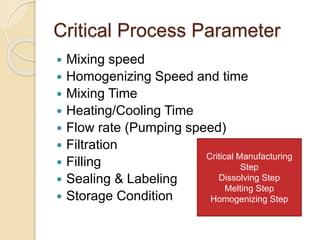
Critical Process Parameter
 Mixing speed
 Homogenizing Speed and time
 Mixing Time
 Heating/Cooling Time
 Flow rate (Pumping speed)
 Filtration
 Filling
 Sealing & Labeling
 Storage Condition
Critical Manufacturing
Step
Dissolving Step
Melting Step
Homogenizing Step
Number of Runs
 During Performance Qualification, 3
consecutive successful batches
 During Process Validation, 3
consecutive successful batches
Product testing
 Validation testing of bulk and finished product
must be based on testing standard release
criteria and in process testing criteria
 Routine QC release testing should be
performed on a routine sample.
 These samples should be taken separately
from the validation samples.
 Validation sampling and testing typically is 3
to 6 time the usual QC sampling
Validation Batch :Bulk
Sampling
 Take 10 sample from the mixture, tank, or during
product transfer to the storage/filling vessel.
 The samples must represent the top, middle and
bottom of the vessel
 If sampling from the mixture/tank using an specific
equipment, samples should be taken immediately
adjacent to blades, baffles, and shafts where product
movement during mixing may restricted.
 The bottom of the tank and any potential dead spots
should be sampled and examined for unmixed material,
if possible.
Sampling Plan
Samples must be representative of each filling nozzle.
For single filling size
● Take a minimum of 3 fill containers from each of the
beginning, middle and end of the filling run.
● The total number of samples must be not less than
10.
● All samples must be tested.
Multiple filling size
Take minimum 3 samples each at the beginning and
end of the filling size
OTHER SAMPLING PATTERN
• Ten equidistant points across the filling
run
must be sampled.
 The beginning and end of filling must
be represented.
 Samples should be taken in triplicate.
PRODUCT PERFORMANCE
CHARECTERISTICS
1) Particle size Consideration
Control of particle morphology and
particle size are important parameters to
attain high quality drug product manufacture
and control procedure.
Particle size distribution for most
disperse system should be in the range of 0.2-
20 microns.
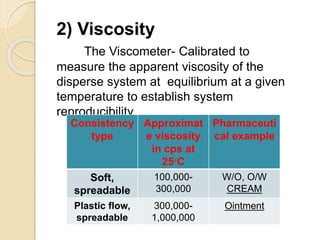
2) Viscosity
The Viscometer- Calibrated to
measure the apparent viscosity of the
disperse system at equilibrium at a given
temperature to establish system
reproducibility.
Consistency
type
Approximat
e viscosity
in cps at
25°C
Pharmaceuti
cal example
Soft,
spreadable
100,000-
300,000
W/O, O/W
CREAM
Plastic flow,
spreadable
300,000-
1,000,000
Ointment
3) Content Uniformity
Most important parameter governing
product stability and process control of
the disperse system.
In ointment/cream formulation are
more dependent on particle size, shear
rate, and mixing efficiency.
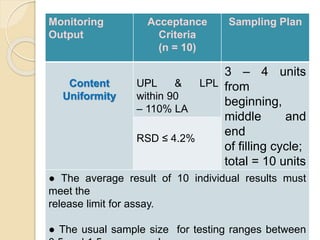
Monitoring
Output
Acceptance
Criteria
(n = 10)
Sampling Plan
Content
Uniformity
UPL & LPL
within 90
– 110% LA
3 – 4 units
from
beginning,
middle and
end
of filling cycle;
total = 10 units
RSD ≤ 4.2%
● The average result of 10 individual results must
meet the
release limit for assay.
● The usual sample size for testing ranges between
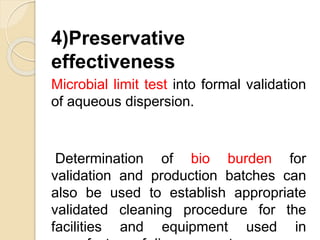
4)Preservative
effectiveness
Microbial limit test into formal validation
of aqueous dispersion.
Determination of bio burden for
validation and production batches can
also be used to establish appropriate
validated cleaning procedure for the
facilities and equipment used in
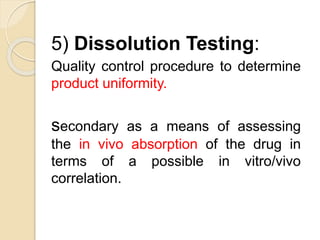
5) Dissolution Testing:
Quality control procedure to determine
product uniformity.
secondary as a means of assessing
the in vivo absorption of the drug in
terms of a possible in vitro/vivo
correlation.
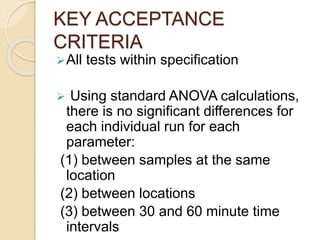
KEY ACCEPTANCE
CRITERIA
All tests within specification
 Using standard ANOVA calculations,
there is no significant differences for
each individual run for each
parameter:
(1) between samples at the same
location
(2) between locations
(3) between 30 and 60 minute time
intervals
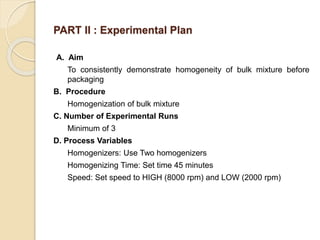
PART II : Experimental Plan
A. Aim
To consistently demonstrate homogeneity of bulk mixture before
packaging
B. Procedure
Homogenization of bulk mixture
C. Number of Experimental Runs
Minimum of 3
D. Process Variables
Homogenizers: Use Two homogenizers
Homogenizing Time: Set time 45 minutes
Speed: Set speed to HIGH (8000 rpm) and LOW (2000 rpm)
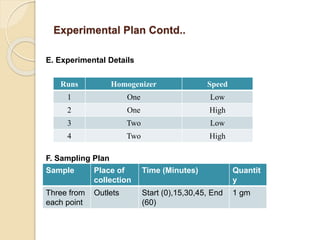
Experimental Plan Contd..
E. Experimental Details
F. Sampling Plan
Runs Homogenizer Speed
1 One Low
2 One High
3 Two Low
4 Two High
Sample Place of
collection
Time (Minutes) Quantit
y
Three from
each point
Outlets Start (0),15,30,45, End
(60)
1 gm
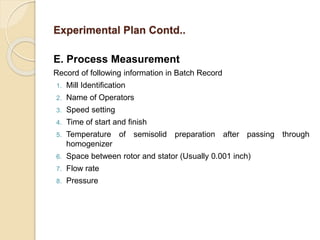
Experimental Plan Contd..
E. Process Measurement
Record of following information in Batch Record
1. Mill Identification
2. Name of Operators
3. Speed setting
4. Time of start and finish
5. Temperature of semisolid preparation after passing through
homogenizer
6. Space between rotor and stator (Usually 0.001 inch)
7. Flow rate
8. Pressure
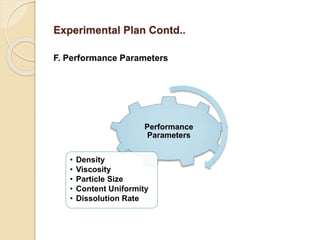
Experimental Plan Contd..
F. Performance Parameters
Performance
Parameters
• Density
• Viscosity
• Particle Size
• Content Uniformity
• Dissolution Rate
Experimental Plan Contd..
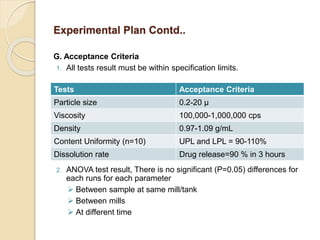
G. Acceptance Criteria
1. All tests result must be within specification limits.
2. ANOVA test result, There is no significant (P=0.05) differences for
each runs for each parameter
 Between sample at same mill/tank
 Between mills
 At different time
Tests Acceptance Criteria
Particle size 0.2-20 µ
Viscosity 100,000-1,000,000 cps
Density 0.97-1.09 g/mL
Content Uniformity (n=10) UPL and LPL = 90-110%
Dissolution rate Drug release=90 % in 3 hours
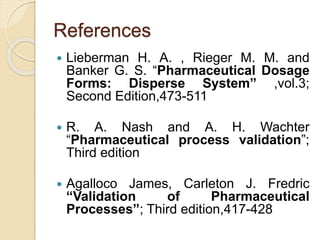
References
 Lieberman H. A. , Rieger M. M. and
Banker G. S. “Pharmaceutical Dosage
Forms: Disperse System” ,vol.3;
Second Edition,473-511
 R. A. Nash and A. H. Wachter
“Pharmaceutical process validation”;
Third edition
 Agalloco James, Carleton J. Fredric
“Validation of Pharmaceutical
Processes”; Third edition,417-428

PROCESS VALIDATION for Sem Solid

  • 1.
    PROCESS VALIDATION PREPARED BY PRAJJWALSHRESTHA PRITY NEUPANE RAJENDRA AYER Semisolid
  • 2.
    Introduction  Semisolids arethe topical dosage form used for the therapeutic, protective or cosmetic function.
  • 3.
    SCOPE  Covers processvalidation of manufacturing of semi solid dosage form
  • 4.
  • 5.
    PRE-REQUISITE  Equipment Qualification Calibration of equipment  Preventive Maintenance for facilities and utilities  Raw material/ Components/Test methods  Process Justification  Documentation  Change Control  Training Operators  Cleaning Validation  Computer system qualified  Understanding of CCP and documentation
  • 6.
    Critical Process Parameter Mixing speed  Homogenizing Speed and time  Mixing Time  Heating/Cooling Time  Flow rate (Pumping speed)  Filtration  Filling  Sealing & Labeling  Storage Condition Critical Manufacturing Step Dissolving Step Melting Step Homogenizing Step
  • 7.
    Number of Runs During Performance Qualification, 3 consecutive successful batches  During Process Validation, 3 consecutive successful batches
  • 8.
    Product testing  Validationtesting of bulk and finished product must be based on testing standard release criteria and in process testing criteria  Routine QC release testing should be performed on a routine sample.  These samples should be taken separately from the validation samples.  Validation sampling and testing typically is 3 to 6 time the usual QC sampling
  • 9.
    Validation Batch :Bulk Sampling Take 10 sample from the mixture, tank, or during product transfer to the storage/filling vessel.  The samples must represent the top, middle and bottom of the vessel  If sampling from the mixture/tank using an specific equipment, samples should be taken immediately adjacent to blades, baffles, and shafts where product movement during mixing may restricted.  The bottom of the tank and any potential dead spots should be sampled and examined for unmixed material, if possible.
  • 10.
    Sampling Plan Samples mustbe representative of each filling nozzle. For single filling size ● Take a minimum of 3 fill containers from each of the beginning, middle and end of the filling run. ● The total number of samples must be not less than 10. ● All samples must be tested. Multiple filling size Take minimum 3 samples each at the beginning and end of the filling size
  • 11.
    OTHER SAMPLING PATTERN •Ten equidistant points across the filling run must be sampled.  The beginning and end of filling must be represented.  Samples should be taken in triplicate.
  • 12.
    PRODUCT PERFORMANCE CHARECTERISTICS 1) Particlesize Consideration Control of particle morphology and particle size are important parameters to attain high quality drug product manufacture and control procedure. Particle size distribution for most disperse system should be in the range of 0.2- 20 microns.
  • 13.
    2) Viscosity The Viscometer-Calibrated to measure the apparent viscosity of the disperse system at equilibrium at a given temperature to establish system reproducibility. Consistency type Approximat e viscosity in cps at 25°C Pharmaceuti cal example Soft, spreadable 100,000- 300,000 W/O, O/W CREAM Plastic flow, spreadable 300,000- 1,000,000 Ointment
  • 14.
    3) Content Uniformity Mostimportant parameter governing product stability and process control of the disperse system. In ointment/cream formulation are more dependent on particle size, shear rate, and mixing efficiency.
  • 15.
    Monitoring Output Acceptance Criteria (n = 10) SamplingPlan Content Uniformity UPL & LPL within 90 – 110% LA 3 – 4 units from beginning, middle and end of filling cycle; total = 10 units RSD ≤ 4.2% ● The average result of 10 individual results must meet the release limit for assay. ● The usual sample size for testing ranges between
  • 16.
    4)Preservative effectiveness Microbial limit testinto formal validation of aqueous dispersion. Determination of bio burden for validation and production batches can also be used to establish appropriate validated cleaning procedure for the facilities and equipment used in
  • 17.
    5) Dissolution Testing: Qualitycontrol procedure to determine product uniformity. secondary as a means of assessing the in vivo absorption of the drug in terms of a possible in vitro/vivo correlation.
  • 18.
    KEY ACCEPTANCE CRITERIA All testswithin specification  Using standard ANOVA calculations, there is no significant differences for each individual run for each parameter: (1) between samples at the same location (2) between locations (3) between 30 and 60 minute time intervals
  • 19.
    PART II :Experimental Plan A. Aim To consistently demonstrate homogeneity of bulk mixture before packaging B. Procedure Homogenization of bulk mixture C. Number of Experimental Runs Minimum of 3 D. Process Variables Homogenizers: Use Two homogenizers Homogenizing Time: Set time 45 minutes Speed: Set speed to HIGH (8000 rpm) and LOW (2000 rpm)
  • 20.
    Experimental Plan Contd.. E.Experimental Details F. Sampling Plan Runs Homogenizer Speed 1 One Low 2 One High 3 Two Low 4 Two High Sample Place of collection Time (Minutes) Quantit y Three from each point Outlets Start (0),15,30,45, End (60) 1 gm
  • 21.
    Experimental Plan Contd.. E.Process Measurement Record of following information in Batch Record 1. Mill Identification 2. Name of Operators 3. Speed setting 4. Time of start and finish 5. Temperature of semisolid preparation after passing through homogenizer 6. Space between rotor and stator (Usually 0.001 inch) 7. Flow rate 8. Pressure
  • 22.
    Experimental Plan Contd.. F.Performance Parameters Performance Parameters • Density • Viscosity • Particle Size • Content Uniformity • Dissolution Rate
  • 23.
    Experimental Plan Contd.. G.Acceptance Criteria 1. All tests result must be within specification limits. 2. ANOVA test result, There is no significant (P=0.05) differences for each runs for each parameter  Between sample at same mill/tank  Between mills  At different time Tests Acceptance Criteria Particle size 0.2-20 µ Viscosity 100,000-1,000,000 cps Density 0.97-1.09 g/mL Content Uniformity (n=10) UPL and LPL = 90-110% Dissolution rate Drug release=90 % in 3 hours
  • 24.
    References  Lieberman H.A. , Rieger M. M. and Banker G. S. “Pharmaceutical Dosage Forms: Disperse System” ,vol.3; Second Edition,473-511  R. A. Nash and A. H. Wachter “Pharmaceutical process validation”; Third edition  Agalloco James, Carleton J. Fredric “Validation of Pharmaceutical Processes”; Third edition,417-428