iNSiGHT
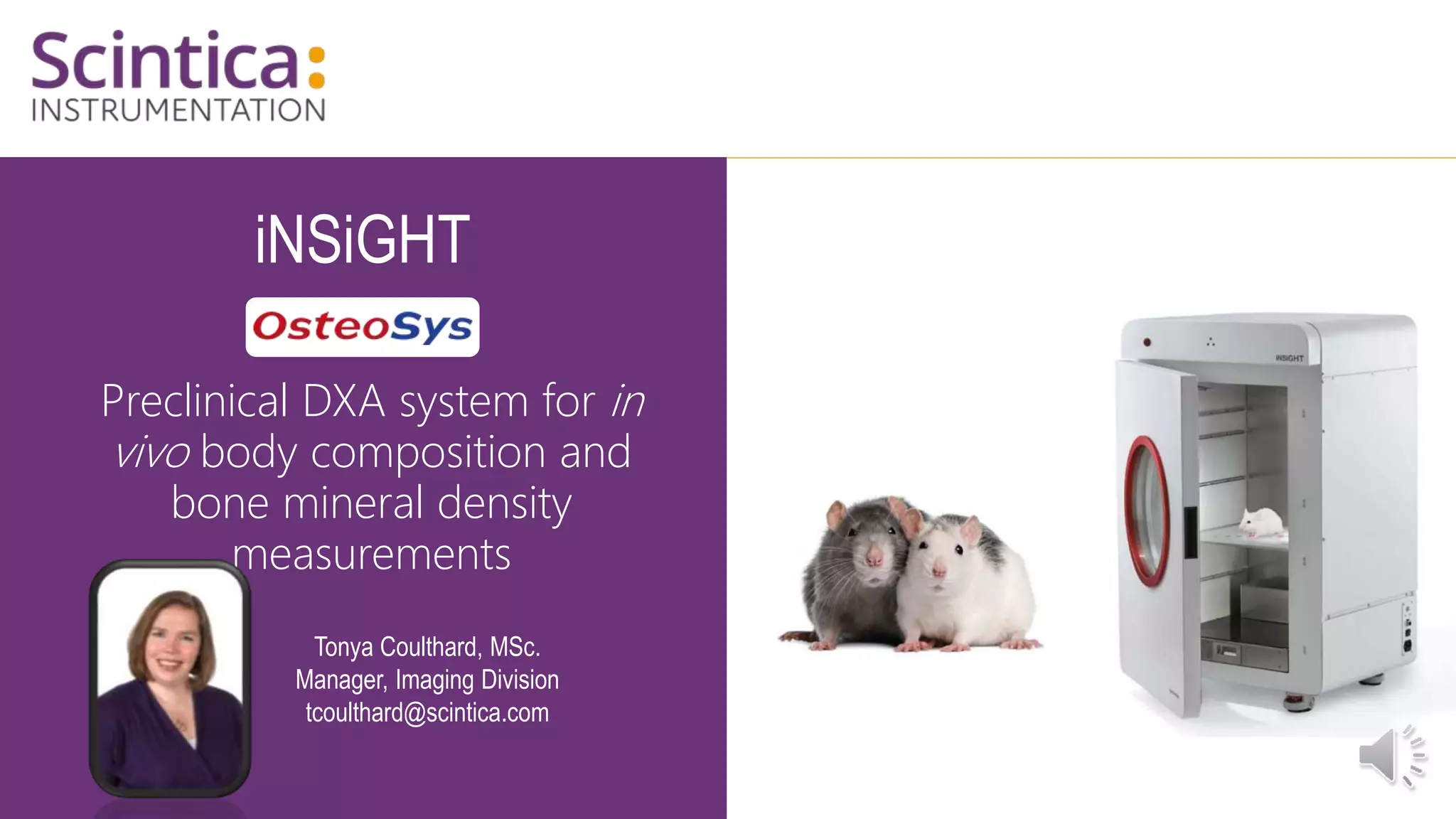
Preclinical DXA system for in
vivo body composition and
bone mineral density
measurements
Tonya Coulthard, MSc.
Manager, Imaging Division
tcoulthard@scintica.com
WWW.SCINTICA.COM
Audience Poll
iNSiGHT
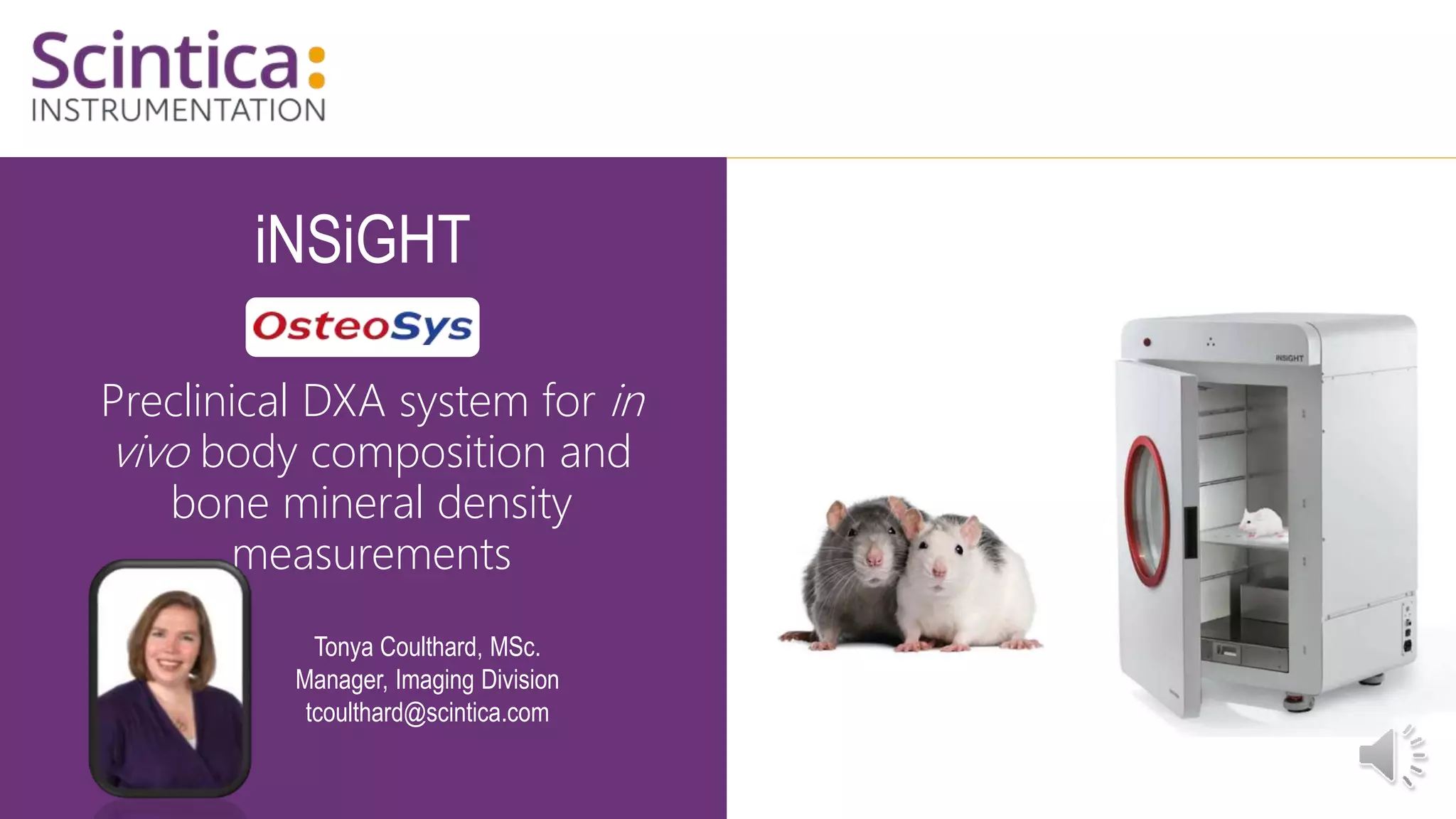
Preclinical DXA system for in
vivo body composition and
bone mineral density
measurements
Tonya Coulthard, MSc.
Manager, Imaging Division
tcoulthard@scintica.com
WWW.SCINTICA.COM
Topics of Discussion
• What is DXA and How Does it Work
• iNSiGHT System Overview
• Key Research Applications
4
WWW.SCINTICA.COM
What is DXA and How Does it Work
• Dual Energy X-Ray Absorptiometry
• Acquired Images
• Available Measurements
• Comparison to Other Techniques
5
WWW.SCINTICA.COM
Dual Energy X-Ray Absorptiometry (DXA or DEXA)
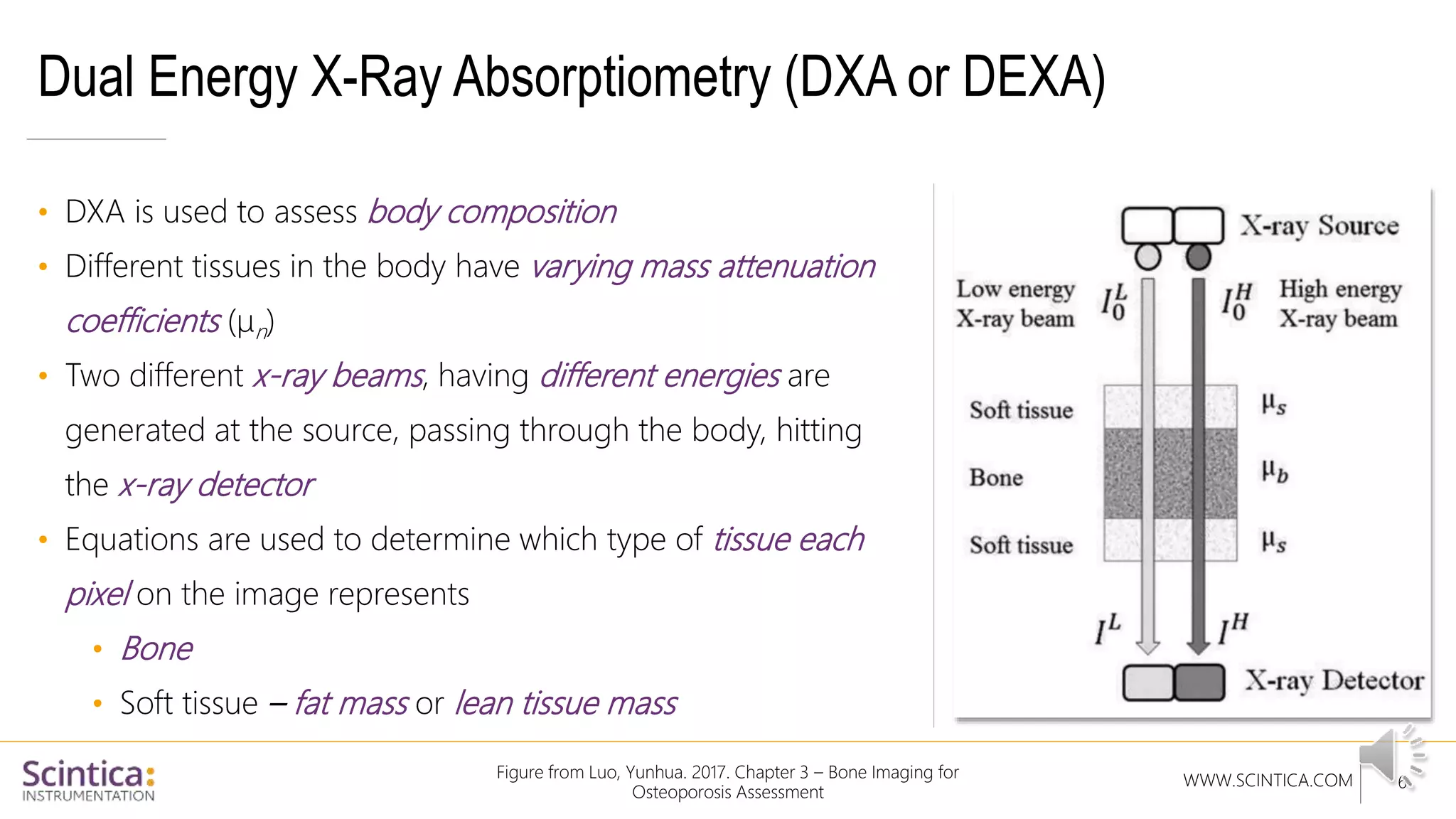
• DXA is used to assess body composition
• Different tissues in the body have varying mass attenuation
coefficients (µn)
• Two different x-ray beams, having different energies are
generated at the source, passing through the body, hitting
the x-ray detector
• Equations are used to determine which type of tissue each
pixel on the image represents
• Bone
• Soft tissue – fat mass or lean tissue mass
Figure from Luo, Yunhua. 2017. Chapter 3 – Bone Imaging for
Osteoporosis Assessment
6
WWW.SCINTICA.COM
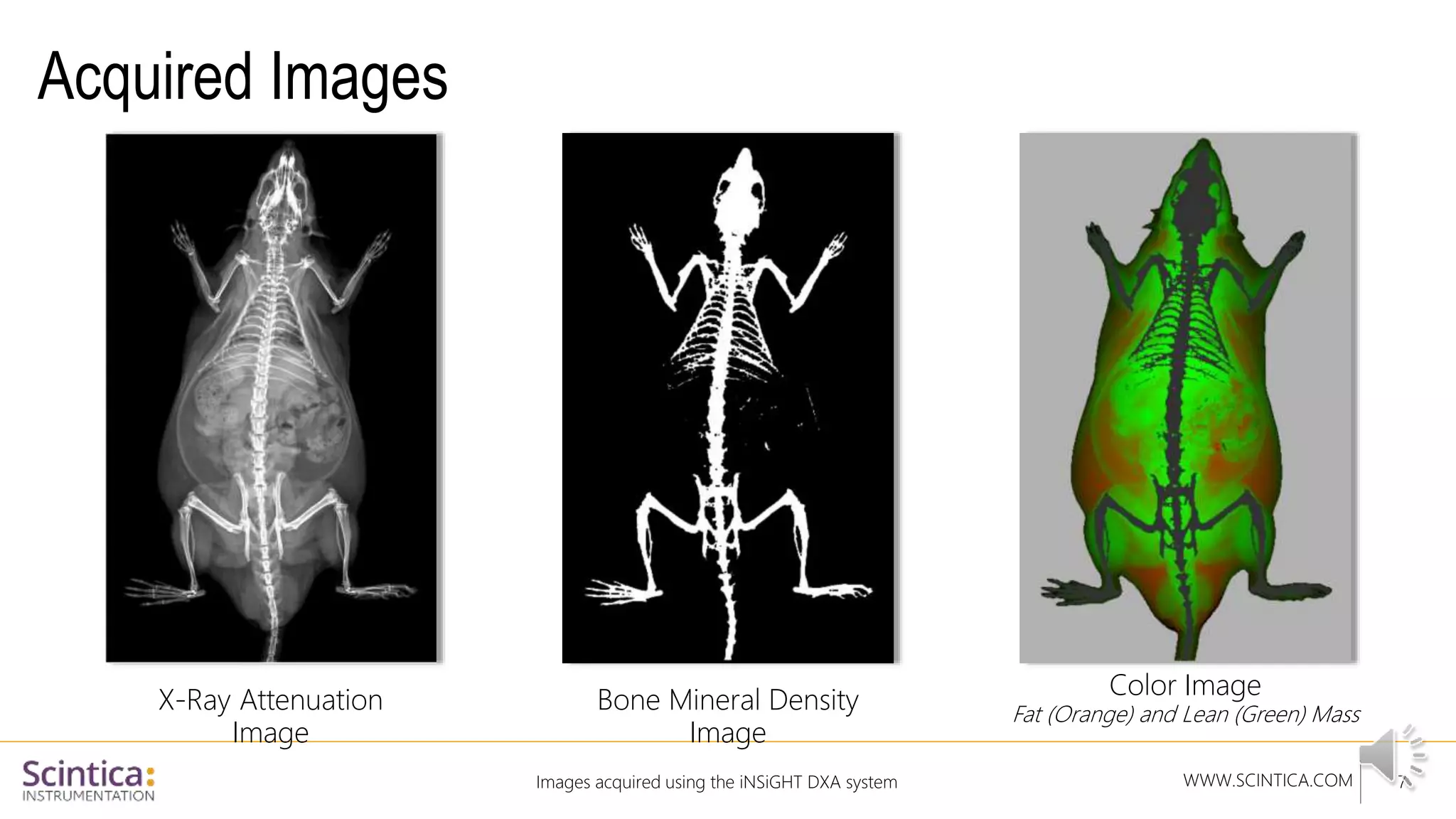
Acquired Images
Images acquired using the iNSiGHT DXA system 7
X-Ray Attenuation
Image
Bone Mineral Density
Image
Color Image
Fat (Orange) and Lean (Green) Mass
WWW.SCINTICA.COM
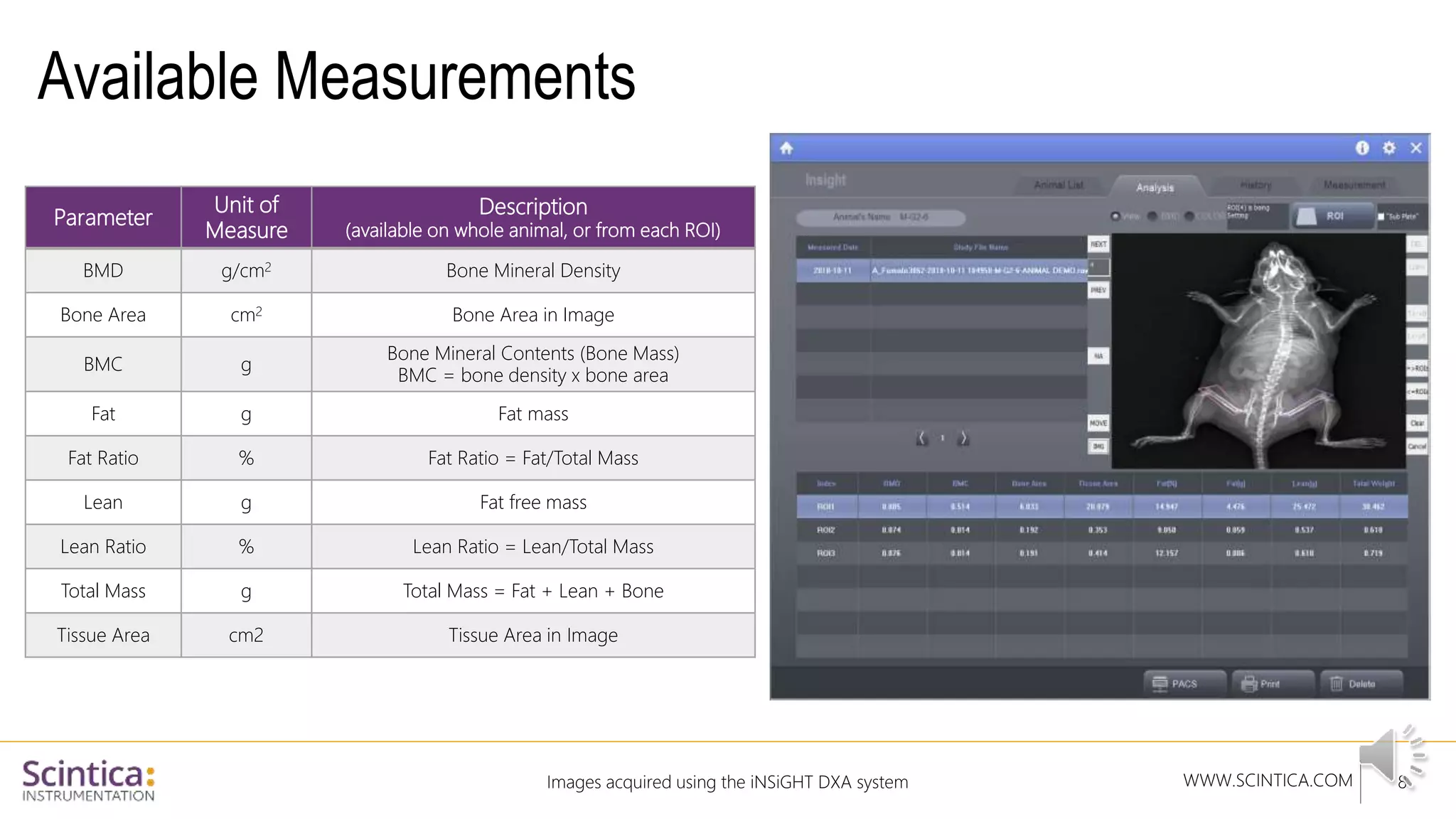
Available Measurements
8
Parameter
Unit of
Measure
Description
(available on whole animal, or from each ROI)
BMD g/cm2 Bone Mineral Density
Bone Area cm2 Bone Area in Image
BMC g
Bone Mineral Contents (Bone Mass)
BMC = bone density x bone area
Fat g Fat mass
Fat Ratio % Fat Ratio = Fat/Total Mass
Lean g Fat free mass
Lean Ratio % Lean Ratio = Lean/Total Mass
Total Mass g Total Mass = Fat + Lean + Bone
Tissue Area cm2 Tissue Area in Image
Images acquired using the iNSiGHT DXA system
WWW.SCINTICA.COM
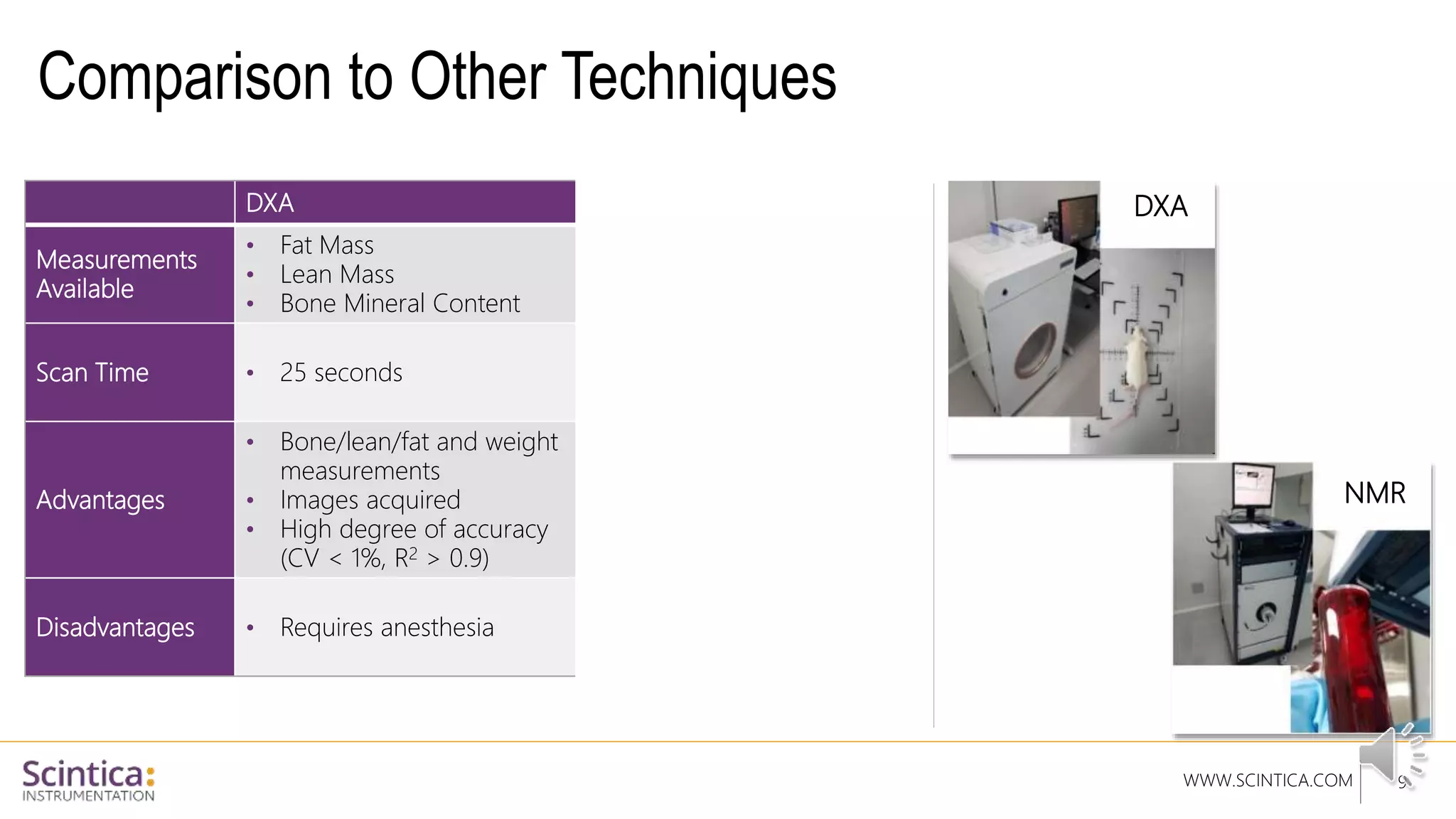
Comparison to Other Techniques
9
DXA NMR (Echo MRI)
Measurements
Available
• Fat Mass
• Lean Mass
• Bone Mineral Content
• Fat Mass
• Lean Mass
• Water Content
Scan Time • 25 seconds
• 80 seconds
• 30 seconds without water
content
Advantages
• Bone/lean/fat and weight
measurements
• Images acquired
• High degree of accuracy
(CV < 1%, R2 > 0.9)
• Water content available
• No anesthesia required
Disadvantages • Requires anesthesia
• No bone or weight
information
• No images available
DXA
NMR
WWW.SCINTICA.COM
iNSiGHT System Overview
• System Components
• System Features and Benefits
• Technical Specification
• Analysis Software
10
WWW.SCINTICA.COM
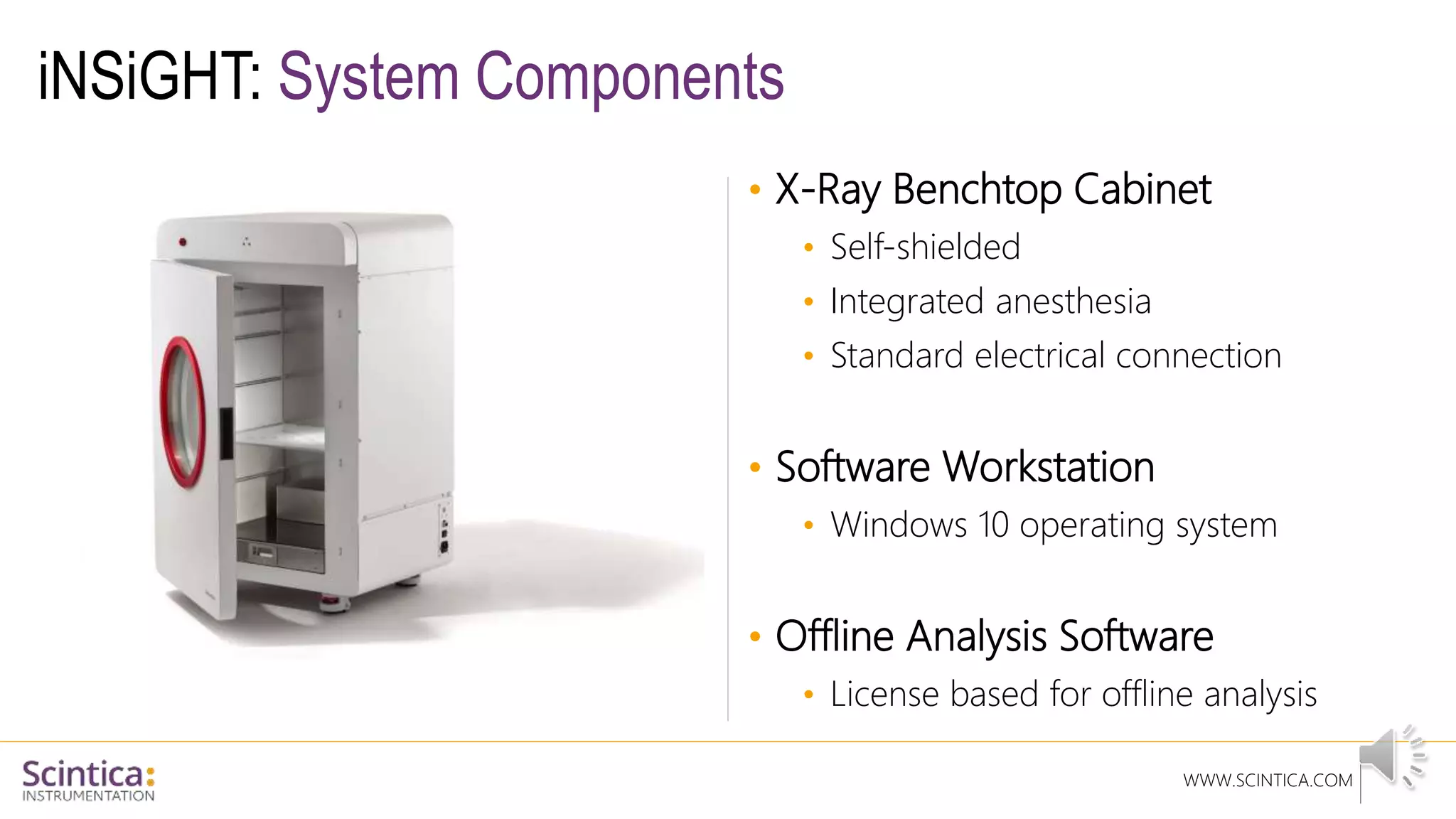
iNSiGHT: System Components
• X-Ray Benchtop Cabinet
• Self-shielded
• Integrated anesthesia
• Standard electrical connection
• Software Workstation
• Windows 10 operating system
• Offline Analysis Software
• License based for offline analysis
WWW.SCINTICA.COM
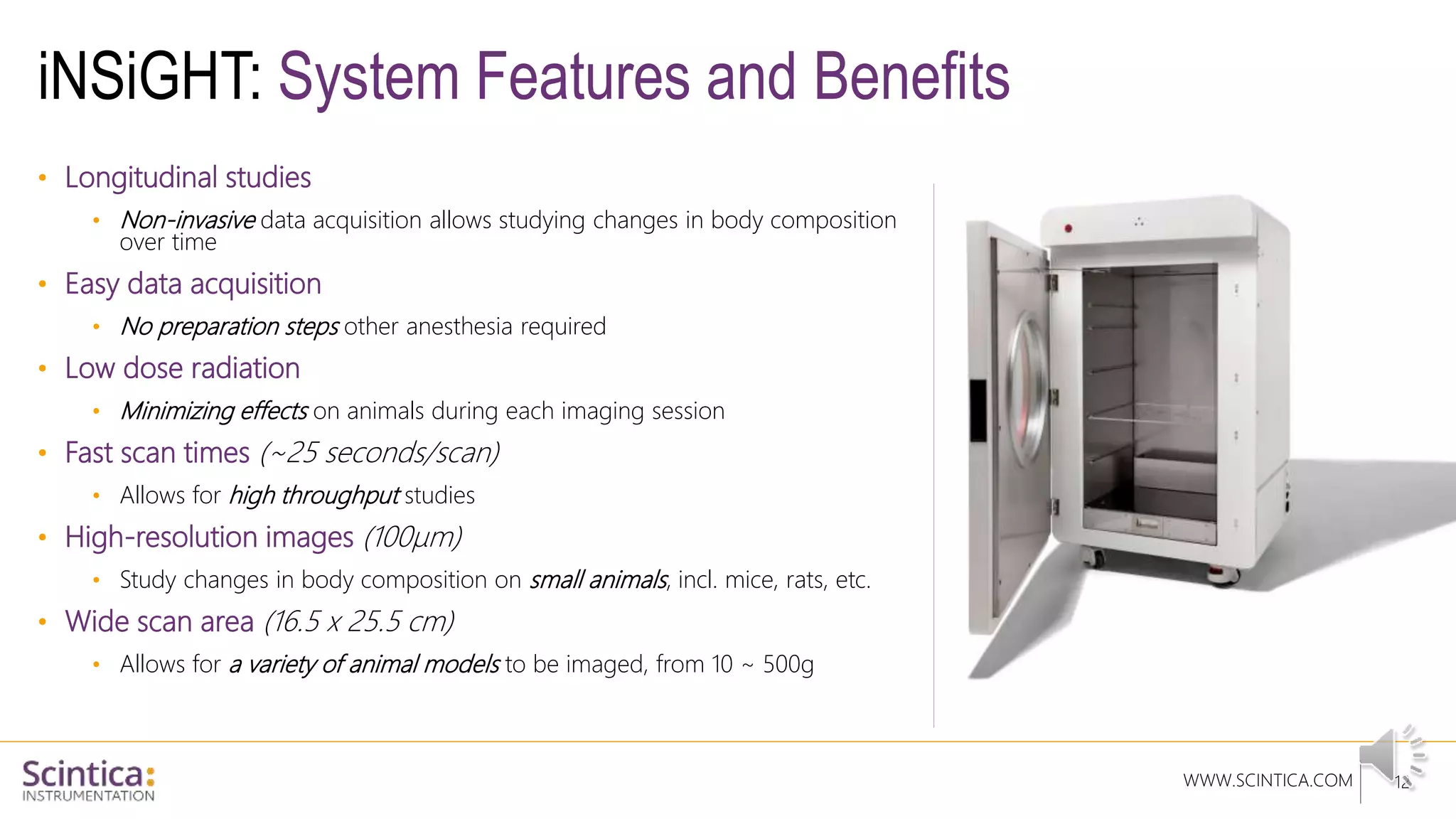
iNSiGHT: System Features and Benefits
12
• Longitudinal studies
• Non-invasive data acquisition allows studying changes in body composition
over time
• Easy data acquisition
• No preparation steps other anesthesia required
• Low dose radiation
• Minimizing effects on animals during each imaging session
• Fast scan times (~25 seconds/scan)
• Allows for high throughput studies
• High-resolution images (100µm)
• Study changes in body composition on small animals, incl. mice, rats, etc.
• Wide scan area (16.5 x 25.5 cm)
• Allows for a variety of animal models to be imaged, from 10 ~ 500g
WWW.SCINTICA.COM
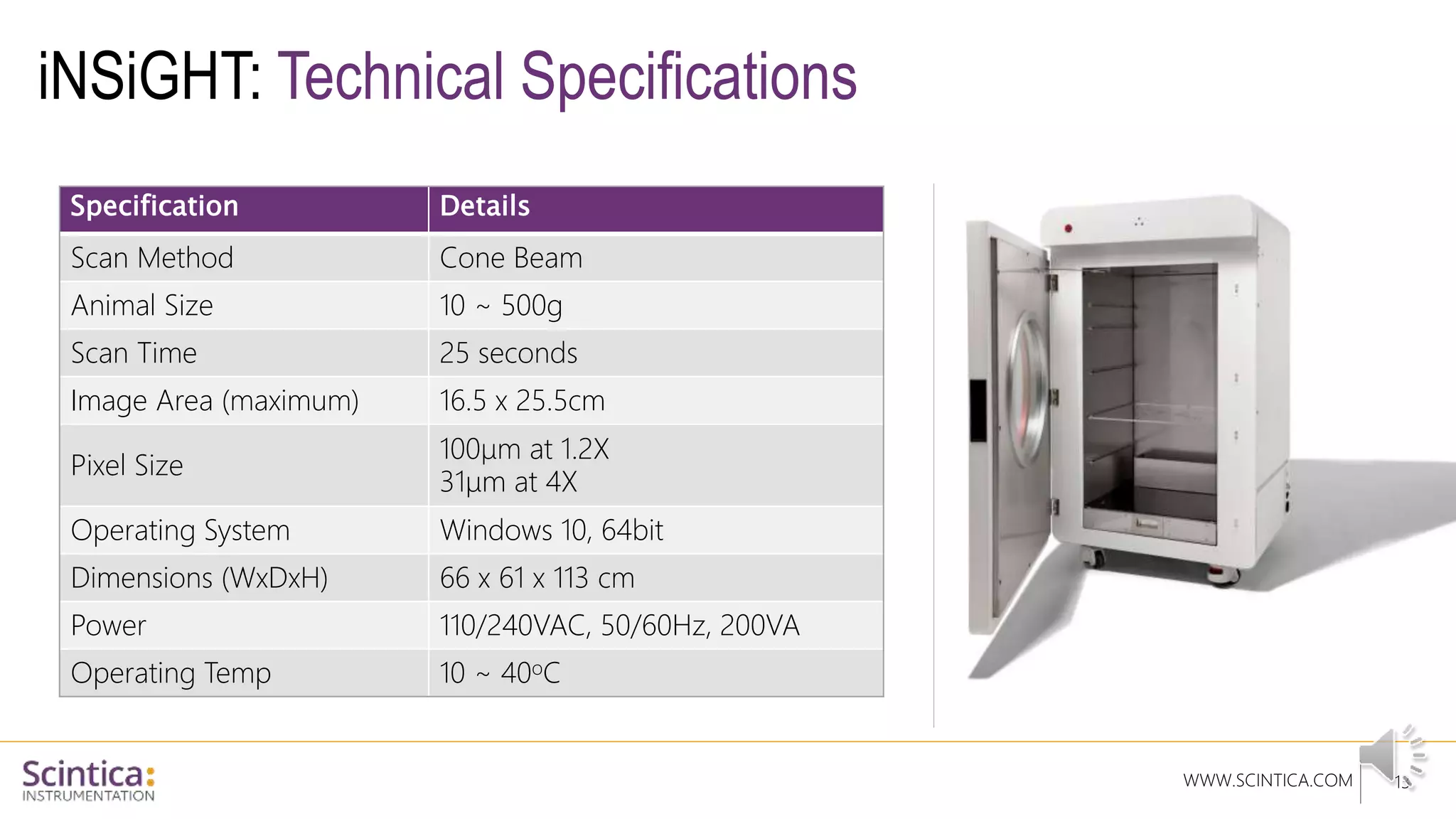
iNSiGHT: Technical Specifications
13
Specification Details
Scan Method Cone Beam
Animal Size 10 ~ 500g
Scan Time 25 seconds
Image Area (maximum) 16.5 x 25.5cm
Pixel Size
100µm at 1.2X
31µm at 4X
Operating System Windows 10, 64bit
Dimensions (WxDxH) 66 x 61 x 113 cm
Power 110/240VAC, 50/60Hz, 200VA
Operating Temp 10 ~ 40oC
WWW.SCINTICA.COM
iNSiGHT: Analysis Software
14
Parameter
Unit of
Measure
Description
(available on whole animal, or from each ROI)
BMC g Bone Mineral Contents (Bone Mass)
BMC = bone density x bone area
Fat g Fat mass
Fat Ratio % Fat Ratio = Fat/Total Mass
Lean g Fat free mass
Lean Ratio % Lean Ratio = Lean/Total Mass
Total Mass g Total Mass = Fat + Lean + Bone
BMD g/cm2 Bone Mineral Density
Bone Area cm2 Bone Area in Image
Tissue Area cm2 Tissue Area in Image
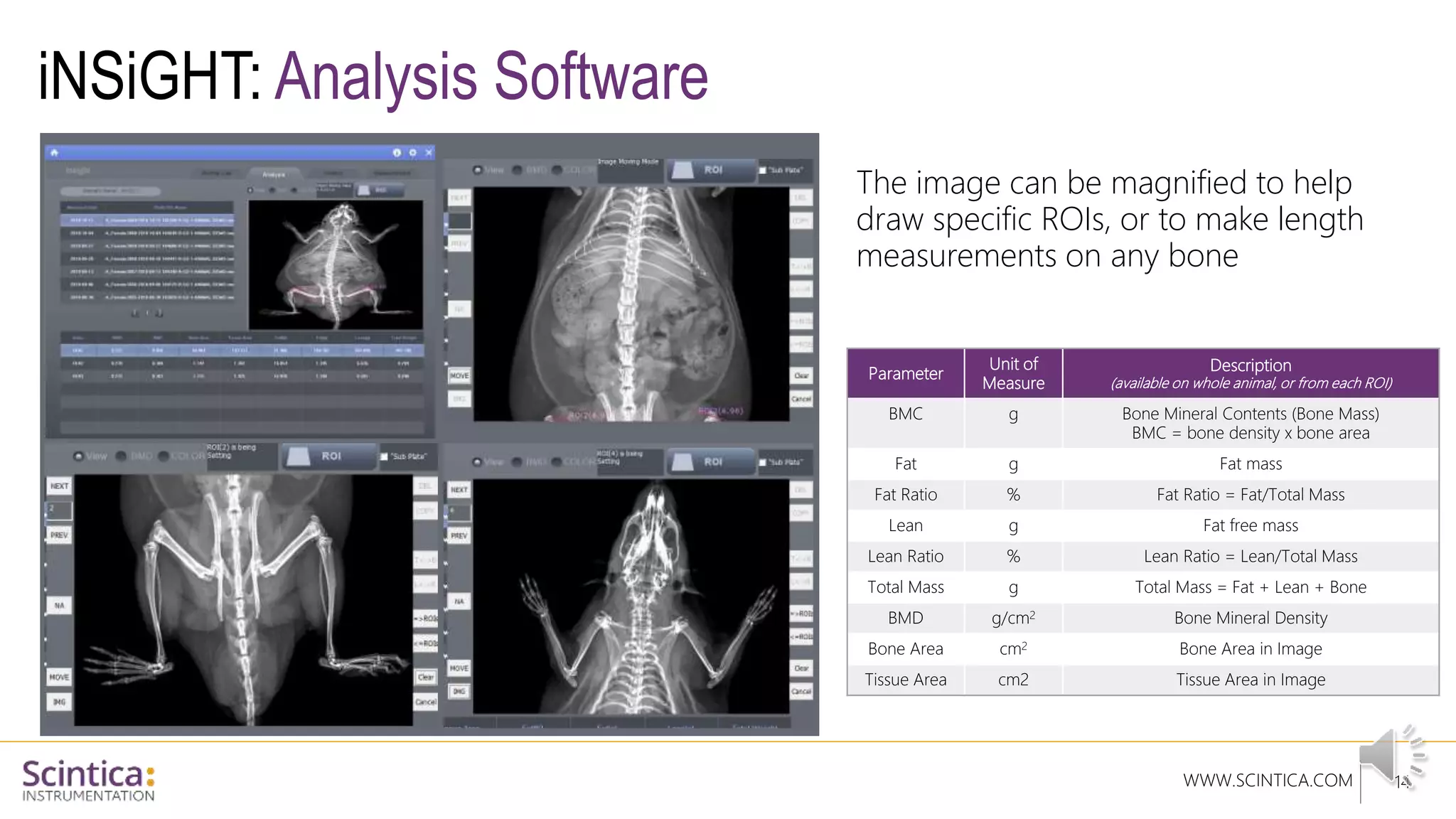
The image can be magnified to help
draw specific ROIs, or to make length
measurements on any bone
WWW.SCINTICA.COM
iNSiGHT: Analysis Software
15
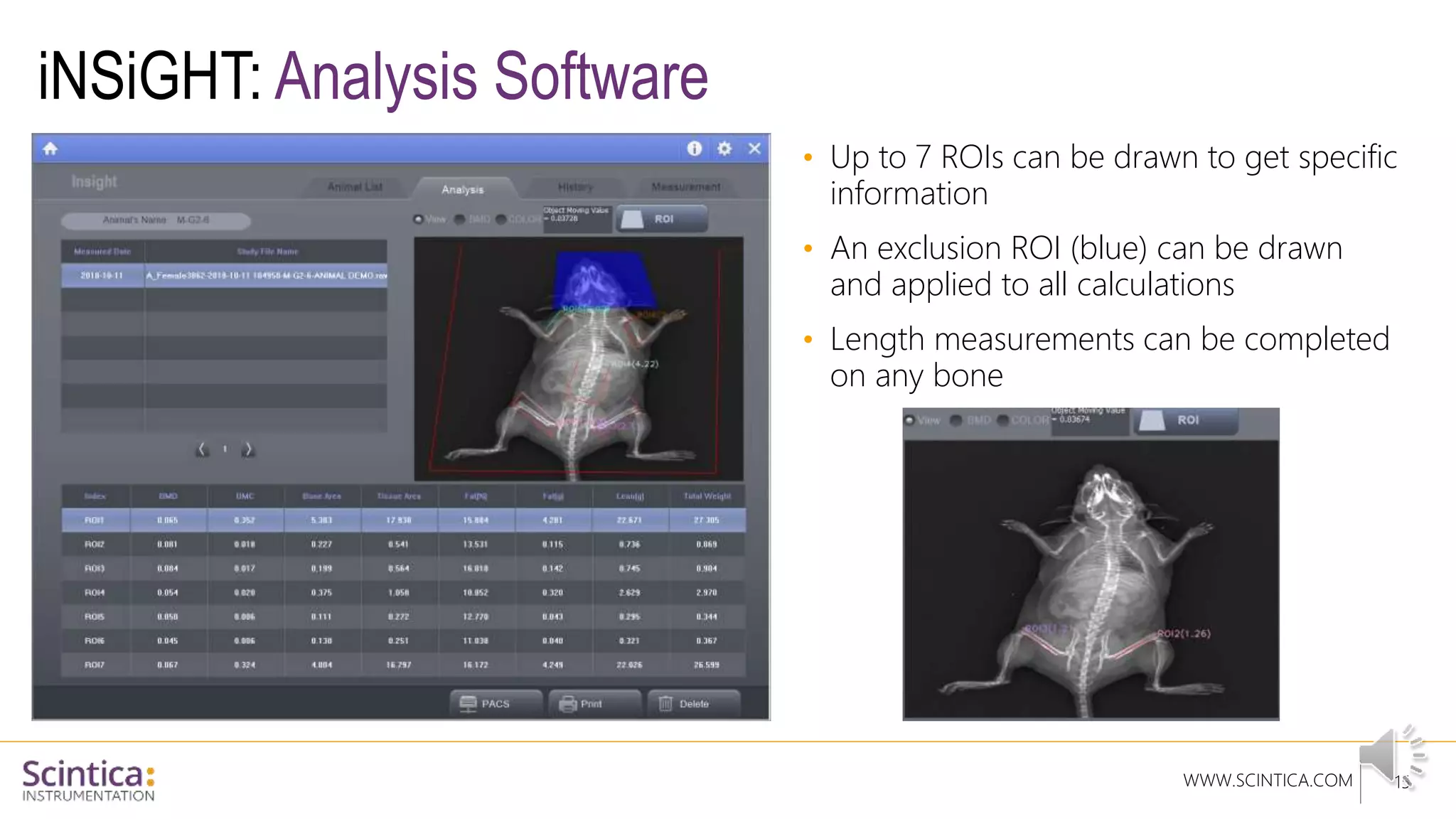
• Up to 7 ROIs can be drawn to get specific
information
• An exclusion ROI (blue) can be drawn
and applied to all calculations
• Length measurements can be completed
on any bone
WWW.SCINTICA.COM
iNSiGHT: Analysis Software
16
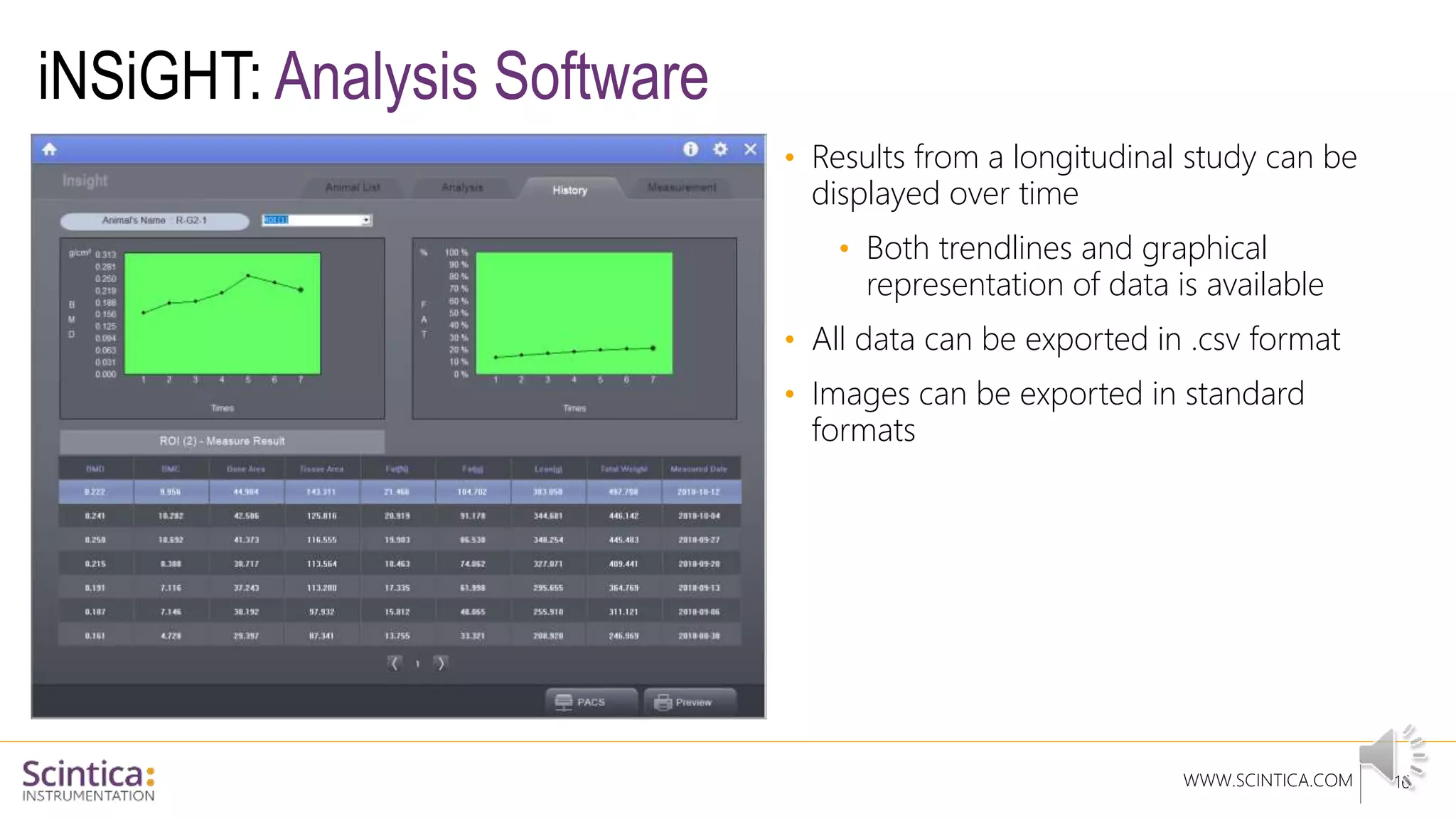
• Results from a longitudinal study can be
displayed over time
• Both trendlines and graphical
representation of data is available
• All data can be exported in .csv format
• Images can be exported in standard
formats
WWW.SCINTICA.COM
Key Research Applications
• Example Images
• Research Areas of Interest
• Key Studies
17
WWW.SCINTICA.COM
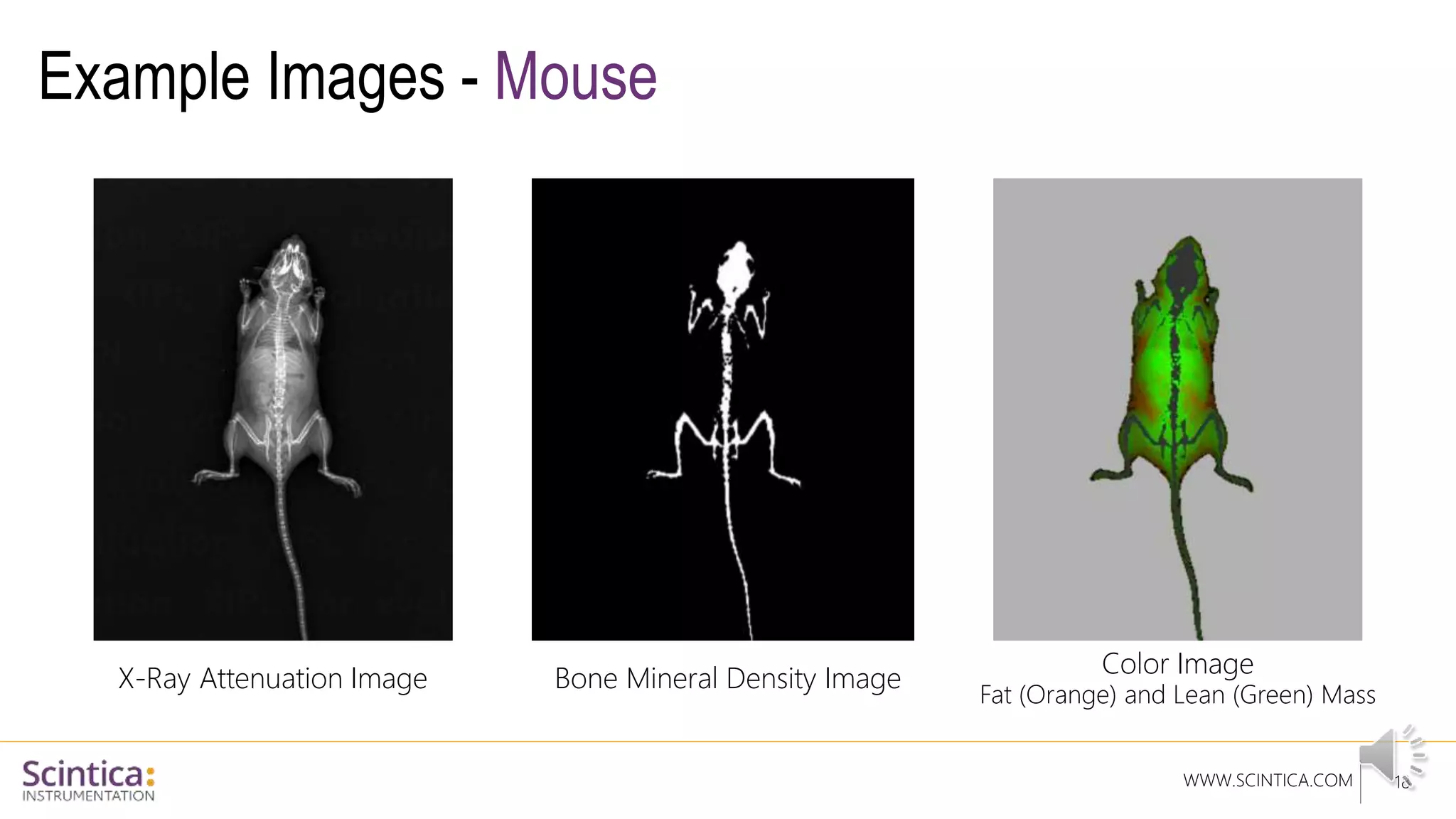
Example Images - Mouse
18
X-Ray Attenuation Image Bone Mineral Density Image
Color Image
Fat (Orange) and Lean (Green) Mass
WWW.SCINTICA.COM
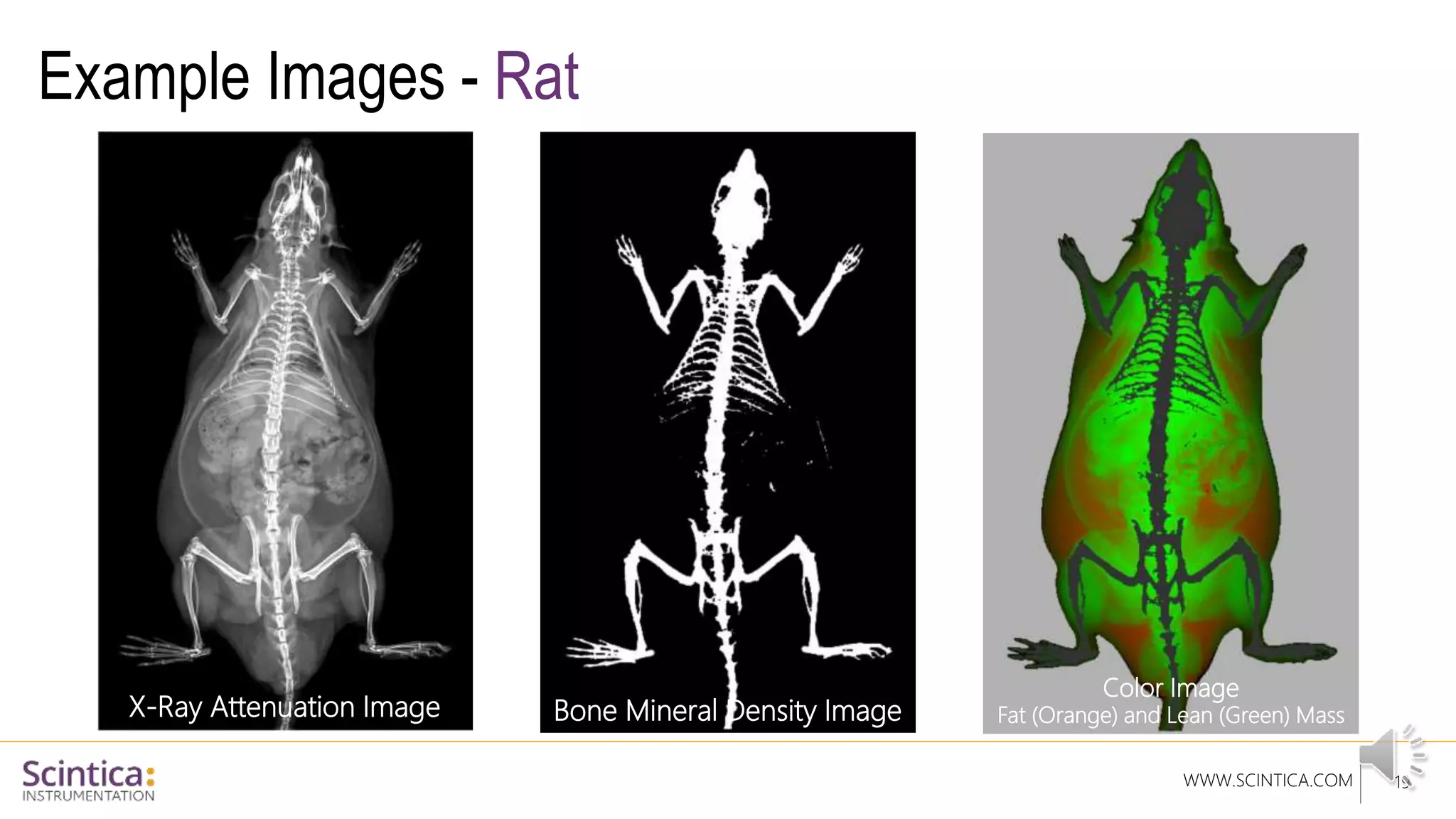
Example Images - Rat
19
X-Ray Attenuation Image Bone Mineral Density Image
Color Image
Fat (Orange) and Lean (Green) Mass
WWW.SCINTICA.COM
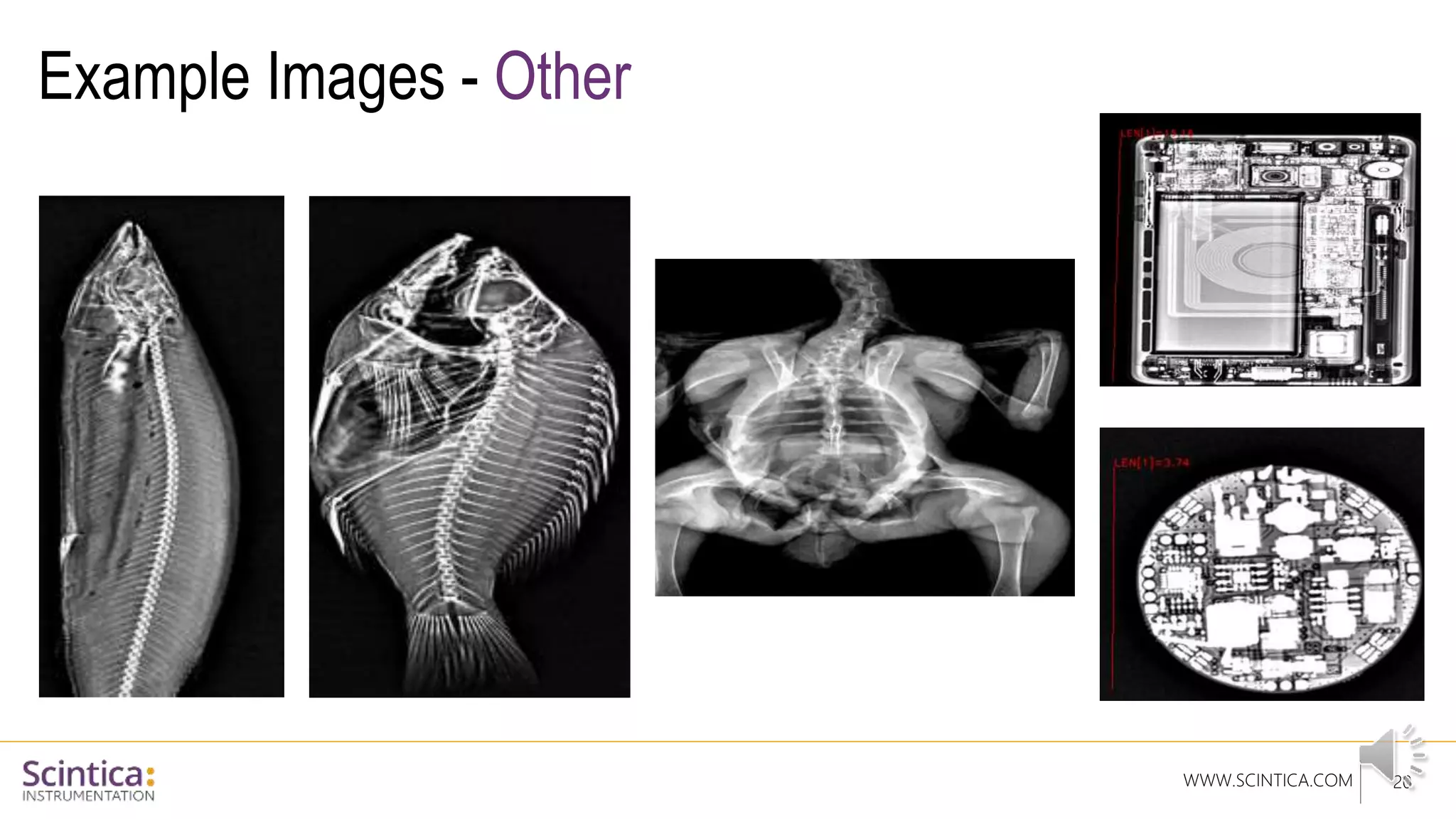
Example Images - Other
20
WWW.SCINTICA.COM
Research Areas of Interest
• DXA, resulting bone mineral density
and body composition data can be
used in a wide variety of research
areas
• The iNSiGHT system can be used to
assess the progression or regression
of disease in response to a
therapeutic regime
• Bone Mineral Density:
• Metabolic bone diseases, such as
osteoporosis, etc.
• Arthritis
• Musculoskeletal diseases
• Drug safety and toxicology
• Lean/Fat Mass:
• Metabolic disorders, such as diabetes,
obesity, etc.
• Musculoskeletal diseases
• Drug safety and toxicology
21
WWW.SCINTICA.COM
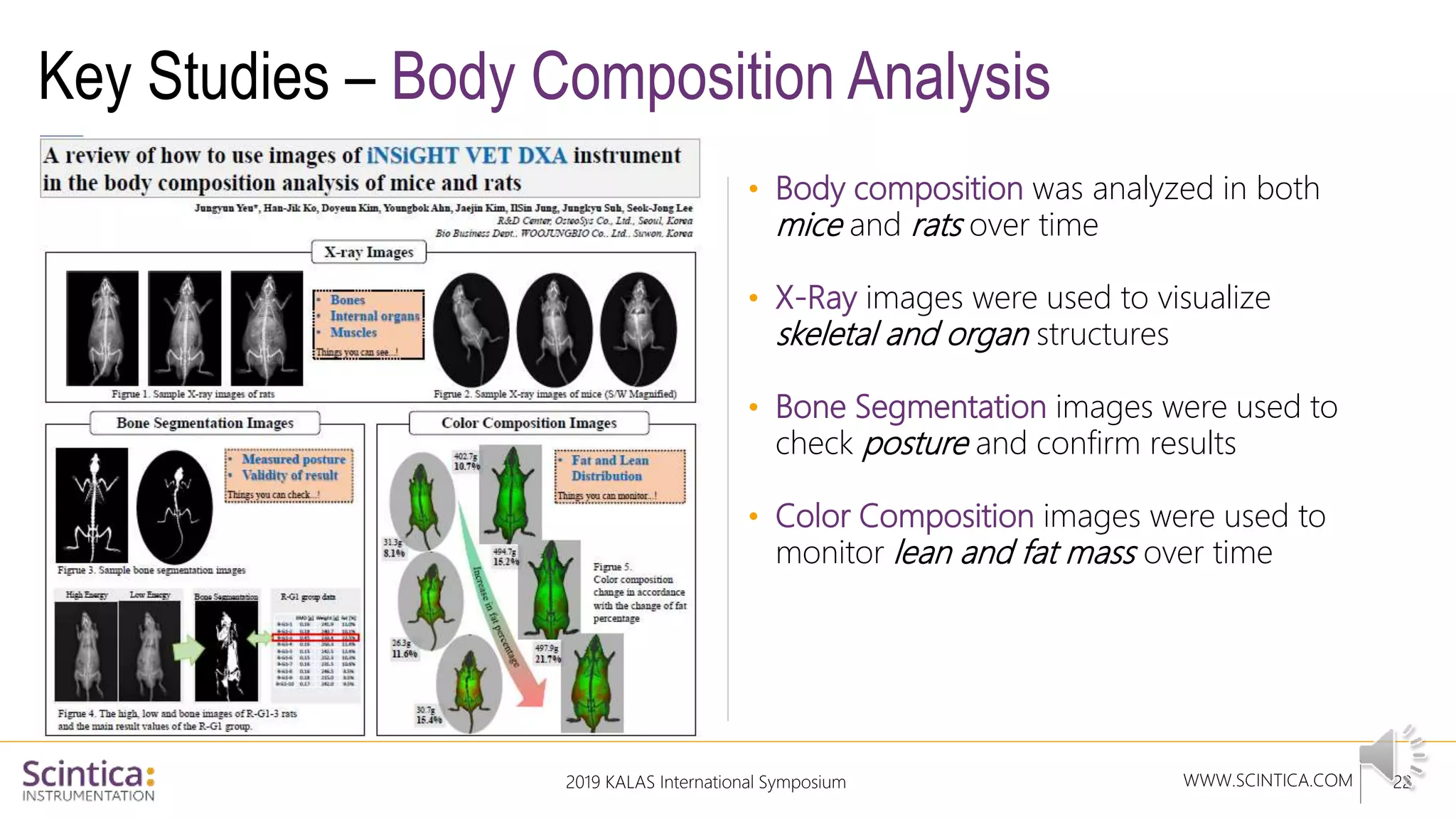
Key Studies – Body Composition Analysis
• Body composition was analyzed in both
mice and rats over time
• X-Ray images were used to visualize
skeletal and organ structures
• Bone Segmentation images were used to
check posture and confirm results
• Color Composition images were used to
monitor lean and fat mass over time
22
2019 KALAS International Symposium
WWW.SCINTICA.COM
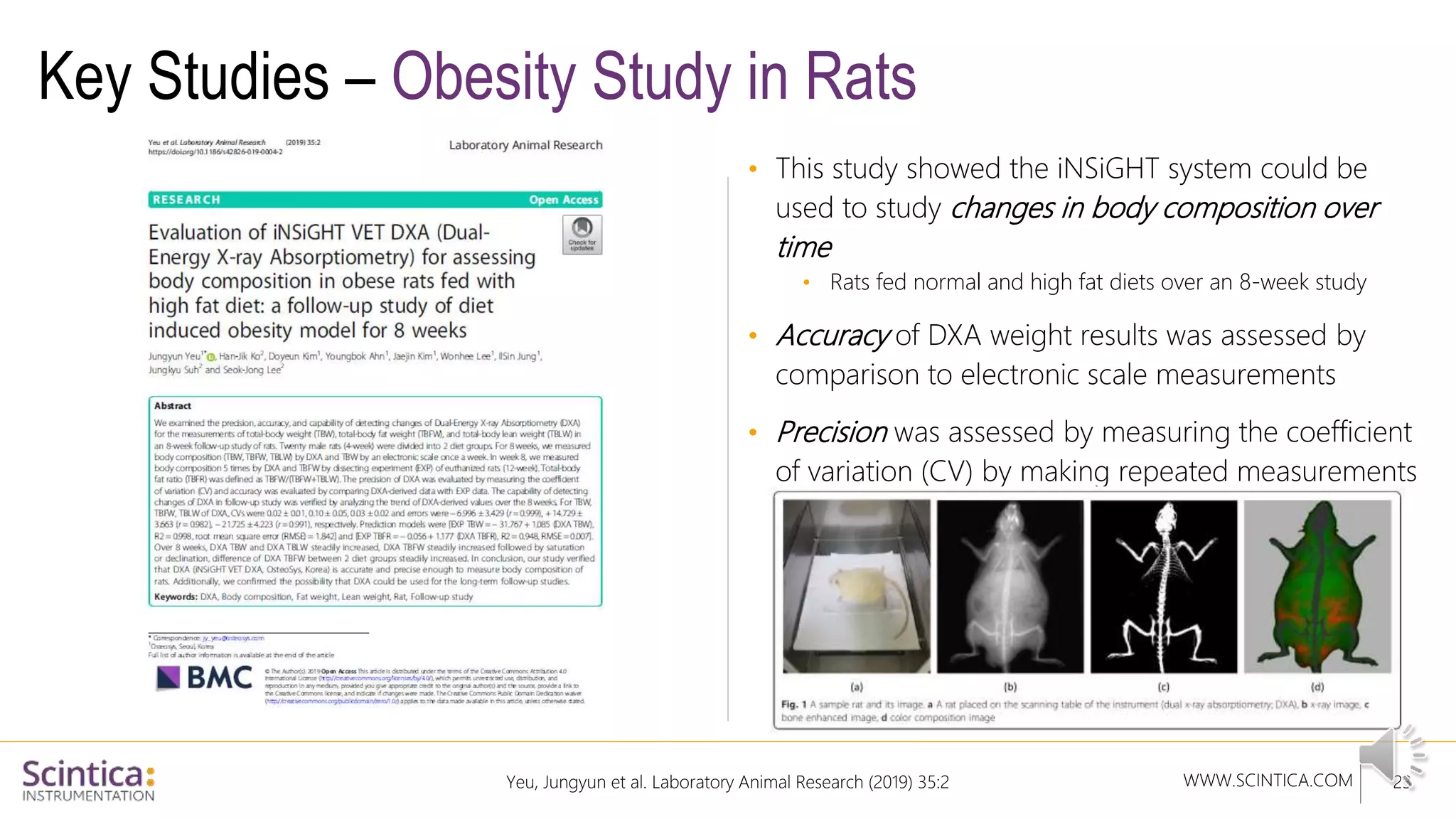
Key Studies – Obesity Study in Rats
• This study showed the iNSiGHT system could be
used to study changes in body composition over
time
• Rats fed normal and high fat diets over an 8-week study
• Accuracy of DXA weight results was assessed by
comparison to electronic scale measurements
• Precision was assessed by measuring the coefficient
of variation (CV) by making repeated measurements
at week 8
23
Yeu, Jungyun et al. Laboratory Animal Research (2019) 35:2
WWW.SCINTICA.COM
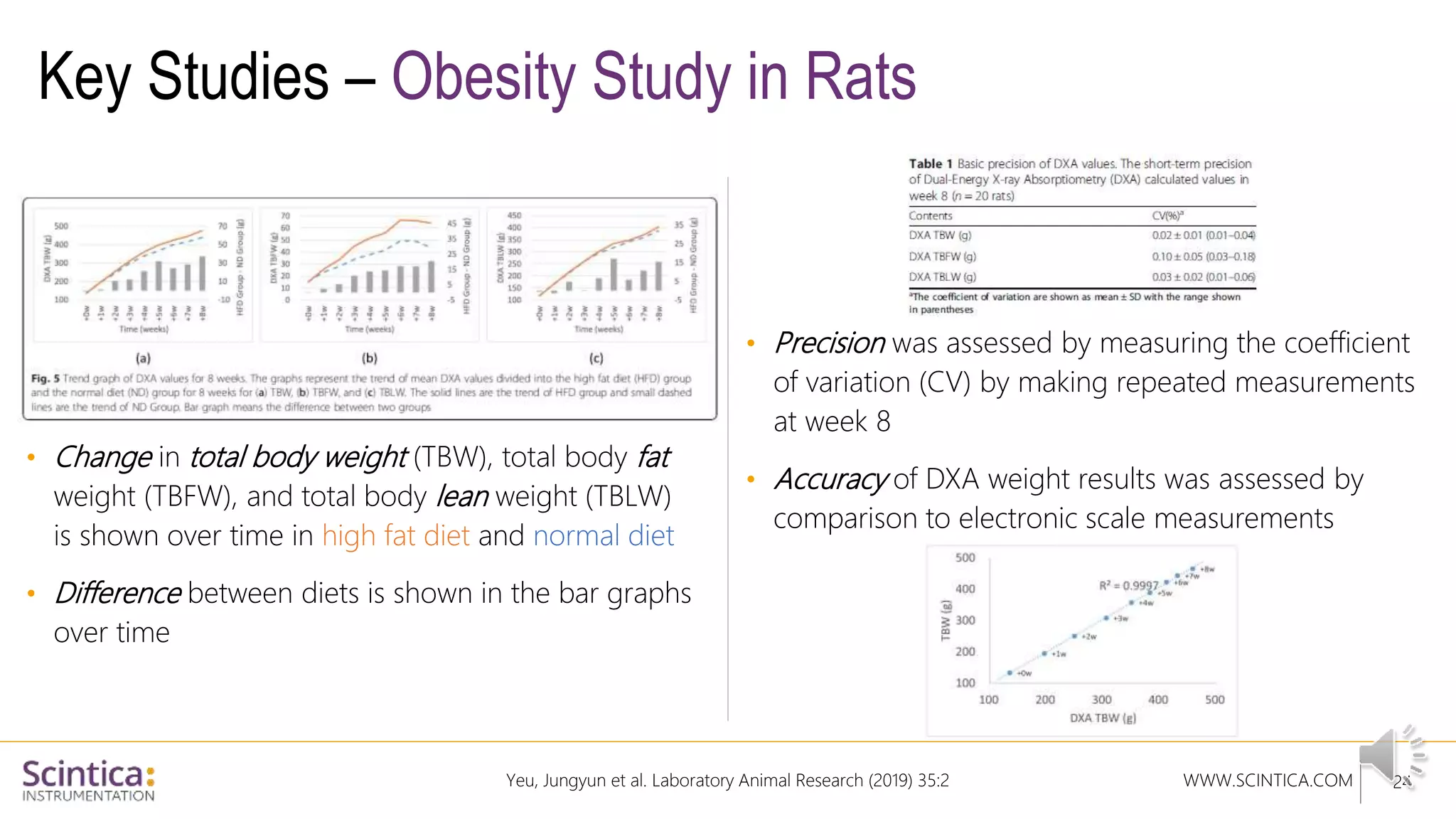
Key Studies – Obesity Study in Rats
• Precision was assessed by measuring the coefficient
of variation (CV) by making repeated measurements
at week 8
• Accuracy of DXA weight results was assessed by
comparison to electronic scale measurements
24
Yeu, Jungyun et al. Laboratory Animal Research (2019) 35:2
• Change in total body weight (TBW), total body fat
weight (TBFW), and total body lean weight (TBLW)
is shown over time in high fat diet and normal diet
• Difference between diets is shown in the bar graphs
over time
WWW.SCINTICA.COM
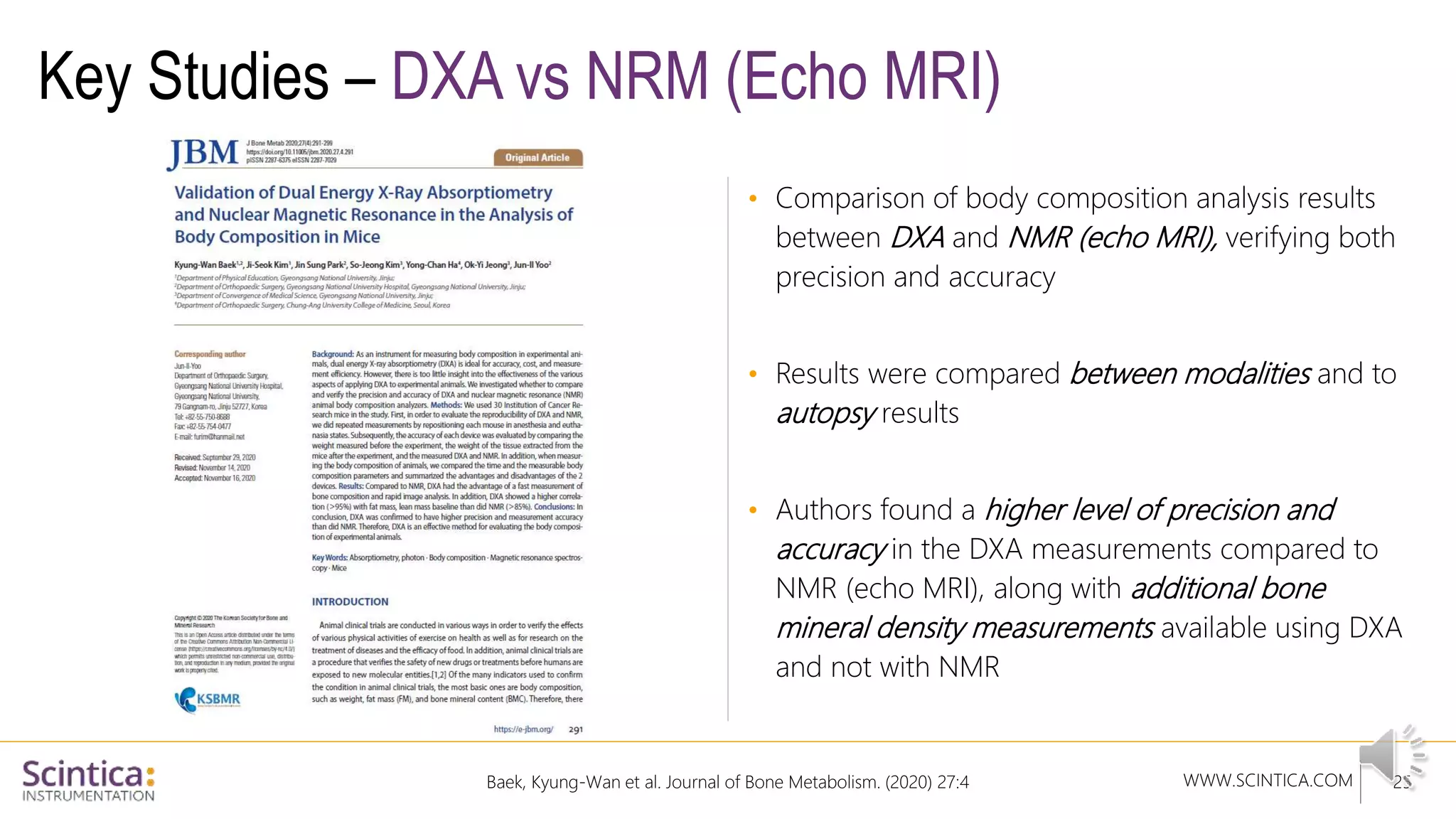
Key Studies – DXA vs NRM (Echo MRI)
• Comparison of body composition analysis results
between DXA and NMR (echo MRI), verifying both
precision and accuracy
• Results were compared between modalities and to
autopsy results
• Authors found a higher level of precision and
accuracy in the DXA measurements compared to
NMR (echo MRI), along with additional bone
mineral density measurements available using DXA
and not with NMR
25
Baek, Kyung-Wan et al. Journal of Bone Metabolism. (2020) 27:4
WWW.SCINTICA.COM
Key Studies – DXA vs NMR (Echo MRI)
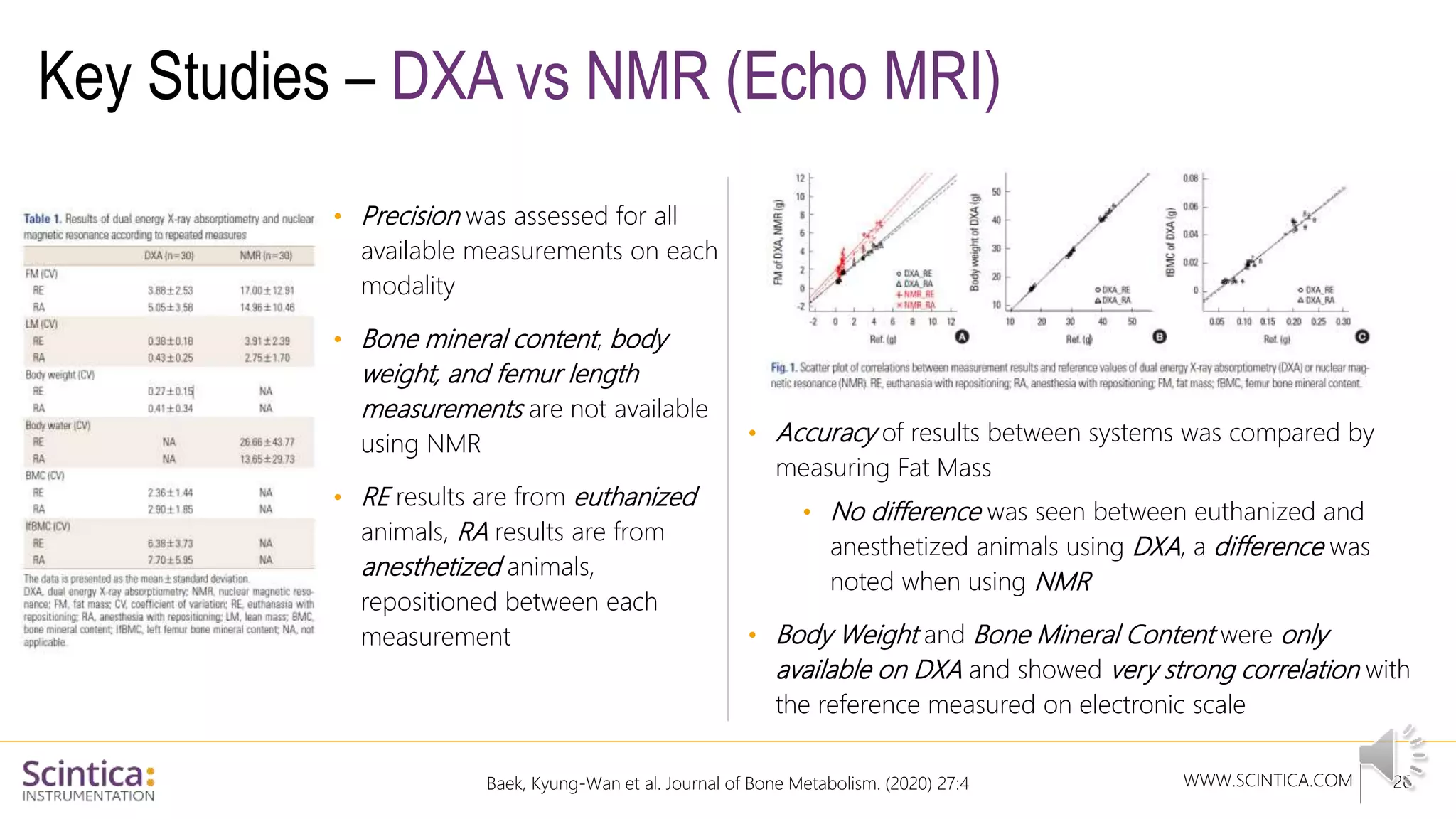
• Accuracy of results between systems was compared by
measuring Fat Mass
• No difference was seen between euthanized and
anesthetized animals using DXA, a difference was
noted when using NMR
• Body Weight and Bone Mineral Content were only
available on DXA and showed very strong correlation with
the reference measured on electronic scale
26
Baek, Kyung-Wan et al. Journal of Bone Metabolism. (2020) 27:4
• Precision was assessed for all
available measurements on each
modality
• Bone mineral content, body
weight, and femur length
measurements are not available
using NMR
• RE results are from euthanized
animals, RA results are from
anesthetized animals,
repositioned between each
measurement
WWW.SCINTICA.COM
Topics of Discussion
• What is DXA and How Does it Work
• iNSiGHT System Overview
• Key Research Applications
27
WWW.SCINTICA.COM
Audience Poll
Questions?
Please enter your questions in the Q&A
Any questions not addressed during the
answered following the event.
For additional information reach out to
info@scintica.com or visit
www.scintica.com
Tonya Coulthard, MSc.
Manager, Imaging Division
tcoulthard@scintica.com

Preclinical DXA for in vivo body composition and bone mineral density measurements

  • 1.
    iNSiGHT Preclinical DXA systemfor in vivo body composition and bone mineral density measurements Tonya Coulthard, MSc. Manager, Imaging Division tcoulthard@scintica.com
  • 2.
  • 3.
    iNSiGHT Preclinical DXA systemfor in vivo body composition and bone mineral density measurements Tonya Coulthard, MSc. Manager, Imaging Division tcoulthard@scintica.com
  • 4.
    WWW.SCINTICA.COM Topics of Discussion •What is DXA and How Does it Work • iNSiGHT System Overview • Key Research Applications 4
  • 5.
    WWW.SCINTICA.COM What is DXAand How Does it Work • Dual Energy X-Ray Absorptiometry • Acquired Images • Available Measurements • Comparison to Other Techniques 5
  • 6.
    WWW.SCINTICA.COM Dual Energy X-RayAbsorptiometry (DXA or DEXA) • DXA is used to assess body composition • Different tissues in the body have varying mass attenuation coefficients (µn) • Two different x-ray beams, having different energies are generated at the source, passing through the body, hitting the x-ray detector • Equations are used to determine which type of tissue each pixel on the image represents • Bone • Soft tissue – fat mass or lean tissue mass Figure from Luo, Yunhua. 2017. Chapter 3 – Bone Imaging for Osteoporosis Assessment 6
  • 7.
    WWW.SCINTICA.COM Acquired Images Images acquiredusing the iNSiGHT DXA system 7 X-Ray Attenuation Image Bone Mineral Density Image Color Image Fat (Orange) and Lean (Green) Mass
  • 8.
    WWW.SCINTICA.COM Available Measurements 8 Parameter Unit of Measure Description (availableon whole animal, or from each ROI) BMD g/cm2 Bone Mineral Density Bone Area cm2 Bone Area in Image BMC g Bone Mineral Contents (Bone Mass) BMC = bone density x bone area Fat g Fat mass Fat Ratio % Fat Ratio = Fat/Total Mass Lean g Fat free mass Lean Ratio % Lean Ratio = Lean/Total Mass Total Mass g Total Mass = Fat + Lean + Bone Tissue Area cm2 Tissue Area in Image Images acquired using the iNSiGHT DXA system
  • 9.
    WWW.SCINTICA.COM Comparison to OtherTechniques 9 DXA NMR (Echo MRI) Measurements Available • Fat Mass • Lean Mass • Bone Mineral Content • Fat Mass • Lean Mass • Water Content Scan Time • 25 seconds • 80 seconds • 30 seconds without water content Advantages • Bone/lean/fat and weight measurements • Images acquired • High degree of accuracy (CV < 1%, R2 > 0.9) • Water content available • No anesthesia required Disadvantages • Requires anesthesia • No bone or weight information • No images available DXA NMR
  • 10.
    WWW.SCINTICA.COM iNSiGHT System Overview •System Components • System Features and Benefits • Technical Specification • Analysis Software 10
  • 11.
    WWW.SCINTICA.COM iNSiGHT: System Components •X-Ray Benchtop Cabinet • Self-shielded • Integrated anesthesia • Standard electrical connection • Software Workstation • Windows 10 operating system • Offline Analysis Software • License based for offline analysis
  • 12.
    WWW.SCINTICA.COM iNSiGHT: System Featuresand Benefits 12 • Longitudinal studies • Non-invasive data acquisition allows studying changes in body composition over time • Easy data acquisition • No preparation steps other anesthesia required • Low dose radiation • Minimizing effects on animals during each imaging session • Fast scan times (~25 seconds/scan) • Allows for high throughput studies • High-resolution images (100µm) • Study changes in body composition on small animals, incl. mice, rats, etc. • Wide scan area (16.5 x 25.5 cm) • Allows for a variety of animal models to be imaged, from 10 ~ 500g
  • 13.
    WWW.SCINTICA.COM iNSiGHT: Technical Specifications 13 SpecificationDetails Scan Method Cone Beam Animal Size 10 ~ 500g Scan Time 25 seconds Image Area (maximum) 16.5 x 25.5cm Pixel Size 100µm at 1.2X 31µm at 4X Operating System Windows 10, 64bit Dimensions (WxDxH) 66 x 61 x 113 cm Power 110/240VAC, 50/60Hz, 200VA Operating Temp 10 ~ 40oC
  • 14.
    WWW.SCINTICA.COM iNSiGHT: Analysis Software 14 Parameter Unitof Measure Description (available on whole animal, or from each ROI) BMC g Bone Mineral Contents (Bone Mass) BMC = bone density x bone area Fat g Fat mass Fat Ratio % Fat Ratio = Fat/Total Mass Lean g Fat free mass Lean Ratio % Lean Ratio = Lean/Total Mass Total Mass g Total Mass = Fat + Lean + Bone BMD g/cm2 Bone Mineral Density Bone Area cm2 Bone Area in Image Tissue Area cm2 Tissue Area in Image The image can be magnified to help draw specific ROIs, or to make length measurements on any bone
  • 15.
    WWW.SCINTICA.COM iNSiGHT: Analysis Software 15 •Up to 7 ROIs can be drawn to get specific information • An exclusion ROI (blue) can be drawn and applied to all calculations • Length measurements can be completed on any bone
  • 16.
    WWW.SCINTICA.COM iNSiGHT: Analysis Software 16 •Results from a longitudinal study can be displayed over time • Both trendlines and graphical representation of data is available • All data can be exported in .csv format • Images can be exported in standard formats
  • 17.
    WWW.SCINTICA.COM Key Research Applications •Example Images • Research Areas of Interest • Key Studies 17
  • 18.
    WWW.SCINTICA.COM Example Images -Mouse 18 X-Ray Attenuation Image Bone Mineral Density Image Color Image Fat (Orange) and Lean (Green) Mass
  • 19.
    WWW.SCINTICA.COM Example Images -Rat 19 X-Ray Attenuation Image Bone Mineral Density Image Color Image Fat (Orange) and Lean (Green) Mass
  • 20.
  • 21.
    WWW.SCINTICA.COM Research Areas ofInterest • DXA, resulting bone mineral density and body composition data can be used in a wide variety of research areas • The iNSiGHT system can be used to assess the progression or regression of disease in response to a therapeutic regime • Bone Mineral Density: • Metabolic bone diseases, such as osteoporosis, etc. • Arthritis • Musculoskeletal diseases • Drug safety and toxicology • Lean/Fat Mass: • Metabolic disorders, such as diabetes, obesity, etc. • Musculoskeletal diseases • Drug safety and toxicology 21
  • 22.
    WWW.SCINTICA.COM Key Studies –Body Composition Analysis • Body composition was analyzed in both mice and rats over time • X-Ray images were used to visualize skeletal and organ structures • Bone Segmentation images were used to check posture and confirm results • Color Composition images were used to monitor lean and fat mass over time 22 2019 KALAS International Symposium
  • 23.
    WWW.SCINTICA.COM Key Studies –Obesity Study in Rats • This study showed the iNSiGHT system could be used to study changes in body composition over time • Rats fed normal and high fat diets over an 8-week study • Accuracy of DXA weight results was assessed by comparison to electronic scale measurements • Precision was assessed by measuring the coefficient of variation (CV) by making repeated measurements at week 8 23 Yeu, Jungyun et al. Laboratory Animal Research (2019) 35:2
  • 24.
    WWW.SCINTICA.COM Key Studies –Obesity Study in Rats • Precision was assessed by measuring the coefficient of variation (CV) by making repeated measurements at week 8 • Accuracy of DXA weight results was assessed by comparison to electronic scale measurements 24 Yeu, Jungyun et al. Laboratory Animal Research (2019) 35:2 • Change in total body weight (TBW), total body fat weight (TBFW), and total body lean weight (TBLW) is shown over time in high fat diet and normal diet • Difference between diets is shown in the bar graphs over time
  • 25.
    WWW.SCINTICA.COM Key Studies –DXA vs NRM (Echo MRI) • Comparison of body composition analysis results between DXA and NMR (echo MRI), verifying both precision and accuracy • Results were compared between modalities and to autopsy results • Authors found a higher level of precision and accuracy in the DXA measurements compared to NMR (echo MRI), along with additional bone mineral density measurements available using DXA and not with NMR 25 Baek, Kyung-Wan et al. Journal of Bone Metabolism. (2020) 27:4
  • 26.
    WWW.SCINTICA.COM Key Studies –DXA vs NMR (Echo MRI) • Accuracy of results between systems was compared by measuring Fat Mass • No difference was seen between euthanized and anesthetized animals using DXA, a difference was noted when using NMR • Body Weight and Bone Mineral Content were only available on DXA and showed very strong correlation with the reference measured on electronic scale 26 Baek, Kyung-Wan et al. Journal of Bone Metabolism. (2020) 27:4 • Precision was assessed for all available measurements on each modality • Bone mineral content, body weight, and femur length measurements are not available using NMR • RE results are from euthanized animals, RA results are from anesthetized animals, repositioned between each measurement
  • 27.
    WWW.SCINTICA.COM Topics of Discussion •What is DXA and How Does it Work • iNSiGHT System Overview • Key Research Applications 27
  • 28.
  • 29.
    Questions? Please enter yourquestions in the Q&A Any questions not addressed during the answered following the event. For additional information reach out to info@scintica.com or visit www.scintica.com Tonya Coulthard, MSc. Manager, Imaging Division tcoulthard@scintica.com