



MODULE ON RADIOLOGICAL EQUIPMENT
CHAPTER ONE
X-RAY TUBES & X-RAY PRODUCTION
Objectives;
Upon successful completion of this chapter students will be able to:
 Identify components of x-ray tube & describe their functions
 Describe line-focus principle for x-ray tubes
 Describe basic process of x-ray production
4 April 2016 By Marema Jebessa 1
• ASSESSMENT
QUIZZES
4 April 2016 By Marema Jebessa 2
X-RAY TUBE ION& X-RAY PRODUCTION
INTRODUCTION
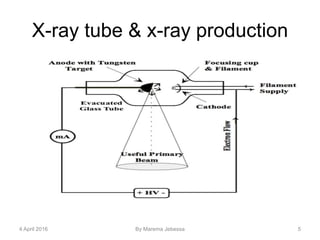
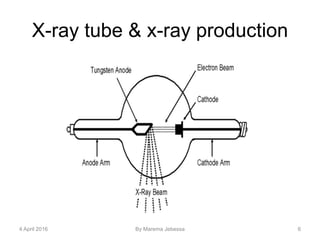
• X-ray tube:-is a relatively simple
electrical device w/c converts energy
from one form into another.
4 April 2016 By Marema Jebessa 3
X-ray tube & x-ray production
Function:-receives electrical energy &
converts into: heat and x-radiation.
NB; x-rays are produced when a fast moving
electrons suddenly decelerated in the target
“ANODE”
4 April 2016 By Marema Jebessa 4
X-ray tube & x-ray production
4 April 2016 By Marema Jebessa 5
X-ray tube & x-ray production
4 April 2016 By Marema Jebessa 6
X-ray tube & x-ray production
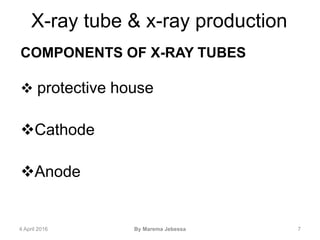
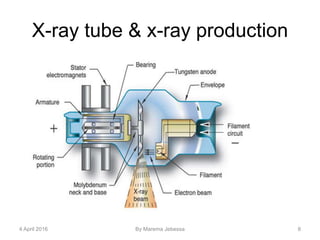
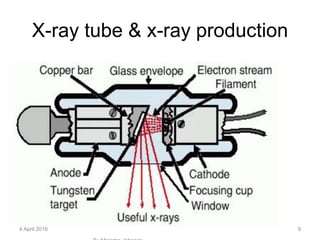
COMPONENTS OF X-RAY TUBES
 protective house
Cathode
Anode
4 April 2016 By Marema Jebessa 7
X-ray tube & x-ray production
4 April 2016 By Marema Jebessa 8
X-ray tube & x-ray production
4 April 2016 9
X-ray tube & x-ray production
Protective housing
 A metal lead-lined
 Designed to enclose & support the components
Control excessive radiation exposure & electrical
shock.
4 April 2016 By Marema Jebessa 10
X-ray tube & x-ray production
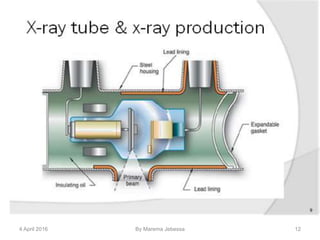
The space between the housing and insert is
filled with oil, which provides electrical
insulation and transfers heat from the insert to
the housing surface.
4 April 2016 By Marema Jebessa 11
4 April 2016 By Marema Jebessa 12
X-ray tube & x-ray production
X-rays are emitted isotropically.
 useful beam through the window.
leakage radiation-through protective
housing.
4 April 2016 By Marema Jebessa 13
X-ray tube & x-ray production
A properly designed protective housing
reduces the level of leakage to less than
100mr/hr at 1m when operated at
maximum conditions.
4 April 2016 By Marema Jebessa 14
X-ray tube & x-ray production
Cathode
Is the negative terminal of the tube.
The primary parts:
The filament &
a focusing cup.
4 April 2016 By Marema Jebessa 15
X-ray tube & x-ray production
FILAMENT-
 Is a small-coiled wire
 Commonly made from TUNGSTEN.
 Emits electrons when the current through the filament
is sufficiently intense…called thermionic emission..
 Normally powered by an alternating current that is
supplied to it by a separate transformer.
4 April 2016 By Marema Jebessa 16
X-ray tube & x-ray production
Why Tungsten is chosen for filament ?
because;
Has high melting point(3410°c)
Can be formed into helical=will have larger area
High resistance=the passed current produce high
heat
4 April 2016 By Marema Jebessa 17
X-ray tube & x-ray production
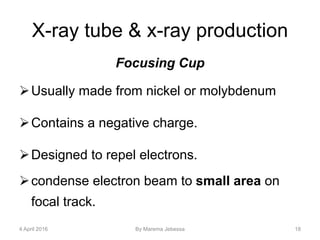
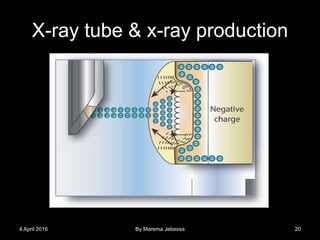
Focusing Cup
Usually made from nickel or molybdenum
Contains a negative charge.
Designed to repel electrons.
condense electron beam to small area on
focal track.
4 April 2016 By Marema Jebessa 18
…
The focusing cup is negatively charged so
that when the electrons are emitted by the
filament they will congregate and surge
across to the anode when the exposure
begins.
4 April 2016 By Marema Jebessa 19
X-ray tube & x-ray production
4 April 2016 By Marema Jebessa 20
X-ray tube & x-ray production
The effectiveness of the focusing cup is
determined by;
1)its size, shape
2)its charge
3)the filament size, shape
4)the position of the filament in the
focusing cup
4 April 2016 By Marema Jebessa 21
4 April 2016 By Marema Jebessa 22
X-ray tube & x-ray production
Anode
It is a positive electrode.
receives the electrons which bombard it.
It serves three important functions:
1-It provides a complete circuit for accelerating the electrons.
2-It houses the target material.
3-It helps to cool the tube.
4 April 2016 By Marema Jebessa 23
X-ray tube & x-ray production
The metal used is tungsten &is chosen for
1)its higher melting point
2)has higher atomic number
3)Is a good conductor of heat
4)doesn’t evaporate easily
5)can be worked and made smooth
X-ray tube & x-ray production
Focal spot
The piece of tungsten within the x-ray tube which
contains the area of electron bombardment is
known as the target.
The target is rectangular or circular in shape.
4 April 2016 By Marema Jebessa 24
X-ray tube & x-ray production
Most x-ray tubes have two focal spot sizes
(small and large), which can be selected
by the operator according to the imaging
procedure.
4 April 2016 By Marema Jebessa 25
X-ray tube & x-ray production
The dimensions of focal spots usually range from 0.1 mm to 2 mm.
X-ray tubes are designed to have specific focal spot sizes.
 small focal spots produce less blurring and better visibility of detail.
large focal spots have a greater heat-dissipating capacity.
4 April 2016 By Marema Jebessa 26
X-ray tube & x-ray production
 Tubes with small focal spots are used when high image
visibility of detail is essential and the amount of radiation
needed is relatively low because of small and thin body
regions as in mammography.
4 April 2016 By Marema Jebessa 27
X-ray tube & x-ray production
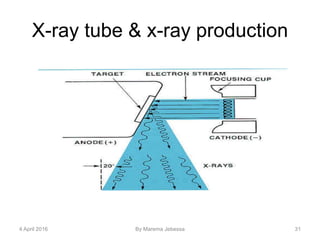
 The radiation is produced in a very small area on
the surface of the anode known as the focal spot.
 In most x-ray tubes, the focal spot is
approximately rectangular.
 The dimensions of the focal spot are determined
by the dimensions of the electron beam arriving
from the cathode.
4 April 2016 By Marema Jebessa 28
Small focal spot
 used when fine image is required.
 0.3-1mm
 associated with small filament.
4 April 2016 By Marema Jebessa 29
Large focal spot
used when techniques that produces
high heat are required.
 1-2.5mm
Associated with large filament
4 April 2016 By Marema Jebessa 30
X-ray tube & x-ray production
4 April 2016 By Marema Jebessa 31
X-ray tube & x-ray production
focal spot size
The size of this area is determined by the features that
are would expect.
 By the size and shape of the filament.
 By the dimension of the focusing slot and by the depth
of the filament in it.
4 April 2016 By Marema Jebessa 32
X-ray tube & x-ray production
By the characteristics of the electric field
associated with the focusing slot.
By the spacing of the two electrodes-that is,
how far apart the cathode and the anode are.
4 April 2016 By Marema Jebessa 33
X-ray tube & x-ray production
The larger this area is, the more heat it will
take on a short exposure before the
temperature of focal spot rises to the melting
of tungsten.
Langer focal spot permits higher
milliamperage to be used without damage the
x-ray tube.
4 April 2016 By Marema Jebessa 34
X-ray tube & x-ray production
Higher MA mean greater intensity of
radiation out put and this all a small amount
of x-radiation is produced & a great amount
of heat is spread over the focal spot.
4 April 2016 By Marema Jebessa 35
X-ray tube & x-ray production
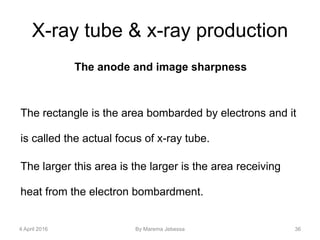
The anode and image sharpness
The rectangle is the area bombarded by electrons and it
is called the actual focus of x-ray tube.
The larger this area is the larger is the area receiving
heat from the electron bombardment.
4 April 2016 By Marema Jebessa 36
X-ray tube & x-ray production
 On a short exposure a larger area can take more heat
than smaller areas before temperature rises to the
melting point of tungsten.
 This means that an x-ray tube with large focus can be
operated at higher milliamperage while decreasing
image sharpness.
4 April 2016 By Marema Jebessa 37
X-ray tube & x-ray production
The sloping anode is able to reconcile these
two conflicts
a large area to take the electron
bombardment
a small x-ray source
4 April 2016 By Marema Jebessa 38
X-ray tube & x-ray production
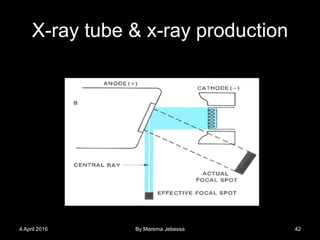
Apparent focus
It is the square projection of the actual
focus of x-ray tube.
It is known as effective or apparent focus.
It determines unsharpness.
4 April 2016 By Marema Jebessa 39
X-ray tube & x-ray production
It is the size of the x-ray source as it
appears to be when viewed from the film.
It determines the amount of geometric
unsharpness present in the image.
4 April 2016 By Marema Jebessa 40
X-ray tube & x-ray production
Actual focus
Is the true size of x-ray source
It determines the electrical load which the
tube will take.
4 April 2016 By Marema Jebessa 41
X-ray tube & x-ray production
4 April 2016 By Marema Jebessa 42
X-ray tube & x-ray production
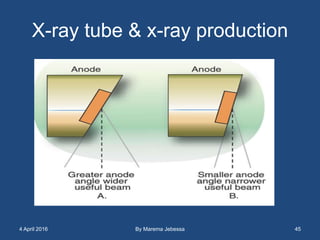
 The angle of the anode
 The anode angle is defined as the angle of the target
surface to the central axis of the X-ray tube.
 The anode of x-ray tube has a sloping face.
 This allows x-rays leave the tube sideways, and the
RT uses a beam which is at right angle to the long axis
of the x-ray tube
4 April 2016 By Marema Jebessa 43
X-ray tube & x-ray production
Line-Focus Principle
Angling of the target
 Used to reduce the effective area of the focal spot.
 The effective focal-spot size is controlled by the size of the actual
focal spot and the anode target angle.
 The effective focal spot's vertical dimension is the one that is
stated as the focal-spot size.
4 April 2016 By Marema Jebessa 44
X-ray tube & x-ray production
4 April 2016 By Marema Jebessa 45
X-ray tube & x-ray production
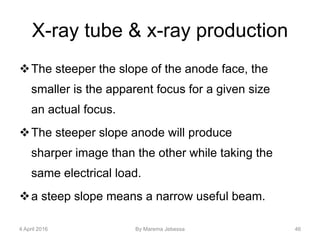
The steeper the slope of the anode face, the
smaller is the apparent focus for a given size
an actual focus.
The steeper slope anode will produce
sharper image than the other while taking the
same electrical load.
a steep slope means a narrow useful beam.
4 April 2016 By Marema Jebessa 46
X-ray tube & x-ray production
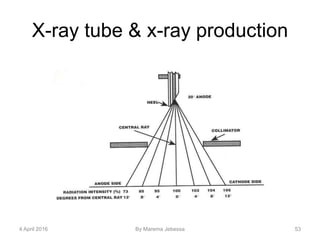
The heel effect
The variation in intensity along the long axis of
the x-ray tube is known as the heel effect
Heel effect is the term applied to the fact that x-
ray radiation does not exit the long axis of the
tube in uniform intensities.
4 April 2016 By Marema Jebessa 47
The intensity of the beam is equal to the number of
rays & diminishes fairly rapidly from the central ray
to the anode side of the patient, while increasing
slightly toward the cathode side of the patient.
4 April 2016 By Marema Jebessa 48
X-ray tube & x-ray production
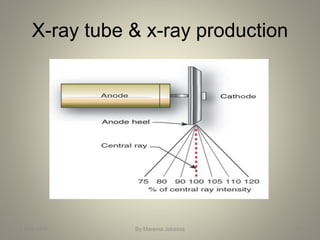
Anode Heel Effect
Is due to the geometry of the angled anode target, the radiation
intensity is greater on the cathode side.
As the figure below indicates the intensity of the x-ray beam is
greater towards the cathode (filament) end of the tube.
4 April 2016 By Marema Jebessa 49
X-ray tube & x-ray production
4 April 2016 By Marema Jebessa 50
X-ray tube & x-ray production
More x-rays will be able to get out of the anode
on the right side (the angle side) than on the
left side because of all the material the x-rays
must pass through to get out of the anode.
4 April 2016 By Marema Jebessa 51
X-ray tube & x-ray production
 The magnitude of influence of the heel effect on
the image depends on factors such as :
– anode angle
– size of film
– focus to film distance
4 April 2016 By Marema Jebessa 52
X-ray tube & x-ray production
4 April 2016 By Marema Jebessa 53
X-ray tube & x-ray production
 X-ray is not uniform along the film surface.
 Therefore the effects of the heel effect are seen toward the edges of
the film.
 To decrease the heel effect, increase the collimation & decrease the
film size.
 With increased collimation you get less heel effect.
4 April 2016 By Marema Jebessa 54
X-ray tube & x-ray production
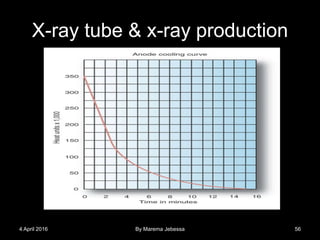
Cooling the x-ray tube
Almost all the electrical energy put into x-ray tube is
converted into heat.
 While small proportion of it gives rise to x-radiation.
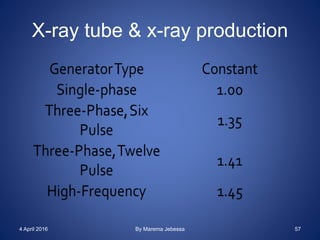
The amount of heat is related to the product
Hu=Kilovoltage x milliampere x duration of exposure
4 April 2016 By Marema Jebessa 55
X-ray tube & x-ray production
4 April 2016 By Marema Jebessa 56
X-ray tube & x-ray production
4 April 2016 By Marema Jebessa 57
X-ray tube & x-ray production
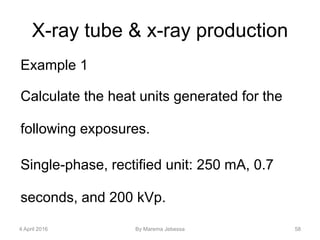
Example 1
Calculate the heat units generated for the
following exposures.
Single-phase, rectified unit: 250 mA, 0.7
seconds, and 200 kVp.
4 April 2016 By Marema Jebessa 58
X-ray tube & x-ray production
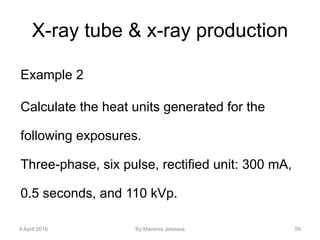
Example 2
Calculate the heat units generated for the
following exposures.
Three-phase, six pulse, rectified unit: 300 mA,
0.5 seconds, and 110 kVp.
4 April 2016 By Marema Jebessa 59
X-ray tube & x-ray production
Example 3
Calculate the heat units generated for the
following exposures.
High Frequency unit: 500 mA, 0.9 seconds,
and 300 kVp.
4 April 2016 By Marema Jebessa 60
X-ray tube & x-ray production
Heat dissipation
If dissipation of heat were not taking place, the melting point of
tungsten would soon be reached.
The process by which heat is dissipated are:
conduction – which takes place in solids
Conduction- which takes place in liquids & gases
Radiation-which can occur in a vacuum.
4 April 2016 By Marema Jebessa 61
X-ray tube & x-ray production
Conduction is for the heat to be removed
from the target
From tungsten wire to copper block.
The target also conveys a small part of its
heat by radiation across the vacuum of x-ray
tube to the glass envelope.
4 April 2016 By Marema Jebessa 62
Heat is conveyed or setup in the oil and the
heat is conveyed to the metal casing.
The metal casing then losses heat by
convention and by radiation to the air
surrounding the x-ray tube.
4 April 2016 By Marema Jebessa 63
X-ray tube & x-ray production
The rotating anode x-ray tube
The anode in the tube is a beveled tungsten disc attached
to a rotor that revolves when the tube is on.
The cathode filament is offset to one side so that the
electron stream hits near the edge of the revolving disc.
The rotating anode continually presents a different area
on the target to the electron stream.
4 April 2016 By Marema Jebessa 64
X-ray tube & x-ray production
The focal spot remains fixed in space while the
circular anode rotates during the exposure to
provide a cooler surface for the electron stream
to strike.
4 April 2016 By Marema Jebessa 65
X-ray tube & x-ray production
The heat is distributed over a broad band, thus
maintaining the temperature rise well within safe limits.
As the capacity of the tube to withstand heat is
increased, the capacity of the tube to produce x-rays is
increased.
4 April 2016 By Marema Jebessa 66
X-ray tube & x-ray production
It also permits manufacturers to produce
tubes with smaller effective focal spots.
The disadvantages are:
The tube is very delicate
Special lubricants are necessary for the
motor which will not produce volatile gases
4 April 2016 By Marema Jebessa 67
X-ray tube & x-ray production
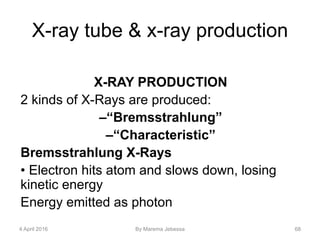
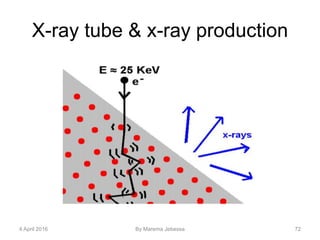
X-RAY PRODUCTION
2 kinds of X-Rays are produced:
–“Bremsstrahlung”
–“Characteristic”
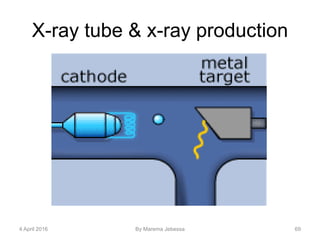
Bremsstrahlung X-Rays
• Electron hits atom and slows down, losing
kinetic energy
Energy emitted as photon
4 April 2016 By Marema Jebessa 68
X-ray tube & x-ray production
4 April 2016 By Marema Jebessa 69
X-ray tube & x-ray production
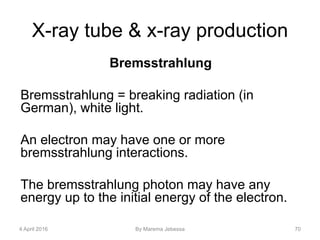
Bremsstrahlung
Bremsstrahlung = breaking radiation (in
German), white light.
An electron may have one or more
bremsstrahlung interactions.
The bremsstrahlung photon may have any
energy up to the initial energy of the electron.
4 April 2016 By Marema Jebessa 70
X-ray tube & x-ray production
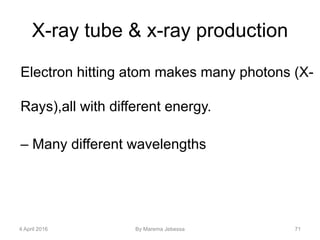
Electron hitting atom makes many photons (X-
Rays),all with different energy.
– Many different wavelengths
4 April 2016 By Marema Jebessa 71
X-ray tube & x-ray production
4 April 2016 By Marema Jebessa 72
X-ray tube & x-ray production
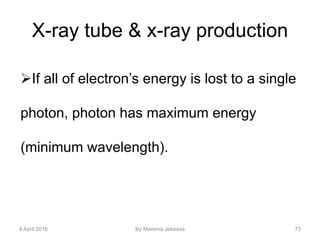
If all of electron’s energy is lost to a single
photon, photon has maximum energy
(minimum wavelength).
4 April 2016 By Marema Jebessa 73
X-ray tube & x-ray production
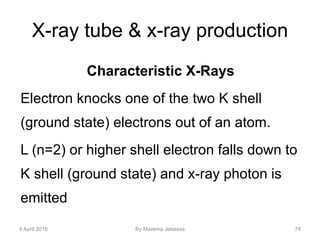
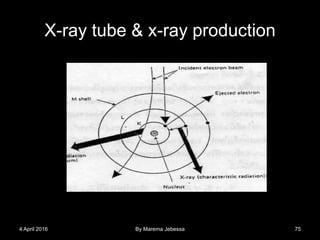
Characteristic X-Rays
Electron knocks one of the two K shell
(ground state) electrons out of an atom.
L (n=2) or higher shell electron falls down to
K shell (ground state) and x-ray photon is
emitted
4 April 2016 By Marema Jebessa 74
X-ray tube & x-ray production
4 April 2016 By Marema Jebessa 75
X-ray tube & x-ray production
Electron knocks one of the two K shell (ground
state) electrons out of an atom.
L (n=2) or higher shell electron falls down to K shell
(ground state) and x-ray photon is emitted
Bremsstrahlung X-Rays and Characteristic X-Rays
both occur at the same time.
4 April 2016 By Marema Jebessa 76
X-ray tube & x-ray production
Recommendations for Extending Tube Life
1. Warm up the anode following manufacturer's
recommendations.
2. Do not hold the rotor switch unnecessarily. Double-
press switches should be completely depressed in one
motion. Dual switches should have exposure switch
depressed first, followed by the rotor switch.
3. Use lower mA stations when possible.
4 April 2016 By Marema Jebessa 77
4. Use lower-speed rotor when possible.
5. Do not make repeated exposures near tube
loading limits.
6. Do not rotate the tube housing rapidly from
one position to another.
7. Do not use a tube when you can hear loud
rotor bearing
4 April 2016 By Marema Jebessa 78
4 April 2016 By Marema Jebessa 79
4 April 2016 By Marema Jebessa 80

x-ray tube

  • 1.
    MODULE ON RADIOLOGICALEQUIPMENT CHAPTER ONE X-RAY TUBES & X-RAY PRODUCTION Objectives; Upon successful completion of this chapter students will be able to:  Identify components of x-ray tube & describe their functions  Describe line-focus principle for x-ray tubes  Describe basic process of x-ray production 4 April 2016 By Marema Jebessa 1
  • 2.
    • ASSESSMENT QUIZZES 4 April2016 By Marema Jebessa 2
  • 3.
    X-RAY TUBE ION&X-RAY PRODUCTION INTRODUCTION • X-ray tube:-is a relatively simple electrical device w/c converts energy from one form into another. 4 April 2016 By Marema Jebessa 3
  • 4.
    X-ray tube &x-ray production Function:-receives electrical energy & converts into: heat and x-radiation. NB; x-rays are produced when a fast moving electrons suddenly decelerated in the target “ANODE” 4 April 2016 By Marema Jebessa 4
  • 5.
    X-ray tube &x-ray production 4 April 2016 By Marema Jebessa 5
  • 6.
    X-ray tube &x-ray production 4 April 2016 By Marema Jebessa 6
  • 7.
    X-ray tube &x-ray production COMPONENTS OF X-RAY TUBES  protective house Cathode Anode 4 April 2016 By Marema Jebessa 7
  • 8.
    X-ray tube &x-ray production 4 April 2016 By Marema Jebessa 8
  • 9.
    X-ray tube &x-ray production 4 April 2016 9
  • 10.
    X-ray tube &x-ray production Protective housing  A metal lead-lined  Designed to enclose & support the components Control excessive radiation exposure & electrical shock. 4 April 2016 By Marema Jebessa 10
  • 11.
    X-ray tube &x-ray production The space between the housing and insert is filled with oil, which provides electrical insulation and transfers heat from the insert to the housing surface. 4 April 2016 By Marema Jebessa 11
  • 12.
    4 April 2016By Marema Jebessa 12
  • 13.
    X-ray tube &x-ray production X-rays are emitted isotropically.  useful beam through the window. leakage radiation-through protective housing. 4 April 2016 By Marema Jebessa 13
  • 14.
    X-ray tube &x-ray production A properly designed protective housing reduces the level of leakage to less than 100mr/hr at 1m when operated at maximum conditions. 4 April 2016 By Marema Jebessa 14
  • 15.
    X-ray tube &x-ray production Cathode Is the negative terminal of the tube. The primary parts: The filament & a focusing cup. 4 April 2016 By Marema Jebessa 15
  • 16.
    X-ray tube &x-ray production FILAMENT-  Is a small-coiled wire  Commonly made from TUNGSTEN.  Emits electrons when the current through the filament is sufficiently intense…called thermionic emission..  Normally powered by an alternating current that is supplied to it by a separate transformer. 4 April 2016 By Marema Jebessa 16
  • 17.
    X-ray tube &x-ray production Why Tungsten is chosen for filament ? because; Has high melting point(3410°c) Can be formed into helical=will have larger area High resistance=the passed current produce high heat 4 April 2016 By Marema Jebessa 17
  • 18.
    X-ray tube &x-ray production Focusing Cup Usually made from nickel or molybdenum Contains a negative charge. Designed to repel electrons. condense electron beam to small area on focal track. 4 April 2016 By Marema Jebessa 18
  • 19.
    … The focusing cupis negatively charged so that when the electrons are emitted by the filament they will congregate and surge across to the anode when the exposure begins. 4 April 2016 By Marema Jebessa 19
  • 20.
    X-ray tube &x-ray production 4 April 2016 By Marema Jebessa 20
  • 21.
    X-ray tube &x-ray production The effectiveness of the focusing cup is determined by; 1)its size, shape 2)its charge 3)the filament size, shape 4)the position of the filament in the focusing cup 4 April 2016 By Marema Jebessa 21
  • 22.
    4 April 2016By Marema Jebessa 22 X-ray tube & x-ray production Anode It is a positive electrode. receives the electrons which bombard it. It serves three important functions: 1-It provides a complete circuit for accelerating the electrons. 2-It houses the target material. 3-It helps to cool the tube.
  • 23.
    4 April 2016By Marema Jebessa 23 X-ray tube & x-ray production The metal used is tungsten &is chosen for 1)its higher melting point 2)has higher atomic number 3)Is a good conductor of heat 4)doesn’t evaporate easily 5)can be worked and made smooth
  • 24.
    X-ray tube &x-ray production Focal spot The piece of tungsten within the x-ray tube which contains the area of electron bombardment is known as the target. The target is rectangular or circular in shape. 4 April 2016 By Marema Jebessa 24
  • 25.
    X-ray tube &x-ray production Most x-ray tubes have two focal spot sizes (small and large), which can be selected by the operator according to the imaging procedure. 4 April 2016 By Marema Jebessa 25
  • 26.
    X-ray tube &x-ray production The dimensions of focal spots usually range from 0.1 mm to 2 mm. X-ray tubes are designed to have specific focal spot sizes.  small focal spots produce less blurring and better visibility of detail. large focal spots have a greater heat-dissipating capacity. 4 April 2016 By Marema Jebessa 26
  • 27.
    X-ray tube &x-ray production  Tubes with small focal spots are used when high image visibility of detail is essential and the amount of radiation needed is relatively low because of small and thin body regions as in mammography. 4 April 2016 By Marema Jebessa 27
  • 28.
    X-ray tube &x-ray production  The radiation is produced in a very small area on the surface of the anode known as the focal spot.  In most x-ray tubes, the focal spot is approximately rectangular.  The dimensions of the focal spot are determined by the dimensions of the electron beam arriving from the cathode. 4 April 2016 By Marema Jebessa 28
  • 29.
    Small focal spot used when fine image is required.  0.3-1mm  associated with small filament. 4 April 2016 By Marema Jebessa 29
  • 30.
    Large focal spot usedwhen techniques that produces high heat are required.  1-2.5mm Associated with large filament 4 April 2016 By Marema Jebessa 30
  • 31.
    X-ray tube &x-ray production 4 April 2016 By Marema Jebessa 31
  • 32.
    X-ray tube &x-ray production focal spot size The size of this area is determined by the features that are would expect.  By the size and shape of the filament.  By the dimension of the focusing slot and by the depth of the filament in it. 4 April 2016 By Marema Jebessa 32
  • 33.
    X-ray tube &x-ray production By the characteristics of the electric field associated with the focusing slot. By the spacing of the two electrodes-that is, how far apart the cathode and the anode are. 4 April 2016 By Marema Jebessa 33
  • 34.
    X-ray tube &x-ray production The larger this area is, the more heat it will take on a short exposure before the temperature of focal spot rises to the melting of tungsten. Langer focal spot permits higher milliamperage to be used without damage the x-ray tube. 4 April 2016 By Marema Jebessa 34
  • 35.
    X-ray tube &x-ray production Higher MA mean greater intensity of radiation out put and this all a small amount of x-radiation is produced & a great amount of heat is spread over the focal spot. 4 April 2016 By Marema Jebessa 35
  • 36.
    X-ray tube &x-ray production The anode and image sharpness The rectangle is the area bombarded by electrons and it is called the actual focus of x-ray tube. The larger this area is the larger is the area receiving heat from the electron bombardment. 4 April 2016 By Marema Jebessa 36
  • 37.
    X-ray tube &x-ray production  On a short exposure a larger area can take more heat than smaller areas before temperature rises to the melting point of tungsten.  This means that an x-ray tube with large focus can be operated at higher milliamperage while decreasing image sharpness. 4 April 2016 By Marema Jebessa 37
  • 38.
    X-ray tube &x-ray production The sloping anode is able to reconcile these two conflicts a large area to take the electron bombardment a small x-ray source 4 April 2016 By Marema Jebessa 38
  • 39.
    X-ray tube &x-ray production Apparent focus It is the square projection of the actual focus of x-ray tube. It is known as effective or apparent focus. It determines unsharpness. 4 April 2016 By Marema Jebessa 39
  • 40.
    X-ray tube &x-ray production It is the size of the x-ray source as it appears to be when viewed from the film. It determines the amount of geometric unsharpness present in the image. 4 April 2016 By Marema Jebessa 40
  • 41.
    X-ray tube &x-ray production Actual focus Is the true size of x-ray source It determines the electrical load which the tube will take. 4 April 2016 By Marema Jebessa 41
  • 42.
    X-ray tube &x-ray production 4 April 2016 By Marema Jebessa 42
  • 43.
    X-ray tube &x-ray production  The angle of the anode  The anode angle is defined as the angle of the target surface to the central axis of the X-ray tube.  The anode of x-ray tube has a sloping face.  This allows x-rays leave the tube sideways, and the RT uses a beam which is at right angle to the long axis of the x-ray tube 4 April 2016 By Marema Jebessa 43
  • 44.
    X-ray tube &x-ray production Line-Focus Principle Angling of the target  Used to reduce the effective area of the focal spot.  The effective focal-spot size is controlled by the size of the actual focal spot and the anode target angle.  The effective focal spot's vertical dimension is the one that is stated as the focal-spot size. 4 April 2016 By Marema Jebessa 44
  • 45.
    X-ray tube &x-ray production 4 April 2016 By Marema Jebessa 45
  • 46.
    X-ray tube &x-ray production The steeper the slope of the anode face, the smaller is the apparent focus for a given size an actual focus. The steeper slope anode will produce sharper image than the other while taking the same electrical load. a steep slope means a narrow useful beam. 4 April 2016 By Marema Jebessa 46
  • 47.
    X-ray tube &x-ray production The heel effect The variation in intensity along the long axis of the x-ray tube is known as the heel effect Heel effect is the term applied to the fact that x- ray radiation does not exit the long axis of the tube in uniform intensities. 4 April 2016 By Marema Jebessa 47
  • 48.
    The intensity ofthe beam is equal to the number of rays & diminishes fairly rapidly from the central ray to the anode side of the patient, while increasing slightly toward the cathode side of the patient. 4 April 2016 By Marema Jebessa 48
  • 49.
    X-ray tube &x-ray production Anode Heel Effect Is due to the geometry of the angled anode target, the radiation intensity is greater on the cathode side. As the figure below indicates the intensity of the x-ray beam is greater towards the cathode (filament) end of the tube. 4 April 2016 By Marema Jebessa 49
  • 50.
    X-ray tube &x-ray production 4 April 2016 By Marema Jebessa 50
  • 51.
    X-ray tube &x-ray production More x-rays will be able to get out of the anode on the right side (the angle side) than on the left side because of all the material the x-rays must pass through to get out of the anode. 4 April 2016 By Marema Jebessa 51
  • 52.
    X-ray tube &x-ray production  The magnitude of influence of the heel effect on the image depends on factors such as : – anode angle – size of film – focus to film distance 4 April 2016 By Marema Jebessa 52
  • 53.
    X-ray tube &x-ray production 4 April 2016 By Marema Jebessa 53
  • 54.
    X-ray tube &x-ray production  X-ray is not uniform along the film surface.  Therefore the effects of the heel effect are seen toward the edges of the film.  To decrease the heel effect, increase the collimation & decrease the film size.  With increased collimation you get less heel effect. 4 April 2016 By Marema Jebessa 54
  • 55.
    X-ray tube &x-ray production Cooling the x-ray tube Almost all the electrical energy put into x-ray tube is converted into heat.  While small proportion of it gives rise to x-radiation. The amount of heat is related to the product Hu=Kilovoltage x milliampere x duration of exposure 4 April 2016 By Marema Jebessa 55
  • 56.
    X-ray tube &x-ray production 4 April 2016 By Marema Jebessa 56
  • 57.
    X-ray tube &x-ray production 4 April 2016 By Marema Jebessa 57
  • 58.
    X-ray tube &x-ray production Example 1 Calculate the heat units generated for the following exposures. Single-phase, rectified unit: 250 mA, 0.7 seconds, and 200 kVp. 4 April 2016 By Marema Jebessa 58
  • 59.
    X-ray tube &x-ray production Example 2 Calculate the heat units generated for the following exposures. Three-phase, six pulse, rectified unit: 300 mA, 0.5 seconds, and 110 kVp. 4 April 2016 By Marema Jebessa 59
  • 60.
    X-ray tube &x-ray production Example 3 Calculate the heat units generated for the following exposures. High Frequency unit: 500 mA, 0.9 seconds, and 300 kVp. 4 April 2016 By Marema Jebessa 60
  • 61.
    X-ray tube &x-ray production Heat dissipation If dissipation of heat were not taking place, the melting point of tungsten would soon be reached. The process by which heat is dissipated are: conduction – which takes place in solids Conduction- which takes place in liquids & gases Radiation-which can occur in a vacuum. 4 April 2016 By Marema Jebessa 61
  • 62.
    X-ray tube &x-ray production Conduction is for the heat to be removed from the target From tungsten wire to copper block. The target also conveys a small part of its heat by radiation across the vacuum of x-ray tube to the glass envelope. 4 April 2016 By Marema Jebessa 62
  • 63.
    Heat is conveyedor setup in the oil and the heat is conveyed to the metal casing. The metal casing then losses heat by convention and by radiation to the air surrounding the x-ray tube. 4 April 2016 By Marema Jebessa 63
  • 64.
    X-ray tube &x-ray production The rotating anode x-ray tube The anode in the tube is a beveled tungsten disc attached to a rotor that revolves when the tube is on. The cathode filament is offset to one side so that the electron stream hits near the edge of the revolving disc. The rotating anode continually presents a different area on the target to the electron stream. 4 April 2016 By Marema Jebessa 64
  • 65.
    X-ray tube &x-ray production The focal spot remains fixed in space while the circular anode rotates during the exposure to provide a cooler surface for the electron stream to strike. 4 April 2016 By Marema Jebessa 65
  • 66.
    X-ray tube &x-ray production The heat is distributed over a broad band, thus maintaining the temperature rise well within safe limits. As the capacity of the tube to withstand heat is increased, the capacity of the tube to produce x-rays is increased. 4 April 2016 By Marema Jebessa 66
  • 67.
    X-ray tube &x-ray production It also permits manufacturers to produce tubes with smaller effective focal spots. The disadvantages are: The tube is very delicate Special lubricants are necessary for the motor which will not produce volatile gases 4 April 2016 By Marema Jebessa 67
  • 68.
    X-ray tube &x-ray production X-RAY PRODUCTION 2 kinds of X-Rays are produced: –“Bremsstrahlung” –“Characteristic” Bremsstrahlung X-Rays • Electron hits atom and slows down, losing kinetic energy Energy emitted as photon 4 April 2016 By Marema Jebessa 68
  • 69.
    X-ray tube &x-ray production 4 April 2016 By Marema Jebessa 69
  • 70.
    X-ray tube &x-ray production Bremsstrahlung Bremsstrahlung = breaking radiation (in German), white light. An electron may have one or more bremsstrahlung interactions. The bremsstrahlung photon may have any energy up to the initial energy of the electron. 4 April 2016 By Marema Jebessa 70
  • 71.
    X-ray tube &x-ray production Electron hitting atom makes many photons (X- Rays),all with different energy. – Many different wavelengths 4 April 2016 By Marema Jebessa 71
  • 72.
    X-ray tube &x-ray production 4 April 2016 By Marema Jebessa 72
  • 73.
    X-ray tube &x-ray production If all of electron’s energy is lost to a single photon, photon has maximum energy (minimum wavelength). 4 April 2016 By Marema Jebessa 73
  • 74.
    X-ray tube &x-ray production Characteristic X-Rays Electron knocks one of the two K shell (ground state) electrons out of an atom. L (n=2) or higher shell electron falls down to K shell (ground state) and x-ray photon is emitted 4 April 2016 By Marema Jebessa 74
  • 75.
    X-ray tube &x-ray production 4 April 2016 By Marema Jebessa 75
  • 76.
    X-ray tube &x-ray production Electron knocks one of the two K shell (ground state) electrons out of an atom. L (n=2) or higher shell electron falls down to K shell (ground state) and x-ray photon is emitted Bremsstrahlung X-Rays and Characteristic X-Rays both occur at the same time. 4 April 2016 By Marema Jebessa 76
  • 77.
    X-ray tube &x-ray production Recommendations for Extending Tube Life 1. Warm up the anode following manufacturer's recommendations. 2. Do not hold the rotor switch unnecessarily. Double- press switches should be completely depressed in one motion. Dual switches should have exposure switch depressed first, followed by the rotor switch. 3. Use lower mA stations when possible. 4 April 2016 By Marema Jebessa 77
  • 78.
    4. Use lower-speedrotor when possible. 5. Do not make repeated exposures near tube loading limits. 6. Do not rotate the tube housing rapidly from one position to another. 7. Do not use a tube when you can hear loud rotor bearing 4 April 2016 By Marema Jebessa 78
  • 79.
    4 April 2016By Marema Jebessa 79
  • 80.
    4 April 2016By Marema Jebessa 80