Lab Incubator Decontamination:
WHY, WHEN and HOW
Randy Engler
Co-Founder & COO, MycoFogTM
• Introduction
• Types of contamination
• Sources of biocontamination
• Cleaning & Disinfection methods
• The MycoFog Advantage
Contamination of cell cultures by bacteria and fungi
almost invariably results in (1) ill humor in the laboratory
lasting from hours to days; and (2) one or many
discarded cell cultures. Accompanying these two major
reactions are the following: (a) soul searching; (b)
culturing of all media components, usually in
thioglycolate broth alone; (c) scrubbing of the laboratory;
(d) tightening of techniques; (e) no further contamination
(temporarily) because of (c) and/or (d).
Donald Armstrong, Contamination of Tissue Culture by
Bacteria and Fungi in “Contamination in Tissue Culture”,
Fogh J. Ed., 1973
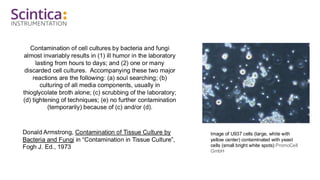
Image of U937 cells (large, white with
yellow center) contaminated with yeast
cells (small bright white spots) PromoCell
GmbH
Types of Contamination of Laboratory Incubators
• Microbiological contamination (e.g. bacteria,
mycoplasmas, yeast, fungi)
• Viral contaminations (SMRV, CMV, EBV, HIV, HCV)
Sub-confluent HeLa cells with yeast contamination
PromoCell GmbH
• Protein contamination (prions, allergens)
• Chemical contamination (leachables and extractables
from plastic ware, heavy metals, endotoxins)
Biodecontamination
Audience Poll
5
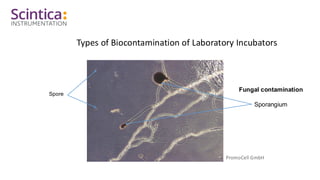
Types of Biocontamination of Laboratory Incubators
Fungal contamination
Sporangium
Spore
PromoCell GmbH
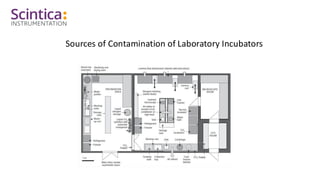
Sources of Contamination of Laboratory Incubators
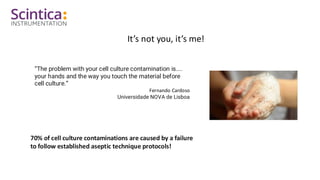
It’s not you, it’s me!
“The problem with your cell culture contamination is....
your hands and the way you touch the material before
cell culture.”
Fernando Cardoso
Universidade NOVA de Lisboa
70% of cell culture contaminations are caused by a failure
to follow established aseptic technique protocols!
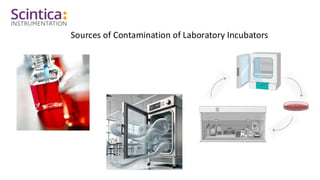
Sources of Contamination of Laboratory Incubators
Cleaning and Disinfection Methods
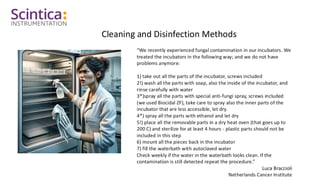
“We recently experienced fungal contamination in our incubators. We
treated the incubators in the following way; and we do not have
problems anymore:
1) take out all the parts of the incubator, screws included
2!) wash all the parts with soap, also the inside of the incubator, and
rinse carefully with water
3*)spray all the parts with special anti-fungi spray, screws included
(we used Biocidal ZF), take care to spray also the inner parts of the
incubator that are less accessible, let dry.
4*) spray all the parts with ethanol and let dry
5!) place all the removable parts in a dry heat oven (that goes up to
200 C) and sterilize for at least 4 hours - plastic parts should not be
included in this step
6) mount all the pieces back in the incubator
7) fill the waterbath with autoclaved water
Check weekly if the water in the waterbath looks clean. If the
contamination is still detected repeat the procedure.”
Luca Braccioli
Netherlands Cancer Institute
An Ounce of Prevention is Worth a Pound of Cure
“Preventative vigilance is better than any remedial suggestion
mentioned above.
Lastly, the most important factor is good technique.
No amount of antibiotics or antimycotics can substitute.”
Gerald Waneck
Curtin University
Audience Poll
12
The MycoFog Advantage
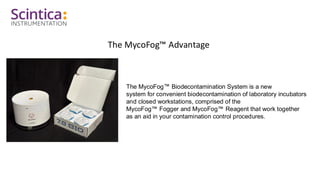
The MycoFog Biodecontamination System is a new
system for convenient biodecontamination of laboratory incubators
and closed workstations, comprised of the
MycoFog Fogger and MycoFog Reagent that work together
as an aid in your contamination control procedures.
The MycoFog Advantage
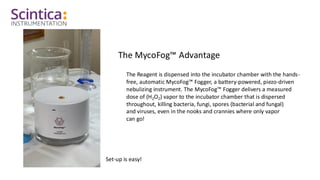
The Reagent is dispensed into the incubator chamber with the hands-
free, automatic MycoFog Fogger, a battery-powered, piezo-driven
nebulizing instrument. The MycoFog Fogger delivers a measured
dose of (H2O2) vapor to the incubator chamber that is dispersed
throughout, killing bacteria, fungi, spores (bacterial and fungal)
and viruses, even in the nooks and crannies where only vapor
can go!
Set-up is easy!
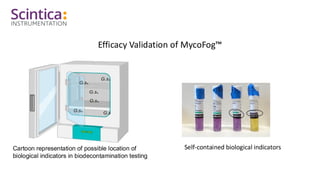
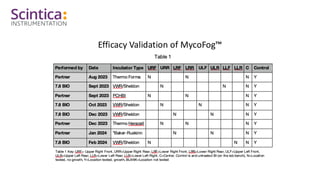
Efficacy Validation of MycoFog
Self-contained biological indicators
Cartoon representation of possible location of
biological indicators in biodecontamination testing.
Efficacy Validation of MycoFog
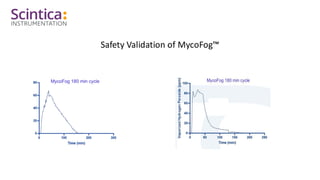
Safety Validation of MycoFog
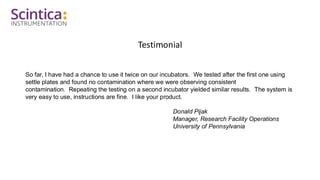
Testimonial
So far, I have had a chance to use it twice on our incubators. We tested after the first one using
settle plates and found no contamination where we were observing consistent
contamination. Repeating the testing on a second incubator yielded similar results. The system is
very easy to use, instructions are fine. I like your product.
Donald Pijak
Manager, Research Facility Operations
University of Pennsylvania
Conclusion
• Proper training and implementation of aseptic technique in the lab is key to contamination control and
prevention.
• Incubator cleaning and disinfection should be done on a regular basis, best if done prophylactically.
• MycoFogTM Biodecontamination system is a convenient, safe, efficacious and economical way to
supplement cleaning protocols for contamination prevention.
WWW.SCINTICA.COM
Q&A Session
WWW.SCINTICA.COM
INFO@SCINTICA.COM
Please enter your questions
in the Q&A section.
Thank You!
20

Lab Incubator Decontamination: WHY, WHEN and HOW

  • 1.
    Lab Incubator Decontamination: WHY,WHEN and HOW Randy Engler Co-Founder & COO, MycoFogTM
  • 2.
    • Introduction • Typesof contamination • Sources of biocontamination • Cleaning & Disinfection methods • The MycoFog Advantage
  • 3.
    Contamination of cellcultures by bacteria and fungi almost invariably results in (1) ill humor in the laboratory lasting from hours to days; and (2) one or many discarded cell cultures. Accompanying these two major reactions are the following: (a) soul searching; (b) culturing of all media components, usually in thioglycolate broth alone; (c) scrubbing of the laboratory; (d) tightening of techniques; (e) no further contamination (temporarily) because of (c) and/or (d). Donald Armstrong, Contamination of Tissue Culture by Bacteria and Fungi in “Contamination in Tissue Culture”, Fogh J. Ed., 1973 Image of U937 cells (large, white with yellow center) contaminated with yeast cells (small bright white spots) PromoCell GmbH
  • 4.
    Types of Contaminationof Laboratory Incubators • Microbiological contamination (e.g. bacteria, mycoplasmas, yeast, fungi) • Viral contaminations (SMRV, CMV, EBV, HIV, HCV) Sub-confluent HeLa cells with yeast contamination PromoCell GmbH • Protein contamination (prions, allergens) • Chemical contamination (leachables and extractables from plastic ware, heavy metals, endotoxins) Biodecontamination
  • 5.
  • 6.
    Types of Biocontaminationof Laboratory Incubators Fungal contamination Sporangium Spore PromoCell GmbH
  • 7.
    Sources of Contaminationof Laboratory Incubators
  • 8.
    It’s not you,it’s me! “The problem with your cell culture contamination is.... your hands and the way you touch the material before cell culture.” Fernando Cardoso Universidade NOVA de Lisboa 70% of cell culture contaminations are caused by a failure to follow established aseptic technique protocols!
  • 9.
    Sources of Contaminationof Laboratory Incubators
  • 10.
    Cleaning and DisinfectionMethods “We recently experienced fungal contamination in our incubators. We treated the incubators in the following way; and we do not have problems anymore: 1) take out all the parts of the incubator, screws included 2!) wash all the parts with soap, also the inside of the incubator, and rinse carefully with water 3*)spray all the parts with special anti-fungi spray, screws included (we used Biocidal ZF), take care to spray also the inner parts of the incubator that are less accessible, let dry. 4*) spray all the parts with ethanol and let dry 5!) place all the removable parts in a dry heat oven (that goes up to 200 C) and sterilize for at least 4 hours - plastic parts should not be included in this step 6) mount all the pieces back in the incubator 7) fill the waterbath with autoclaved water Check weekly if the water in the waterbath looks clean. If the contamination is still detected repeat the procedure.” Luca Braccioli Netherlands Cancer Institute
  • 11.
    An Ounce ofPrevention is Worth a Pound of Cure “Preventative vigilance is better than any remedial suggestion mentioned above. Lastly, the most important factor is good technique. No amount of antibiotics or antimycotics can substitute.” Gerald Waneck Curtin University
  • 12.
  • 13.
    The MycoFog Advantage TheMycoFog Biodecontamination System is a new system for convenient biodecontamination of laboratory incubators and closed workstations, comprised of the MycoFog Fogger and MycoFog Reagent that work together as an aid in your contamination control procedures.
  • 14.
    The MycoFog Advantage TheReagent is dispensed into the incubator chamber with the hands- free, automatic MycoFog Fogger, a battery-powered, piezo-driven nebulizing instrument. The MycoFog Fogger delivers a measured dose of (H2O2) vapor to the incubator chamber that is dispersed throughout, killing bacteria, fungi, spores (bacterial and fungal) and viruses, even in the nooks and crannies where only vapor can go! Set-up is easy!
  • 15.
    Efficacy Validation ofMycoFog Self-contained biological indicators Cartoon representation of possible location of biological indicators in biodecontamination testing.
  • 16.
  • 17.
  • 18.
    Testimonial So far, Ihave had a chance to use it twice on our incubators. We tested after the first one using settle plates and found no contamination where we were observing consistent contamination. Repeating the testing on a second incubator yielded similar results. The system is very easy to use, instructions are fine. I like your product. Donald Pijak Manager, Research Facility Operations University of Pennsylvania
  • 19.
    Conclusion • Proper trainingand implementation of aseptic technique in the lab is key to contamination control and prevention. • Incubator cleaning and disinfection should be done on a regular basis, best if done prophylactically. • MycoFogTM Biodecontamination system is a convenient, safe, efficacious and economical way to supplement cleaning protocols for contamination prevention.
  • 20.