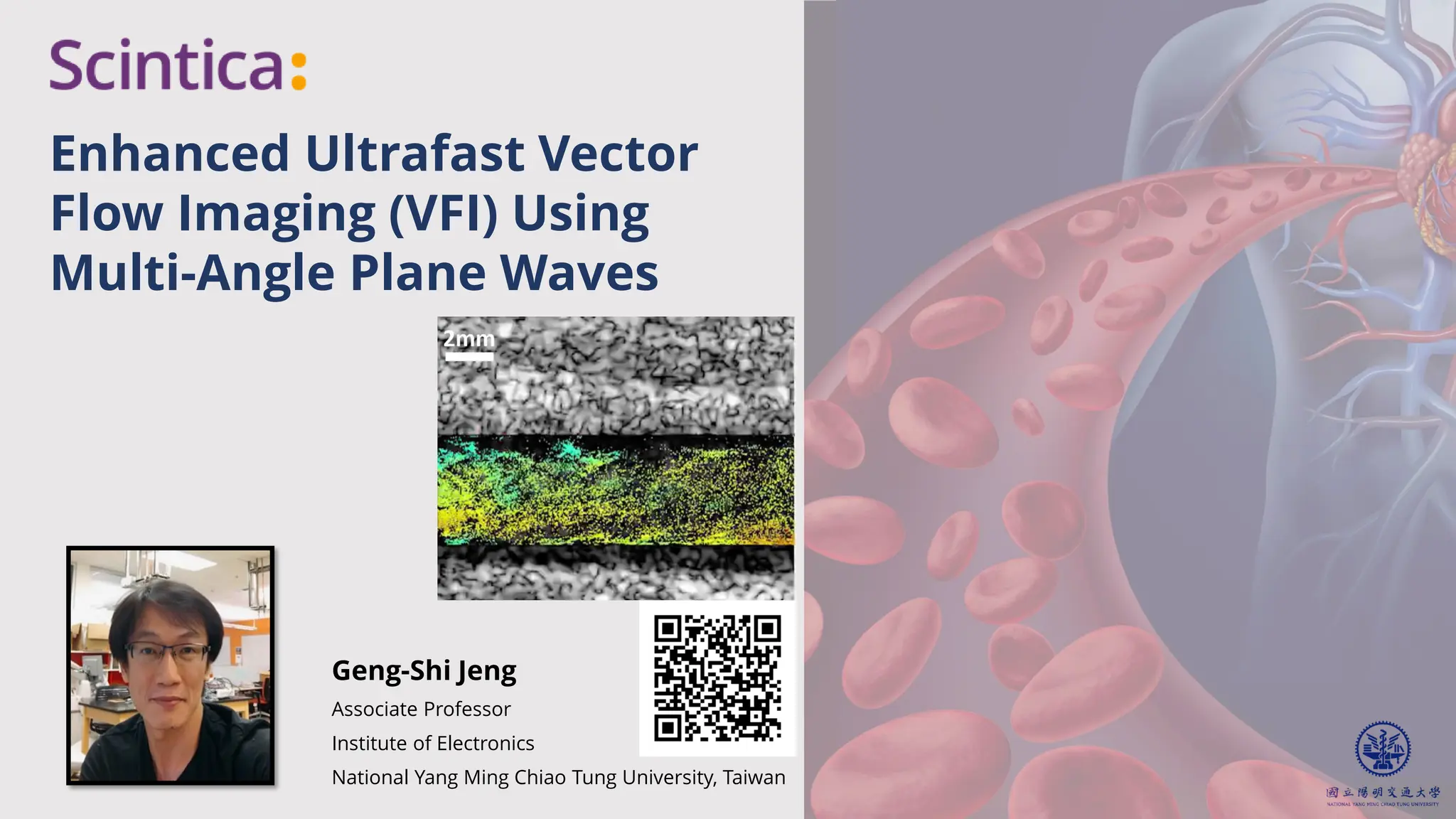
Enhanced Ultrafast Vector
Flow Imaging (VFI) Using
Multi-Angle Plane Waves
Geng-Shi Jeng
Associate Professor
Institute of Electronics
National Yang Ming Chiao Tung University, Taiwan
What You Can Learn
• Ultrasound clinical Doppler imaging: Overview and limitations
• Advanced vector flow imaging (VFI): Techniques and applications
• Integration of ultrafast imaging and speckle tracking with VFI for
enhanced flow visualization
• Experimental findings utilizing a 128-channel research platform
(Prodigy) for comprehensive flow analysis
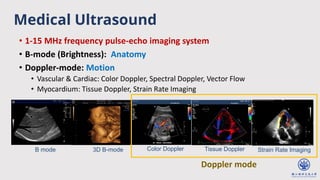
Medical Ultrasound
• 1-15 MHz frequency pulse-echo imaging system
• B-mode (Brightness): Anatomy
• Doppler-mode: Motion
• Vascular & Cardiac: Color Doppler, Spectral Doppler, Vector Flow
• Myocardium: Tissue Doppler, Strain Rate Imaging
Color Doppler
B mode 3D B-mode Tissue Doppler Strain Rate Imaging
Doppler mode
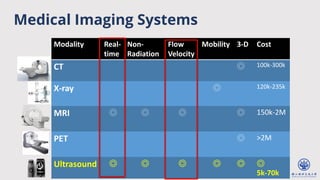
Medical Imaging Systems
Modality Real-
time
Non-
Radiation
Flow
Velocity
Mobility 3-D Cost
CT ◎ 100k-300k
X-ray ◎ 120k-235k
MRI ◎ ◎ ◎ ◎ 150k-2M
PET ◎ >2M
Ultrasound ◎ ◎ ◎ ◎ ◎ ◎
5k-70k
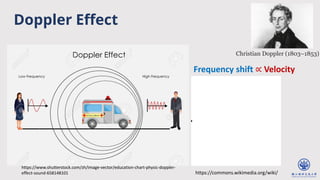
Doppler Effect
Christian Doppler (1803–1853)
https://commons.wikimedia.org/wiki/
https://www.shutterstock.com/zh/image-vector/education-chart-physic-doppler-
effect-sound-658148101
Frequency shift ∝ Velocity
Probe
Beam
direction
Blood Flow
200 400 600 800 1000 1200 1400
-2
-1.5
-1
-0.5
0
0.5
1
1.5
2
Tx
Rx
𝑓𝑐 𝑓𝑐 +𝑓𝑑
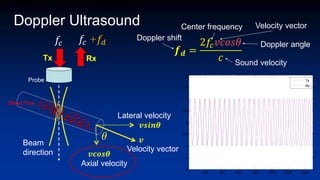
Doppler Ultrasound
Tx Rx
𝒇𝒅 =
2𝑓𝑐𝑣𝑐𝑜𝑠𝜃
𝑐
Doppler shift
Velocity vector
Center frequency
Sound velocity
Doppler angle
Axial velocity
Lateral velocity
Velocity vector
𝜃
𝒗𝒔𝒊𝒏𝜽
𝒗𝒄𝒐𝒔𝜽
𝒗
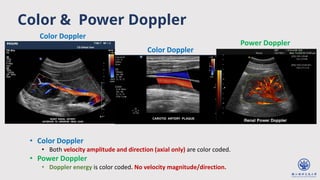
Color & Power Doppler
Color Doppler
Color Doppler
Power Doppler
• Color Doppler
• Both velocity amplitude and direction (axial only) are color coded.
• Power Doppler
• Doppler energy is color coded. No velocity magnitude/direction.
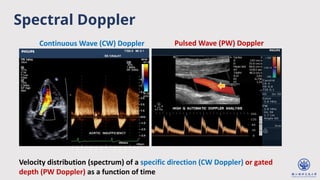
Spectral Doppler
Continuous Wave (CW) Doppler Pulsed Wave (PW) Doppler
Velocity distribution (spectrum) of a specific direction (CW Doppler) or gated
depth (PW Doppler) as a function of time
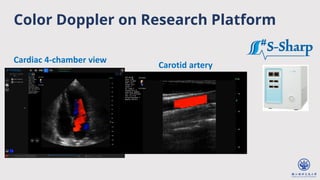
Color Doppler on Research Platform
Cardiac 4-chamber view
Carotid artery
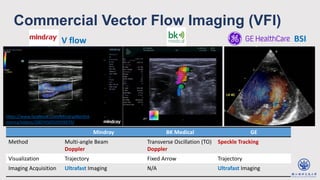
Commercial Vector Flow Imaging (VFI)
https://www.facebook.com/MindrayNorthA
merica/videos/2007450559399979/
V flow BSI
Mindray BK Medical GE
Method Multi-angle Beam
Doppler
Transverse Oscillation (TO)
Doppler
Speckle Tracking
Visualization Trajectory Fixed Arrow Trajectory
Imaging Acquisition Ultrafast Imaging N/A Ultrafast Imaging
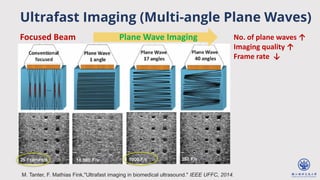
Ultrafast Imaging (Multi-angle Plane Waves)
M. Tanter, F. Mathias Fink,"Ultrafast imaging in biomedical ultrasound." IEEE UFFC, 2014.
No. of plane waves ↑
Imaging quality ↑
Frame rate ↓
Plane Wave Imaging
Focused Beam
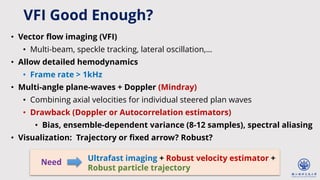
• Vector flow imaging (VFI)
• Multi-beam, speckle tracking, lateral oscillation,…
• Allow detailed hemodynamics
• Frame rate > 1kHz
• Multi-angle plane-waves + Doppler (Mindray)
• Combining axial velocities for individual steered plan waves
• Drawback (Doppler or Autocorrelation estimators)
• Bias, ensemble-dependent variance (8-12 samples), spectral aliasing
• Visualization: Trajectory or fixed arrow? Robust?
VFI Good Enough?
Ultrafast imaging + Robust velocity estimator +
Robust particle trajectory
Need
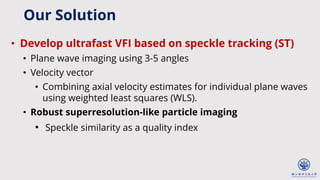
• Develop ultrafast VFI based on speckle tracking (ST)
• Plane wave imaging using 3-5 angles
• Velocity vector
• Combining axial velocity estimates for individual plane waves
using weighted least squares (WLS).
• Robust superresolution-like particle imaging
• Speckle similarity as a quality index
Our Solution
14
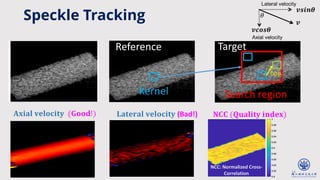
Search region
Kernel
Target
Reference
𝐍𝐂𝐂 (𝐐𝐮𝐚𝐥𝐢𝐭𝐲 𝐢𝐧𝐝𝐞𝐱)
𝐀𝐱𝐢𝐚𝐥 𝐯𝐞𝐥𝐨𝐜𝐢𝐭𝐲 (𝐆𝐨𝐨𝐝!)
Disp.
𝐋𝐚𝐭𝐞𝐫𝐚𝐥 𝐯𝐞𝐥𝐨𝐜𝐢𝐭𝐲 (Bad!)
Speckle Tracking
NCC: Normalized Cross-
Correlation
NCC: Normalized Cross-
Correlation
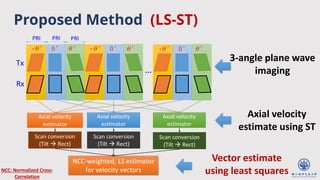
Proposed Method (LS-ST)
3-angle plane wave
imaging
Axial velocity
estimate using ST
Vector estimate
using least squares
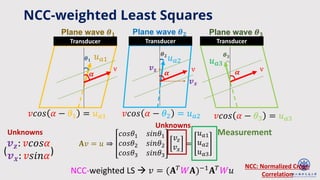
Transducer
𝑣𝑐𝑜𝑠 𝛼 − 𝜃2 = 𝑢𝑎2 𝑣𝑐𝑜𝑠 𝛼 − 𝜃3 = 𝑢𝑎3
𝑣𝑐𝑜𝑠 𝛼 − 𝜃1 = 𝑢𝑎1
𝜽𝟏
Transducer
𝒗𝐳
𝜽𝟐
Transducer
𝜽𝟑
𝐀𝑣 = 𝑢 ⇒
𝑐𝑜𝑠𝜃1 𝑠𝑖𝑛𝜃1
𝑐𝑜𝑠𝜃2 𝑠𝑖𝑛𝜃2
𝑐𝑜𝑠𝜃3 𝑠𝑖𝑛𝜃3
𝑣𝑧
𝑣𝑥
=
𝑢𝑎1
𝑢𝑎2
𝑢𝑎3
(
𝒗𝒛: 𝑣𝑐𝑜𝑠𝛼
𝒗𝒙: 𝑣𝑠𝑖𝑛𝛼)
NCC-weighted LS → 𝑣 = (𝐀𝑇
𝑊𝐀)−1
𝐀𝑇
𝑊𝑢
Unknowns
Measurement
Unknowns
NCC-weighted Least Squares
Plane wave 𝜽𝟏 Plane wave 𝜽𝟐 Plane wave 𝜽𝟑
NCC: Normalized Cross-
Correlation
𝒗𝒙
𝑢𝑎1 𝑢𝑎2 𝑢𝑎3
17
Laminar flow
v r = 𝑣0[1 −
𝑟
𝑅
2
]
Parameter Value
Number of Tx/Rx channels 128
Array pitch 0.2 mm
Sampling rate 32 MHz
Center frequency 8 MHz
Plane wave angle −𝟖𝒐, 𝟎𝒐, 𝟖𝒐
Pulse repetition frequency 10 kHz
Radius of blood vessel (R) 4 mm
Peak flow velocity (𝒗𝟎) 0.2 m/s
Ensemble size 10
Simulation (Field II)
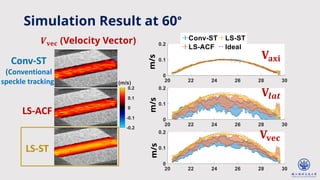
Simulation Result at 60°
LS-ST
Conv-ST
(Conventional
speckle tracking)
-0.2
-0.1
0
0.1
0.2
(m/s)
LS-ACF
m/s
𝐕𝐚𝐱𝐢
𝐕𝒍𝒂𝒕
𝐕𝐯𝐞𝐜
m/s
m/s
𝑽𝐯𝐞𝐜 (Velocity Vector)
19
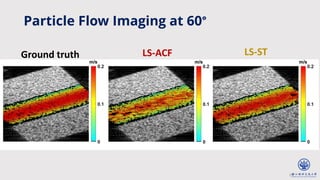
Ground truth LS-ACF LS-ST
Particle Flow Imaging at 60°
20
Parameter Vessel 𝜽 = 𝟗𝟎𝒐 Vessel 𝜽 = 𝟓𝟓𝒐
Array element 128 128
Array pitch 0.2 mm 0.2 mm
Sampling rate 32 MHz 32 MHz
Center frequency 8 MHz 6 MHz
Pulse repetition
frequency
10 kHz 9 kHz
Ensemble size 10 10
Plane wave angle [−16o
, 0o
, 16o
] [16o
, −8o
, 0o
, 8o
, 16o
]
Source: https://jdigitaldiagnostics.com/DD/article/view/76511#tabs-5
Source: https://www.s-sharp.com/uploads/
root//Prodigy256system20201126.jpg
in vitro Experiments
Vessel 𝜽 = 𝟓𝟓𝒐
Vessel 𝜽 = 𝟗𝟎𝒐
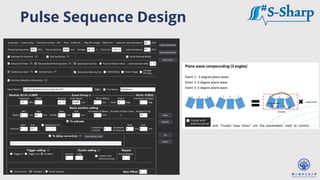
Pulse Sequence Design
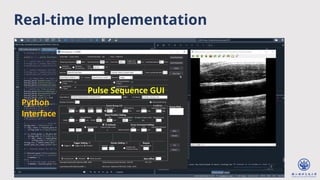
Real-time Implementation
Pulse Sequence GUI
Python
Interface
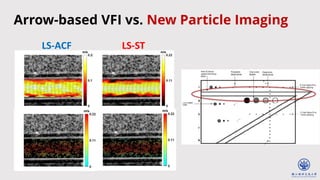
LS-ACF LS-ST
Arrow-based VFI vs. New Particle Imaging
24
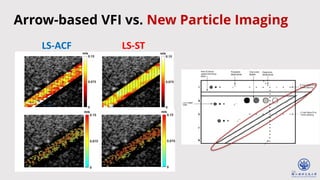
LS-ACF LS-ST
Arrow-based VFI vs. New Particle Imaging
25
Parameter Value
Number of Tx/Rx channels 128
Array pitch 0.2 mm
Sampling rate 32 MHz
Center frequency 8 MHz
Pulse repetition frequency 12 kHz
Ensemble size 10
Plane wave angle [−16o
, 0o
, 16o
]
Source: https://www.docknet.jp/media/medical-checkup-23/
in vivo Experiments
Carotid arteries were measured
26
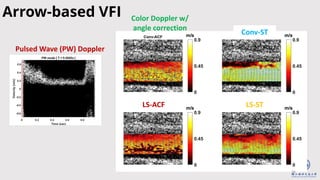
Arrow-based VFI Color Doppler w/
angle correction
LS-ACF
Conv-ST
LS-ST
Pulsed Wave (PW) Doppler
27
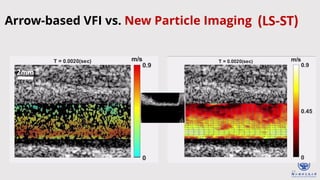
2mm
2mm
(LS-ST)
Arrow-based VFI vs. New Particle Imaging
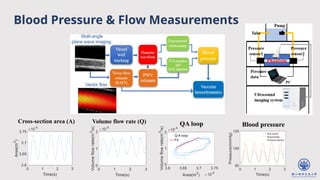
Blood Pressure & Flow Measurements
Blood pressure
Cross-section area (A) Volume flow rate (Q) QA loop
What You Need to Know
• Conventional Doppler imaging only detects 1-D velocity component.
• VFI enables visualization of velocity vectors using trajectory or arrow-
based approaches.
• Ultrafast imaging + VFI allow for comprehensive hemodynamics
evaluation.
• Speckle tracking-based VFI provides a promising alternative to current
Doppler-based VFI techniques.
• Prodigy array research platform facilitates seamless integration of pulse
sequences and developed algorithms for advanced flow imaging
analysis.
Q&A
WWW.SCINTICA.COM
INFO@SCINTICA.COM
Please enter your questions
in the Q&A section
Thank You!

(May 9, 2024) Enhanced Ultrafast Vector Flow Imaging (VFI) Using Multi-Angle Plane Waves

  • 1.
    Enhanced Ultrafast Vector FlowImaging (VFI) Using Multi-Angle Plane Waves Geng-Shi Jeng Associate Professor Institute of Electronics National Yang Ming Chiao Tung University, Taiwan
  • 2.
    What You CanLearn • Ultrasound clinical Doppler imaging: Overview and limitations • Advanced vector flow imaging (VFI): Techniques and applications • Integration of ultrafast imaging and speckle tracking with VFI for enhanced flow visualization • Experimental findings utilizing a 128-channel research platform (Prodigy) for comprehensive flow analysis
  • 3.
    Medical Ultrasound • 1-15MHz frequency pulse-echo imaging system • B-mode (Brightness): Anatomy • Doppler-mode: Motion • Vascular & Cardiac: Color Doppler, Spectral Doppler, Vector Flow • Myocardium: Tissue Doppler, Strain Rate Imaging Color Doppler B mode 3D B-mode Tissue Doppler Strain Rate Imaging Doppler mode
  • 4.
    Medical Imaging Systems ModalityReal- time Non- Radiation Flow Velocity Mobility 3-D Cost CT ◎ 100k-300k X-ray ◎ 120k-235k MRI ◎ ◎ ◎ ◎ 150k-2M PET ◎ >2M Ultrasound ◎ ◎ ◎ ◎ ◎ ◎ 5k-70k
  • 5.
    Doppler Effect Christian Doppler(1803–1853) https://commons.wikimedia.org/wiki/ https://www.shutterstock.com/zh/image-vector/education-chart-physic-doppler- effect-sound-658148101 Frequency shift ∝ Velocity
  • 6.
    Probe Beam direction Blood Flow 200 400600 800 1000 1200 1400 -2 -1.5 -1 -0.5 0 0.5 1 1.5 2 Tx Rx 𝑓𝑐 𝑓𝑐 +𝑓𝑑 Doppler Ultrasound Tx Rx 𝒇𝒅 = 2𝑓𝑐𝑣𝑐𝑜𝑠𝜃 𝑐 Doppler shift Velocity vector Center frequency Sound velocity Doppler angle Axial velocity Lateral velocity Velocity vector 𝜃 𝒗𝒔𝒊𝒏𝜽 𝒗𝒄𝒐𝒔𝜽 𝒗
  • 7.
    Color & PowerDoppler Color Doppler Color Doppler Power Doppler • Color Doppler • Both velocity amplitude and direction (axial only) are color coded. • Power Doppler • Doppler energy is color coded. No velocity magnitude/direction.
  • 8.
    Spectral Doppler Continuous Wave(CW) Doppler Pulsed Wave (PW) Doppler Velocity distribution (spectrum) of a specific direction (CW Doppler) or gated depth (PW Doppler) as a function of time
  • 9.
    Color Doppler onResearch Platform Cardiac 4-chamber view Carotid artery
  • 10.
    Commercial Vector FlowImaging (VFI) https://www.facebook.com/MindrayNorthA merica/videos/2007450559399979/ V flow BSI Mindray BK Medical GE Method Multi-angle Beam Doppler Transverse Oscillation (TO) Doppler Speckle Tracking Visualization Trajectory Fixed Arrow Trajectory Imaging Acquisition Ultrafast Imaging N/A Ultrafast Imaging
  • 11.
    Ultrafast Imaging (Multi-anglePlane Waves) M. Tanter, F. Mathias Fink,"Ultrafast imaging in biomedical ultrasound." IEEE UFFC, 2014. No. of plane waves ↑ Imaging quality ↑ Frame rate ↓ Plane Wave Imaging Focused Beam
  • 12.
    • Vector flowimaging (VFI) • Multi-beam, speckle tracking, lateral oscillation,… • Allow detailed hemodynamics • Frame rate > 1kHz • Multi-angle plane-waves + Doppler (Mindray) • Combining axial velocities for individual steered plan waves • Drawback (Doppler or Autocorrelation estimators) • Bias, ensemble-dependent variance (8-12 samples), spectral aliasing • Visualization: Trajectory or fixed arrow? Robust? VFI Good Enough? Ultrafast imaging + Robust velocity estimator + Robust particle trajectory Need
  • 13.
    • Develop ultrafastVFI based on speckle tracking (ST) • Plane wave imaging using 3-5 angles • Velocity vector • Combining axial velocity estimates for individual plane waves using weighted least squares (WLS). • Robust superresolution-like particle imaging • Speckle similarity as a quality index Our Solution
  • 14.
    14 Search region Kernel Target Reference 𝐍𝐂𝐂 (𝐐𝐮𝐚𝐥𝐢𝐭𝐲𝐢𝐧𝐝𝐞𝐱) 𝐀𝐱𝐢𝐚𝐥 𝐯𝐞𝐥𝐨𝐜𝐢𝐭𝐲 (𝐆𝐨𝐨𝐝!) Disp. 𝐋𝐚𝐭𝐞𝐫𝐚𝐥 𝐯𝐞𝐥𝐨𝐜𝐢𝐭𝐲 (Bad!) Speckle Tracking NCC: Normalized Cross- Correlation
  • 15.
    NCC: Normalized Cross- Correlation ProposedMethod (LS-ST) 3-angle plane wave imaging Axial velocity estimate using ST Vector estimate using least squares
  • 16.
    Transducer 𝑣𝑐𝑜𝑠 𝛼 −𝜃2 = 𝑢𝑎2 𝑣𝑐𝑜𝑠 𝛼 − 𝜃3 = 𝑢𝑎3 𝑣𝑐𝑜𝑠 𝛼 − 𝜃1 = 𝑢𝑎1 𝜽𝟏 Transducer 𝒗𝐳 𝜽𝟐 Transducer 𝜽𝟑 𝐀𝑣 = 𝑢 ⇒ 𝑐𝑜𝑠𝜃1 𝑠𝑖𝑛𝜃1 𝑐𝑜𝑠𝜃2 𝑠𝑖𝑛𝜃2 𝑐𝑜𝑠𝜃3 𝑠𝑖𝑛𝜃3 𝑣𝑧 𝑣𝑥 = 𝑢𝑎1 𝑢𝑎2 𝑢𝑎3 ( 𝒗𝒛: 𝑣𝑐𝑜𝑠𝛼 𝒗𝒙: 𝑣𝑠𝑖𝑛𝛼) NCC-weighted LS → 𝑣 = (𝐀𝑇 𝑊𝐀)−1 𝐀𝑇 𝑊𝑢 Unknowns Measurement Unknowns NCC-weighted Least Squares Plane wave 𝜽𝟏 Plane wave 𝜽𝟐 Plane wave 𝜽𝟑 NCC: Normalized Cross- Correlation 𝒗𝒙 𝑢𝑎1 𝑢𝑎2 𝑢𝑎3
  • 17.
    17 Laminar flow v r= 𝑣0[1 − 𝑟 𝑅 2 ] Parameter Value Number of Tx/Rx channels 128 Array pitch 0.2 mm Sampling rate 32 MHz Center frequency 8 MHz Plane wave angle −𝟖𝒐, 𝟎𝒐, 𝟖𝒐 Pulse repetition frequency 10 kHz Radius of blood vessel (R) 4 mm Peak flow velocity (𝒗𝟎) 0.2 m/s Ensemble size 10 Simulation (Field II)
  • 18.
    Simulation Result at60° LS-ST Conv-ST (Conventional speckle tracking) -0.2 -0.1 0 0.1 0.2 (m/s) LS-ACF m/s 𝐕𝐚𝐱𝐢 𝐕𝒍𝒂𝒕 𝐕𝐯𝐞𝐜 m/s m/s 𝑽𝐯𝐞𝐜 (Velocity Vector)
  • 19.
    19 Ground truth LS-ACFLS-ST Particle Flow Imaging at 60°
  • 20.
    20 Parameter Vessel 𝜽= 𝟗𝟎𝒐 Vessel 𝜽 = 𝟓𝟓𝒐 Array element 128 128 Array pitch 0.2 mm 0.2 mm Sampling rate 32 MHz 32 MHz Center frequency 8 MHz 6 MHz Pulse repetition frequency 10 kHz 9 kHz Ensemble size 10 10 Plane wave angle [−16o , 0o , 16o ] [16o , −8o , 0o , 8o , 16o ] Source: https://jdigitaldiagnostics.com/DD/article/view/76511#tabs-5 Source: https://www.s-sharp.com/uploads/ root//Prodigy256system20201126.jpg in vitro Experiments Vessel 𝜽 = 𝟓𝟓𝒐 Vessel 𝜽 = 𝟗𝟎𝒐
  • 21.
  • 22.
  • 23.
    LS-ACF LS-ST Arrow-based VFIvs. New Particle Imaging
  • 24.
    24 LS-ACF LS-ST Arrow-based VFIvs. New Particle Imaging
  • 25.
    25 Parameter Value Number ofTx/Rx channels 128 Array pitch 0.2 mm Sampling rate 32 MHz Center frequency 8 MHz Pulse repetition frequency 12 kHz Ensemble size 10 Plane wave angle [−16o , 0o , 16o ] Source: https://www.docknet.jp/media/medical-checkup-23/ in vivo Experiments Carotid arteries were measured
  • 26.
    26 Arrow-based VFI ColorDoppler w/ angle correction LS-ACF Conv-ST LS-ST Pulsed Wave (PW) Doppler
  • 27.
  • 28.
    Blood Pressure &Flow Measurements Blood pressure Cross-section area (A) Volume flow rate (Q) QA loop
  • 29.
    What You Needto Know • Conventional Doppler imaging only detects 1-D velocity component. • VFI enables visualization of velocity vectors using trajectory or arrow- based approaches. • Ultrafast imaging + VFI allow for comprehensive hemodynamics evaluation. • Speckle tracking-based VFI provides a promising alternative to current Doppler-based VFI techniques. • Prodigy array research platform facilitates seamless integration of pulse sequences and developed algorithms for advanced flow imaging analysis.
  • 30.
    Q&A WWW.SCINTICA.COM INFO@SCINTICA.COM Please enter yourquestions in the Q&A section Thank You!