John P. Kotter

LEADING CHANGE


                 Dr. V. R. Kesava Ram (P.T.)   August 8, 2012
Why firms fail…common errors
# 1: allowing too much complacency
# 2: failing to create a sufficiently powerful
  guiding coalition
# 3: underestimating the power of vision
# 4: under communicating the vision
# 5: permitting obstacles to block the new vision
# 6: failing to create shot term wins
# 7: declaring victory too soon
# 8: neglecting to anchor changes firmly in the
  corporate culture
                         Dr. V. R. Kesava Ram (P.T.)   August 8, 2012
Consequences

 New strategies aren’t implemented well
 Acquisitions don’t achieve expected
  synergies
 Reengineering takes too long and costs too
  much
 Downsizing doesn’t get costs under control
 Quality programs don’t deliver hoped-for
  results

                       Dr. V. R. Kesava Ram (P.T.)   August 8, 2012
Economic and social forces
driving change
 Technological
 International economic integration
 Maturation of markets in developed countries
 Fall of communist and socialist regimes
 Globalization of markets and competition
 More competition and increased speed with
  Bigger markets and fewer barriers


                       Dr. V. R. Kesava Ram (P.T.)   August 8, 2012
More large scale change in
organizations
 Reengineering
 Restructuring
 Quality programs
 Mergers and acquisitions
 Strategic change
 Cultural change


                       Dr. V. R. Kesava Ram (P.T.)   August 8, 2012
THE EIGHT-STAGE PROCESS OF
CREATING MAJOR CHANGE

             Dr. V. R. Kesava Ram (P.T.)   August 8, 2012
1. Establishing a sense of
urgency
 Examining the market and competitive
  realities

 Identifying and discussing crises, potential
  crises or major opportunities


                        Dr. V. R. Kesava Ram (P.T.)   August 8, 2012
2. Creating the guiding
coalition
 Putting together a group with enough power
  to lead the change

 Getting the group work together like a team


                       Dr. V. R. Kesava Ram (P.T.)   August 8, 2012
3. Developing a vision and
strategy
 Creating a vision to help direct the change
  effort

 Developing strategies for achieving that
  vision


                        Dr. V. R. Kesava Ram (P.T.)   August 8, 2012
4. Communicating the change
vision
 Using every vehicle possible to constantly
  communicate the new vision and strategies

 Having the guiding coalition role model the
  behavior expected of employees


                        Dr. V. R. Kesava Ram (P.T.)   August 8, 2012
5. Empowering broad based
action
 Getting rid of obstacles


 Changing systems or structures that
  undermine the change vision

 Encouraging risk taking and nontraditional
  ideas, activities, and actions


                        Dr. V. R. Kesava Ram (P.T.)   August 8, 2012
6. Generating short term
wins
 Planning for visible improvements in
  performance or wins
 Creating those wins
 Visibly recognizing and rewarding people
  who made the wins possible


                       Dr. V. R. Kesava Ram (P.T.)   August 8, 2012
7. Consolidating gains and
producing more change
 Using increased credibility to change all
  systems structures and policies that don’t fit
  together and don’t fit the transformation
  vision
 Hiring promoting and developing people who
  can implement the change vision
 Reinvigorating the process with new projects
  themes, and change agents

                        Dr. V. R. Kesava Ram (P.T.)   August 8, 2012
8. Anchoring new approaches
in the culture
 Creating better performance through
  customer and productivity oriented behavior
  more and better leadership and more
  effective management
 Articulating the connections between new
  behaviors and organizational success
 Developing means to ensure leadership
  development and succession

                       Dr. V. R. Kesava Ram (P.T.)   August 8, 2012
Leadership

 Establishing direction
 Aligning people
 Motivating and inspiring
 Producing change


                           Dr. V. R. Kesava Ram (P.T.)   August 8, 2012
Complacency

 The absence of major and visible crisis
 Too many visible resources
 Low overall performance standards
 Narrow functional goals
 Wrong performance indexes
 Insufficient feedback
 Kill the messenger of bad news, low candor, low
  confrontation culture
 Denial
 Too much happy talk from senior management

                         Dr. V. R. Kesava Ram (P.T.)   August 8, 2012
Effective guiding coalition

 Position power
 Expertise
 Credibility
 Leadership


                   Dr. V. R. Kesava Ram (P.T.)   August 8, 2012
Building a coalition that
make change happen
 Find the right people


 Create trust


 Develop common goal


                          Dr. V. R. Kesava Ram (P.T.)   August 8, 2012
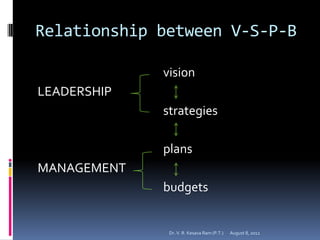
Relationship between V-S-P-B

             vision
LEADERSHIP
             strategies

             plans
MANAGEMENT
             budgets


              Dr. V. R. Kesava Ram (P.T.)   August 8, 2012
Characteristics of an
effective vision
 Imaginable
 Desirable
 Feasible
 Focused
 Flexible
 Communicable


                 Dr. V. R. Kesava Ram (P.T.)   August 8, 2012
Creating an effective vision

 First draft
 Role of the guiding coalition
 Importance of teamwork
 Role of the head and the heart
 Messiness of the process
 Time frame
 End product


                        Dr. V. R. Kesava Ram (P.T.)   August 8, 2012
Key elements of the effective
communication of vision
 Simplicity
 Metaphor
 Analogy and example
 Multiple forms
 Repetition
 Leadership by example
 Explanation of seeming inconsistencies
 Give and take
                        Dr. V. R. Kesava Ram (P.T.)   August 8, 2012
Barriers to empowerment

 Formal structures
 Lack of needed skills to action
 Obstructing personnel and information
  systems
 Bosses discourage actions for the new vision


                        Dr. V. R. Kesava Ram (P.T.)   August 8, 2012
Empowering people to effect
change
 Communicate a sensible vision to employees
 Make structures compatible with the vision
 Provide the training employees need
 Align information and personnel systems to
  the vision
 Confront supervisors who undercut needed
  change


                       Dr. V. R. Kesava Ram (P.T.)   August 8, 2012
Role of short term wins

 Provide evidence that sacrifices are worth it
 Reward change agents with a pat on the back
 Help fine tune vision and strategies
 Undermine cynics and self serving resisters
 Keep bosses on board
 Build momentum


                        Dr. V. R. Kesava Ram (P.T.)   August 8, 2012
Why culture is powerful

1. Because individuals are selected and
   indoctrinated so well
2. Because the culture exerts itself through the
   actions of hundreds or thousands of people
3. Because all of this happen without much
   conscious intent and thus is difficult to
   challenge or even discuss


                        Dr. V. R. Kesava Ram (P.T.)   August 8, 2012
Anchoring change in culture

 Comes last, not first
 Depends on results
 Requires lot of talk
 May involve turnover
 Makes decisions on succession crucial


                          Dr. V. R. Kesava Ram (P.T.)   August 8, 2012
Twenty first century
organization
Structure:
i. Non bureaucratic
ii. Limited to fewer levels
iii. Management leads and employees manage
iv. Policies and procedures with minimal
     internal interdependence needed to serve
     customers


                      Dr. V. R. Kesava Ram (P.T.)   August 8, 2012
Systems:
i. Many performance information systems
ii. Distribute performance data widely
iii. Offer management training and support
     systems to many people


                      Dr. V. R. Kesava Ram (P.T.)   August 8, 2012
Culture:
i. Externally oriented
ii. Empowering
iii. Quick to make decisions
iv. Open and candid
v. More risk tolerant


                        Dr. V. R. Kesava Ram (P.T.)   August 8, 2012
The relationship of lifelong learning, leadership
     skills and the capacity to succeed in future


Personal history
 Inborn capabilities
 Childhood experiences
 Job and educational experiences
Competitive drive
 Level of standards
 Desire to do well
 Self confidence in competitive situations
                        Dr. V. R. Kesava Ram (P.T.)   August 8, 2012
Life long learning
 Willingness to seek new challenges
 Willingness to reflect honestly on successes
  and failures
Skills and abilities
 Knowledge
 Leadership skills
 Other skills

                        Dr. V. R. Kesava Ram (P.T.)   August 8, 2012
Competitive capacity

 Capability of dealing with an increasingly
  competitive and fast moving economic
  environment


                        Dr. V. R. Kesava Ram (P.T.)   August 8, 2012
Mental habits that support life
long learning
 Risk taking- willingness to push oneself out of
  comfort zones
 Humble self reflection- honest assessment of
  successes and failures especially the latter
 Solicitation of opinions- aggressive collection
  of information and ideas from others
 Careful listening- propensity to listen to
  others
 Openness to new ideas- willingness to view
  life with an open mind
                        Dr. V. R. Kesava Ram (P.T.)   August 8, 2012
Dr. V. R. Kesava Ram (P.T.)   August 8, 2012

Leadingchange john kotter

  • 1.
    John P. Kotter LEADINGCHANGE Dr. V. R. Kesava Ram (P.T.) August 8, 2012
  • 2.
    Why firms fail…commonerrors # 1: allowing too much complacency # 2: failing to create a sufficiently powerful guiding coalition # 3: underestimating the power of vision # 4: under communicating the vision # 5: permitting obstacles to block the new vision # 6: failing to create shot term wins # 7: declaring victory too soon # 8: neglecting to anchor changes firmly in the corporate culture Dr. V. R. Kesava Ram (P.T.) August 8, 2012
  • 3.
    Consequences  New strategiesaren’t implemented well  Acquisitions don’t achieve expected synergies  Reengineering takes too long and costs too much  Downsizing doesn’t get costs under control  Quality programs don’t deliver hoped-for results Dr. V. R. Kesava Ram (P.T.) August 8, 2012
  • 4.
    Economic and socialforces driving change  Technological  International economic integration  Maturation of markets in developed countries  Fall of communist and socialist regimes  Globalization of markets and competition  More competition and increased speed with Bigger markets and fewer barriers Dr. V. R. Kesava Ram (P.T.) August 8, 2012
  • 5.
    More large scalechange in organizations  Reengineering  Restructuring  Quality programs  Mergers and acquisitions  Strategic change  Cultural change Dr. V. R. Kesava Ram (P.T.) August 8, 2012
  • 6.
    THE EIGHT-STAGE PROCESSOF CREATING MAJOR CHANGE Dr. V. R. Kesava Ram (P.T.) August 8, 2012
  • 7.
    1. Establishing asense of urgency  Examining the market and competitive realities  Identifying and discussing crises, potential crises or major opportunities Dr. V. R. Kesava Ram (P.T.) August 8, 2012
  • 8.
    2. Creating theguiding coalition  Putting together a group with enough power to lead the change  Getting the group work together like a team Dr. V. R. Kesava Ram (P.T.) August 8, 2012
  • 9.
    3. Developing avision and strategy  Creating a vision to help direct the change effort  Developing strategies for achieving that vision Dr. V. R. Kesava Ram (P.T.) August 8, 2012
  • 10.
    4. Communicating thechange vision  Using every vehicle possible to constantly communicate the new vision and strategies  Having the guiding coalition role model the behavior expected of employees Dr. V. R. Kesava Ram (P.T.) August 8, 2012
  • 11.
    5. Empowering broadbased action  Getting rid of obstacles  Changing systems or structures that undermine the change vision  Encouraging risk taking and nontraditional ideas, activities, and actions Dr. V. R. Kesava Ram (P.T.) August 8, 2012
  • 12.
    6. Generating shortterm wins  Planning for visible improvements in performance or wins  Creating those wins  Visibly recognizing and rewarding people who made the wins possible Dr. V. R. Kesava Ram (P.T.) August 8, 2012
  • 13.
    7. Consolidating gainsand producing more change  Using increased credibility to change all systems structures and policies that don’t fit together and don’t fit the transformation vision  Hiring promoting and developing people who can implement the change vision  Reinvigorating the process with new projects themes, and change agents Dr. V. R. Kesava Ram (P.T.) August 8, 2012
  • 14.
    8. Anchoring newapproaches in the culture  Creating better performance through customer and productivity oriented behavior more and better leadership and more effective management  Articulating the connections between new behaviors and organizational success  Developing means to ensure leadership development and succession Dr. V. R. Kesava Ram (P.T.) August 8, 2012
  • 15.
    Leadership  Establishing direction Aligning people  Motivating and inspiring  Producing change Dr. V. R. Kesava Ram (P.T.) August 8, 2012
  • 16.
    Complacency  The absenceof major and visible crisis  Too many visible resources  Low overall performance standards  Narrow functional goals  Wrong performance indexes  Insufficient feedback  Kill the messenger of bad news, low candor, low confrontation culture  Denial  Too much happy talk from senior management Dr. V. R. Kesava Ram (P.T.) August 8, 2012
  • 17.
    Effective guiding coalition Position power  Expertise  Credibility  Leadership Dr. V. R. Kesava Ram (P.T.) August 8, 2012
  • 18.
    Building a coalitionthat make change happen  Find the right people  Create trust  Develop common goal Dr. V. R. Kesava Ram (P.T.) August 8, 2012
  • 19.
    Relationship between V-S-P-B vision LEADERSHIP strategies plans MANAGEMENT budgets Dr. V. R. Kesava Ram (P.T.) August 8, 2012
  • 20.
    Characteristics of an effectivevision  Imaginable  Desirable  Feasible  Focused  Flexible  Communicable Dr. V. R. Kesava Ram (P.T.) August 8, 2012
  • 21.
    Creating an effectivevision  First draft  Role of the guiding coalition  Importance of teamwork  Role of the head and the heart  Messiness of the process  Time frame  End product Dr. V. R. Kesava Ram (P.T.) August 8, 2012
  • 22.
    Key elements ofthe effective communication of vision  Simplicity  Metaphor  Analogy and example  Multiple forms  Repetition  Leadership by example  Explanation of seeming inconsistencies  Give and take Dr. V. R. Kesava Ram (P.T.) August 8, 2012
  • 23.
    Barriers to empowerment Formal structures  Lack of needed skills to action  Obstructing personnel and information systems  Bosses discourage actions for the new vision Dr. V. R. Kesava Ram (P.T.) August 8, 2012
  • 24.
    Empowering people toeffect change  Communicate a sensible vision to employees  Make structures compatible with the vision  Provide the training employees need  Align information and personnel systems to the vision  Confront supervisors who undercut needed change Dr. V. R. Kesava Ram (P.T.) August 8, 2012
  • 25.
    Role of shortterm wins  Provide evidence that sacrifices are worth it  Reward change agents with a pat on the back  Help fine tune vision and strategies  Undermine cynics and self serving resisters  Keep bosses on board  Build momentum Dr. V. R. Kesava Ram (P.T.) August 8, 2012
  • 26.
    Why culture ispowerful 1. Because individuals are selected and indoctrinated so well 2. Because the culture exerts itself through the actions of hundreds or thousands of people 3. Because all of this happen without much conscious intent and thus is difficult to challenge or even discuss Dr. V. R. Kesava Ram (P.T.) August 8, 2012
  • 27.
    Anchoring change inculture  Comes last, not first  Depends on results  Requires lot of talk  May involve turnover  Makes decisions on succession crucial Dr. V. R. Kesava Ram (P.T.) August 8, 2012
  • 28.
    Twenty first century organization Structure: i.Non bureaucratic ii. Limited to fewer levels iii. Management leads and employees manage iv. Policies and procedures with minimal internal interdependence needed to serve customers Dr. V. R. Kesava Ram (P.T.) August 8, 2012
  • 29.
    Systems: i. Many performanceinformation systems ii. Distribute performance data widely iii. Offer management training and support systems to many people Dr. V. R. Kesava Ram (P.T.) August 8, 2012
  • 30.
    Culture: i. Externally oriented ii.Empowering iii. Quick to make decisions iv. Open and candid v. More risk tolerant Dr. V. R. Kesava Ram (P.T.) August 8, 2012
  • 31.
    The relationship oflifelong learning, leadership skills and the capacity to succeed in future Personal history  Inborn capabilities  Childhood experiences  Job and educational experiences Competitive drive  Level of standards  Desire to do well  Self confidence in competitive situations Dr. V. R. Kesava Ram (P.T.) August 8, 2012
  • 32.
    Life long learning Willingness to seek new challenges  Willingness to reflect honestly on successes and failures Skills and abilities  Knowledge  Leadership skills  Other skills Dr. V. R. Kesava Ram (P.T.) August 8, 2012
  • 33.
    Competitive capacity  Capabilityof dealing with an increasingly competitive and fast moving economic environment Dr. V. R. Kesava Ram (P.T.) August 8, 2012
  • 34.
    Mental habits thatsupport life long learning  Risk taking- willingness to push oneself out of comfort zones  Humble self reflection- honest assessment of successes and failures especially the latter  Solicitation of opinions- aggressive collection of information and ideas from others  Careful listening- propensity to listen to others  Openness to new ideas- willingness to view life with an open mind Dr. V. R. Kesava Ram (P.T.) August 8, 2012
  • 35.
    Dr. V. R.Kesava Ram (P.T.) August 8, 2012