P RO F. D R . S . S H A F I Q - U R - R E H M A N
D E PA RT M E N T O F E N V I RO N M E N TA L S C I E N C ES
U N I V E RS I T Y O F P ES H AWA R
Planet Earth:
from origin to present
TheGeologicalTimeScale
1. Planets revolve around the Sun in same direction
2. The orbits are all nearly circular
3. The orbits are in the same flat plane
4. The Sun rotates in almost the same plane as the
planets and in the same direction as the they
revolve
5. Most of the planets rotate in the same direction as
the sun
6. Seven of the nine planets have moons
Six facts worth considering about
the origin of Earth
Origin of the Universe
The universe began about
14.4 billion years ago
The Big Bang Theory states
that, in the beginning, the
universe was all in one
place
All of its matter and energy
were squished into an
infinitely small point, a
singularity
Then it exploded and
material blown out by the
explosion eventually
formed stars and galaxies
Nebular Hypothesis:
The currently accepted
argument regarding how
Solar System may have
formed
5 billion years ago a cloud
of gas and dust (nebula),
at least 10 billion km in
diameter, rotated slowly
in space
As time passed the cloud
condensed under its own
gravity and shrank in size
The Nebular Hypothesis
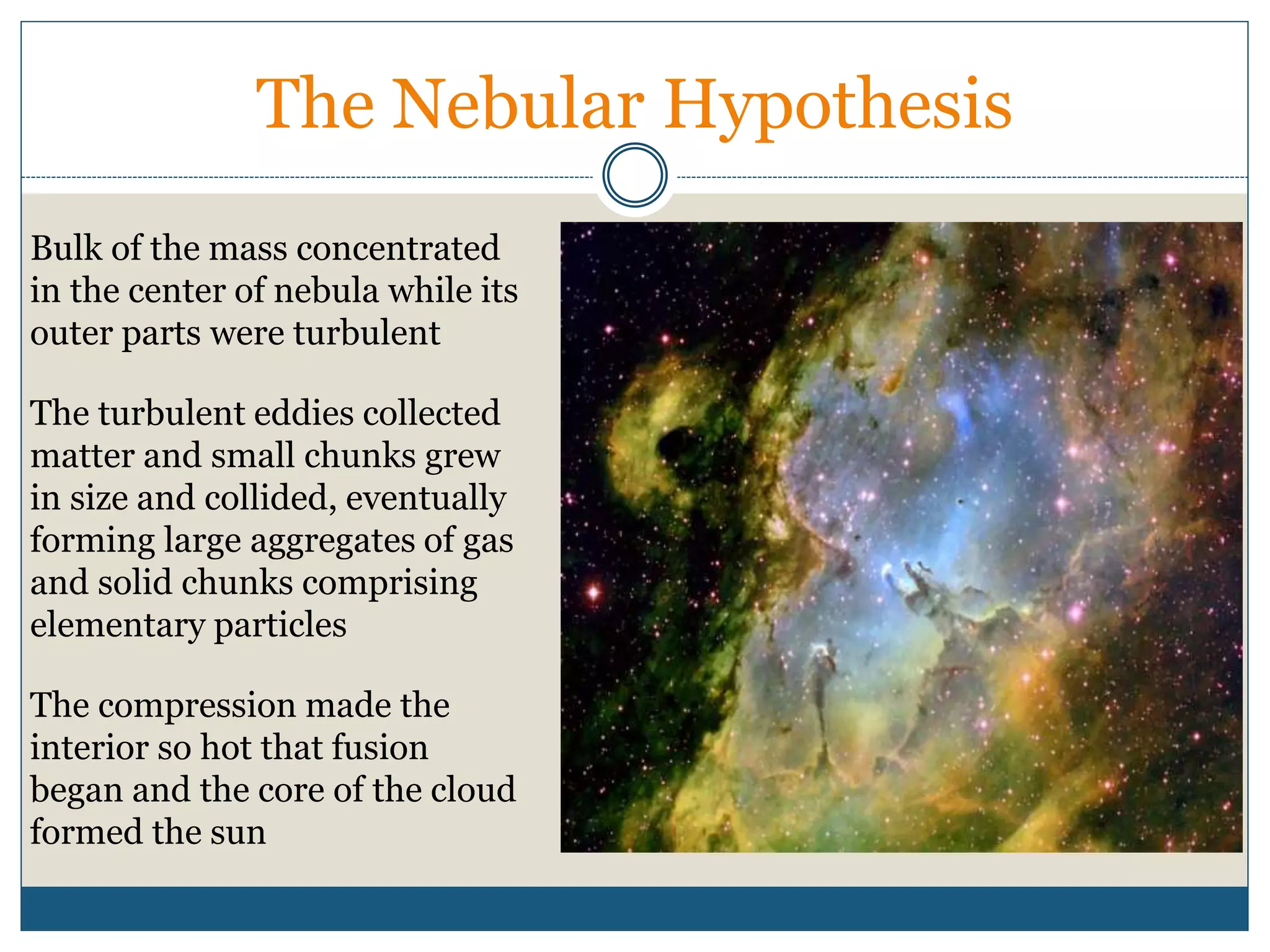
Bulk of the mass concentrated
in the center of nebula while its
outer parts were turbulent
The turbulent eddies collected
matter and small chunks grew
in size and collided, eventually
forming large aggregates of gas
and solid chunks comprising
elementary particles
The compression made the
interior so hot that fusion
began and the core of the cloud
formed the sun
The Nebular Hypothesis
After sufficient mass and density
was achieved in the Sun, the
temperature rose to one million
°C, resulting in thermonuclear
fusion:
H + H = He + energy
The Sun
 Gravitational forces allowed the inner planets to
accrue and compact solid matter (including light and
heavy atoms)
 Solar radiation blew gases (primarily H & He) away
from the inner planets
 These gases were collected and condensed into the gas
giants (Jupiter, Saturn, Uranus, Neptune)
 Beyond Neptune, ice and frozen gases formed Pluto,
Sedna and the Kuiper Belt Objects
 The left-over debris formed comets and asteroids
Proto-planets
Size of the Planets
Bombardment From Space
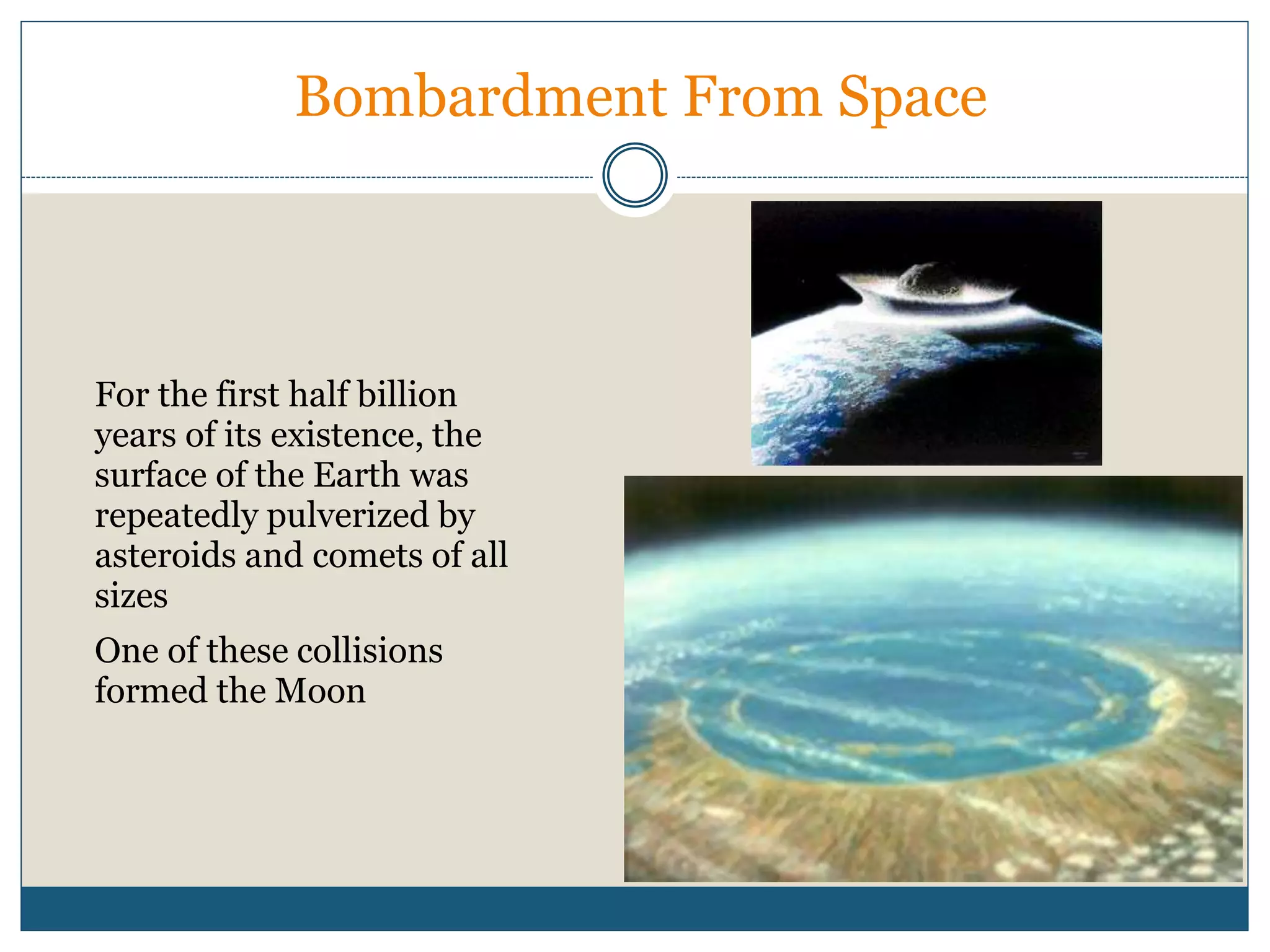
For the first half billion
years of its existence, the
surface of the Earth was
repeatedly pulverized by
asteroids and comets of all
sizes
One of these collisions
formed the Moon
Formation of the Moon
The Giant Impact Hypothesis
predicts that around 50 million
years after the initial creation of
Earth, a planet about the size of
Mars collided with Earth
This idea was first proposed about
30 years ago, but it took
calculations by modern high-speed
computers to prove the feasibility
Formation of the Moon
Part of the material from the collision remained in orbit around the
Earth
By the process collision and accretion, this orbiting material
coalesced into the Moon
The early Moon orbited very close to the Earth
Internal Heating of Early Earth
1. Collisions (Transfer of kinetic
energy into heat)
2. Compression
3. Radioactivity of elements (e.g.
uranium, potassium, or
thorium)
Three major factors that caused heating and melting in the early Earth’s
interior:
Internal Heating
About 100 million years after
initial accretion, temperatures at
depths of 400 to 800 km below
the Earth’s surface reach the
melting point of iron
In a process called global
chemical differential, the
heavier elements, including the
melted iron, began to sink down
into the core of the Earth, while
the lighter elements such as
oxygen and silica floated up
towards the surface
Global Chemical Differentiation
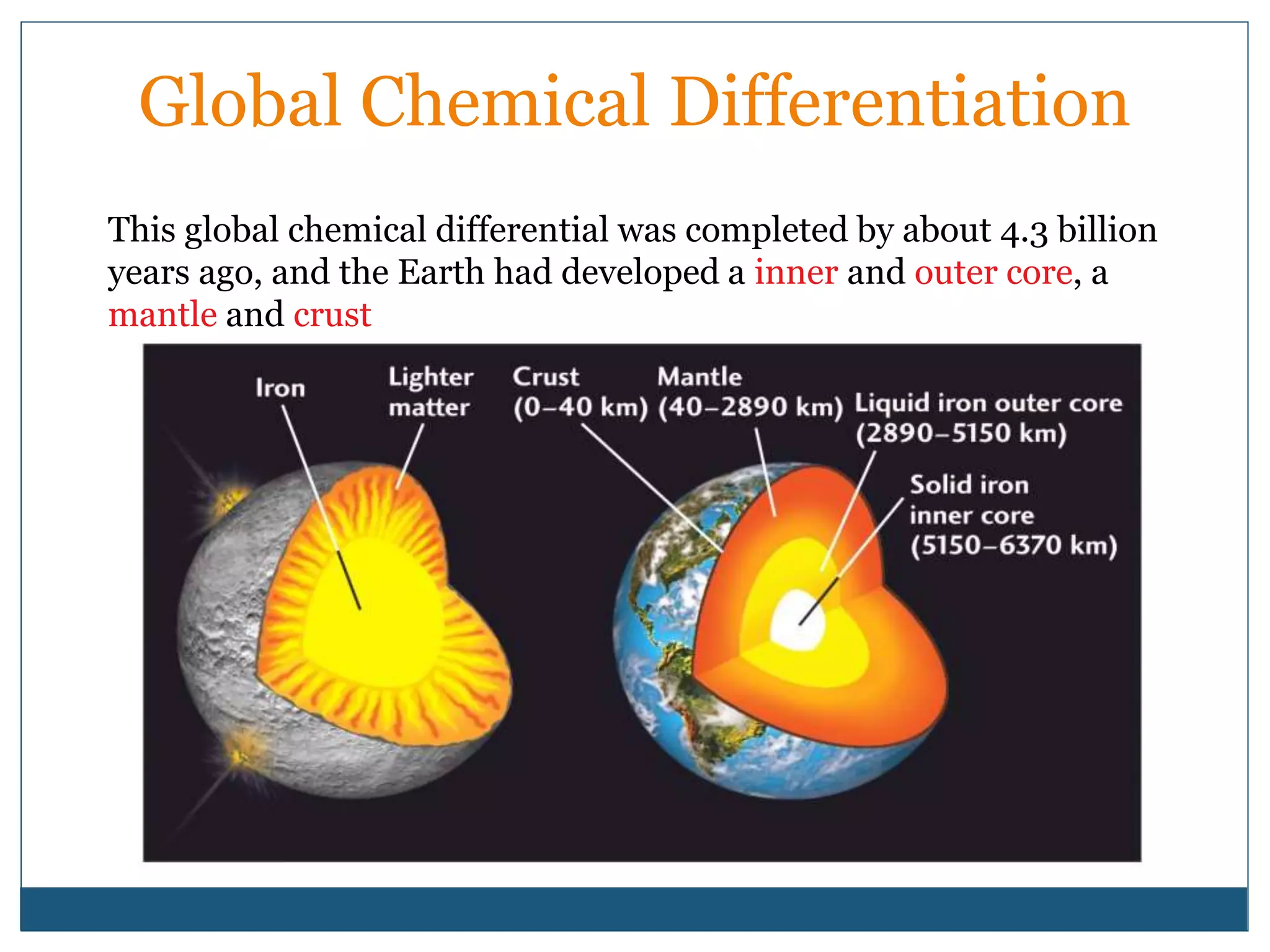
This global chemical differential was completed by about 4.3 billion
years ago, and the Earth had developed a inner and outer core, a
mantle and crust
Chemical Composition of Earth
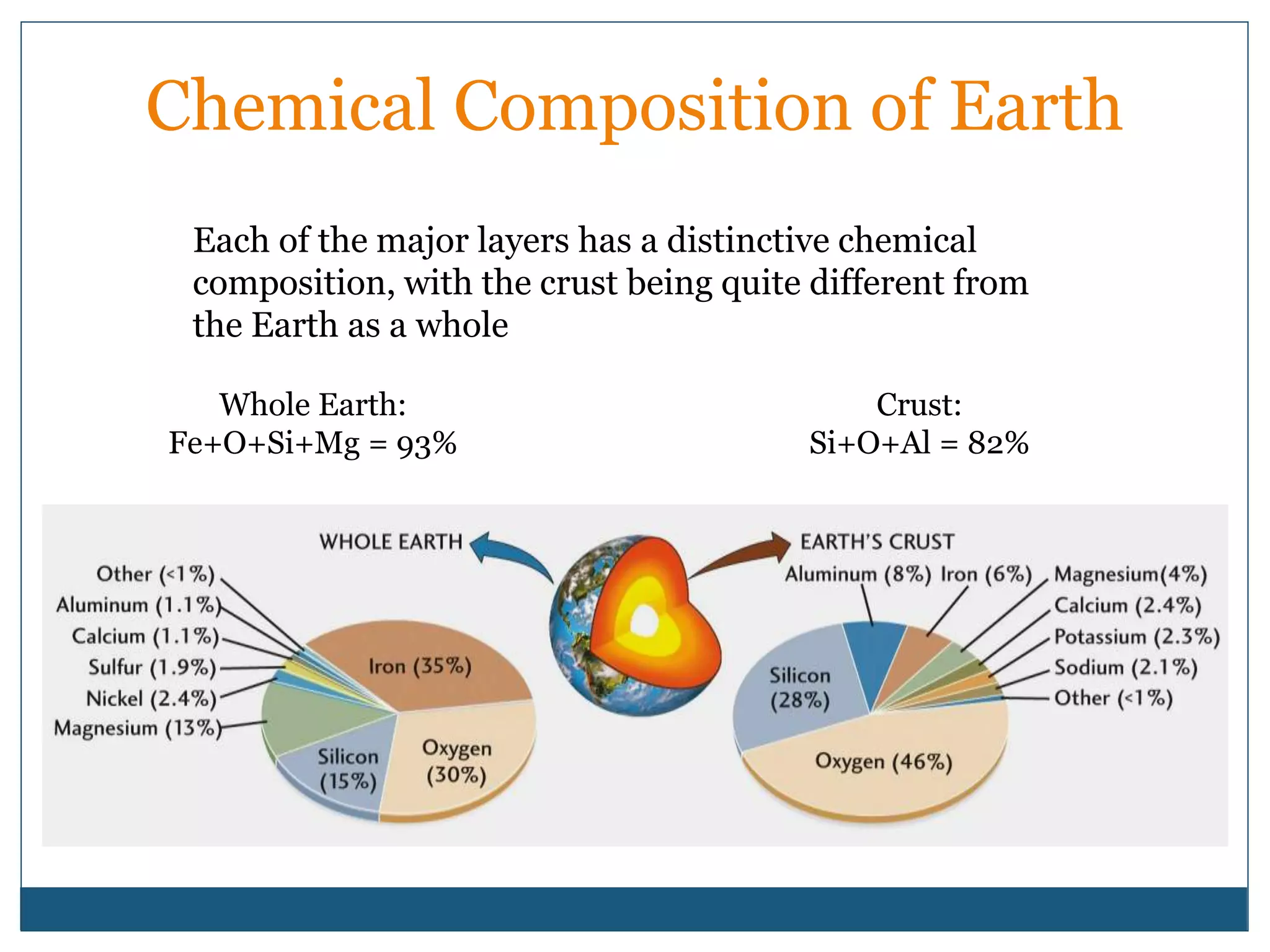
Whole Earth:
Fe+O+Si+Mg = 93%
Crust:
Si+O+Al = 82%
Each of the major layers has a distinctive chemical
composition, with the crust being quite different from
the Earth as a whole
Continents: Formed from
solidified magma that floated up
from the Mantle
Continent, Oceans & Atmosphere
Oceans and Atmosphere: Fluid
and gaseous outer layers believed
to have been created by out-
gassing of gases and fluids from
volcanic eruptions (in a process
called volatile transfer)
The Continents
By 2.5 billion years ago, the continents
had been formed
The density of the continental crust
(2.8 g/cm3) is lighter that the crust
found on ocean bottoms (3.2 g/cm3),
so the continents rise above the ocean
floor
A question that remains unanswered
is, when did plate tectonics start?
Evolution of Atmosphere
Initially the Earth is thought to have had a thin atmosphere made
up primarily of helium and hydrogen gases, but they escaped into
outer space as the Earth’s gravity could not hold them together
For the next several hundred million years, volcanic out-gassing
began to create a thicker atmosphere composed of a wide variety
of gasses, similar to modern volcanic eruptions
By 3.5 billion years ago, when the
Earth was a billion years old, it had
a thick atmosphere composed of
CO2, methane and water vapors etc.
By human standards this early
atmosphere was very poisonous as
it contained almost no oxygen
These volcanic eruptions include:
Water vapor (H2O)
Sulfur dioxide (SO2)
Hydrogen sulfide (H2S)
Carbon dioxide (CO2)
Carbon Monoxide (CO)
Ammonia (NH3)
Methane (CH4)
Atmosphere
Note that oxygen (O2) gas is not created by volcanic eruptions
It is hypothesized that water vapor escaping from the interior of
Earth via countless volcanic eruptions created the oceans (this
took hundreds of millions of years). The earliest evidence of
surface water on Earth dates back about 3.8 billion years
Oceans
Astronomers also
hypothesize that comets
impacting the Earth were a
major source of water that
contributed to creation of
the oceans
Remember, that comets are
best described as “dirty ice
balls”
Origin Of Life on Earth
These 3.5 billion year old fossilized algae mats, found in
Western Australia, are called stromatolites, and considered to
be the earliest known life on earth
Stromatolites
 Stromatolites are fossil remnants of early life
 They are mounds, columns and sheet-like
sedimentary rocks originally formed by the growth of
layer upon layer of cyanobacteria
 These are uni cellular photosynthesizing microbes
found in aquatic environment
 They produce oxygen as a by product. As such
photosynthesis is the only major source of free
oxygen in atmosphere
Stromatolites
 As stromatolites became more common 2.5 b.y.a.
they gradually changed the Earth’s atmosphere from
CO2 rich mixture to the present day O2 rich
composition
 Microfossils in rocks dating between 2.7 and 3.0 Ga
show more conclusive evidence for life
 It seems unlikely that life started on land because
early atmosphere was highly deficient in O2
Evidence of Life
 Stromatolites offer evidence for the existence of
microbial colonies as far back as 3.5 Ga
 Individual fossilized cells were found in a rock 3.5 Ga
formation in northwestern Australia
 Microscopic photos of sections of this rock show
structures that resemble individual cells
 The structure and chemical analyses show the presence
of organic carbon, possibly from sedimentary rocks
formed in shallow seas
 As such the protective layer of ozone in the upper
atmosphere was lacking and early forms of life were
exposed to high level of UV radiation
Life on Earth
 Thus the microfossil evidence clearly points to
existence of life before 3.0 Ga
 Isotopic carbon (C12) is far more common than C13
(typically 1 out of 89 atoms). As such low C13 ratio
indicate organic percentage
 Rocks recovered from sea near Greenland indicate a
lower ratio of C13 isotope from a rock that was dated
more than 3.85 Ga
 Recent evidence suggests that life already existed by
3.85 b.y.a.
Prokaryota
Bacteria are cells without nuclei and are called Prokaryota
While prokaryotes are nearly always unicellular, some are capable of
forming groups of cells called colonies
Cyanobacteria
Cyanobacteria, commonly called blue-green algae, is a phylum of bacteria
that obtain their energy through photosynthesis
This was the first life on Earth
Banded Iron Formations
It is hypothesized that the banded iron layers were formed in sea
water as the result of free oxygen released by photosynthetic
cyanobacteria combining with dissolved iron in the oceans to form
insoluble iron oxides, which precipitated out, forming a thin layer
on the seafloor
Nucleus Bearing Cells
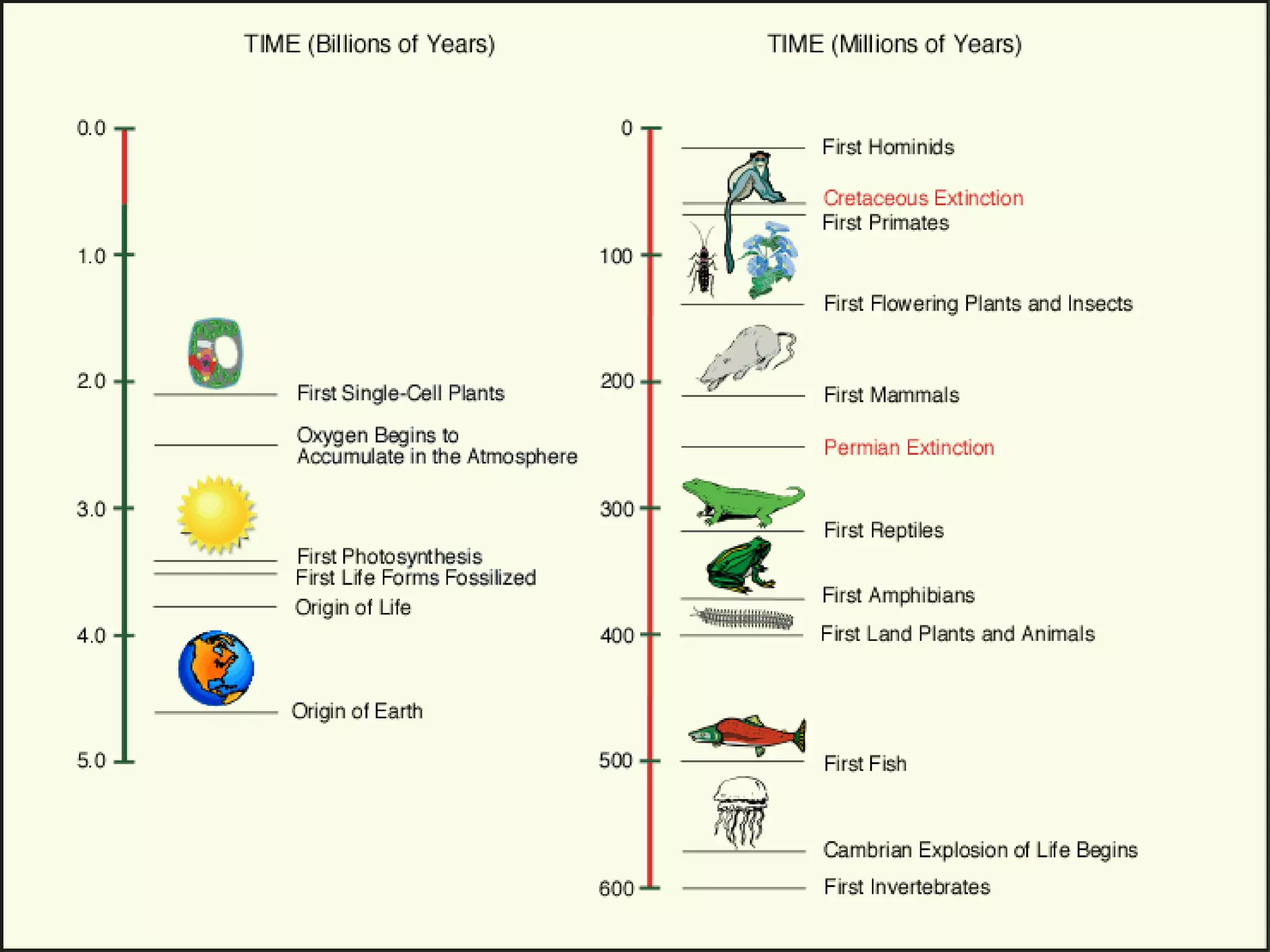
Then, at the start of the Cambrian, 570 million years ago, there was an
explosion in the diversity of life on Earth by Nucleus-bearing cells
Evolution of Planet Earth and Life

Evolution of Planet Earth and Life

  • 1.
    P RO F.D R . S . S H A F I Q - U R - R E H M A N D E PA RT M E N T O F E N V I RO N M E N TA L S C I E N C ES U N I V E RS I T Y O F P ES H AWA R Planet Earth: from origin to present
  • 2.
  • 3.
    1. Planets revolvearound the Sun in same direction 2. The orbits are all nearly circular 3. The orbits are in the same flat plane 4. The Sun rotates in almost the same plane as the planets and in the same direction as the they revolve 5. Most of the planets rotate in the same direction as the sun 6. Seven of the nine planets have moons Six facts worth considering about the origin of Earth
  • 4.
    Origin of theUniverse The universe began about 14.4 billion years ago The Big Bang Theory states that, in the beginning, the universe was all in one place All of its matter and energy were squished into an infinitely small point, a singularity Then it exploded and material blown out by the explosion eventually formed stars and galaxies
  • 5.
    Nebular Hypothesis: The currentlyaccepted argument regarding how Solar System may have formed 5 billion years ago a cloud of gas and dust (nebula), at least 10 billion km in diameter, rotated slowly in space As time passed the cloud condensed under its own gravity and shrank in size The Nebular Hypothesis
  • 6.
    Bulk of themass concentrated in the center of nebula while its outer parts were turbulent The turbulent eddies collected matter and small chunks grew in size and collided, eventually forming large aggregates of gas and solid chunks comprising elementary particles The compression made the interior so hot that fusion began and the core of the cloud formed the sun The Nebular Hypothesis
  • 7.
    After sufficient massand density was achieved in the Sun, the temperature rose to one million °C, resulting in thermonuclear fusion: H + H = He + energy The Sun
  • 8.
     Gravitational forcesallowed the inner planets to accrue and compact solid matter (including light and heavy atoms)  Solar radiation blew gases (primarily H & He) away from the inner planets  These gases were collected and condensed into the gas giants (Jupiter, Saturn, Uranus, Neptune)  Beyond Neptune, ice and frozen gases formed Pluto, Sedna and the Kuiper Belt Objects  The left-over debris formed comets and asteroids Proto-planets
  • 9.
    Size of thePlanets
  • 10.
    Bombardment From Space Forthe first half billion years of its existence, the surface of the Earth was repeatedly pulverized by asteroids and comets of all sizes One of these collisions formed the Moon
  • 11.
    Formation of theMoon The Giant Impact Hypothesis predicts that around 50 million years after the initial creation of Earth, a planet about the size of Mars collided with Earth This idea was first proposed about 30 years ago, but it took calculations by modern high-speed computers to prove the feasibility
  • 12.
    Formation of theMoon Part of the material from the collision remained in orbit around the Earth By the process collision and accretion, this orbiting material coalesced into the Moon The early Moon orbited very close to the Earth
  • 13.
    Internal Heating ofEarly Earth 1. Collisions (Transfer of kinetic energy into heat) 2. Compression 3. Radioactivity of elements (e.g. uranium, potassium, or thorium) Three major factors that caused heating and melting in the early Earth’s interior:
  • 14.
    Internal Heating About 100million years after initial accretion, temperatures at depths of 400 to 800 km below the Earth’s surface reach the melting point of iron In a process called global chemical differential, the heavier elements, including the melted iron, began to sink down into the core of the Earth, while the lighter elements such as oxygen and silica floated up towards the surface
  • 15.
    Global Chemical Differentiation Thisglobal chemical differential was completed by about 4.3 billion years ago, and the Earth had developed a inner and outer core, a mantle and crust
  • 16.
    Chemical Composition ofEarth Whole Earth: Fe+O+Si+Mg = 93% Crust: Si+O+Al = 82% Each of the major layers has a distinctive chemical composition, with the crust being quite different from the Earth as a whole
  • 17.
    Continents: Formed from solidifiedmagma that floated up from the Mantle Continent, Oceans & Atmosphere Oceans and Atmosphere: Fluid and gaseous outer layers believed to have been created by out- gassing of gases and fluids from volcanic eruptions (in a process called volatile transfer)
  • 18.
    The Continents By 2.5billion years ago, the continents had been formed The density of the continental crust (2.8 g/cm3) is lighter that the crust found on ocean bottoms (3.2 g/cm3), so the continents rise above the ocean floor A question that remains unanswered is, when did plate tectonics start?
  • 20.
    Evolution of Atmosphere Initiallythe Earth is thought to have had a thin atmosphere made up primarily of helium and hydrogen gases, but they escaped into outer space as the Earth’s gravity could not hold them together For the next several hundred million years, volcanic out-gassing began to create a thicker atmosphere composed of a wide variety of gasses, similar to modern volcanic eruptions By 3.5 billion years ago, when the Earth was a billion years old, it had a thick atmosphere composed of CO2, methane and water vapors etc. By human standards this early atmosphere was very poisonous as it contained almost no oxygen
  • 21.
    These volcanic eruptionsinclude: Water vapor (H2O) Sulfur dioxide (SO2) Hydrogen sulfide (H2S) Carbon dioxide (CO2) Carbon Monoxide (CO) Ammonia (NH3) Methane (CH4) Atmosphere Note that oxygen (O2) gas is not created by volcanic eruptions
  • 22.
    It is hypothesizedthat water vapor escaping from the interior of Earth via countless volcanic eruptions created the oceans (this took hundreds of millions of years). The earliest evidence of surface water on Earth dates back about 3.8 billion years Oceans Astronomers also hypothesize that comets impacting the Earth were a major source of water that contributed to creation of the oceans Remember, that comets are best described as “dirty ice balls”
  • 23.
    Origin Of Lifeon Earth These 3.5 billion year old fossilized algae mats, found in Western Australia, are called stromatolites, and considered to be the earliest known life on earth
  • 25.
    Stromatolites  Stromatolites arefossil remnants of early life  They are mounds, columns and sheet-like sedimentary rocks originally formed by the growth of layer upon layer of cyanobacteria  These are uni cellular photosynthesizing microbes found in aquatic environment  They produce oxygen as a by product. As such photosynthesis is the only major source of free oxygen in atmosphere
  • 26.
    Stromatolites  As stromatolitesbecame more common 2.5 b.y.a. they gradually changed the Earth’s atmosphere from CO2 rich mixture to the present day O2 rich composition  Microfossils in rocks dating between 2.7 and 3.0 Ga show more conclusive evidence for life  It seems unlikely that life started on land because early atmosphere was highly deficient in O2
  • 27.
    Evidence of Life Stromatolites offer evidence for the existence of microbial colonies as far back as 3.5 Ga  Individual fossilized cells were found in a rock 3.5 Ga formation in northwestern Australia  Microscopic photos of sections of this rock show structures that resemble individual cells  The structure and chemical analyses show the presence of organic carbon, possibly from sedimentary rocks formed in shallow seas  As such the protective layer of ozone in the upper atmosphere was lacking and early forms of life were exposed to high level of UV radiation
  • 28.
    Life on Earth Thus the microfossil evidence clearly points to existence of life before 3.0 Ga  Isotopic carbon (C12) is far more common than C13 (typically 1 out of 89 atoms). As such low C13 ratio indicate organic percentage  Rocks recovered from sea near Greenland indicate a lower ratio of C13 isotope from a rock that was dated more than 3.85 Ga  Recent evidence suggests that life already existed by 3.85 b.y.a.
  • 29.
    Prokaryota Bacteria are cellswithout nuclei and are called Prokaryota While prokaryotes are nearly always unicellular, some are capable of forming groups of cells called colonies
  • 30.
    Cyanobacteria Cyanobacteria, commonly calledblue-green algae, is a phylum of bacteria that obtain their energy through photosynthesis This was the first life on Earth
  • 32.
    Banded Iron Formations Itis hypothesized that the banded iron layers were formed in sea water as the result of free oxygen released by photosynthetic cyanobacteria combining with dissolved iron in the oceans to form insoluble iron oxides, which precipitated out, forming a thin layer on the seafloor
  • 33.
    Nucleus Bearing Cells Then,at the start of the Cambrian, 570 million years ago, there was an explosion in the diversity of life on Earth by Nucleus-bearing cells