Preoperative assessment and
preparation for anaesthesia
Session outline
Preoperative assessment:
1. History taking
2. Physical examination
3. Surgical urgency
4. Investigations
Introduction: what is POA?
Introduction
What are the aims of POA?
 Reduce morbidity and mortality associated with surgery
 Assess pre-existing medical conditions
 Plan preoperative and postoperative management of these conditions
 Prevent unnecessary cancellations
 Ensure the patient is fully prepared for surgery
 Reduce length of hospital stay
 Inform the patient of the proposed procedure and gain consent
Introduction
 Why is POA important?
1. Induction is dangerous without correct preparation
2. Anaesthetic has profound effect on CVS and RS
3. Pre-existing medical conditions can have a dramatic influence
4. To enable you to adequately prepare for an anaesthetic type
5. To minimizes the risk to the patient
 Structured approach: Take a few moments to outline on a piece of paper a
plan for a preoperative assessment.
Preoperative assessment
1: History taking
 History of present compliant?
Determine surgical urgency
Influence of anaesthetic technique
Determine the acceptable starvation period
Surgical condition which have systemic effect. E.g. bowl ca
Anesthesia fitness chart
Preoperative assessment
1: History taking
Medical History – CV disease
 For cardiovascular disease, ask:
 Exercise tolerance
 Palpitations
 Collapse/syncope
 Ankle swelling
 History of MI/Hypertension/raised cholesterol/diabetes
 Known valvular or congenital heart disease
Preoperative assessment
1: History taking
 Medical History – RS disease
 For respiratory disease, ask:
 Exercise tolerance
 Cough/sputum/haemoptysis
 Smoking history
 Wheeze
 Exposure to industrial dusts
 Weight loss
 Night sweats
 Fever
Preoperative assessment
1: History taking
Medical history: exercise tolerance
Preoperative assessment
1: History taking
 Medical history: other conditions
 Malnourished
 Dehydration
 Elderly (>75 years)
 Diabetes mellitus
 Endocrine dysfunction
 Chronic renal failure
 Nephrotic syndrome
 Obstructive jaundice
Preoperative assessment
1: History taking
Medical history: Anaesthetic history
 Note details of previous anaesthetics and any problems
encountered
 Examine previous anaesthetic charts if available
 Note last exposure to halothane anaesthesia
Medical history: family history
 Malignant hyperthermia
 Suxamethonium apnoea
 Porphyria
 Haemoglobinopathies
Preoperative assessment
1: History taking
Medical history:
Drug history
Allergies and addiction
Pregnancy
Reflex
Preparation
 What should you prepare prior to anaesthetising a
patient for surgery?
1.Patients
2.Drugs and blood products
3.Equipment check
4.Communicate with ward
5.Communicate with theatre team
Preoperative assessment
2: physical examination
 Look at your patient as a whole to decide how sick
he/she is
 Assess the degree of hydration
 Check peripheral perfusion (is he cold to touch?).
 Check for cyanosis (central and peripheral).
 Check for jaundice
Preoperative assessment
2: physical examination
Cardiovascular System and respiratory Examination
Look
Listen(Auscultate)
Feel
 Look Other systems
Preoperative assessment
2: physical examination
Airway assessment
 Airway assessment aims to predict:
Difficult mask ventilation (with or without adjuncts/aids)
Difficult placement of LMA Difficult intubation
Difficult surgical access to trachea (rarely required)
Preoperative assessment
2: physical examination
Poor management of the difficult airway can result in:
Dental trauma
Airway trauma
Pulmonary aspiration
Hypoxia
Death
Preoperative assessment
2: physical examination
 Successful intubation requires:
Good mouth opening
Extension of the upper cervical spine
The ability to move soft tissue within the mandible out of the way
Preoperative assessment
2: physical examination
Quick airway assessment
 Mallampati test
 Mouth opening (interinciser gap)
 Jaw slide
 Neck movement
Preoperative assessment
2: physical examination
Preoperative assessment
2: physical examination
Mouth opening
Neck movement
Preoperative assessment
2: physical examination
Jaw slide
Thyro and sterno - mental distance
Difficult ventilation
 Which features are associated with difficult mask ventilation?
Overweight/Pregnant
Bearded or Burns/Trauma to face
Edentulous (lack of teeth)
Snoring/Obstructive Sleep Apnoea/space occupying lesion of
oropharynx or larynx
Elderly
Difficult intubation
 Which features are associated with difficult
intubation?
Protruding/awkward teeth
Space occupying lesion of oropharynx and larynx
Facial trauma or burns
Obesity
Previous tracheostomy/tracheal stenosis
Pregnancy
Preoperative assessment
3: surgical urgency
 Why for anaesthetist?
To communicate with surgeon
To minimize the overall risk
Aware the risks associated with the surgical urgency
Risk – benefit analysis
Consensus b/n the team and family
Preoperative assessment
3: surgical urgency
There are four categories:
Immediate life, limb or organ saving
Urgent
Expedited
Elective
Preoperative assessment
3: surgical urgency
Surgical grades Examples
 Grade 1 (minor)
 Excision skin lesion; drainage breast abscess
 Grade 2 (intermediate)
 Inguinal hernia; varicose vein(s); tonsillectomy; arthroscopy
 Grade 3 (major)
 Hysterectomy; TURP; lumbar discectomy; thyroidectomy
 Grade 4 (major+)
 Joint replacement; thoracic operations; colonic resection;
radical neck dissection
The ASA classification of general preoperative health
 Extended version
ASA 1: Healthy patient.
ASA 2: Healthy patient with
remarks.
ASA 3: Patient with moderate
clinical illness.
ASA 4: Severely ill patient.
ASA 5: Patient with an
immediately life-threatening
condition.
 Add E for emergency
Original version
 ASA I: A normal healthypatient
 ASA II: A patient with mild systemic disease
 ASA III: A patient with severe systemic disease
 ASA IV: A patient with severe systemic disease
that is a constant threat to life
 ASA V: A moribund patient who is not expected
to survive without the operation
 ASA VI: A declared brain-dead patient whose
organs are being removed for donor
purposes
Preoperative Assessment
4: Investigations
The decision to order tests will depend on:
 Age of the patient
 General health/co-morbidities of the patient
 Medications
 Presenting condition
 Urgency of surgery
 Nature of surgery planned
 Facilities available for testing
Age
 Healthy patients over 60 years old may need the
following if major surgery is planned:
 Electrocardiogram (ECG)
 Full blood count (FBC)
 Renal function tests (U&E)
 The type of surgery planned is a major determinant of
preoperative investigations.
Full blood count (FBC)
 Full blood count (FBC)
 Measure when:
 The history or examination indicates anaemia
 The proposed operation is expected to cause substantial
blood loss
 Measure in patients with:
 Jaundice
 Malignancy
 Infection
 HIV
 Significant blood loss
 Also measure in patients with cardiac/renal/respiratory
disease.
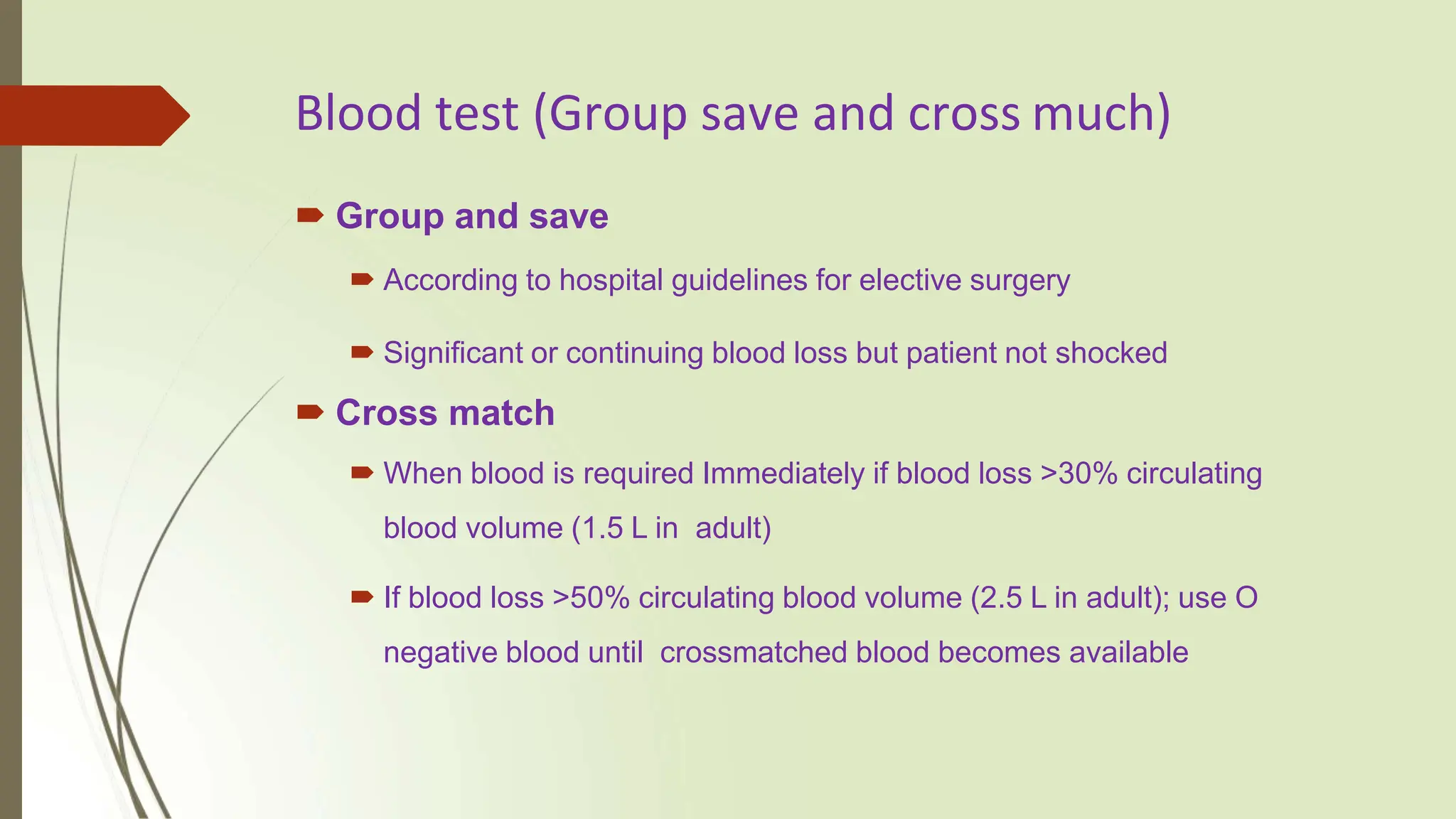
Blood test (Group save and cross much)
 Group and save
 According to hospital guidelines for elective surgery
 Significant or continuing blood loss but patient not shocked
 Cross match
 When blood is required Immediately if blood loss >30% circulating
blood volume (1.5 L in adult)
 If blood loss >50% circulating blood volume (2.5 L in adult); use O
negative blood until crossmatched blood becomes available
Blood test (coagulation screen)
 Measure when the patient :
 Has hepatic disease
 Is on warfarin or anticoagulants
 History of inappropriate excessive bleeding
 If there is a family history of bleeding disorders
 Severe sepsis
 Major haemorrhage
Blood glucose
Measure if the patient has:
Diabetes
Glycosuria
Steroid treatment
Altered conscious level
Radiograph
Chest
 Chest X rays (CXR) are not routinely ordered
 Usually limited to patients listed for major surgery with
 Substantial cardiac or respiratory disease,
 Heavy smoking or exposure to TB
 They may be requested as part of the surgical work up of the
patient.
 Acute respiratory symptoms:
 May require as part of their management
 These should be treated before elective surgery
Radiograph
Spine
Cervical spine x-rays (AP, lateral) are indicated in
• History of arthritis
• Susceptibility in clinical examination
• Trauma / RTA
• Diabetes
Electrocardiogram
 Consider when patient scheduled for major surgery has:
Cardiovascular risk factors or history of cardiovascular
disease for example: hypertension, smoking, high
cholesterol, significant family history, and obesity
Signs of heart failure
You suspect an arrhythmia from clinical examination
Atypical abdominal pain or cardiac sounding chest pain
Echocardiography
 Do not routinely offer resting echocardiography before
surgery.
 Consider resting echocardiography if the patient has:
 A heart murmur and any cardiac symptom (including breathlessness,
pre-syncope, syncope or chest pain) or
 Signs or symptoms of heart failure.
 Before ordering the resting echocardiogram, carry out a
resting electrocardiogram (ECG) and discuss the findings
with surgeon
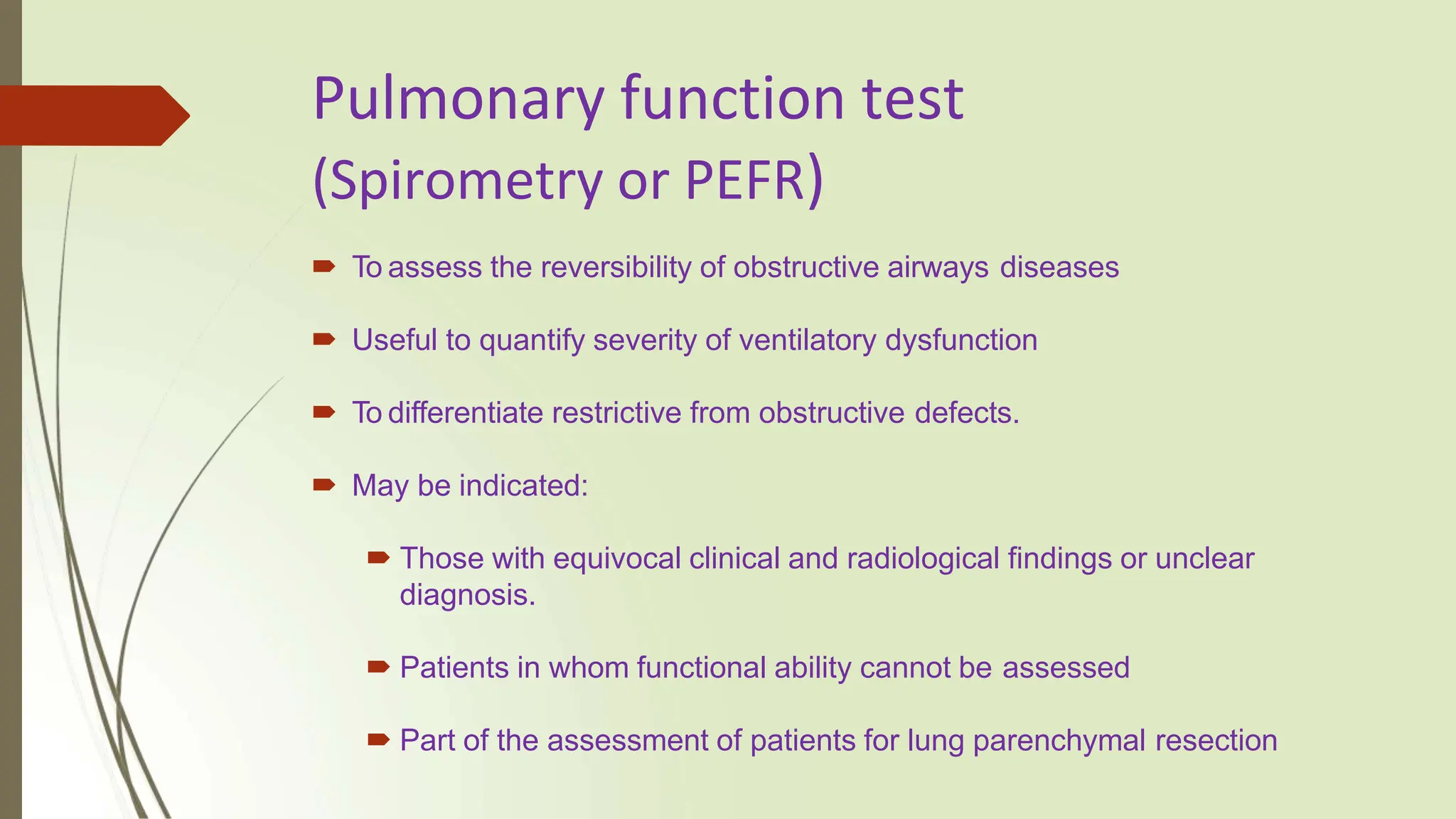
Pulmonary function test
(Spirometry or PEFR)
 To assess the reversibility of obstructive airways diseases
 Useful to quantify severity of ventilatory dysfunction
 To differentiate restrictive from obstructive defects.
 May be indicated:
 Those with equivocal clinical and radiological findings or unclear
diagnosis.
 Patients in whom functional ability cannot be assessed
 Part of the assessment of patients for lung parenchymal resection
Renal function test
 Measure:
 For all major surgery
 Measure in patients on:
 On diuretics or cardiovascular drugs
 Measure in patients with:
 Infection
 Diabetes
 Dehydration
 Hypertension
 Poor urine output
Liver function tests
 Measure in patients with:
Cardiac/hepatic disease
Biliary disease
Infection
Alcohol abuse
Jaundice

PRE OP pre operative assessment before surgery

  • 1.
  • 2.
    Session outline Preoperative assessment: 1.History taking 2. Physical examination 3. Surgical urgency 4. Investigations
  • 3.
  • 4.
    Introduction What are theaims of POA?  Reduce morbidity and mortality associated with surgery  Assess pre-existing medical conditions  Plan preoperative and postoperative management of these conditions  Prevent unnecessary cancellations  Ensure the patient is fully prepared for surgery  Reduce length of hospital stay  Inform the patient of the proposed procedure and gain consent
  • 5.
    Introduction  Why isPOA important? 1. Induction is dangerous without correct preparation 2. Anaesthetic has profound effect on CVS and RS 3. Pre-existing medical conditions can have a dramatic influence 4. To enable you to adequately prepare for an anaesthetic type 5. To minimizes the risk to the patient  Structured approach: Take a few moments to outline on a piece of paper a plan for a preoperative assessment.
  • 6.
    Preoperative assessment 1: Historytaking  History of present compliant? Determine surgical urgency Influence of anaesthetic technique Determine the acceptable starvation period Surgical condition which have systemic effect. E.g. bowl ca
  • 7.
  • 8.
    Preoperative assessment 1: Historytaking Medical History – CV disease  For cardiovascular disease, ask:  Exercise tolerance  Palpitations  Collapse/syncope  Ankle swelling  History of MI/Hypertension/raised cholesterol/diabetes  Known valvular or congenital heart disease
  • 9.
    Preoperative assessment 1: Historytaking  Medical History – RS disease  For respiratory disease, ask:  Exercise tolerance  Cough/sputum/haemoptysis  Smoking history  Wheeze  Exposure to industrial dusts  Weight loss  Night sweats  Fever
  • 10.
    Preoperative assessment 1: Historytaking Medical history: exercise tolerance
  • 11.
    Preoperative assessment 1: Historytaking  Medical history: other conditions  Malnourished  Dehydration  Elderly (>75 years)  Diabetes mellitus  Endocrine dysfunction  Chronic renal failure  Nephrotic syndrome  Obstructive jaundice
  • 12.
    Preoperative assessment 1: Historytaking Medical history: Anaesthetic history  Note details of previous anaesthetics and any problems encountered  Examine previous anaesthetic charts if available  Note last exposure to halothane anaesthesia Medical history: family history  Malignant hyperthermia  Suxamethonium apnoea  Porphyria  Haemoglobinopathies
  • 13.
    Preoperative assessment 1: Historytaking Medical history: Drug history Allergies and addiction Pregnancy Reflex
  • 14.
    Preparation  What shouldyou prepare prior to anaesthetising a patient for surgery? 1.Patients 2.Drugs and blood products 3.Equipment check 4.Communicate with ward 5.Communicate with theatre team
  • 15.
    Preoperative assessment 2: physicalexamination  Look at your patient as a whole to decide how sick he/she is  Assess the degree of hydration  Check peripheral perfusion (is he cold to touch?).  Check for cyanosis (central and peripheral).  Check for jaundice
  • 16.
    Preoperative assessment 2: physicalexamination Cardiovascular System and respiratory Examination Look Listen(Auscultate) Feel  Look Other systems
  • 17.
    Preoperative assessment 2: physicalexamination Airway assessment  Airway assessment aims to predict: Difficult mask ventilation (with or without adjuncts/aids) Difficult placement of LMA Difficult intubation Difficult surgical access to trachea (rarely required)
  • 18.
    Preoperative assessment 2: physicalexamination Poor management of the difficult airway can result in: Dental trauma Airway trauma Pulmonary aspiration Hypoxia Death
  • 19.
    Preoperative assessment 2: physicalexamination  Successful intubation requires: Good mouth opening Extension of the upper cervical spine The ability to move soft tissue within the mandible out of the way
  • 20.
    Preoperative assessment 2: physicalexamination Quick airway assessment  Mallampati test  Mouth opening (interinciser gap)  Jaw slide  Neck movement
  • 21.
  • 22.
    Preoperative assessment 2: physicalexamination Mouth opening Neck movement
  • 23.
    Preoperative assessment 2: physicalexamination Jaw slide Thyro and sterno - mental distance
  • 24.
    Difficult ventilation  Whichfeatures are associated with difficult mask ventilation? Overweight/Pregnant Bearded or Burns/Trauma to face Edentulous (lack of teeth) Snoring/Obstructive Sleep Apnoea/space occupying lesion of oropharynx or larynx Elderly
  • 25.
    Difficult intubation  Whichfeatures are associated with difficult intubation? Protruding/awkward teeth Space occupying lesion of oropharynx and larynx Facial trauma or burns Obesity Previous tracheostomy/tracheal stenosis Pregnancy
  • 26.
    Preoperative assessment 3: surgicalurgency  Why for anaesthetist? To communicate with surgeon To minimize the overall risk Aware the risks associated with the surgical urgency Risk – benefit analysis Consensus b/n the team and family
  • 27.
    Preoperative assessment 3: surgicalurgency There are four categories: Immediate life, limb or organ saving Urgent Expedited Elective
  • 28.
    Preoperative assessment 3: surgicalurgency Surgical grades Examples  Grade 1 (minor)  Excision skin lesion; drainage breast abscess  Grade 2 (intermediate)  Inguinal hernia; varicose vein(s); tonsillectomy; arthroscopy  Grade 3 (major)  Hysterectomy; TURP; lumbar discectomy; thyroidectomy  Grade 4 (major+)  Joint replacement; thoracic operations; colonic resection; radical neck dissection
  • 29.
    The ASA classificationof general preoperative health  Extended version ASA 1: Healthy patient. ASA 2: Healthy patient with remarks. ASA 3: Patient with moderate clinical illness. ASA 4: Severely ill patient. ASA 5: Patient with an immediately life-threatening condition.  Add E for emergency Original version  ASA I: A normal healthypatient  ASA II: A patient with mild systemic disease  ASA III: A patient with severe systemic disease  ASA IV: A patient with severe systemic disease that is a constant threat to life  ASA V: A moribund patient who is not expected to survive without the operation  ASA VI: A declared brain-dead patient whose organs are being removed for donor purposes
  • 30.
    Preoperative Assessment 4: Investigations Thedecision to order tests will depend on:  Age of the patient  General health/co-morbidities of the patient  Medications  Presenting condition  Urgency of surgery  Nature of surgery planned  Facilities available for testing
  • 31.
    Age  Healthy patientsover 60 years old may need the following if major surgery is planned:  Electrocardiogram (ECG)  Full blood count (FBC)  Renal function tests (U&E)  The type of surgery planned is a major determinant of preoperative investigations.
  • 32.
    Full blood count(FBC)  Full blood count (FBC)  Measure when:  The history or examination indicates anaemia  The proposed operation is expected to cause substantial blood loss  Measure in patients with:  Jaundice  Malignancy  Infection  HIV  Significant blood loss  Also measure in patients with cardiac/renal/respiratory disease.
  • 33.
    Blood test (Groupsave and cross much)  Group and save  According to hospital guidelines for elective surgery  Significant or continuing blood loss but patient not shocked  Cross match  When blood is required Immediately if blood loss >30% circulating blood volume (1.5 L in adult)  If blood loss >50% circulating blood volume (2.5 L in adult); use O negative blood until crossmatched blood becomes available
  • 34.
    Blood test (coagulationscreen)  Measure when the patient :  Has hepatic disease  Is on warfarin or anticoagulants  History of inappropriate excessive bleeding  If there is a family history of bleeding disorders  Severe sepsis  Major haemorrhage
  • 35.
    Blood glucose Measure ifthe patient has: Diabetes Glycosuria Steroid treatment Altered conscious level
  • 36.
    Radiograph Chest  Chest Xrays (CXR) are not routinely ordered  Usually limited to patients listed for major surgery with  Substantial cardiac or respiratory disease,  Heavy smoking or exposure to TB  They may be requested as part of the surgical work up of the patient.  Acute respiratory symptoms:  May require as part of their management  These should be treated before elective surgery
  • 37.
    Radiograph Spine Cervical spine x-rays(AP, lateral) are indicated in • History of arthritis • Susceptibility in clinical examination • Trauma / RTA • Diabetes
  • 38.
    Electrocardiogram  Consider whenpatient scheduled for major surgery has: Cardiovascular risk factors or history of cardiovascular disease for example: hypertension, smoking, high cholesterol, significant family history, and obesity Signs of heart failure You suspect an arrhythmia from clinical examination Atypical abdominal pain or cardiac sounding chest pain
  • 39.
    Echocardiography  Do notroutinely offer resting echocardiography before surgery.  Consider resting echocardiography if the patient has:  A heart murmur and any cardiac symptom (including breathlessness, pre-syncope, syncope or chest pain) or  Signs or symptoms of heart failure.  Before ordering the resting echocardiogram, carry out a resting electrocardiogram (ECG) and discuss the findings with surgeon
  • 40.
    Pulmonary function test (Spirometryor PEFR)  To assess the reversibility of obstructive airways diseases  Useful to quantify severity of ventilatory dysfunction  To differentiate restrictive from obstructive defects.  May be indicated:  Those with equivocal clinical and radiological findings or unclear diagnosis.  Patients in whom functional ability cannot be assessed  Part of the assessment of patients for lung parenchymal resection
  • 41.
    Renal function test Measure:  For all major surgery  Measure in patients on:  On diuretics or cardiovascular drugs  Measure in patients with:  Infection  Diabetes  Dehydration  Hypertension  Poor urine output
  • 42.
    Liver function tests Measure in patients with: Cardiac/hepatic disease Biliary disease Infection Alcohol abuse Jaundice