Pre-modern European Migrations: Germanic Migrations
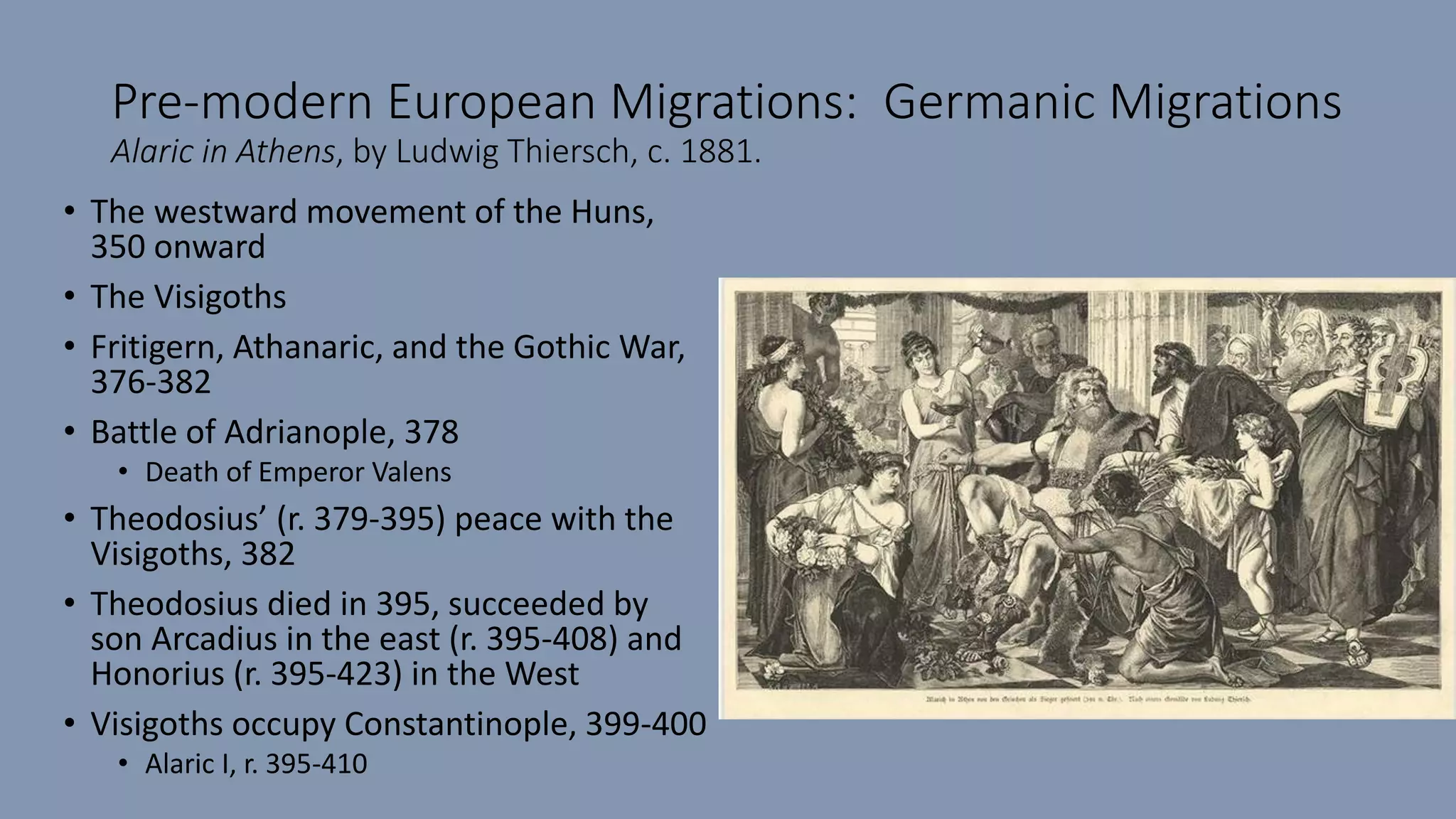
Alaric in Athens, by Ludwig Thiersch, c. 1881.
• The westward movement of the Huns,
350 onward
• The Visigoths
• Fritigern, Athanaric, and the Gothic War,
376-382
• Battle of Adrianople, 378
• Death of Emperor Valens
• Theodosius’ (r. 379-395) peace with the
Visigoths, 382
• Theodosius died in 395, succeeded by
son Arcadius in the east (r. 395-408) and
Honorius (r. 395-423) in the West
• Visigoths occupy Constantinople, 399-400
• Alaric I, r. 395-410
Pre-modern European Migrations: Germanic Migrations
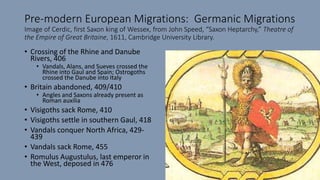
Image of Cerdic, first Saxon king of Wessex, from John Speed, “Saxon Heptarchy,” Theatre of
the Empire of Great Britaine, 1611, Cambridge University Library.
• Crossing of the Rhine and Danube
Rivers, 406
• Vandals, Alans, and Sueves crossed the
Rhine into Gaul and Spain; Ostrogoths
crossed the Danube into Italy
• Britain abandoned, 409/410
• Angles and Saxons already present as
Roman auxilia
• Visigoths sack Rome, 410
• Visigoths settle in southern Gaul, 418
• Vandals conquer North Africa, 429-
439
• Vandals sack Rome, 455
• Romulus Augustulus, last emperor in
the West, deposed in 476
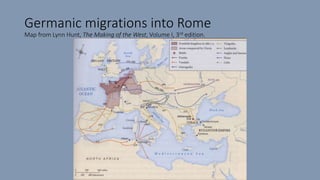
Germanic migrations into Rome
Map from Lynn Hunt, The Making of the West, Volume I, 3rd edition.
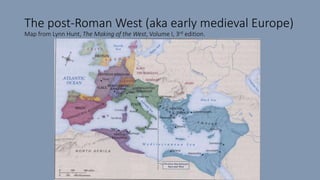
The post-Roman West (aka early medieval Europe)
Map from Lynn Hunt, The Making of the West, Volume I, 3rd edition.
Pre-modern European Migrations: Germanic Migrations
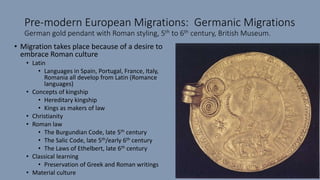
German gold pendant with Roman styling, 5th to 6th century, British Museum.
• Migration takes place because of a desire to
embrace Roman culture
• Latin
• Languages in Spain, Portugal, France, Italy,
Romania all develop from Latin (Romance
languages)
• Concepts of kingship
• Hereditary kingship
• Kings as makers of law
• Christianity
• Roman law
• The Burgundian Code, late 5th century
• The Salic Code, late 5th/early 6th century
• The Laws of Ethelbert, late 6th century
• Classical learning
• Preservation of Greek and Roman writings
• Material culture
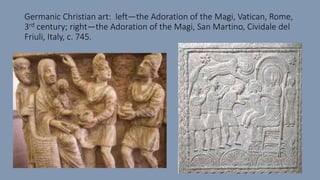
Germanic Christian art: left—the Adoration of the Magi, Vatican, Rome,
3rd century; right—the Adoration of the Magi, San Martino, Cividale del
Friuli, Italy, c. 745.
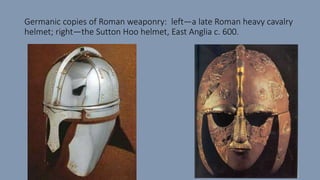
Germanic copies of Roman weaponry: left—a late Roman heavy cavalry
helmet; right—the Sutton Hoo helmet, East Anglia c. 600.
Pre-modern European Migrations: Germanic Migrations
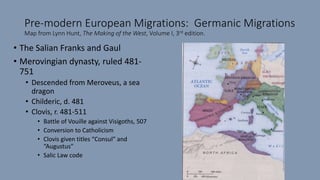
Map from Lynn Hunt, The Making of the West, Volume I, 3rd edition.
• The Salian Franks and Gaul
• Merovingian dynasty, ruled 481-
751
• Descended from Meroveus, a sea
dragon
• Childeric, d. 481
• Clovis, r. 481-511
• Battle of Vouille against Visigoths, 507
• Conversion to Catholicism
• Clovis given titles “Consul” and
“Augustus”
• Salic Law code
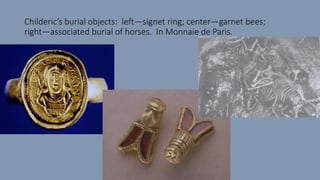
Childeric’s burial objects: left—signet ring; center—garnet bees;
right—associated burial of horses. In Monnaie de Paris.
Pre-modern European Migrations: Germanic Migrations
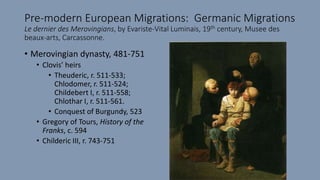
Le dernier des Merovingians, by Evariste-Vital Luminais, 19th century, Musee des
beaux-arts, Carcassonne.
• Merovingian dynasty, 481-751
• Clovis’ heirs
• Theuderic, r. 511-533;
Chlodomer, r. 511-524;
Childebert I, r. 511-558;
Chlothar I, r. 511-561.
• Conquest of Burgundy, 523
• Gregory of Tours, History of the
Franks, c. 594
• Childeric III, r. 743-751
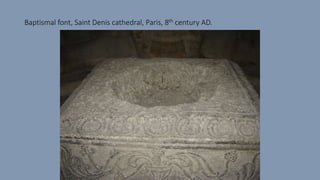
Baptismal font, Saint Denis cathedral, Paris, 8th century AD.
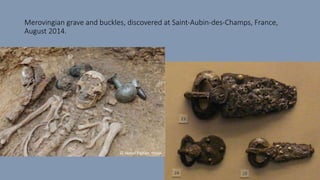
Merovingian grave and buckles, discovered at Saint-Aubin-des-Champs, France,
August 2014.

Pre-Modern European Migrations the Germans Part 2 - By Dr. Lizabeth Johnson

  • 1.
    Pre-modern European Migrations:Germanic Migrations Alaric in Athens, by Ludwig Thiersch, c. 1881. • The westward movement of the Huns, 350 onward • The Visigoths • Fritigern, Athanaric, and the Gothic War, 376-382 • Battle of Adrianople, 378 • Death of Emperor Valens • Theodosius’ (r. 379-395) peace with the Visigoths, 382 • Theodosius died in 395, succeeded by son Arcadius in the east (r. 395-408) and Honorius (r. 395-423) in the West • Visigoths occupy Constantinople, 399-400 • Alaric I, r. 395-410
  • 2.
    Pre-modern European Migrations:Germanic Migrations Image of Cerdic, first Saxon king of Wessex, from John Speed, “Saxon Heptarchy,” Theatre of the Empire of Great Britaine, 1611, Cambridge University Library. • Crossing of the Rhine and Danube Rivers, 406 • Vandals, Alans, and Sueves crossed the Rhine into Gaul and Spain; Ostrogoths crossed the Danube into Italy • Britain abandoned, 409/410 • Angles and Saxons already present as Roman auxilia • Visigoths sack Rome, 410 • Visigoths settle in southern Gaul, 418 • Vandals conquer North Africa, 429- 439 • Vandals sack Rome, 455 • Romulus Augustulus, last emperor in the West, deposed in 476
  • 3.
    Germanic migrations intoRome Map from Lynn Hunt, The Making of the West, Volume I, 3rd edition.
  • 4.
    The post-Roman West(aka early medieval Europe) Map from Lynn Hunt, The Making of the West, Volume I, 3rd edition.
  • 5.
    Pre-modern European Migrations:Germanic Migrations German gold pendant with Roman styling, 5th to 6th century, British Museum. • Migration takes place because of a desire to embrace Roman culture • Latin • Languages in Spain, Portugal, France, Italy, Romania all develop from Latin (Romance languages) • Concepts of kingship • Hereditary kingship • Kings as makers of law • Christianity • Roman law • The Burgundian Code, late 5th century • The Salic Code, late 5th/early 6th century • The Laws of Ethelbert, late 6th century • Classical learning • Preservation of Greek and Roman writings • Material culture
  • 6.
    Germanic Christian art:left—the Adoration of the Magi, Vatican, Rome, 3rd century; right—the Adoration of the Magi, San Martino, Cividale del Friuli, Italy, c. 745.
  • 7.
    Germanic copies ofRoman weaponry: left—a late Roman heavy cavalry helmet; right—the Sutton Hoo helmet, East Anglia c. 600.
  • 8.
    Pre-modern European Migrations:Germanic Migrations Map from Lynn Hunt, The Making of the West, Volume I, 3rd edition. • The Salian Franks and Gaul • Merovingian dynasty, ruled 481- 751 • Descended from Meroveus, a sea dragon • Childeric, d. 481 • Clovis, r. 481-511 • Battle of Vouille against Visigoths, 507 • Conversion to Catholicism • Clovis given titles “Consul” and “Augustus” • Salic Law code
  • 9.
    Childeric’s burial objects:left—signet ring; center—garnet bees; right—associated burial of horses. In Monnaie de Paris.
  • 10.
    Pre-modern European Migrations:Germanic Migrations Le dernier des Merovingians, by Evariste-Vital Luminais, 19th century, Musee des beaux-arts, Carcassonne. • Merovingian dynasty, 481-751 • Clovis’ heirs • Theuderic, r. 511-533; Chlodomer, r. 511-524; Childebert I, r. 511-558; Chlothar I, r. 511-561. • Conquest of Burgundy, 523 • Gregory of Tours, History of the Franks, c. 594 • Childeric III, r. 743-751
  • 11.
    Baptismal font, SaintDenis cathedral, Paris, 8th century AD.
  • 12.
    Merovingian grave andbuckles, discovered at Saint-Aubin-des-Champs, France, August 2014.