Learning Objectives
Todiscuss pre-test information counselling session
To discuss post test information counselling session
Discuss follow up counselling and referral
Define positive living in the context of HIV.
State the benefits of positive living and how to co-exist
with HIV.
Discuss disclosure
3.
Pre-test Information/ CounsellingSession
Group Information sessions can be used prior to
provision of both client Initiated Testing and
Counselling and PITC services.
These sessions are aimed at providing information
rather than individual counseling.
The goal of these sessions is to discuss general
information about HIV and AIDS including HTS
specifically, prior to rapid HIV testing.
This is then followed by quality individual post-test
4.
Post Test CounsellingSessions
The individual post-test counseling is provided
for both HIV positive and HIV negative clients.
This session assesses the clients’ readiness to
receive results and confirm their readiness.
Confirm clients’ identity.
5.
Follow up Counsellingand Referrals
Follow up counselling must be provided to both HIV
negative and HIV positive clients.
It empowers the HIV negative clients to continue with
the risk reduction strategies so as to remain HIV
negative.
6.
Adherence Counselling
This processaims at reducing the impact
of stressors, develop coping strategies as
well as prepare and support clients
during management of chronic
conditions.
7.
Key points toremember
The guiding principles of HTS are consent, confidentiality,
competence in counseling, correct results and connections
to HIV care, treatment and prevention services.
Effective counseling is a blend of skills, techniques, and
other key elements, such as possessing the basic attitudes
and beliefs about people and the ability to help others
successfully.
HCWs need to have self-awareness to better understand
themselves and be able to provide clients treatment with
dignity and respect.
Discuss referral options
8.
Group Discussion
What ispositive living in the context of HIV?
What does “Positive Living” mean?
How can a well PLHIV (one without any illness
or symptoms) live a healthy, productive life for
as long as possible?
How can the life of someone who is already ill
with HIV be improved?
9.
Definition of positiveliving in the
context of HIV
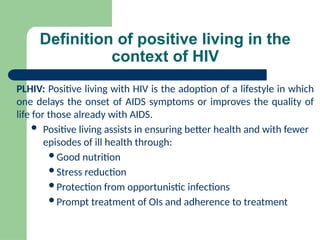
PLHIV: Positive living with HIV is the adoption of a lifestyle in which
one delays the onset of AIDS symptoms or improves the quality of
life for those already with AIDS.
Positive living assists in ensuring better health and with fewer
episodes of ill health through:
Good nutrition
Stress reduction
Protection from opportunistic infections
Prompt treatment of OIs and adherence to treatment
10.
Definition of positiveliving in the
context of HIV (2)
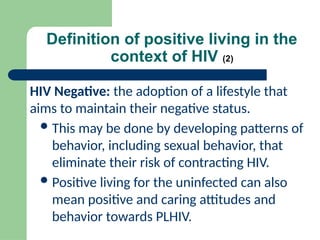
HIV Negative: the adoption of a lifestyle that
aims to maintain their negative status.
This may be done by developing patterns of
behavior, including sexual behavior, that
eliminate their risk of contracting HIV.
Positive living for the uninfected can also
mean positive and caring attitudes and
behavior towards PLHIV.
11.
Perspectives of “PositiveLiving” in the
context of HIV (3)
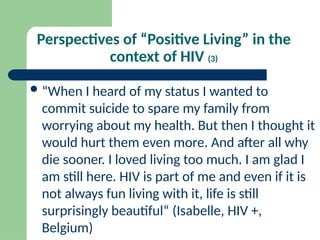
“When I heard of my status I wanted to
commit suicide to spare my family from
worrying about my health. But then I thought it
would hurt them even more. And after all why
die sooner. I loved living too much. I am glad I
am still here. HIV is part of me and even if it is
not always fun living with it, life is still
surprisingly beautiful“ (Isabelle, HIV +,
Belgium)
12.
Components of positiveliving in the
context of HIV
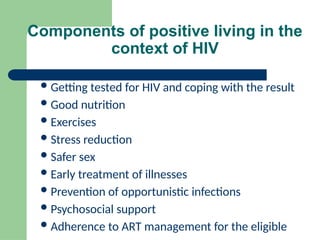
Getting tested for HIV and coping with the result
Good nutrition
Exercises
Stress reduction
Safer sex
Early treatment of illnesses
Prevention of opportunistic infections
Psychosocial support
Adherence to ART management for the eligible
13.
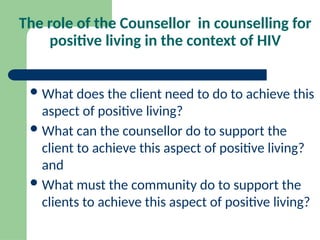
The role ofthe Counsellor in counselling for
positive living in the context of HIV
What does the client need to do to achieve this
aspect of positive living?
What can the counsellor do to support the
client to achieve this aspect of positive living?
and
What must the community do to support the
clients to achieve this aspect of positive living?
14.
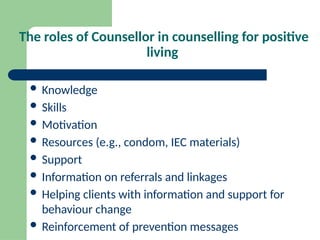
The roles ofCounsellor in counselling for positive
living
Knowledge
Skills
Motivation
Resources (e.g., condom, IEC materials)
Support
Information on referrals and linkages
Helping clients with information and support for
behaviour change
Reinforcement of prevention messages
Resources
Clients must havethe necessary resources
and materials to carry out the Counsellor’s
recommendations.
19.
Support
Clients must receivethe necessary support
(whether emotional, social, or financial) to
carry out the Counsellor’s
recommendations.
20.
Helping clients withinformation and
support for behaviour change
Counsellors should address lack of knowledge,
denial, misinformation.
Clients will need to make a plan for action.
Clients will need praise and encouragement.
Clients may not always be successful at
following recommendations at first.
21.
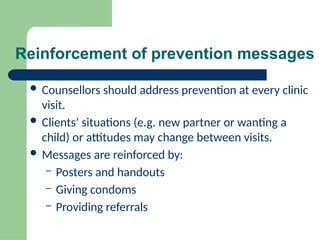
Reinforcement of preventionmessages
Counsellors should address prevention at every clinic
visit.
Clients’ situations (e.g. new partner or wanting a
child) or attitudes may change between visits.
Messages are reinforced by:
– Posters and handouts
– Giving condoms
– Providing referrals
22.
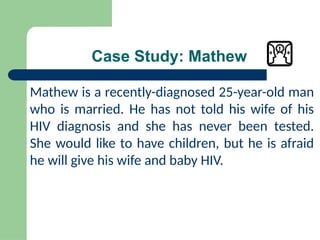
Case Study: Mathew
Mathewis a recently-diagnosed 25-year-old man
who is married. He has not told his wife of his
HIV diagnosis and she has never been tested.
She would like to have children, but he is afraid
he will give his wife and baby HIV.
23.
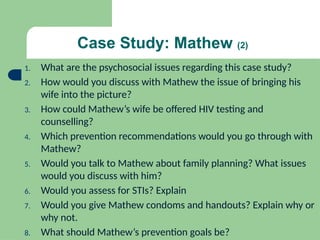
Case Study: Mathew(2)
1. What are the psychosocial issues regarding this case study?
2. How would you discuss with Mathew the issue of bringing his
wife into the picture?
3. How could Mathew’s wife be offered HIV testing and
counselling?
4. Which prevention recommendations would you go through with
Mathew?
5. Would you talk to Mathew about family planning? What issues
would you discuss with him?
6. Would you assess for STIs? Explain
7. Would you give Mathew condoms and handouts? Explain why or
why not.
8. What should Mathew’s prevention goals be?
24.
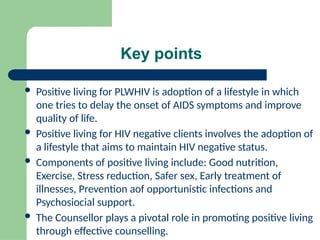
Key points
Positiveliving for PLWHIV is adoption of a lifestyle in which
one tries to delay the onset of AIDS symptoms and improve
quality of life.
Positive living for HIV negative clients involves the adoption of
a lifestyle that aims to maintain HIV negative status.
Components of positive living include: Good nutrition,
Exercise, Stress reduction, Safer sex, Early treatment of
illnesses, Prevention aof opportunistic infections and
Psychosiocial support.
The Counsellor plays a pivotal role in promoting positive living
through effective counselling.
25.
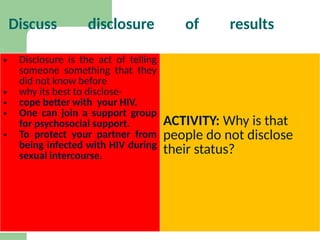
Discuss disclosure ofresults
.
• Disclosure is the act of telling
someone something that they
did not know before
• why its best to disclose-
• cope better with your HIV.
• One can join a support group
for psychosocial support.
• To protect your partner from
being infected with HIV during
sexual intercourse.
ACTIVITY: Why is that
people do not disclose
their status?
26.
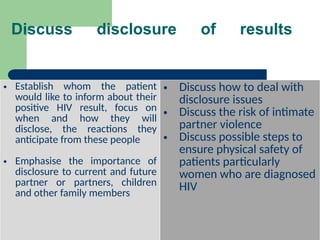
Discuss disclosure ofresults
.
• Establish whom the patient
would like to inform about their
positive HIV result, focus on
when and how they will
disclose, the reactions they
anticipate from these people
• Emphasise the importance of
disclosure to current and future
partner or partners, children
and other family members
• Discuss how to deal with
disclosure issues
• Discuss the risk of intimate
partner violence
• Discuss possible steps to
ensure physical safety of
patients particularly
women who are diagnosed
HIV
27.
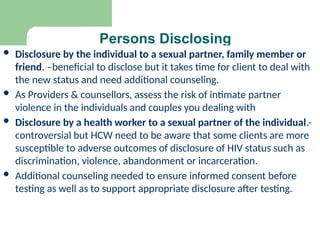
Persons Disclosing
Disclosureby the individual to a sexual partner, family member or
friend. –beneficial to disclose but it takes time for client to deal with
the new status and need additional counseling.
As Providers & counsellors, assess the risk of intimate partner
violence in the individuals and couples you dealing with
Disclosure by a health worker to a sexual partner of the individual.-
controversial but HCW need to be aware that some clients are more
susceptible to adverse outcomes of disclosure of HIV status such as
discrimination, violence, abandonment or incarceration.
Additional counseling needed to ensure informed consent before
testing as well as to support appropriate disclosure after testing.
28.
Persons disclosing…continued
Disclosureby a health worker to other health
workers involved in the client’s care- Providers need
to inform people who test positive that in order to
assure appropriate medical care, the diagnosis will be
shared with other medical workers as needed.
This disclosure should respect the basic client right to



![Living in an era of HIV jc03-16 [441212]](https://cdn.slidesharecdn.com/ss_thumbnails/961d9cce-7a2d-4bca-a907-2b9ade8d8a17-160309060819-thumbnail.jpg?width=640&height=640&fit=bounds)


