1
Statistics, Practice Test 1
Intro to Stats, Summarizing, Describing & Comparing Data
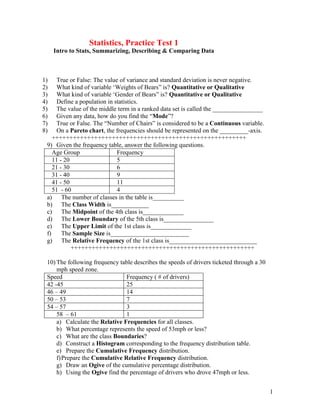
1) True or False: The value of variance and standard deviation is never negative.
2) What kind of variable ‘Weights of Bears” is? Quantitative or Qualitative
3) What kind of variable ‘Gender of Bears” is? Quantitative or Qualitative
4) Define a population in statistics.
5) The value of the middle term in a ranked data set is called the ________________
6) Given any data, how do you find the “Mode”?
7) True or False. The “Number of Chairs” is considered to be a Continuous variable.
8) On a Pareto chart, the frequencies should be represented on the _________-axis.
+++++++++++++++++++++++++++++++++++++++++++++++++++++++
9) Given the frequency table, answer the following questions.
Age Group Frequency
11 - 20 5
21 - 30 6
31 - 40 9
41 - 50 11
51 - 60 4
a) The number of classes in the table is__________
b) The Class Width is____________
c) The Midpoint of the 4th class is_____________
d) The Lower Boundary of the 5th class is________________
e) The Upper Limit of the 1st class is_____________
f) The Sample Size is_________________________
g) The Relative Frequency of the 1st class is____________________________
++++++++++++++++++++++++++++++++++++++++++++++++++++
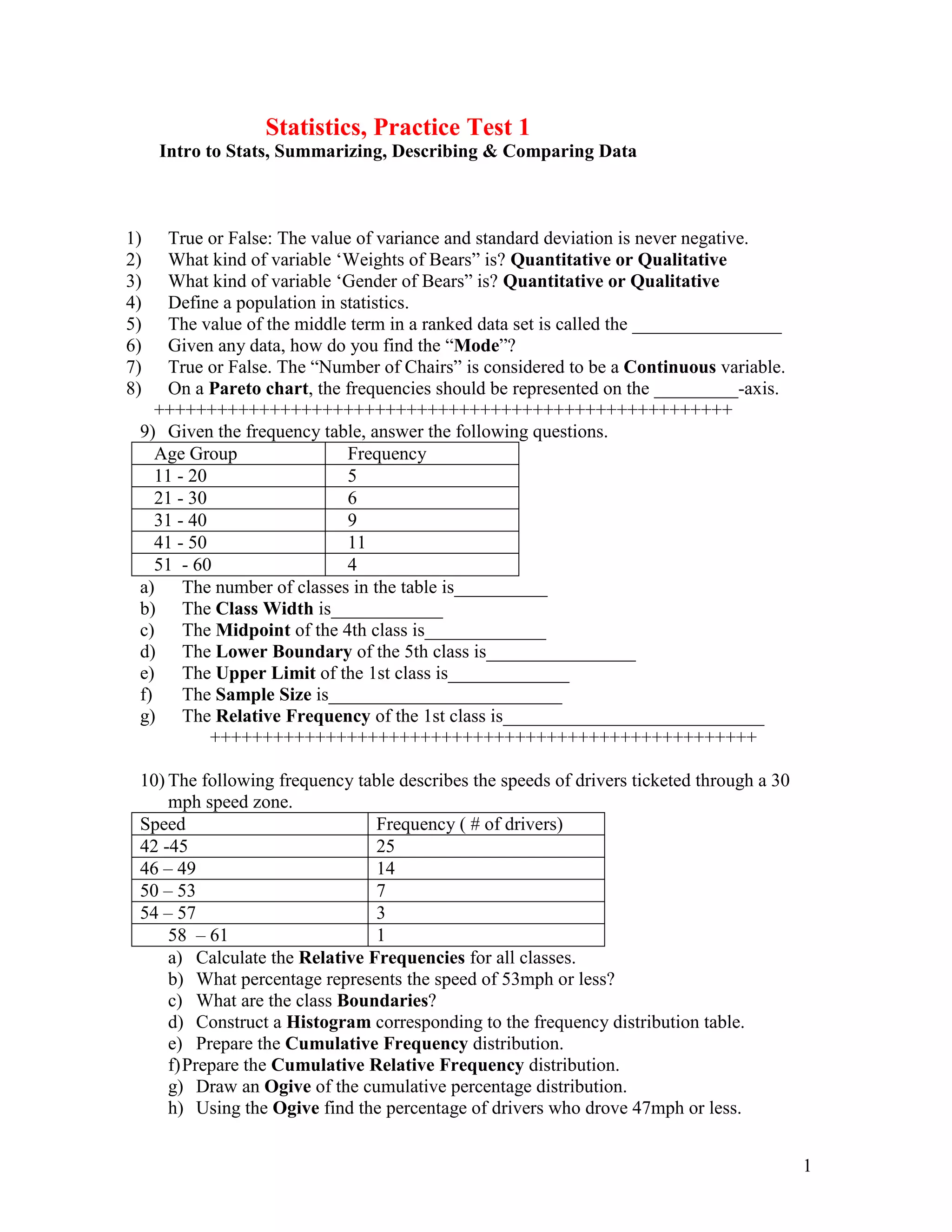
10) The following frequency table describes the speeds of drivers ticketed through a 30
mph speed zone.
Speed Frequency ( # of drivers)
42 -45 25
46 – 49 14
50 – 53 7
54 – 57 3
58 – 61 1
a) Calculate the Relative Frequencies for all classes.
b) What percentage represents the speed of 53mph or less?
c) What are the class Boundaries?
d) Construct a Histogram corresponding to the frequency distribution table.
e) Prepare the Cumulative Frequency distribution.
f)Prepare the Cumulative Relative Frequency distribution.
g) Draw an Ogive of the cumulative percentage distribution.
h) Using the Ogive find the percentage of drivers who drove 47mph or less.
2
+++++++++++++++++++++++++++++++++++++++++++++++++++++++
11) The following data gives the number of hours that a few employees at the GM factory
worked last week. 17, 38, 27, 14, 18, 34, 16, 42, 28, 24, 40, 20, 23, 31, 37, 21, 30, 25.
a) Find the mean
b) Find the Mode.
c) Find the Median.
d) Find the Midrange.
e) Find the Range.
f) Find the Variance
g) Find the Standard Deviation.
h) Find the Interquartile Range (IQR).
+++++++++++++++++++++++++++++++++++++++++++++++++++++++++++
12) I Q scores have a mean of 100 and a standard deviation of 15.
a) Find the Coefficient of Variance.
b) Use the Range Rule of Thumb to estimate the minimum and maximum ''Usual'' I
Q scores.
c) Using Chebyshev's Theorem, find what is the least percentage of those who will
have an I Q score of 70 to 130.
d) Using the Empirical Rule find the percentage of those who will have an I Q
score of 70 to 130.
13) Define a Parameter and a Statistic.
14) Define Random Sample and Simple Random Sample.
15) Define the following types of sampling: Systematic, Convenience, Stratified and
Cluster.
16) What are different Levels of Measurement of Data? Give examples.
17) What’s the difference between an Observational Study and an Experiment? Give
examples.
18) Given the following set of data: 32, 19, 14, 7, 15, 3, 4, 5, 9, 16, 15, 16, 19, , 50
a) Rank the data from smallest to largest.
b) Prepare a box-and-whisker plot. [Box plot]
c) Does this data set contain any outliers? [Make sure to show the lower and the upper
fences on your graph]
d) Are the data symmetric or skewed? [If skewed, are they skewed left or right?]
19) Draw the box-and-whisker plot for the following data set:
77, 79, 80, 86, 87, 87, 94, 99
3
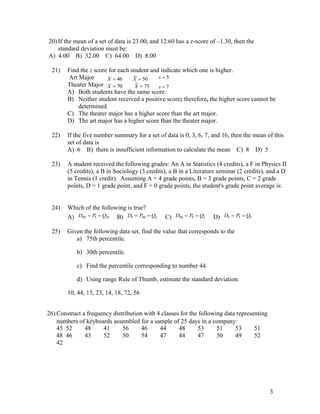
20) If the mean of a set of data is 23.00, and 12.60 has a z-score of –1.30, then the
standard deviation must be:
A) 4.00 B) 32.00 C) 64.00 D) 8.00
21) Find the z score for each student and indicate which one is higher.
Art Major X  46 X  50 s  5
Theater Major X  70 X  75 s  7
A) Both students have the same score.
B) Neither student received a positive score; therefore, the higher score cannot be
determined.
C) The theater major has a higher score than the art major.
D) The art major has a higher score than the theater major.
22) If the five number summary for a set of data is 0, 3, 6, 7, and 16, then the mean of this
set of data is
A) 6 B) there is insufficient information to calculate the mean C) 8 D) 5
23) A student received the following grades: An A in Statistics (4 credits), a F in Physics II
(5 credits), a B in Sociology (3 credits), a B in a Literature seminar (2 credits), and a D
in Tennis (1 credit). Assuming A = 4 grade points, B = 3 grade points, C = 2 grade
points, D = 1 grade point, and F = 0 grade points, the student's grade point average is:
24) Which of the following is true?
A) D P Q50 5 25  B) D P Q5 50 2  C) D P Q50 5 2  D) D P Q5 5 5 
25) Given the following data set, find the value that corresponds to the
a) 75th percentile.
b) 30th percentile.
c) Find the percentile corresponding to number 44.
d) Using range Rule of Thumb, estimate the standard deviation.
10, 44, 15, 23, 14, 18, 72, 56
26) Construct a frequency distribution with 4 classes for the following data representing
numbers of keyboards assembled for a sample of 25 days in a company:
45 52 48 41 56 46 44 48 53 51 53 51
48 46 43 52 50 54 47 44 47 50 49 52
42

Practive test 1

  • 1.
    1 Statistics, Practice Test1 Intro to Stats, Summarizing, Describing & Comparing Data 1) True or False: The value of variance and standard deviation is never negative. 2) What kind of variable ‘Weights of Bears” is? Quantitative or Qualitative 3) What kind of variable ‘Gender of Bears” is? Quantitative or Qualitative 4) Define a population in statistics. 5) The value of the middle term in a ranked data set is called the ________________ 6) Given any data, how do you find the “Mode”? 7) True or False. The “Number of Chairs” is considered to be a Continuous variable. 8) On a Pareto chart, the frequencies should be represented on the _________-axis. +++++++++++++++++++++++++++++++++++++++++++++++++++++++ 9) Given the frequency table, answer the following questions. Age Group Frequency 11 - 20 5 21 - 30 6 31 - 40 9 41 - 50 11 51 - 60 4 a) The number of classes in the table is__________ b) The Class Width is____________ c) The Midpoint of the 4th class is_____________ d) The Lower Boundary of the 5th class is________________ e) The Upper Limit of the 1st class is_____________ f) The Sample Size is_________________________ g) The Relative Frequency of the 1st class is____________________________ ++++++++++++++++++++++++++++++++++++++++++++++++++++ 10) The following frequency table describes the speeds of drivers ticketed through a 30 mph speed zone. Speed Frequency ( # of drivers) 42 -45 25 46 – 49 14 50 – 53 7 54 – 57 3 58 – 61 1 a) Calculate the Relative Frequencies for all classes. b) What percentage represents the speed of 53mph or less? c) What are the class Boundaries? d) Construct a Histogram corresponding to the frequency distribution table. e) Prepare the Cumulative Frequency distribution. f)Prepare the Cumulative Relative Frequency distribution. g) Draw an Ogive of the cumulative percentage distribution. h) Using the Ogive find the percentage of drivers who drove 47mph or less.
  • 2.
    2 +++++++++++++++++++++++++++++++++++++++++++++++++++++++ 11) The followingdata gives the number of hours that a few employees at the GM factory worked last week. 17, 38, 27, 14, 18, 34, 16, 42, 28, 24, 40, 20, 23, 31, 37, 21, 30, 25. a) Find the mean b) Find the Mode. c) Find the Median. d) Find the Midrange. e) Find the Range. f) Find the Variance g) Find the Standard Deviation. h) Find the Interquartile Range (IQR). +++++++++++++++++++++++++++++++++++++++++++++++++++++++++++ 12) I Q scores have a mean of 100 and a standard deviation of 15. a) Find the Coefficient of Variance. b) Use the Range Rule of Thumb to estimate the minimum and maximum ''Usual'' I Q scores. c) Using Chebyshev's Theorem, find what is the least percentage of those who will have an I Q score of 70 to 130. d) Using the Empirical Rule find the percentage of those who will have an I Q score of 70 to 130. 13) Define a Parameter and a Statistic. 14) Define Random Sample and Simple Random Sample. 15) Define the following types of sampling: Systematic, Convenience, Stratified and Cluster. 16) What are different Levels of Measurement of Data? Give examples. 17) What’s the difference between an Observational Study and an Experiment? Give examples. 18) Given the following set of data: 32, 19, 14, 7, 15, 3, 4, 5, 9, 16, 15, 16, 19, , 50 a) Rank the data from smallest to largest. b) Prepare a box-and-whisker plot. [Box plot] c) Does this data set contain any outliers? [Make sure to show the lower and the upper fences on your graph] d) Are the data symmetric or skewed? [If skewed, are they skewed left or right?] 19) Draw the box-and-whisker plot for the following data set: 77, 79, 80, 86, 87, 87, 94, 99
  • 3.
    3 20) If themean of a set of data is 23.00, and 12.60 has a z-score of –1.30, then the standard deviation must be: A) 4.00 B) 32.00 C) 64.00 D) 8.00 21) Find the z score for each student and indicate which one is higher. Art Major X  46 X  50 s  5 Theater Major X  70 X  75 s  7 A) Both students have the same score. B) Neither student received a positive score; therefore, the higher score cannot be determined. C) The theater major has a higher score than the art major. D) The art major has a higher score than the theater major. 22) If the five number summary for a set of data is 0, 3, 6, 7, and 16, then the mean of this set of data is A) 6 B) there is insufficient information to calculate the mean C) 8 D) 5 23) A student received the following grades: An A in Statistics (4 credits), a F in Physics II (5 credits), a B in Sociology (3 credits), a B in a Literature seminar (2 credits), and a D in Tennis (1 credit). Assuming A = 4 grade points, B = 3 grade points, C = 2 grade points, D = 1 grade point, and F = 0 grade points, the student's grade point average is: 24) Which of the following is true? A) D P Q50 5 25  B) D P Q5 50 2  C) D P Q50 5 2  D) D P Q5 5 5  25) Given the following data set, find the value that corresponds to the a) 75th percentile. b) 30th percentile. c) Find the percentile corresponding to number 44. d) Using range Rule of Thumb, estimate the standard deviation. 10, 44, 15, 23, 14, 18, 72, 56 26) Construct a frequency distribution with 4 classes for the following data representing numbers of keyboards assembled for a sample of 25 days in a company: 45 52 48 41 56 46 44 48 53 51 53 51 48 46 43 52 50 54 47 44 47 50 49 52 42