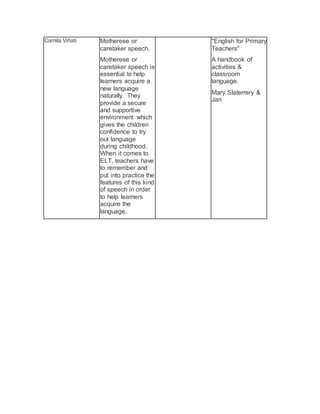
Camila Viñati Motherese or
caretaker speech.
Motherese or
caretaker speech is
essential to help
learners acquire a
new language
naturally. They
provide a secure
and supportive
environment which
gives the children
confidence to try
out language
during childhood.
When it comes to
ELT, teachers have
to remember and
put into practice the
features of this kind
of speech in order
to help learners
acquire the
language.
"English for Primary
Teachers"
A handbook of
activities &
classroom
language.
Mary Slaterrery &
Jan
Camila Viñati Behaviorism.
Behaviourism had a strong
influence on the audio-
lingual approach,which can still
be seen in some parts of the
worls. Behaviourists believe
that imitationand practice or habit
formation are key processes in
language development.
Children imitate to acquire
language, and this is possible
thanks to envirinment and
constant positive reinforcement.
As a result, children continue to
imitate and practice to form
proper habits, communicate,
shape language behavior.
Also, children go through two
main processes: IMITATION
"word-for-word repetition of all or
part of someone else's
utterance", PRACTICE "based
on repetitive manipulation of
form".
After new elements become
solid, children imitate new ones,
and apply previous ones to new
environments.
There are many examples that
show how these processes are
developed through language:
* patterns in language
*unfamiliar formulas
*question formation
*order of events
As a conclusion, children who
imitate less acquire language
faster than those who imitate a
lot. Behaviorism cannot explain
the acquisition of more complex
grammar that children acquire.
B.F.Skinner "The Primary
English
Teacher´s
Guide"
New Edition
Jean Brewster
and Gail Ellis
with Denis
Girard
"How Language
are Learned"
 Patsy M.
Lightbown-
Nina Spada
PRACTICAL 8

PRACTICAL 8

  • 1.
    Camila Viñati Mothereseor caretaker speech. Motherese or caretaker speech is essential to help learners acquire a new language naturally. They provide a secure and supportive environment which gives the children confidence to try out language during childhood. When it comes to ELT, teachers have to remember and put into practice the features of this kind of speech in order to help learners acquire the language. "English for Primary Teachers" A handbook of activities & classroom language. Mary Slaterrery & Jan
  • 2.
    Camila Viñati Behaviorism. Behaviourismhad a strong influence on the audio- lingual approach,which can still be seen in some parts of the worls. Behaviourists believe that imitationand practice or habit formation are key processes in language development. Children imitate to acquire language, and this is possible thanks to envirinment and constant positive reinforcement. As a result, children continue to imitate and practice to form proper habits, communicate, shape language behavior. Also, children go through two main processes: IMITATION "word-for-word repetition of all or part of someone else's utterance", PRACTICE "based on repetitive manipulation of form". After new elements become solid, children imitate new ones, and apply previous ones to new environments. There are many examples that show how these processes are developed through language: * patterns in language *unfamiliar formulas *question formation *order of events As a conclusion, children who imitate less acquire language faster than those who imitate a lot. Behaviorism cannot explain the acquisition of more complex grammar that children acquire. B.F.Skinner "The Primary English Teacher´s Guide" New Edition Jean Brewster and Gail Ellis with Denis Girard "How Language are Learned"  Patsy M. Lightbown- Nina Spada