Date: 23th
October
School: School N°6 Ricardo Gutierrez
Teacher in charge: Ana Gomez Garcia
Trainees:Viñati Camila, Escudero Belén
Courses: 4th
D and 4th
C.
Timetable Fit: Tuesday 4th
D (13:15-14:00) 4th
C (14:05-15:50)
Course Book: “Follow your trail 1”
Topic: My favourite things (unit 3)
CLIL PROJECT:How can we have a healthy body?
Aims
 Revision of vocabulary learned in the previous class(parts of the body)
 Teach new vocabulary related with healthy and unhealthy habits
 Recognize and make a relation between parts of the body and healthy/unhealthy
habits
Content
 A healthy body
ROUTINES:
“Hello song” and the date on the green board.
WARM UP:
We will start the lesson by singing the “Hello” song and then write the date on the
green board. After that we will start with the activities.
ACTIVITY 1: Extra activity about CLIL
Type of interaction: Students-trainees.
Macro-skills: Listening and speaking.
Timing: 20 minutes.
Materials: Flashcards and poster.
DEVELOPMENT
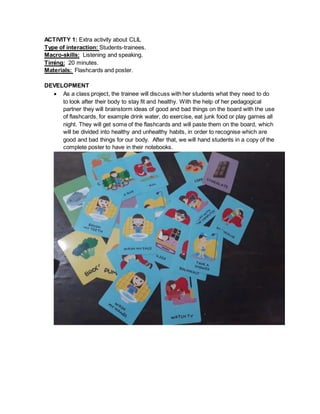
 As a class project, the trainee will discuss with her students what they need to do
to look after their body to stay fit and healthy. With the help of her pedagogical
partner they will brainstorm ideas of good and bad things on the board with the use
of flashcards, for example drink water, do exercise, eat junk food or play games all
night. They will get some of the flashcards and will paste them on the board, which
will be divided into healthy and unhealthy habits, in order to recognise which are
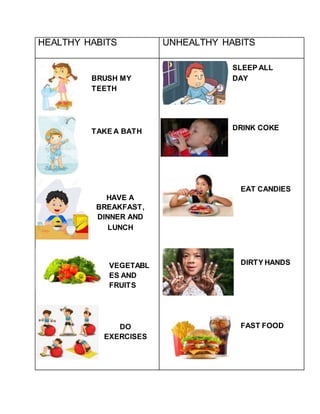
good and bad things for our body. After that, we will hand students in a copy of the
complete poster to have in their notebooks.
HEALTHY HABITS UNHEALTHY HABITS
BRUSH MY
TEETH
TAKE A BATH
HAVE A
BREAKFAST,
DINNER AND
LUNCH
VEGETABL
ES AND
FRUITS
DO
EXERCISES
SLEEP ALL
DAY
DRINK COKE
EAT CANDIES
DIRTY HANDS
FAST FOOD
ACTIVITY 2: Extra activity about CLIL
Type of interaction: Students-trainees.
Macro-skills: Writing.
Timing: 15 minutes.
Materials: A piece of paper.
DEVELOPMENT
 The trainee will give students and extra activity where they have to recognize
healthy and unhealthy habits and complete with the first letter. Then, they have to
number the images with the corresponding sentences.
 Say which habit is healthy (h) and which unhealthy (u), and then they have to put
the corresponding number in each pictures.
1) BRUSH MY TEETH------
2) DRINK COKE-------
3) HAVE BREAKFAST-------
4) SPEND A LOT OF TIME IN FRONT OF THE SCREEN-------
5) TAKE A BATH-------
6) DO EXERCISES-------
7) SLEEP ALL DAY-----
8) EAT CANDIES------
9) DIRTY HANDS------
ACTIVITY 3: Extra activity about CLIL
Type of interaction: Students-trainees.
Macro-skills: Writing.
Timing: 20 minutes.
Materials: A piece of paper.
DEVELOPMENT
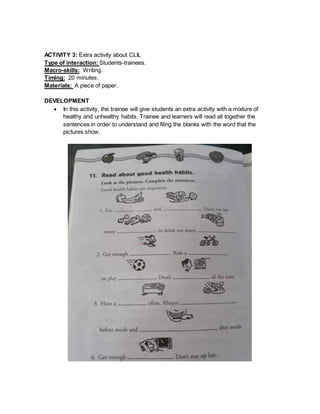
 In this activity, the trainee will give students an extra activity with a mixture of
healthy and unhealthy habits. Trainee and learners will read all together the
sentences in order to understand and filing the blanks with the word that the
pictures show.
ACTIVITY 4: Extra activity about CLIL
Type of interaction: Students-trainees.
Macro-skills: Listening.
Timing: 30 minutes.
Materials: Rug.
DEVELOPMENT
 The trainee will introduce an extra activity, a game which includes 5 colourful rugs
with different big circles on it and each circle will have a colour with pictures that
represent a good or a bad habit, healthy or unhealthy food or drinks. The game
consists of organising children in five groups of five members and each group will
have a rug; also the teacher will give them a number, from 1 to 5 to each member
of the group. After that, the trainee in charge will give them some orders to do
something, for example: “numbers 2 put one leg on a healthy food” and all children
with the number 2 in their chest will have to put their leg in the circle with the
picture that represent the healthy food.
The orders that trainee will provide them will consist on revise all the new
vocabulary, “Parts of the body” learned in the previous class, to put into practice
with the CLIL project related to “healthy and unhealthy habits”. The idea is that
children could recognize with their bodies their daily life routines in order to
separate them into good or bad habits.
“Twister Game”
1. Number three put your hands on a healthy food.
2. Number five put your right foot on an unhealthy habit.
3. Number one put your fingers on a healthy habit.
4. Number two put the head on an unhealthy food.
5. Number four put one knee on a healthy drink.
 The first group who stay for one minute in their position will be a winner of the
game.
 As this class will be the last one, the teacher in charge will give them a gift.
IMAGES
Lesson plan 8 clil project

Lesson plan 8 clil project

  • 1.
    Date: 23th October School: SchoolN°6 Ricardo Gutierrez Teacher in charge: Ana Gomez Garcia Trainees:Viñati Camila, Escudero Belén Courses: 4th D and 4th C. Timetable Fit: Tuesday 4th D (13:15-14:00) 4th C (14:05-15:50) Course Book: “Follow your trail 1” Topic: My favourite things (unit 3) CLIL PROJECT:How can we have a healthy body? Aims  Revision of vocabulary learned in the previous class(parts of the body)  Teach new vocabulary related with healthy and unhealthy habits  Recognize and make a relation between parts of the body and healthy/unhealthy habits Content  A healthy body ROUTINES: “Hello song” and the date on the green board. WARM UP: We will start the lesson by singing the “Hello” song and then write the date on the green board. After that we will start with the activities.
  • 2.
    ACTIVITY 1: Extraactivity about CLIL Type of interaction: Students-trainees. Macro-skills: Listening and speaking. Timing: 20 minutes. Materials: Flashcards and poster. DEVELOPMENT  As a class project, the trainee will discuss with her students what they need to do to look after their body to stay fit and healthy. With the help of her pedagogical partner they will brainstorm ideas of good and bad things on the board with the use of flashcards, for example drink water, do exercise, eat junk food or play games all night. They will get some of the flashcards and will paste them on the board, which will be divided into healthy and unhealthy habits, in order to recognise which are good and bad things for our body. After that, we will hand students in a copy of the complete poster to have in their notebooks.
  • 3.
    HEALTHY HABITS UNHEALTHYHABITS BRUSH MY TEETH TAKE A BATH HAVE A BREAKFAST, DINNER AND LUNCH VEGETABL ES AND FRUITS DO EXERCISES SLEEP ALL DAY DRINK COKE EAT CANDIES DIRTY HANDS FAST FOOD
  • 4.
    ACTIVITY 2: Extraactivity about CLIL Type of interaction: Students-trainees. Macro-skills: Writing. Timing: 15 minutes. Materials: A piece of paper. DEVELOPMENT  The trainee will give students and extra activity where they have to recognize healthy and unhealthy habits and complete with the first letter. Then, they have to number the images with the corresponding sentences.
  • 5.
     Say whichhabit is healthy (h) and which unhealthy (u), and then they have to put the corresponding number in each pictures. 1) BRUSH MY TEETH------ 2) DRINK COKE------- 3) HAVE BREAKFAST------- 4) SPEND A LOT OF TIME IN FRONT OF THE SCREEN------- 5) TAKE A BATH------- 6) DO EXERCISES------- 7) SLEEP ALL DAY----- 8) EAT CANDIES------ 9) DIRTY HANDS------
  • 6.
    ACTIVITY 3: Extraactivity about CLIL Type of interaction: Students-trainees. Macro-skills: Writing. Timing: 20 minutes. Materials: A piece of paper. DEVELOPMENT  In this activity, the trainee will give students an extra activity with a mixture of healthy and unhealthy habits. Trainee and learners will read all together the sentences in order to understand and filing the blanks with the word that the pictures show.
  • 7.
    ACTIVITY 4: Extraactivity about CLIL Type of interaction: Students-trainees. Macro-skills: Listening. Timing: 30 minutes. Materials: Rug. DEVELOPMENT  The trainee will introduce an extra activity, a game which includes 5 colourful rugs with different big circles on it and each circle will have a colour with pictures that represent a good or a bad habit, healthy or unhealthy food or drinks. The game consists of organising children in five groups of five members and each group will have a rug; also the teacher will give them a number, from 1 to 5 to each member of the group. After that, the trainee in charge will give them some orders to do something, for example: “numbers 2 put one leg on a healthy food” and all children with the number 2 in their chest will have to put their leg in the circle with the picture that represent the healthy food. The orders that trainee will provide them will consist on revise all the new vocabulary, “Parts of the body” learned in the previous class, to put into practice with the CLIL project related to “healthy and unhealthy habits”. The idea is that children could recognize with their bodies their daily life routines in order to separate them into good or bad habits. “Twister Game” 1. Number three put your hands on a healthy food. 2. Number five put your right foot on an unhealthy habit. 3. Number one put your fingers on a healthy habit. 4. Number two put the head on an unhealthy food. 5. Number four put one knee on a healthy drink.  The first group who stay for one minute in their position will be a winner of the game.  As this class will be the last one, the teacher in charge will give them a gift.
  • 8.