What?
How?
Why?
Make it your Own!
Children with limited verbal skills can be supported with the strategies featured in Easy
Guides: Oral language for beginners. The following methods for promoting oral language for
students at the beginning stages include: Description/Self-talk, Narration/Parallel talk,
Modeling language, Repetition, and Extension.
Families can create opportunities to build beginning oral language skills by incorporating self
talk, parallel talk, language modeling, repetition, and extension into the daily routine. The Easy
Guide: Oral language for beginners can be used as a reminder to use these strategies on a
daily basis, especially with children who need support in the beginning stages of language
learning.
The language that children learn depends on the language learning opportunities provided.
Speaking and listening skills learned in the preschool years are essential to future reading and
writing achievement and school success. By providing and modeling rich language input for
children, labeling words and actions in natural contexts, conveying a message of interest
through narration of the child’s actions and repetitions and extensions of the child’s limited
language, families pave the way for more advanced language learning.
For families
Building on your child’s interests forms the basis of strategies like parallel talk,
repetition, and extension. Remember that you are most likely to build your child’s
language when focusing on a topic that is meaningful to him or her. You may choose
to use gestures or point to objects that represent words to aid understanding.
Oral Language
Communication Toolkit
Oral language for beginners
www.simplifiedstrategies.org
SimplifiedStrategies
OralLanguage
Orallanguageforbeginners
CommunicationToolkit
SimplifiedStrategies,LLC-www.simplifiedstrategies.org Strategies
Repetition Extension
Description/Self-talk Narration/Paralleltalk
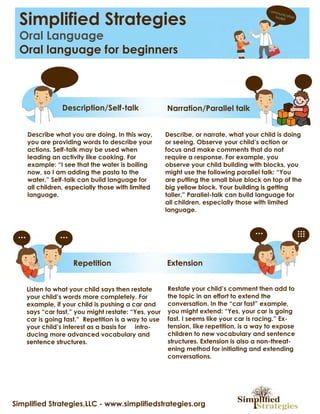
Listentowhatyourchildsaysthenrestate
yourchild’swordsmorecompletely.For
example,ifyourchildispushingacarand
says“carfast,”youmightrestate:“Yes,your
carisgoingfast.”Repetitionisawaytouse
yourchild’sinterestasabasisfor intro-
ducingmoreadvancedvocabularyand
sentencestructures.sentencestructures.
Restateyourchild’scommentthenaddto
thetopicinanefforttoextendthe
conversation.Inthe“carfast”example,
youmightextend:“Yes,yourcarisgoing
fast.Iseemslikeyourcarisracing.”Ex-
tension,likerepetition,isawaytoexpose
childrentonewvocabularyandsentence
structures.Extensionisalsoanon-threatstructures.Extensionisalsoanon-threat-
eningmethodforinitiatingandextending
conversations.
Describewhatyouaredoing.Inthisway,
youareprovidingwordstodescribeyour
actions.Self-talkmaybeusedwhen
leadinganactivitylikecooking.For
example:“Iseethatthewaterisboiling
now,soIam addingthepastatothe
water.”Self-talkcanbuildlanguagefor
allchildren,especiallythosewithlimitedallchildren,especiallythosewithlimited
language.
Describe,ornarrate,whatyourchildisdoing
orseeing.Observeyourchild’sactionor
focusandmakecommentsthatdonot
requirearesponse.Forexample,you
observeyourchildbuildingwithblocks,you
mightusethefollowingparalleltalk:“You
areputtingthesmallblueblockontopofthe
bigyellowblock.Yourbuildingisgettingbigyellowblock.Yourbuildingisgetting
taller.”Parallel-talkcanbuildlanguagefor
allchildren,especiallythosewithlimited
language.
...... ...
.........

Oral Language for Beginners

  • 1.
    What? How? Why? Make it yourOwn! Children with limited verbal skills can be supported with the strategies featured in Easy Guides: Oral language for beginners. The following methods for promoting oral language for students at the beginning stages include: Description/Self-talk, Narration/Parallel talk, Modeling language, Repetition, and Extension. Families can create opportunities to build beginning oral language skills by incorporating self talk, parallel talk, language modeling, repetition, and extension into the daily routine. The Easy Guide: Oral language for beginners can be used as a reminder to use these strategies on a daily basis, especially with children who need support in the beginning stages of language learning. The language that children learn depends on the language learning opportunities provided. Speaking and listening skills learned in the preschool years are essential to future reading and writing achievement and school success. By providing and modeling rich language input for children, labeling words and actions in natural contexts, conveying a message of interest through narration of the child’s actions and repetitions and extensions of the child’s limited language, families pave the way for more advanced language learning. For families Building on your child’s interests forms the basis of strategies like parallel talk, repetition, and extension. Remember that you are most likely to build your child’s language when focusing on a topic that is meaningful to him or her. You may choose to use gestures or point to objects that represent words to aid understanding. Oral Language Communication Toolkit Oral language for beginners www.simplifiedstrategies.org
  • 2.
    SimplifiedStrategies OralLanguage Orallanguageforbeginners CommunicationToolkit SimplifiedStrategies,LLC-www.simplifiedstrategies.org Strategies Repetition Extension Description/Self-talkNarration/Paralleltalk Listentowhatyourchildsaysthenrestate yourchild’swordsmorecompletely.For example,ifyourchildispushingacarand says“carfast,”youmightrestate:“Yes,your carisgoingfast.”Repetitionisawaytouse yourchild’sinterestasabasisfor intro- ducingmoreadvancedvocabularyand sentencestructures.sentencestructures. Restateyourchild’scommentthenaddto thetopicinanefforttoextendthe conversation.Inthe“carfast”example, youmightextend:“Yes,yourcarisgoing fast.Iseemslikeyourcarisracing.”Ex- tension,likerepetition,isawaytoexpose childrentonewvocabularyandsentence structures.Extensionisalsoanon-threatstructures.Extensionisalsoanon-threat- eningmethodforinitiatingandextending conversations. Describewhatyouaredoing.Inthisway, youareprovidingwordstodescribeyour actions.Self-talkmaybeusedwhen leadinganactivitylikecooking.For example:“Iseethatthewaterisboiling now,soIam addingthepastatothe water.”Self-talkcanbuildlanguagefor allchildren,especiallythosewithlimitedallchildren,especiallythosewithlimited language. Describe,ornarrate,whatyourchildisdoing orseeing.Observeyourchild’sactionor focusandmakecommentsthatdonot requirearesponse.Forexample,you observeyourchildbuildingwithblocks,you mightusethefollowingparalleltalk:“You areputtingthesmallblueblockontopofthe bigyellowblock.Yourbuildingisgettingbigyellowblock.Yourbuildingisgetting taller.”Parallel-talkcanbuildlanguagefor allchildren,especiallythosewithlimited language. ...... ... .........