z
ENGLISH ALS PROJECT
(2023-24)
on the topic
‘MOTHER LANGUAGE’’
by:- Shivani, Nimish, Harshit, Pranjal, Shilesh
Submitted to:- Shweta Gaba
(English teacher)
z
CERTIFICATE
This is to certify that Shivani, Nimish, Pranjal,
Harshit, Shilesh, a students of class XII-B, has
successfully completed the research on the project
‘Mother Language’ under the guidance of
Ms. Shweta Gaba during the session 2023-2024 for
English ALS project. It has been found to be
satisfactory and here by approved for submission.
____________________
_____________________
TEACHER’S SIGN,
EXAMINER’S SIGN.
z Acknowledgement
I would like to express my special thanks of
gratitude to my English teacher, MS.
SHWETA GABA as well as our principal MR.
RAJAN GAUTAM, who gave me this golden
opportunity to do this wonderful project on the
topic ‘Mother Language’, which also helped me
in doing a lot of research of work and I came
to know about opinions of different people on
mother language.
Secondly, I would also like to thank my family
and friends who helped me in finalizing this
1/3/2024
z
S. No. Contents
1 Objective
2 Material required
3 Action plan
4 “Mother Language”-
-Importance
-International
Mother Language Day
- Need to
Preserve it
5 The last lesson
6 The present scenario
7 Questionnaire
8 Report on questionnaire
9 Inference
10 Conclusion
11 Photo Collage
12 Group reflection
13 Bibliography
1/3/2024
z Objective
(a). to enable the learner to communicate
effectively and appropriately in real life situation
(b). to use English effectively for study purpose
across the curriculum.
(c). to develop interest in and appreciation of
Literature
(d). to develop and integrate the use of the four
language skills i.e. Reading, Listening, Speaking
z
z
MATERIAL
REQUIRED
-NCERT Flamingo
book
-Survey using Google
forms
-Questionnaire
1/3/2024
z
Action Plan
1/3/2024
S.no. Date Day Work done
1 21.12.2023 Thursday Selecting type of project and topic, collection of
data, making of questionnaire and sharing it
2 22.12.2023 Friday Inferencing the data from form and concluding,
making the presentation for project
3 23.12.2023 Saturday Writing and adding the reflections and future scope in
the presentation
z
MOTHER LANGUAGE
The mother tongue is the language that we use most freely and
actively in all cases of daily life. The child learns the world
through the natal tongue. This term refers to the language we
hear from our parents, which we are brought up in and which is
common to the people and the place where we were born.
It is the language that a child gets to hear after birth and
helps give a definite shape to our feelings and thoughts.
Learning in the mother tongue is also crucial for improving
other critical thinking skills, second language learning, and
literacy skills.
Since people from different regions have varying mother
languages, that is why many institutions and parents teach a
second language to children so that they can communicate with
more people, without any language barriers. A person might be
able to converse in multiple languages, but if they are spoken
to in their mother language, then a sense of familiarity prevails
1/3/2024
z
To suffice human’s social need for more effective
communication the language was created. The extremely
complex or versatile code, i.e. language, is used to express
our thoughts and experiences to other people. This makes
language a natural phenomenon that is learnt by a human at
an early age for the desire to express themselves to others.
The mother language is an essential aspect in one’s upbringing
as it shapes the way they perceive the world and the way
one expresses themselves to others. Babies tend to imitate
what they see or hear. Infants are fast learners as they
acquire their mother language by imitating their parents. It
is easier for children to learn languages in their growing
years than in comparison to adults learning a new language.
Having a strong grip on one’s mother language also helps in
creating a strong foundation for learning additional
languages. Children are capable of learning languages other
than their native language while they are young by
transferring the different structure of a language to other
languages. If a child learns the grammar of their mother
1/3/2024
z
z
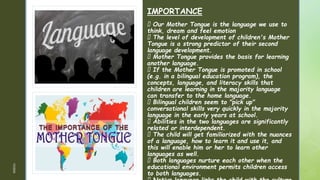
IMPORTANCE
Our Mother Tongue is the language we use to
think, dream and feel emotion
The level of development of children's Mother
Tongue is a strong predictor of their second
language development.
Mother Tongue provides the basis for learning
another language.
If the Mother Tongue is promoted in school
(e.g. in a bilingual education program), the
concepts, language, and literacy skills that
children are learning in the majority language
can transfer to the home language.
Bilingual children seem to "pick up"
conversational skills very quickly in the majority
language in the early years at school.
Abilities in the two languages are significantly
related or interdependent.
The child will get familiarized with the nuances
of a language, how to learn it and use it, and
this will enable him or her to learn other
languages as well.
Both languages nurture each other when the
educational environment permits children access
to both languages.
1/3/2024
z
z
INTERNATIONAL MOTHER
LANGUAGE DAY:-
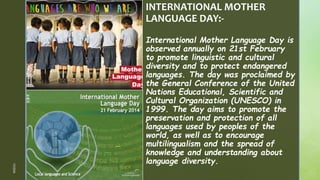
International Mother Language Day is
observed annually on 21st February
to promote linguistic and cultural
diversity and to protect endangered
languages. The day was proclaimed by
the General Conference of the United
Nations Educational, Scientific and
Cultural Organization (UNESCO) in
1999. The day aims to promote the
preservation and protection of all
languages used by peoples of the
world, as well as to encourage
multilingualism and the spread of
knowledge and understanding about
language diversity.
1/3/2024
z
Scientific research has shown that learning a child's mother language can
positively impact her overall cognitive development and academic success. Here
are some key findings that highlight the importance of education in one’s mother
language:
1-Improved cognitive development: Studies have shown that children who learn
in their mother language have better cognitive development and increased
critical thinking skills, compared to those who learn in a foreign language.
2-Improved literacy: Research indicates that children who are taught to read
and write in their mother language are more likely to develop strong literacy
skills and have higher academic achievement, compared to those who are taught
in a second language.
3-Better engagement and motivation: When children are taught in their
mother language, they are more likely to be engaged and motivated in the
learning process. This is because they can understand the material better,
which leads to increased self-esteem and academic confidence.
4-Cultural preservation: Learning in a mother language can help to preserve a
child's cultural heritage and identity. When children can connect with their
culture through language, they are more likely to feel a sense of belonging and
develop a positive self-image.
1/3/2024
z
z
NEED TO PRESERVE
MOTHER TONGUE:-
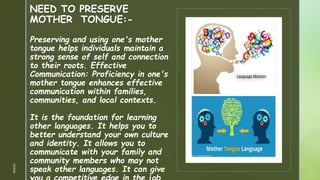
Preserving and using one's mother
tongue helps individuals maintain a
strong sense of self and connection
to their roots. Effective
Communication: Proficiency in one's
mother tongue enhances effective
communication within families,
communities, and local contexts.
It is the foundation for learning
other languages. It helps you to
better understand your own culture
and identity. It allows you to
communicate with your family and
community members who may not
speak other languages. It can give
1/3/2024
z
THE LAST LESSON
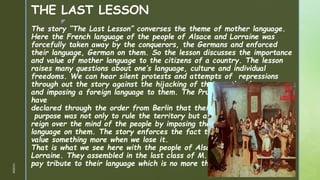
The story “The Last Lesson” converses the theme of mother language.
Here the French language of the people of Alsace and Lorraine was
forcefully taken away by the conquerors, the Germans and enforced
their language, German on them. So the lesson discusses the importance
and value of mother language to the citizens of a country. The lesson
raises many questions about one’s language, culture and individual
freedoms. We can hear silent protests and attempts of repressions
through out the story against the hijacking of their mother language
and imposing a foreign language to them. The Prussians in the story
have
declared through the order from Berlin that their whole
purpose was not only to rule the territory but also to
reign over the mind of the people by imposing their
language on them. The story enforces the fact that we
value something more when we lose it.
That is what we see here with the people of Alsace and
Lorraine. They assembled in the last class of M. Hamel to
pay tribute to their language which is no more theirs.
1/3/2024
z
Present scenario in our life
The present situation existing around us is something like
what has been discussed in the story. The mother
tongue of ours is getting forgotten even at the primary
stage of our education then no need of thinking about
the higher education sectors. Even though human brain is
capable of learning multiple languages, our educational
system ignores to extend the due respect to our own
mother tongues.
The language imposed on us through educational medium,
technology, science, commerce and globalization started
overpowering us even in our domestic situations. I fear
one day it will thrash our mother tongue so the need of
the hour is it should be protected among ourselves
because it is part of our culture and parcel of our life.
1/3/2024
z
z
QUESTIONNAIRE
1/3/2024
z
1/3/2024
Sample
Footer
Text
17
z
1/3/2024
Sample
Footer
Text
18
z
QUESTIONNAIRE REPORT
1/3/2024
z
1/3/2024
Sample
Footer
Text
20
z
1/3/2024
Sample
Footer
Text
21
z Inference
As per the opinions of different people, I have inferred and noted some
points as follows:-
◦As per question 2, 3 and 4, we can see that 54% of the people want to
speak their mother language, but with family, 64% people always and 23
percent most of the time speak in their mother language, showing that
families support speaking of mother language. On the other hand, only
10% people speak their mother language in their offices/schools/etc.
showing that English has overtaken all other languages as a world formal
language. We also see that 18% never and 13% occasionally speak their
mother language in the professional space, which is a great concern.
After further research, I found that these 31% people are mostly
children and teenagers, which shows that the current older generations
still have affection for their mother language, whereas the present
generation is shifting more towards English.
1/3/2024
z
◦The above inference shows that there is huge amount of societal
pressure on us to show ourselves as good than we actually are in front
of the society. And, from question 8, we get that 44% of people face
societal pressure, because of which they have to speak English, even if
they wish to speak their mother language. Due to this, many of us
cannot express ourselves properly and cannot be ourselves. Question 5
shows that most of us are not inferior to converse in their mother
language, but 18% do, rather we should be proud of speaking our mother
language even on international television, to which 82% of people agrees
to as per question 6.
◦From question 9, we get that when people are thinking or speaking
completely emotionally, then their true self reflects and 54% of people
chose their mother language, which clearly tells us that even if we speak
English in professional spaces, we will originally be, who we really are.
And, question 10 tell us that 82% of people are very strongly connected
to their mother language.
◦We can clearly see that since a digital boom has taken place, everyone
is being shifted to online work/learning which leads to further ignorance
of our mother language. Majority of the people agree to this as we can
see in question 11.
1/3/2024
z
CONCLUSION
From all this data, we can conclude that people have different
opinions when asked about their mother language. Most of them
love their mother language, some of them doesn’t. Some of them
fear that their mother language is not being respected to the
extent it should be, and it is important to conserve mother
language. Some steps can be taken to preserve our mother
language; teaching and learning in mother language, using digital
and social media outlets in mother language and insisting on
speaking our mother language.
This data can be utilized to know about the opinion of people on
mother language in a country, and take certain steps to preserve
it.
In conclusion, I observed that it is too late that we take certain
fruitful steps to protect our own mother languages. For that we
have to protect our own mother language from now. For that we
have to take certain steps like the suggestions in the NEP 2020
compulsory primary education in one’s mother language, providing
1/3/2024
z
PHOTO COLLAGE
1/3/2024
z
z
GROUP’S
REFLECTION
SHIVANI
NEEMVAL
It is often said
that language is
the key to
identity. And
while this may be
true to some
extent, it is not
the whole story.
Language is only
one part of what
makes us who we
are. It is our
culture, our
values, and our
experiences that
make up our
NIMISH
TIWARI
Mother language,
or one's native
language, holds
profound cultural
and emotional
significance. It
shapes our identity
and forms a crucial
part of our
communication and
understanding of
the world.
Preserving and
celebrating one's
mother language is
z
HARSHIT PANCHAL
 knowing your mother
tongue can also help
you connect with your
heritage and roots. For
many people, their
native language is an
important part of their
identity. Learning about
your mother tongue can
help you better
understand where you
come from and feel
SHILESH KUMAR
 Mother tongue makes
it easier for children
to pick up and learn
other languages. It
develops a child's
personal, social and
cultural identity.
Using mother tongue
helps a child develop
their critical thinking
and literacy skills.
1/3/2024
z
PRANJAL
SINGH
 It is said that a person’s mother tongue is the best
language they will ever learn. This is because it is
the language that they first acquire and it is also
the language that they are most comfortable with.
It has been proven time and time again that people
who know their mother tongue well, perform better
academically than those who do not.
1/3/2024
z
z
BIBLOGRAPHY
◦YouTube
◦Reference project
◦NCERT Flamingo book
Class
XII
◦Google forms
https://www.google.com/
search
https://web.whatsapp.co
1/3/2024