CHAPTER 9, HARMER
“PROBLEM BEHAVIOUR AND
WHAT TO DO ABOUT IT.”.
Práctica Educativa II-Alexis Cora & Aylen Fernandez
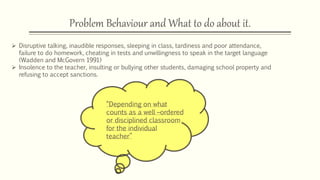
Problem Behaviour and What to do about it.
 Disruptive talking, inaudible responses, sleeping in class, tardiness and poor attendance,
failure to do homework, cheating in tests and unwillingness to speak in the target language
(Wadden and McGovern 1991)
 Insolence to the teacher, insulting or bullying other students, damaging school property and
refusing to accept sanctions.
“Depending on what
counts as a well –ordered
or disciplined classroom
for the individual
teacher”
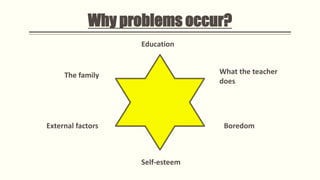
Why problems occur?
The family
Education
Self-esteem
BoredomExternal factors
What the teacher
does
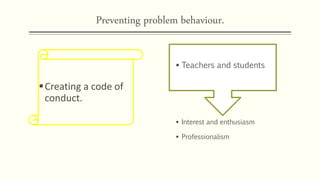
Preventing problem behaviour.
 Teachers and students
Creating a code of
conduct.
 Interest and enthusiasm
 Professionalism
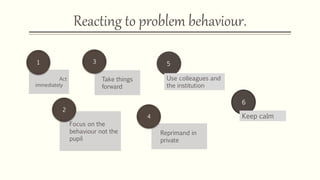
Reacting to problem behaviour.
Act
immediately
1
Focus on the
behaviour not the
pupil
2
Take things
forward
3
Reprimand in
private
4
Use colleagues and
the institution
5
6
Keep calm
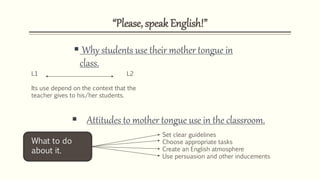
“Please, speak English!”
 Why students use their mother tongue in
class.
L1 L2
Its use depend on the context that the
teacher gives to his/her students.
 Attitudes to mother tongue use in the classroom.
What to do
about it.
Set clear guidelines
Choose appropriate tasks
Create an English atmosphere
Use persuasion and other inducements

Chapter 9 - Harmer.pp

  • 1.
    CHAPTER 9, HARMER “PROBLEMBEHAVIOUR AND WHAT TO DO ABOUT IT.”. Práctica Educativa II-Alexis Cora & Aylen Fernandez
  • 2.
    Problem Behaviour andWhat to do about it.  Disruptive talking, inaudible responses, sleeping in class, tardiness and poor attendance, failure to do homework, cheating in tests and unwillingness to speak in the target language (Wadden and McGovern 1991)  Insolence to the teacher, insulting or bullying other students, damaging school property and refusing to accept sanctions. “Depending on what counts as a well –ordered or disciplined classroom for the individual teacher”
  • 3.
    Why problems occur? Thefamily Education Self-esteem BoredomExternal factors What the teacher does
  • 4.
    Preventing problem behaviour. Teachers and students Creating a code of conduct.  Interest and enthusiasm  Professionalism
  • 5.
    Reacting to problembehaviour. Act immediately 1 Focus on the behaviour not the pupil 2 Take things forward 3 Reprimand in private 4 Use colleagues and the institution 5 6 Keep calm
  • 6.
    “Please, speak English!” Why students use their mother tongue in class. L1 L2 Its use depend on the context that the teacher gives to his/her students.  Attitudes to mother tongue use in the classroom. What to do about it. Set clear guidelines Choose appropriate tasks Create an English atmosphere Use persuasion and other inducements