Approach refers to theories
about the nature of language
and language learning.
Method is the practical
realization of an approach.
Methods include various
procedures and techniques
as part of their standard fare.
Procedures constitute an
ordered sequence of
techniques.
Techniques denote specific
strategies that we use in the
classroom to achieve a
particular result.
APPROACHES, METHODS, PROCEDURES AND TECHNIQUES.
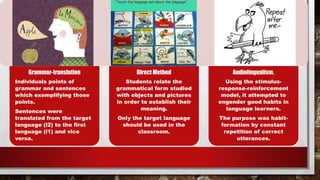
Grammar-translation
Individuals points of
grammar and sentences
which exemplifying those
points.
Sentences were
translated from the target
language (l2) to the first
language (l1) and vice
versa.
Direct Method
Students relate the
grammatical form studied
with objects and pictures
in order to establish their
meaning.
Only the target language
should be used in the
classroom.
Audiolingualism.
Using the stimulus-
response-reinforcement
model, it attempted to
engender good habits in
language learners.
The purpose was habit-
formation by constant
repetition of correct
utterances.
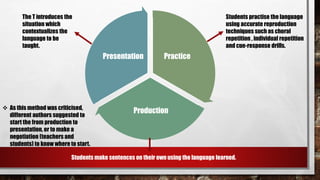
Practice
Production
Presentation
The T introduces the
situation which
contextualizes the
language to be
taught.
Students practise the language
using accurate reproduction
techniques such as choral
repetition , individual repetition
and cue-response drills.
Students make sentences on their own using the language learned.
 As this method was criticised,
different authors suggested to
start the from production to
presentation, or to make a
negotiation (teachers and
students) to know where to start.
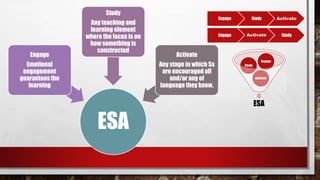
ESA
Engage
Emotional
engagement
guarantees the
learning
Study
Any teaching and
learning element
where the focus is on
how something is
constructed
Activate
Any stage in which Ss
are encouraged all
and/or any of
language they know.
Engage Study Activate
StudyActivateEngage
ESA
Activate
Study
Engage
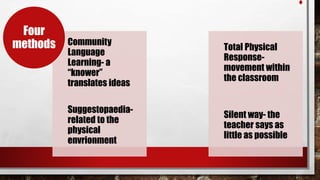
Community
Language
Learning- a
“knower”
translates ideas
Suggestopaedia-
related to the
physical
envrionment
Four
methods Total Physical
Response-
movement within
the classroom
Silent way- the
teacher says as
little as possible
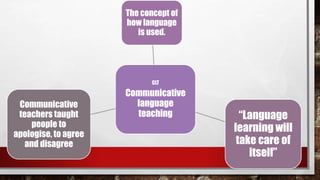
CLT
Communicative
language
teaching
The concept of
how language
is used.
“Language
learning will
take care of
itself”
Communicative
teachers taught
people to
apologise, to agree
and disagree
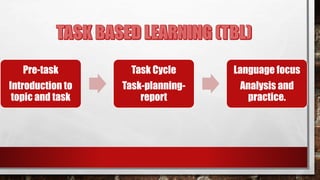
Pre-task
Introduction to
topic and task
Task Cycle
Task-planning-
report
Language focus
Analysis and
practice.
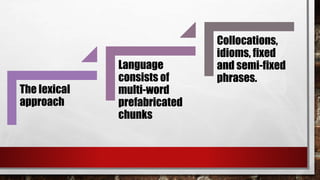
The lexical
approach
Language
consists of
multi-word
prefabricated
chunks
Collocations,
idioms, fixed
and semi-fixed
phrases.
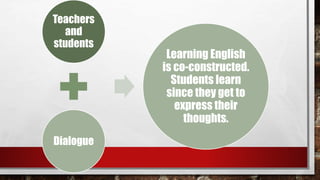
Teachers
and
students
Dialogue
Learning English
is co-constructed.
Students learn
since they get to
express their
thoughts.
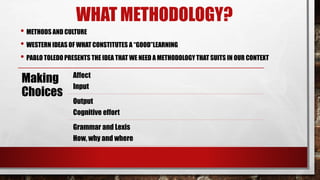
WHAT METHODOLOGY?
• METHODS AND CULTURE
• WESTERN IDEAS OF WHAT CONSTITUTES A “GOOD”LEARNING
• PABLO TOLEDO PRESENTS THE IDEA THAT WE NEED A METHODOLOGY THAT SUITS IN OUR CONTEXT
Making
Choices
Affect
Input
Output
Cognitive effort
Grammar and Lexis
How, why and where

Practica educativa ii chapter 4 harmer

  • 2.
    Approach refers totheories about the nature of language and language learning. Method is the practical realization of an approach. Methods include various procedures and techniques as part of their standard fare. Procedures constitute an ordered sequence of techniques. Techniques denote specific strategies that we use in the classroom to achieve a particular result. APPROACHES, METHODS, PROCEDURES AND TECHNIQUES.
  • 3.
    Grammar-translation Individuals points of grammarand sentences which exemplifying those points. Sentences were translated from the target language (l2) to the first language (l1) and vice versa. Direct Method Students relate the grammatical form studied with objects and pictures in order to establish their meaning. Only the target language should be used in the classroom. Audiolingualism. Using the stimulus- response-reinforcement model, it attempted to engender good habits in language learners. The purpose was habit- formation by constant repetition of correct utterances.
  • 4.
    Practice Production Presentation The T introducesthe situation which contextualizes the language to be taught. Students practise the language using accurate reproduction techniques such as choral repetition , individual repetition and cue-response drills. Students make sentences on their own using the language learned.  As this method was criticised, different authors suggested to start the from production to presentation, or to make a negotiation (teachers and students) to know where to start.
  • 5.
    ESA Engage Emotional engagement guarantees the learning Study Any teachingand learning element where the focus is on how something is constructed Activate Any stage in which Ss are encouraged all and/or any of language they know. Engage Study Activate StudyActivateEngage ESA Activate Study Engage
  • 6.
    Community Language Learning- a “knower” translates ideas Suggestopaedia- relatedto the physical envrionment Four methods Total Physical Response- movement within the classroom Silent way- the teacher says as little as possible
  • 7.
    CLT Communicative language teaching The concept of howlanguage is used. “Language learning will take care of itself” Communicative teachers taught people to apologise, to agree and disagree
  • 8.
    Pre-task Introduction to topic andtask Task Cycle Task-planning- report Language focus Analysis and practice.
  • 9.
  • 10.
  • 11.
    WHAT METHODOLOGY? • METHODSAND CULTURE • WESTERN IDEAS OF WHAT CONSTITUTES A “GOOD”LEARNING • PABLO TOLEDO PRESENTS THE IDEA THAT WE NEED A METHODOLOGY THAT SUITS IN OUR CONTEXT Making Choices Affect Input Output Cognitive effort Grammar and Lexis How, why and where