Cognitivism
in a technological classroom


                        KELSEY MARTIN
Cognitive Theorists

 Lewin- developed field theory, which posited that
  learning is the result of changes in: cognitive structure,
  one’s sense of belonging and gain in muscle control.
 Gagne-developed information processing theory which
  identified 8 levels of intellectual skills including: Signal,
  stimulus-response, chaining, verbal association, multiple
  discrimination, concept formation, principle formation
  and problem solving.
 Bloom-described the domains of learning. He identified
  three: cognitive/intellectual, affective attitudes, values,
  psychomotor i.e. motor skills.
 Anderson- developed a schema of learning. This new
  theory attempted to describe learning as the storing of
  information by the human mind in structures of ideas
  and meanings.
Introduction to Cognitivism I

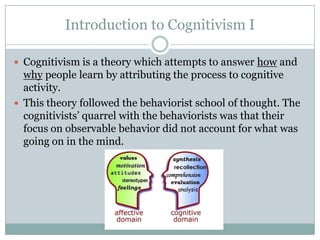
 Cognitivism is a theory which attempts to answer how and
  why people learn by attributing the process to cognitive
  activity.
 This theory followed the behaviorist school of thought. The
  cognitivists’ quarrel with the behaviorists was that their
  focus on observable behavior did not account for what was
  going on in the mind.
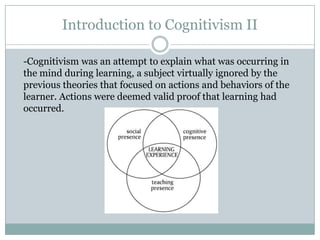
Introduction to Cognitivism II

-Cognitivism was an attempt to explain what was occurring in
the mind during learning, a subject virtually ignored by the
previous theories that focused on actions and behaviors of the
learner. Actions were deemed valid proof that learning had
occurred.
Classroom Implications I

 What does a teacher do under this theory?
-Teachers in a cognitivist classroom realize that not only are they
   teaching students material, but they are teaching them to
   comprehend it and expound upon it on their own.
   -A key part of cognitive learning is Problem Based Learning
   (PBL) Small groups can work together to solve real problems.
   This method is much more open-ended than anchored
   instruction.
- There is also a process called inquiry and discovery
   learningduring which students form their own questions and go
   through the process of learning the answer on their own by using
   many resources and strategies
Classroom Implications II

 How to incorporate technology into your cognitive
  teaching:
  -When teaching in a way that stimulates the minds of students it
  is important to use “attention getters” or things the students
  might find inspiring.
  -Many times items such as movie clips form popular secular
  movies or YouTube can assist in proving a point. Keep your eyes
  open for these.
-Using white boards or other SMART technology has proven
  incredibly effective for clearly presenting material to students
  and allowing them to understand and think on their own.
Classroom Implications III

 What students do students do under this theory?
  -During Cognitive and collaborative learning students work
  together in groups and use each other as resources. Placing
  students at computer stations or interactive white boards would
  allow them to use technology and idea webbing as a way to
  express their own ideas and bring the ideas of the group together
  in an organized fashion.
  -Using technology would also help them better recognize that
  there are multiple intelligences. Students learn through a variety
  of ways, and not everyone learns and thinks the same way.
  -Cognitive learning is all about thinking and what goes on in the
  mind of a student. Allowing them to be creative with each other
  and with technology will not only help you learn how they learn
  but help them learn how to teach themselves more efficiently.
My Own Teaching

 I have always been a huge supporter of individual
 thinking and learning. I am also a huge supporter of
 technology. Individual thinking and reaction is what the
 cognitive theory is all about. I believe that through
 technology material can be made more relevant to
 students. Incorporating video clips, websites or
 informative blogs into my cirriculum would be incredible
 helpful for my students and encourage them to get out
 there and think for themselves and decide what they
 believe and who they want to become with their own
 mind. There are so many resources to use, teachers just
 need to dive in and get up to date with their technology
 and theories!

Cognitivism

  • 1.
    Cognitivism in a technologicalclassroom KELSEY MARTIN
  • 2.
    Cognitive Theorists  Lewin-developed field theory, which posited that learning is the result of changes in: cognitive structure, one’s sense of belonging and gain in muscle control.  Gagne-developed information processing theory which identified 8 levels of intellectual skills including: Signal, stimulus-response, chaining, verbal association, multiple discrimination, concept formation, principle formation and problem solving.  Bloom-described the domains of learning. He identified three: cognitive/intellectual, affective attitudes, values, psychomotor i.e. motor skills.  Anderson- developed a schema of learning. This new theory attempted to describe learning as the storing of information by the human mind in structures of ideas and meanings.
  • 3.
    Introduction to CognitivismI  Cognitivism is a theory which attempts to answer how and why people learn by attributing the process to cognitive activity.  This theory followed the behaviorist school of thought. The cognitivists’ quarrel with the behaviorists was that their focus on observable behavior did not account for what was going on in the mind.
  • 4.
    Introduction to CognitivismII -Cognitivism was an attempt to explain what was occurring in the mind during learning, a subject virtually ignored by the previous theories that focused on actions and behaviors of the learner. Actions were deemed valid proof that learning had occurred.
  • 5.
    Classroom Implications I What does a teacher do under this theory? -Teachers in a cognitivist classroom realize that not only are they teaching students material, but they are teaching them to comprehend it and expound upon it on their own. -A key part of cognitive learning is Problem Based Learning (PBL) Small groups can work together to solve real problems. This method is much more open-ended than anchored instruction. - There is also a process called inquiry and discovery learningduring which students form their own questions and go through the process of learning the answer on their own by using many resources and strategies
  • 6.
    Classroom Implications II How to incorporate technology into your cognitive teaching: -When teaching in a way that stimulates the minds of students it is important to use “attention getters” or things the students might find inspiring. -Many times items such as movie clips form popular secular movies or YouTube can assist in proving a point. Keep your eyes open for these. -Using white boards or other SMART technology has proven incredibly effective for clearly presenting material to students and allowing them to understand and think on their own.
  • 7.
    Classroom Implications III What students do students do under this theory? -During Cognitive and collaborative learning students work together in groups and use each other as resources. Placing students at computer stations or interactive white boards would allow them to use technology and idea webbing as a way to express their own ideas and bring the ideas of the group together in an organized fashion. -Using technology would also help them better recognize that there are multiple intelligences. Students learn through a variety of ways, and not everyone learns and thinks the same way. -Cognitive learning is all about thinking and what goes on in the mind of a student. Allowing them to be creative with each other and with technology will not only help you learn how they learn but help them learn how to teach themselves more efficiently.
  • 8.
    My Own Teaching I have always been a huge supporter of individual thinking and learning. I am also a huge supporter of technology. Individual thinking and reaction is what the cognitive theory is all about. I believe that through technology material can be made more relevant to students. Incorporating video clips, websites or informative blogs into my cirriculum would be incredible helpful for my students and encourage them to get out there and think for themselves and decide what they believe and who they want to become with their own mind. There are so many resources to use, teachers just need to dive in and get up to date with their technology and theories!