Teaching English to
    Korean Young Learners


          Aaron D. Jolly
         Korea TESOL Teacher Trainer

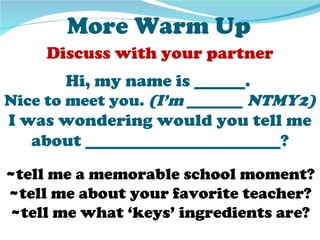
More Warm Up
     Discuss with your partner
        Hi, my name is ______.
Nice to meet you. (I’m _______ NTMY2)
I was wondering would you tell me
   about _______________________?
~tell me a memorable school moment?
~tell me about your favorite teacher?
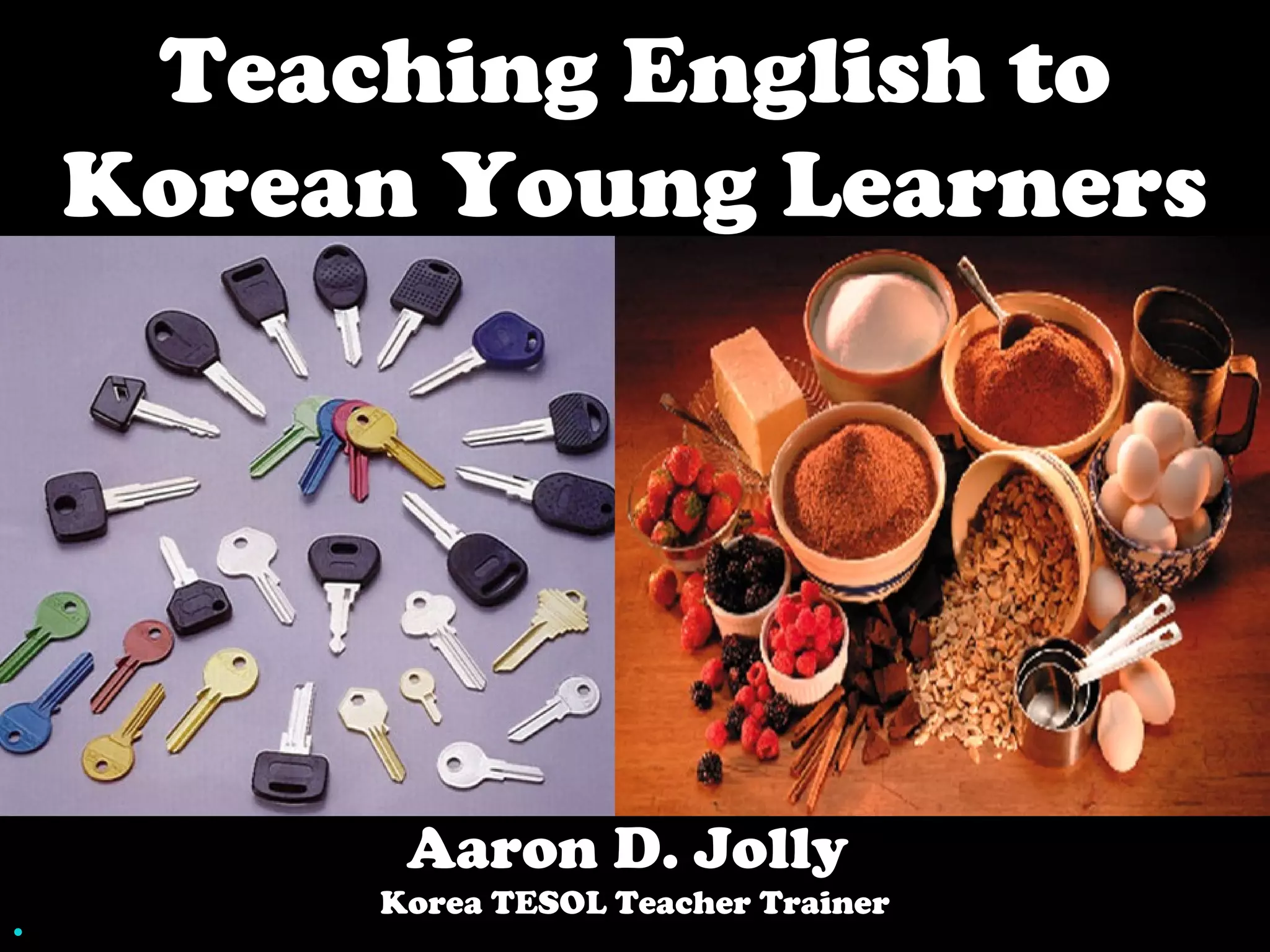
~tell me what ‘keys’ ingredients are?
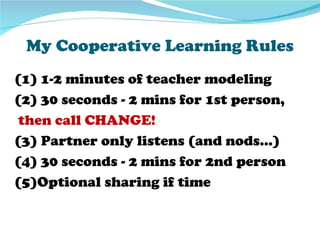
My Cooperative Learning Rules
(1) 1-2 minutes of teacher modeling
(2) 30 seconds - 2 mins for 1st person,
 then call CHANGE!
(3) Partner only listens (and nods…)
(4) 30 seconds - 2 mins for 2nd person
(5)Optional sharing if time
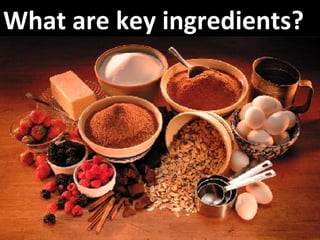
What are key ingredients?
Key Ingredients
 (1) Understanding Korean kids
 (2) Working with Korean co-teachers
 (3)How to be a happy & inspired teacher
 (4) Making fun & laughter in the class
 (5) Creating a student centered class
 (6) Lowering affective filters (fear & boring)
 (7) The 4 x 25% rule for course/class design
 (8) Bring your course-book alive adaptation
 (9) Using awesome MALL & Internet tools
 (10) DIY is best: The classroom is your canvas
(1) Understanding Korean Kids
  Strong group mentality
  Rice planting culture & Confucian
   training
  Youngest kids want someone who is
   a mother or father figure
  They expect teachers to be “god-like”
  Too busy for homework sometimes
Tips for Teaching Korean Kids
 Always smile
 Be patient – takes time to get it right
 Never, ever shout - or be too nice
 Ask co-teachers to help
 Find your own management system
 Never admit failure
 Tune into your inner brilliance
(2) Working with co-Teachers
 Co-teachers will vary
 Ur key is compassion & care, interest
 Koreans very passionate - very quiet
 Some teachers are taught not to
 “interfere” with others
 Age is very important in Korea. If
 your colleague is older than you
 there may be a “respect gap” which
 you have to navigate carefully.
Tips for co-Teachers
 Always smile
 Be patient and realize it takes time
 Show how much you are interested
  in your students, and in Korea
 Be uber-polite and schedule time
  with them at their convenience.
 Dress for success, appearance,
  posture, voice tone - all the signs of
  professionalism as a public person.
Read tips from
experienced teachers
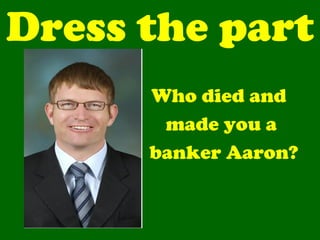
Dress the part
      Who died and
       made you a
      banker Aaron?
(3) A Happy Teacher
  Are you happy?
  Are you healthy?
  Are you smiling?
  Are you organized?
  Where are you on the Humanist v
   Behaviorists Continuum?
  Intrinsic v Extrinsic Motivation
Video here
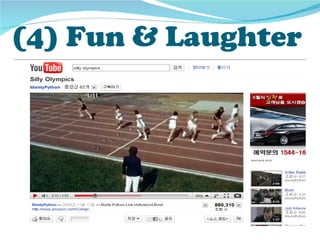
(4) Fun & Laughter
(5) Student Centered
 80-20% rule. Possible? Nearly?
  Sometimes?
 Classroom organization
 Needs analysis
 Softening the environment
 Allow mistakes in the classroom
80-20
Rule
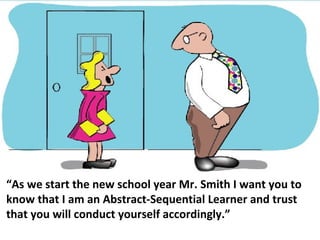
“As we start the new school year Mr. Smith I want you to
know that I am an Abstract-Sequential Learner and trust
that you will conduct yourself accordingly.”
(6) Affective Filters
 Student’s interests.
 Learner surveys.
 Asking for information before
  you make the PPTs.
 Following kids media, what kids
  play online etc.
 Knowing latest trends/music etc.
Student Centered
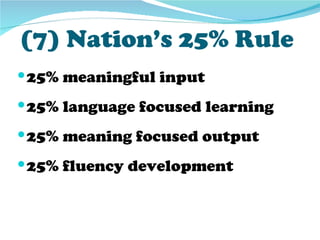
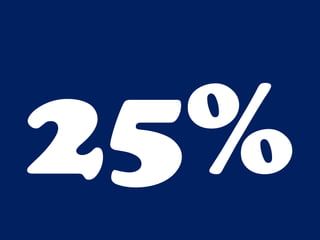
(7) Nation’s 25% Rule
 25% meaningful input
 25% language focused learning
 25% meaning focused output
 25% fluency development
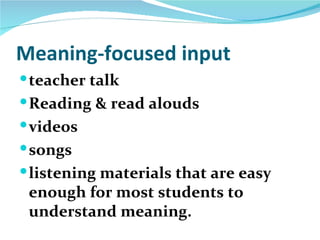
Meaning-focused input
 teacher talk
 Reading & read alouds
 videos
 songs
 listening materials that are easy
 enough for most students to
 understand meaning.
Language focused learning =
 word study,
 grammar drilling,
 learning chants and songs teacher
 explaining cultural use of language,
  sentence building,
 practicing and memorizing the course-
  book dialogues.
Meaning-focused output=
 Students talking or writing about things
  that they are actually invested in, care
  about, have an interest-in.
 The focus is on task not on completing a
  task, not perfect language accuracy.
Fluency development =
 ery simple - 25% of all your class time
  should be student-centered review of
  previously learned material from within
  the class and from previous classes.
 They need practice with the language.
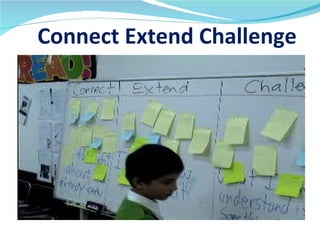
Connect
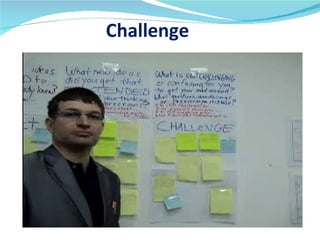
How are the ideas connected to
   what you already know?
 I thought about how______.
 I already knew __________.
I remembered _____________.
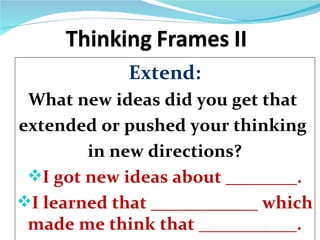
Extend:
 What new ideas did you get that
extended or pushed your thinking
        in new directions?
 I got new ideas about ________.
I learned that ____________ which
 made me think that ___________.
25%
(8) Adaptation &
Supplementation
My favorite adaptation ‘keys’


 Change the color of your textbook!
i. Using “Entry Points”.
      ii. 5 minute “Brain Based” activities
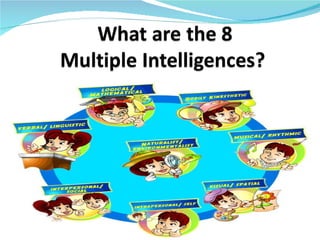
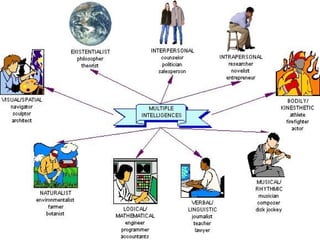
iii. “Multiple Intelligence” lesson plans.
       iv. Cooperative Learning activities.
      v. “Thinking Routines” from HGSE.
       vi. Speaking frames using PPT
There are 5 kinds of Entry Points:
                      -The Aesthetic.
                      -The Narrative.
                      -The Logical/Quantitative.
                      -The Foundational.
                      -The Experiential.
Gardner, H. (1991), The Unschooled Mind, New York: Basic Books.
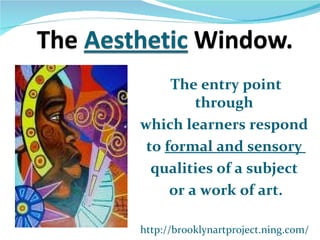
The entry point
         through
which learners respond
 to formal and sensory
  qualities of a subject
     or a work of art.

http://brooklynartproject.ning.com/
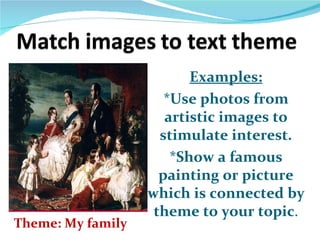
Examples:
                      *Use photos from
                      artistic images to
                     stimulate interest.
                       *Show a famous
                     painting or picture
                   which is connected by
                    theme to your topic.
Theme: My family
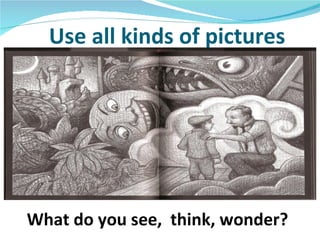
Is your dad like this?
Use all kinds of pictures


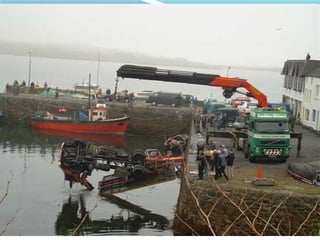
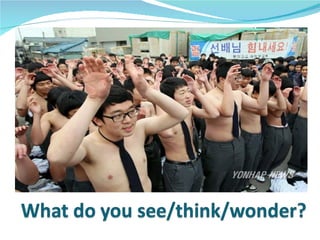
What do you see, think, wonder?
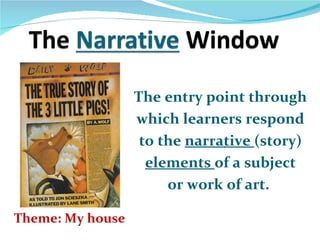
The entry point through
                  which learners respond
                   to the narrative (story)
                    elements of a subject
                       or work of art.

Theme: My house
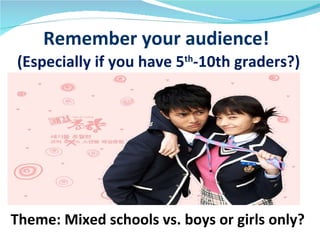
Remember your audience!
(Especially if you have 5th-10th graders?)


Theme: Mixed schools vs. boys or girls only?
The entry point through
 which learners respond
to aspects of a subject, or
  work of art that invite
 deductive reasoning or
numerical consideration.
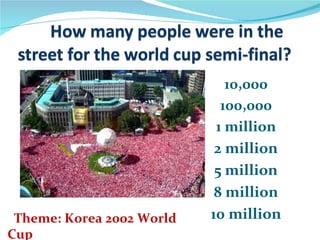
10,000
                             100,000
                            1 million
                            2 million
                            5 million
                            8 million
 Theme: Korea 2002 World   10 million
Cup
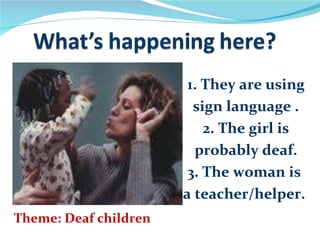
1. They are using
                         sign language .
                           2. The girl is
                         probably deaf.
                        3. The woman is
                       a teacher/helper.
Theme: Deaf children
The entry point through
 which learners respond
to the broader concepts,
or philosophical issues,
   raised by a subject
       or artwork.
Why is it so?
 Why do we need English?
Why do you love your family?
 Why do you study so hard?
  Why do you play soccer?
   Why is Korea so busy?
 Why do people drive like
           that?
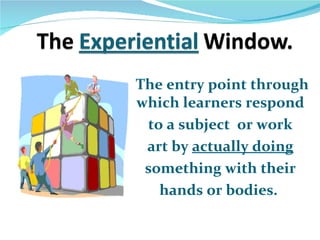
The entry point through
which learners respond
 to a subject or work
 art by actually doing
 something with their
   hands or bodies.
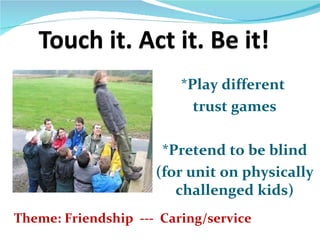
*Play different
                           trust games

                      *Pretend to be blind
                     (for unit on physically
                        challenged kids)
Theme: Friendship --- Caring/service
Adapted from WIDEWORLD professional development
                    resources.
       http://www.wideworld.pz.harvard.edu/

  These examples were excerpted and adapted from:
   Davis, J. (1996). The MUSE Book. Cambridge, MA:
  President and Fellows of Harvard College/Harvard
                       Project Zero
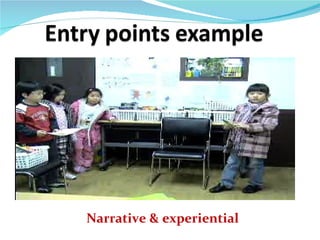
Narrative & experiential
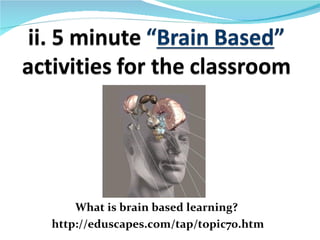
What is brain based learning?
http://eduscapes.com/tap/topic70.htm
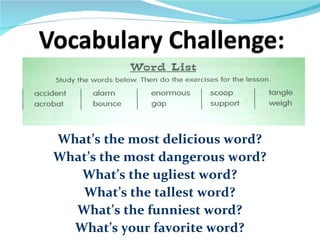
What’s the most delicious word?
What’s the most dangerous word?
   What’s the ugliest word?
   What’s the tallest word?
  What’s the funniest word?
  What’s your favorite word?
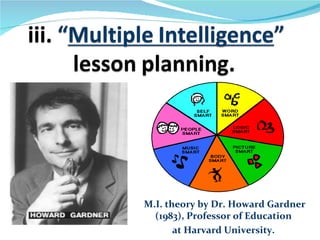
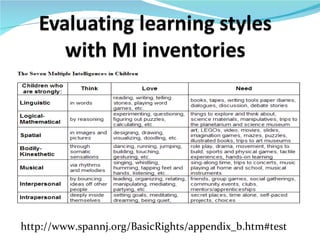
M.I. theory by Dr. Howard Gardner
  (1983), Professor of Education
       at Harvard University.
http://www.spannj.org/BasicRights/appendix_b.htm#test
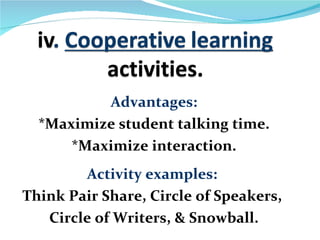
Advantages:
  *Maximize student talking time.
      *Maximize interaction.
        Activity examples:
Think Pair Share, Circle of Speakers,
   Circle of Writers, & Snowball.
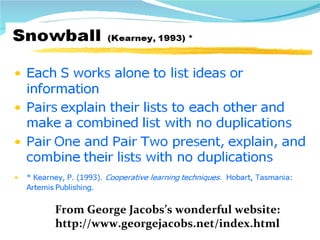
From George Jacobs’s wonderful website:
http://www.georgejacobs.net/index.html
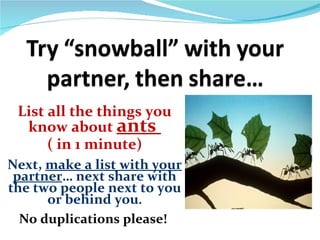
List all the things you
  know about ants
      ( in 1 minute)
Next, make a list with your
 partner… next share with
the two people next to you
      or behind you.
  No duplications please!
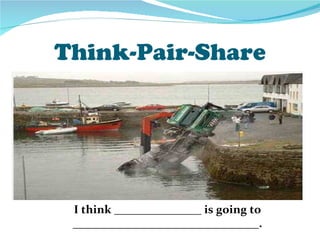
Think-Pair-Share


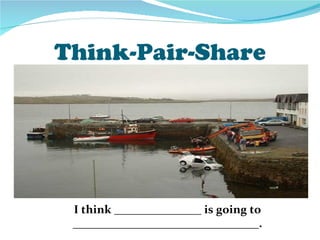
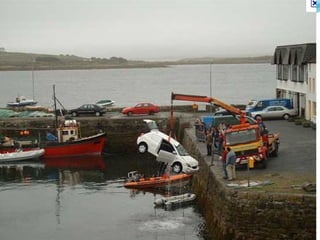
 I think _______________ is going to
 ________________________________.
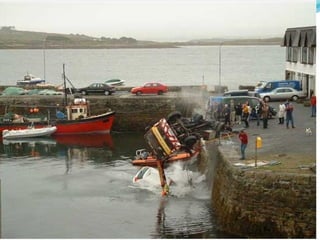
Think-Pair-Share


 I think _______________ is going to
 ________________________________.
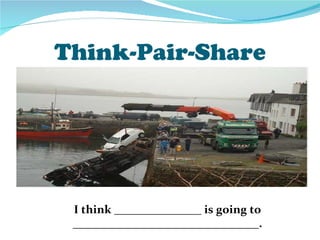
Think-Pair-Share


 I think _______________ is going to
 ________________________________.
http://www.pz.harvard.edu/Research/AERA06ThinkingRoutines.pdf
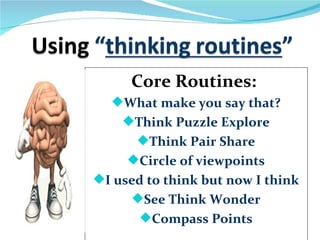
Core Routines:
  What make you say that?
    Think Puzzle Explore
      Think Pair Share
     Circle of viewpoints
I used to think but now I think
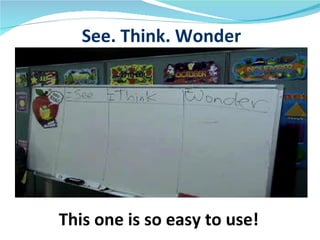
      See Think Wonder
       Compass Points
http://pzweb.harvard.edu/vt/VisibleThinking_html_file
s/03_ThinkingRoutines/03c_CoreRoutines.html
See. Think. Wonder


This one is so easy to use!
Connect Extend Challenge
Challenge
For heaven’s sake use


   PPT
Yes you can use PPT to
    make your own:

Word/phrase cards
& speaking frames
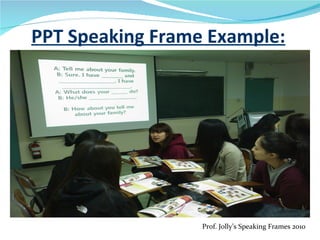
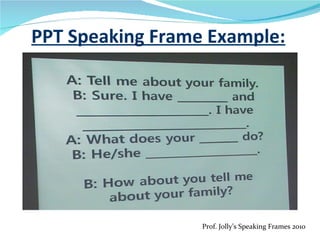
PPT Speaking Frame Example:


                  Prof. Jolly’s Speaking Frames 2010
PPT Speaking Frame Example:


                  Prof. Jolly’s Speaking Frames 2010
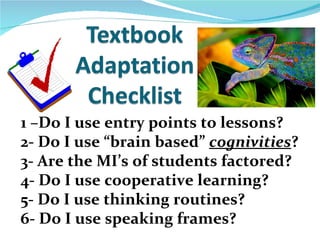
1 –Do I use entry points to lessons?
2- Do I use “brain based” cognivities?
3- Are the MI’s of students factored?
4- Do I use cooperative learning?
5- Do I use thinking routines?
6- Do I use speaking frames?
(9) Supplemental ‘keys’


I use the 1 + 1 approach to add stuff!
Use Graded Readers!


Graded Readers are “books prepared so that
 they stay within strictly limited vocabulary.”
                  (Nation, 2001)
By Rob Waring (distributed in Korea by YBM Sisa)
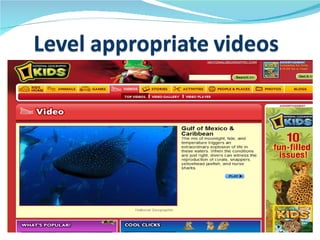
a. Use Real-English.com to watch
 videos with subtitles, for all levels.
b. Find video materials on DVD or
     that are level appropriate.
 c. EnglishCentral great example
http://jasonrenshaw.typepad.com/jason_renshaws_web_log
/
Are you   ?
1 –Do I have time for anything?
2 – How can I make (more) time?
3-Do I practice the 1 + 1 approach?
4- Is it for in-class only, or out too?
5- How do I assess learning, or do I?
6- What varies? What stays the same?
Teaching.english.to.korean.young.learners

Teaching.english.to.korean.young.learners

  • 1.
    Teaching English to Korean Young Learners Aaron D. Jolly Korea TESOL Teacher Trainer 
  • 3.
    More Warm Up Discuss with your partner Hi, my name is ______. Nice to meet you. (I’m _______ NTMY2) I was wondering would you tell me about _______________________? ~tell me a memorable school moment? ~tell me about your favorite teacher? ~tell me what ‘keys’ ingredients are?
  • 4.
    My Cooperative LearningRules (1) 1-2 minutes of teacher modeling (2) 30 seconds - 2 mins for 1st person, then call CHANGE! (3) Partner only listens (and nods…) (4) 30 seconds - 2 mins for 2nd person (5)Optional sharing if time
  • 5.
    What are keyingredients?
  • 6.
    Key Ingredients  (1)Understanding Korean kids  (2) Working with Korean co-teachers  (3)How to be a happy & inspired teacher  (4) Making fun & laughter in the class  (5) Creating a student centered class  (6) Lowering affective filters (fear & boring)  (7) The 4 x 25% rule for course/class design  (8) Bring your course-book alive adaptation  (9) Using awesome MALL & Internet tools  (10) DIY is best: The classroom is your canvas
  • 7.
    (1) Understanding KoreanKids  Strong group mentality  Rice planting culture & Confucian training  Youngest kids want someone who is a mother or father figure  They expect teachers to be “god-like”  Too busy for homework sometimes

  • 8.
    Tips for TeachingKorean Kids  Always smile  Be patient – takes time to get it right  Never, ever shout - or be too nice  Ask co-teachers to help  Find your own management system  Never admit failure  Tune into your inner brilliance
  • 10.
    (2) Working withco-Teachers  Co-teachers will vary  Ur key is compassion & care, interest  Koreans very passionate - very quiet  Some teachers are taught not to “interfere” with others  Age is very important in Korea. If your colleague is older than you there may be a “respect gap” which you have to navigate carefully.
  • 11.
    Tips for co-Teachers Always smile  Be patient and realize it takes time  Show how much you are interested in your students, and in Korea  Be uber-polite and schedule time with them at their convenience.  Dress for success, appearance, posture, voice tone - all the signs of professionalism as a public person.
  • 12.
  • 13.
    Dress the part Who died and made you a banker Aaron?
  • 14.
    (3) A HappyTeacher  Are you happy?  Are you healthy?  Are you smiling?  Are you organized?  Where are you on the Humanist v Behaviorists Continuum?  Intrinsic v Extrinsic Motivation
  • 15.
  • 17.
    (4) Fun &Laughter
  • 18.
    (5) Student Centered 80-20% rule. Possible? Nearly? Sometimes?  Classroom organization  Needs analysis  Softening the environment  Allow mistakes in the classroom
  • 19.
  • 20.
    “As we startthe new school year Mr. Smith I want you to know that I am an Abstract-Sequential Learner and trust that you will conduct yourself accordingly.”
  • 21.
    (6) Affective Filters Student’s interests.  Learner surveys.  Asking for information before you make the PPTs.  Following kids media, what kids play online etc.  Knowing latest trends/music etc.
  • 23.
  • 24.
    (7) Nation’s 25%Rule  25% meaningful input  25% language focused learning  25% meaning focused output  25% fluency development
  • 25.
    Meaning-focused input  teachertalk  Reading & read alouds  videos  songs  listening materials that are easy enough for most students to understand meaning.
  • 26.
    Language focused learning=  word study,  grammar drilling,  learning chants and songs teacher  explaining cultural use of language, sentence building,  practicing and memorizing the course- book dialogues.
  • 27.
    Meaning-focused output=  Studentstalking or writing about things that they are actually invested in, care about, have an interest-in.  The focus is on task not on completing a task, not perfect language accuracy.
  • 28.
    Fluency development = ery simple - 25% of all your class time should be student-centered review of previously learned material from within the class and from previous classes.  They need practice with the language.
  • 29.
    Connect How are theideas connected to what you already know? I thought about how______. I already knew __________. I remembered _____________.
  • 30.
    Extend: What newideas did you get that extended or pushed your thinking in new directions? I got new ideas about ________. I learned that ____________ which made me think that ___________.
  • 32.
  • 33.
  • 34.
    My favorite adaptation‘keys’ Change the color of your textbook!
  • 36.
    i. Using “EntryPoints”. ii. 5 minute “Brain Based” activities iii. “Multiple Intelligence” lesson plans. iv. Cooperative Learning activities. v. “Thinking Routines” from HGSE. vi. Speaking frames using PPT
  • 37.
    There are 5kinds of Entry Points: -The Aesthetic. -The Narrative. -The Logical/Quantitative. -The Foundational. -The Experiential. Gardner, H. (1991), The Unschooled Mind, New York: Basic Books.
  • 38.
    The entry point through which learners respond to formal and sensory qualities of a subject or a work of art. http://brooklynartproject.ning.com/
  • 39.
    Examples: *Use photos from artistic images to stimulate interest. *Show a famous painting or picture which is connected by theme to your topic. Theme: My family
  • 40.
    Is your dadlike this?
  • 41.
    Use all kindsof pictures What do you see, think, wonder?
  • 42.
    The entry pointthrough which learners respond to the narrative (story) elements of a subject or work of art. Theme: My house
  • 44.
    Remember your audience! (Especiallyif you have 5th-10th graders?) Theme: Mixed schools vs. boys or girls only?
  • 45.
    The entry pointthrough which learners respond to aspects of a subject, or work of art that invite deductive reasoning or numerical consideration.
  • 46.
    10,000 100,000 1 million 2 million 5 million 8 million Theme: Korea 2002 World 10 million Cup
  • 47.
    1. They areusing sign language . 2. The girl is probably deaf. 3. The woman is a teacher/helper. Theme: Deaf children
  • 48.
    The entry pointthrough which learners respond to the broader concepts, or philosophical issues, raised by a subject or artwork.
  • 49.
    Why is itso? Why do we need English? Why do you love your family? Why do you study so hard? Why do you play soccer? Why is Korea so busy? Why do people drive like that?
  • 50.
    The entry pointthrough which learners respond to a subject or work art by actually doing something with their hands or bodies.
  • 51.
    *Play different trust games *Pretend to be blind (for unit on physically challenged kids) Theme: Friendship --- Caring/service
  • 52.
    Adapted from WIDEWORLDprofessional development resources. http://www.wideworld.pz.harvard.edu/ These examples were excerpted and adapted from: Davis, J. (1996). The MUSE Book. Cambridge, MA: President and Fellows of Harvard College/Harvard Project Zero
  • 53.
  • 54.
    What is brainbased learning? http://eduscapes.com/tap/topic70.htm
  • 55.
    What’s the mostdelicious word? What’s the most dangerous word? What’s the ugliest word? What’s the tallest word? What’s the funniest word? What’s your favorite word?
  • 56.
    M.I. theory byDr. Howard Gardner (1983), Professor of Education at Harvard University.
  • 59.
  • 60.
    Advantages: *Maximizestudent talking time. *Maximize interaction. Activity examples: Think Pair Share, Circle of Speakers, Circle of Writers, & Snowball.
  • 61.
    From George Jacobs’swonderful website: http://www.georgejacobs.net/index.html
  • 62.
    List all thethings you know about ants ( in 1 minute) Next, make a list with your partner… next share with the two people next to you or behind you. No duplications please!
  • 63.
    Think-Pair-Share I think_______________ is going to ________________________________.
  • 66.
    Think-Pair-Share I think_______________ is going to ________________________________.
  • 71.
    Think-Pair-Share I think_______________ is going to ________________________________.
  • 72.
  • 73.
    Core Routines: What make you say that? Think Puzzle Explore Think Pair Share Circle of viewpoints I used to think but now I think See Think Wonder Compass Points
  • 74.
  • 76.
    See. Think. Wonder Thisone is so easy to use!
  • 79.
  • 80.
  • 81.
  • 82.
    Yes you canuse PPT to make your own: Word/phrase cards & speaking frames
  • 83.
    PPT Speaking FrameExample: Prof. Jolly’s Speaking Frames 2010
  • 84.
    PPT Speaking FrameExample: Prof. Jolly’s Speaking Frames 2010
  • 85.
    1 –Do Iuse entry points to lessons? 2- Do I use “brain based” cognivities? 3- Are the MI’s of students factored? 4- Do I use cooperative learning? 5- Do I use thinking routines? 6- Do I use speaking frames?
  • 86.
    (9) Supplemental ‘keys’ Iuse the 1 + 1 approach to add stuff!
  • 87.
    Use Graded Readers! GradedReaders are “books prepared so that they stay within strictly limited vocabulary.” (Nation, 2001)
  • 88.
    By Rob Waring(distributed in Korea by YBM Sisa)
  • 89.
    a. Use Real-English.comto watch videos with subtitles, for all levels. b. Find video materials on DVD or that are level appropriate. c. EnglishCentral great example
  • 92.
  • 93.
  • 94.
    1 –Do Ihave time for anything? 2 – How can I make (more) time? 3-Do I practice the 1 + 1 approach? 4- Is it for in-class only, or out too? 5- How do I assess learning, or do I? 6- What varies? What stays the same?

Editor's Notes

  • #4 No sexism, racism, party political answers. Teams and give points! Rules nothing too emotional please!
  • #30 Think of activities that challenge your students to think and to be invested in the words, find inventive ways for them to use them and to own them…
  • #31 Think of activities that challenge your students to think and to be invested in the words, find inventive ways for them to use them and to own them…
  • #36 Students and parents praying for success on the university entrance exams.
  • #39 For example: the color, line, expression, and composition of a painting; the intricate patterns on the surface of a beehive; or the alliteration and meter of a poem.
  • #40 For example: the color, line, expression, and composition of a painting; the intricate patterns on the surface of a beehive; or the alliteration and meter of a poem.
  • #42 Language Research has shown that comprehensible input is crucial, and also without narrative students cannot develop fluency.
  • #43 For example: the legend depicted in a painting, the sequence of events in a period of history, or the story behind the construction of a skyscraper.
  • #45 More about lexiled books later… joke about dark circles…
  • #46 For example: the question of what decisions led to the creation of an art object, the problem of calculating the overall dimensions of an automobile, or the determination of which character in a mystery is the real villain.
  • #47 For example: the question of what decisions led to the creation of an art object, the problem of calculating the overall dimensions of an automobile, or the determination of which character in a mystery is the real villain.
  • #48 For example: the question of what decisions led to the creation of an art object, the problem of calculating the overall dimensions of an automobile, or the determination of which character in a mystery is the real villain.
  • #49 For example: whether and why calculus is thought to be important to society, whether metaphors depict or defy reality, or why a painting of soup cans is considered art.
  • #50 For example: whether and why calculus is thought to be important to society, whether metaphors depict or defy reality, or why a painting of soup cans is considered art.
  • #51 For example: manipulating the same materials used in a work of art, producing a play about the history of a neighborhood, or setting a poem to music.
  • #52 For example: manipulating the same materials used in a work of art, producing a play about the history of a neighborhood, or setting a poem to music.
  • #54 -Think of an idea about an entry point that you might use for this example.
  • #55 Think of activities that challenge your students to think and to be invested in the words, find inventive ways for them to use them and to own them…
  • #57 -It suggests that the traditional notion of intelligence, based on I.Q. testing, is far too limited. Instead, he proposed 7 different intelligences to account for a broader range of human potential in children and adults.
  • #58 What about you? What are you’re strongest?
  • #74 The core routines are a set of seven or so routines that target different types of thinking from across the modules. These routines are easy to get started with and are commonly found in Visible Thinking teachers' toolkits. Try getting started with with one of these routines. http://www.pz.harvard.edu/vt/VisibleThinking_html_files/03_ThinkingRoutines/03c_CoreRoutines.html
  • #77 Reflective teaching rocks!!! I’ve been reflecting a lot on the difficulties my students have had with authentic literature.
  • #78 Adapted for lesson with if_________ … _________ might happen
  • #80 Language Research has shown that comprehensible input is crucial, and also without narrative students cannot develop fluency.
  • #81 Language Research has shown that comprehensible input is crucial, and also without narrative students cannot develop fluency.
  • #82 Think of activities that challenge your students to think and to be invested in the words, find inventive ways for them to use them and to own them…
  • #83 For classroom English
  • #84 Always good to use PPT to keep a repertoire of speaking frames at hand, or plan them into your lesson plan…
  • #85 Always good to use PPT to keep a repertoire of speaking frames at hand, or plan them into your lesson plan…
  • #88 The books are the stars!!!
  • #96 A lot of “Classroom English” is actually teacher modeling language at the right input level for teachers.