American Bureau of Shipping
                                       Oracle Access Manager and the WebLogic SSPI

                                       In 2009, Partners Consulting was engaged by a worldwide marine and offshore
                                       classification and standards organization located in Houston, Texas. The primary
                                       focus of the business was to verify that merchant ships and marine structures
                                       comply with rules that the society has established for marine and offshore
                                       design, construction and periodic survey. The organization’s divisional offices
                                       support a worldwide network of more than two hundred representative offices in
                                       over 60 countries.


                                       Centralized Access Management 
                                        
                                       The organizational goal was to deploy a commercial off-the-shelf solution in
                                       order to provide Enterprise Single Sign-On (SSO) to their customer facing web
                                       applications. The marine and offshore compliance and standards applications
                                       (and other static resources for builders were all served from a WebLogic Portal
                                       environment. External users could either register by phone or via the portal
                                       interface and request the appropriate access or rights from the organization.
                                       However, in the organization’s existing access request model, development
                                       teams would still have to write custom authentication into each of the web based
                                       applications in order to achieve SSO with other applications not served from
                                       WebLogic Portal.

                                       It was determined that it was necessary to license and deploy an Access
                                       Management solution that would not only provide seamless integration with the
                                       WebLogic Security Provider Interface, but also help eliminate the cost and time
                                       required to write authentication into individual customer facing applications.

                                       The Challenges Faced 

                                               •   Credentials were stored in separate Oracle databases and the
                                                   organization had no centralized LDAP repository.

                                               •   Customers had to logon to each application separately to receive the
                                                   appropriate authorization

                                               •   Existing development effort had not kept up with growth, compounding
                                                   current Access Management issues.


www.partnersconsulting.com | 1(866) 736.5500
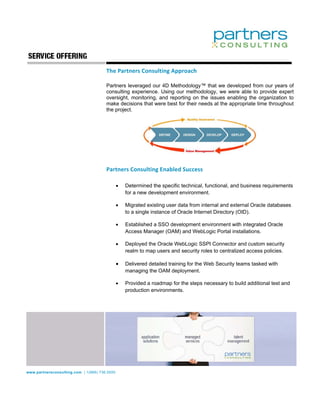
The Partners Consulting Approach

                                       Partners leveraged our 4D Methodology™ that we developed from our years of
                                       consulting experience. Using our methodology, we were able to provide expert
                                       oversight, monitoring, and reporting on the issues enabling the organization to
                                       make decisions that were best for their needs at the appropriate time throughout
                                       the project.


                                       Partners Consulting Enabled Success 
                                        
                                               •   Determined the specific technical, functional, and business requirements
                                                   for a new development environment.

                                               •   Migrated existing user data from internal and external Oracle databases
                                                   to a single instance of Oracle Internet Directory (OID).

                                               •   Established a SSO development environment with integrated Oracle
                                                   Access Manager (OAM) and WebLogic Portal installations.

                                               •   Deployed the Oracle WebLogic SSPI Connector and custom security
                                                   realm to map users and security roles to centralized access policies.

                                               •   Delivered detailed training for the Web Security teams tasked with
                                                   managing the OAM deployment.

                                               •   Provided a roadmap for the steps necessary to build additional test and
                                                   production environments.


www.partnersconsulting.com | 1(866) 736.5500
Oracle Access Manager 
                                        
                                       With the guidance of Partners Consulting, the American Bureau of Shipping
                                       chose Oracle Access Manager (OAM) over other competitors as their web
                                       access management solution to address their needs with respect to:

                                               •   Enterprise Single Sign-on (SSO)
                                               •   Centralized Policy Management
                                               •   WebLogic SSPI Integration

                                       A Central User Repository 
                                        
                                       Partners Consulting installed an instance of Oracle Virtual Directory (OVD) to
                                       connect to the existing Oracle Database instances and provide a view
                                       (“virtualized” abstraction) of user data in a structured LDAP hierarchical format.
                                       Once the connectors were defined and a single unified user tree was created in
                                       OVD, Partners Consulting then performed a data migration using standard
                                       Oracle utilities and exported the user data. A new central user repository was
                                       created and stored in a new instance of OID.

                                       The OID would hold the new user directory tree with organizational units to
                                       contain user, group, and access policy data. The OID instance would serve as a
                                       central repository for all of this data going forward, and OAM would be able to
                                       authenticate from this LDAP directory. OID now provides the organization the
                                       ability to integrate web based applications protected with OAM while minimizing
                                       the need to change either the infrastructure or the applications being developed.

                                       A Single Sign‐On (SSO) Environment 
                                        
                                       To alleviate the burden of having to re-write individual applications to integrate
                                       with an existing SSO solution, Partners Consulting had to deploy an Access
                                       Management solution that would integrate with existing WebLogic Portal
                                       applications and their security realms. The solution would not only need to
                                       provide SSO to all customer facing applications, but it would have to perform
                                       role-based authorizations that would be understood by WebLogic Portal.
                                       Partners Consulting installed OAM to provide the authentication, authorization,
                                       and auditing services necessary to protect more than 20 portal applications.


www.partnersconsulting.com | 1(866) 736.5500
(SSO, continued)

                                       The base solution was comprised of OAM Identity and Access Servers
                                       installed on a single machine. These servers serve as the “decision making”
                                       components in basic user and access management for the organization. Then
                                       OAM’s “WebGates” were plugged into existing web servers as the “policy
                                       enforcement points”.

                                       User’s requesting access to portal applications would either have to present an
                                       SSO authentication token or they would have to authenticate to with whichever
                                       authentication mechanism was defined for that application. Once a user
                                       authenticates to a WebGate protected resource he or she is granted an
                                       obSSOCookie (token) and is not authenticated again until a designated timeout.
                                        
                                       Existing WebLogic Security 
                                        
                                       The greatest challenge for the organization however, was not in simply creating
                                       an environment where users had only a single authentication. For this
                                       organization, the entirety of their applications in the portal had all been written to
                                       authenticate and authorize users within the WebLogic security model.
                                       In this model, a security principal (user or group with a collective set of
                                       permissions) is set and the roles assigned to that principal are determined for
                                       authorization to a given resource.

                                       The SSPI Connector 
                                        
                                       In the development environment, OAM was integrated with the existing
                                       WebLogic Server and Portal by installing and configuring a WebLogic SSPI
                                       Connector. The SSPI connector installation forms a bridge between OAM and
                                       WebLogic. A new security realm is created and was configured to trust OAM’s
                                       session cookie for authentication and to read and map user roles to WebLogic
                                       security roles and application permissions. The connector allows SSO and
                                       eliminates the need to re-write security in existing applications.

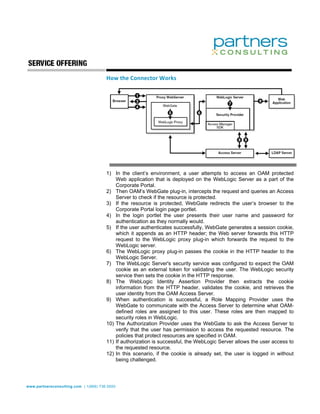
                                       (A diagram of the OAM and WebLogic authentication flow is included on the last
                                       page of this document)


www.partnersconsulting.com | 1(866) 736.5500
How the Connector Works 


                                       1) In the client’s environment, a user attempts to access an OAM protected
                                           Web application that is deployed on the WebLogic Server as a part of the
                                           Corporate Portal.
                                       2) Then OAM’s WebGate plug-in, intercepts the request and queries an Access
                                           Server to check if the resource is protected.
                                       3) If the resource is protected, WebGate redirects the user’s browser to the
                                           Corporate Portal login page portlet.
                                       4) In the login portlet the user presents their user name and password for
                                           authentication as they normally would.
                                       5) If the user authenticates successfully, WebGate generates a session cookie,
                                           which it appends as an HTTP header; the Web server forwards this HTTP
                                           request to the WebLogic proxy plug-in which forwards the request to the
                                           WebLogic server.
                                       6) The WebLogic proxy plug-in passes the cookie in the HTTP header to the
                                           WebLogic Server.
                                       7) The WebLogic Server's security service was configured to expect the OAM
                                           cookie as an external token for validating the user. The WebLogic security
                                           service then sets the cookie in the HTTP response.
                                       8) The WebLogic Identity Assertion Provider then extracts the cookie
                                           information from the HTTP header, validates the cookie, and retrieves the
                                           user identity from the OAM Access Server.
                                       9) When authentication is successful, a Role Mapping Provider uses the
                                           WebGate to communicate with the Access Server to determine what OAM-
                                           defined roles are assigned to this user. These roles are then mapped to
                                           security roles in WebLogic.
                                       10) The Authorization Provider uses the WebGate to ask the Access Server to
                                           verify that the user has permission to access the requested resource. The
                                           policies that protect resources are specified in OAM.
                                       11) If authorization is successful, the WebLogic Server allows the user access to
                                           the requested resource.
                                       12) In this scenario, if the cookie is already set, the user is logged in without
                                           being challenged.


www.partnersconsulting.com | 1(866) 736.5500

Case Study: ABS OAM

  • 1.
    American Bureau ofShipping Oracle Access Manager and the WebLogic SSPI In 2009, Partners Consulting was engaged by a worldwide marine and offshore classification and standards organization located in Houston, Texas. The primary focus of the business was to verify that merchant ships and marine structures comply with rules that the society has established for marine and offshore design, construction and periodic survey. The organization’s divisional offices support a worldwide network of more than two hundred representative offices in over 60 countries. Centralized Access Management    The organizational goal was to deploy a commercial off-the-shelf solution in order to provide Enterprise Single Sign-On (SSO) to their customer facing web applications. The marine and offshore compliance and standards applications (and other static resources for builders were all served from a WebLogic Portal environment. External users could either register by phone or via the portal interface and request the appropriate access or rights from the organization. However, in the organization’s existing access request model, development teams would still have to write custom authentication into each of the web based applications in order to achieve SSO with other applications not served from WebLogic Portal. It was determined that it was necessary to license and deploy an Access Management solution that would not only provide seamless integration with the WebLogic Security Provider Interface, but also help eliminate the cost and time required to write authentication into individual customer facing applications. The Challenges Faced  • Credentials were stored in separate Oracle databases and the organization had no centralized LDAP repository. • Customers had to logon to each application separately to receive the appropriate authorization • Existing development effort had not kept up with growth, compounding current Access Management issues. www.partnersconsulting.com | 1(866) 736.5500
  • 2.
    The Partners Consulting Approach Partners leveraged our 4D Methodology™ that we developed from our years of consulting experience. Using our methodology, we were able to provide expert oversight, monitoring, and reporting on the issues enabling the organization to make decisions that were best for their needs at the appropriate time throughout the project. Partners Consulting Enabled Success    • Determined the specific technical, functional, and business requirements for a new development environment. • Migrated existing user data from internal and external Oracle databases to a single instance of Oracle Internet Directory (OID). • Established a SSO development environment with integrated Oracle Access Manager (OAM) and WebLogic Portal installations. • Deployed the Oracle WebLogic SSPI Connector and custom security realm to map users and security roles to centralized access policies. • Delivered detailed training for the Web Security teams tasked with managing the OAM deployment. • Provided a roadmap for the steps necessary to build additional test and production environments. www.partnersconsulting.com | 1(866) 736.5500
  • 3.
    Oracle Access Manager    With the guidance of Partners Consulting, the American Bureau of Shipping chose Oracle Access Manager (OAM) over other competitors as their web access management solution to address their needs with respect to: • Enterprise Single Sign-on (SSO) • Centralized Policy Management • WebLogic SSPI Integration A Central User Repository    Partners Consulting installed an instance of Oracle Virtual Directory (OVD) to connect to the existing Oracle Database instances and provide a view (“virtualized” abstraction) of user data in a structured LDAP hierarchical format. Once the connectors were defined and a single unified user tree was created in OVD, Partners Consulting then performed a data migration using standard Oracle utilities and exported the user data. A new central user repository was created and stored in a new instance of OID. The OID would hold the new user directory tree with organizational units to contain user, group, and access policy data. The OID instance would serve as a central repository for all of this data going forward, and OAM would be able to authenticate from this LDAP directory. OID now provides the organization the ability to integrate web based applications protected with OAM while minimizing the need to change either the infrastructure or the applications being developed. A Single Sign‐On (SSO) Environment    To alleviate the burden of having to re-write individual applications to integrate with an existing SSO solution, Partners Consulting had to deploy an Access Management solution that would integrate with existing WebLogic Portal applications and their security realms. The solution would not only need to provide SSO to all customer facing applications, but it would have to perform role-based authorizations that would be understood by WebLogic Portal. Partners Consulting installed OAM to provide the authentication, authorization, and auditing services necessary to protect more than 20 portal applications. www.partnersconsulting.com | 1(866) 736.5500
  • 4.
    (SSO, continued) The base solution was comprised of OAM Identity and Access Servers installed on a single machine. These servers serve as the “decision making” components in basic user and access management for the organization. Then OAM’s “WebGates” were plugged into existing web servers as the “policy enforcement points”. User’s requesting access to portal applications would either have to present an SSO authentication token or they would have to authenticate to with whichever authentication mechanism was defined for that application. Once a user authenticates to a WebGate protected resource he or she is granted an obSSOCookie (token) and is not authenticated again until a designated timeout.   Existing WebLogic Security    The greatest challenge for the organization however, was not in simply creating an environment where users had only a single authentication. For this organization, the entirety of their applications in the portal had all been written to authenticate and authorize users within the WebLogic security model. In this model, a security principal (user or group with a collective set of permissions) is set and the roles assigned to that principal are determined for authorization to a given resource. The SSPI Connector    In the development environment, OAM was integrated with the existing WebLogic Server and Portal by installing and configuring a WebLogic SSPI Connector. The SSPI connector installation forms a bridge between OAM and WebLogic. A new security realm is created and was configured to trust OAM’s session cookie for authentication and to read and map user roles to WebLogic security roles and application permissions. The connector allows SSO and eliminates the need to re-write security in existing applications. (A diagram of the OAM and WebLogic authentication flow is included on the last page of this document) www.partnersconsulting.com | 1(866) 736.5500
  • 5.
    How the Connector Works  1) In the client’s environment, a user attempts to access an OAM protected Web application that is deployed on the WebLogic Server as a part of the Corporate Portal. 2) Then OAM’s WebGate plug-in, intercepts the request and queries an Access Server to check if the resource is protected. 3) If the resource is protected, WebGate redirects the user’s browser to the Corporate Portal login page portlet. 4) In the login portlet the user presents their user name and password for authentication as they normally would. 5) If the user authenticates successfully, WebGate generates a session cookie, which it appends as an HTTP header; the Web server forwards this HTTP request to the WebLogic proxy plug-in which forwards the request to the WebLogic server. 6) The WebLogic proxy plug-in passes the cookie in the HTTP header to the WebLogic Server. 7) The WebLogic Server's security service was configured to expect the OAM cookie as an external token for validating the user. The WebLogic security service then sets the cookie in the HTTP response. 8) The WebLogic Identity Assertion Provider then extracts the cookie information from the HTTP header, validates the cookie, and retrieves the user identity from the OAM Access Server. 9) When authentication is successful, a Role Mapping Provider uses the WebGate to communicate with the Access Server to determine what OAM- defined roles are assigned to this user. These roles are then mapped to security roles in WebLogic. 10) The Authorization Provider uses the WebGate to ask the Access Server to verify that the user has permission to access the requested resource. The policies that protect resources are specified in OAM. 11) If authorization is successful, the WebLogic Server allows the user access to the requested resource. 12) In this scenario, if the cookie is already set, the user is logged in without being challenged. www.partnersconsulting.com | 1(866) 736.5500