Media Compression - Video Coding Standards   Fall 2005 CMPT 365 Multimedia Systems
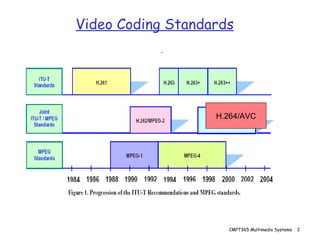
Video Coding Standards H.264/AVC
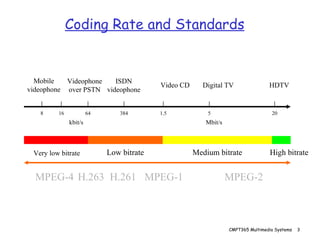
Coding Rate and Standards Mobile videophone Videophone over PSTN ISDN videophone Digital TV HDTV Video CD MPEG-4 MPEG-1 MPEG-2 H.261 H.263 8 16 64 384 1.5 5 20 kbit/s Mbit/s Very low bitrate Low bitrate Medium bitrate High bitrate
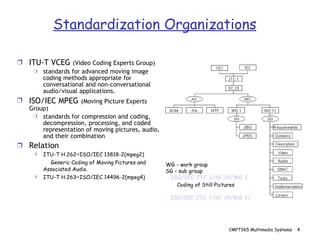
Standardization Organizations ITU-T VCEG  (Video Coding Experts Group)  standards for advanced moving image coding methods appropriate for conversational and non-conversational audio/visual applications.  ISO/IEC MPEG   (Moving Picture Experts Group)  standards for compression and coding, decompression, processing, and coded representation of moving pictures, audio, and their combination Relation ITU-T H.262~ISO/IEC 13818-2(mpeg2) Generic Coding of Moving Pictures and Associated Audio. ITU-T H.263~ISO/IEC 14496-2(mpeg4) WG - work group SG – sub group ISO/IEC JTC 1/SC 29/WG 1   Coding of Still Pictures ISO/IEC JTC 1/SC 29/WG 11
Introduction H.261 MPEG-1 MPEG-2 H.263 MPEG-4 H.264
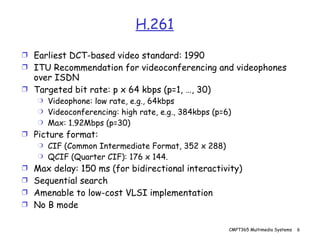
H.261 Earliest DCT-based video standard: 1990 ITU Recommendation for videoconferencing and videophones over ISDN Targeted bit rate: p x 64 kbps (p=1, …, 30) Videophone: low rate, e.g., 64kbps Videoconferencing: high rate, e.g., 384kbps (p=6) Max: 1.92Mbps (p=30) Picture format:  CIF (Common Intermediate Format, 352 x 288) QCIF (Quarter CIF): 176 x 144. Max delay: 150 ms (for bidirectional interactivity) Sequential search Amenable to low-cost VLSI implementation No B mode
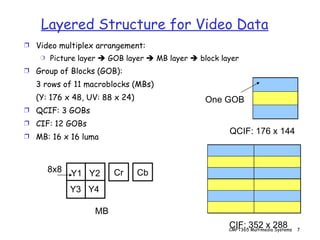
Layered Structure for Video Data Video multiplex arrangement: Picture layer    GOB layer    MB layer    block layer Group of Blocks (GOB):  3 rows of 11 macroblocks (MBs) (Y: 176 x 48, UV: 88 x 24) QCIF: 3 GOBs CIF: 12 GOBs MB: 16 x 16 luma One GOB QCIF: 176 x 144 CIF: 352 x 288 Cr Cb MB Y1  Y2 Y3  Y4 8x8
Entropy coding Similar to JPEG Zigzag scan (Run, Level) coding EOB
Introduction H.261 MPEG-1 MPEG-2 H.263 MPEG-4 H.264
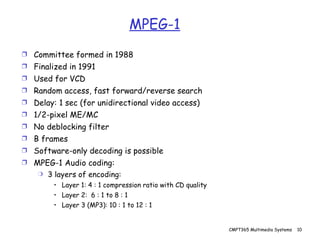
MPEG-1 Committee formed in 1988 Finalized in 1991 Used for VCD Random access, fast forward/reverse search Delay: 1 sec (for unidirectional video access) 1/2-pixel ME/MC No deblocking filter B frames Software-only decoding is possible MPEG-1 Audio coding: 3 layers of encoding: Layer 1: 4 : 1 compression ratio with CD quality Layer 2:  6 : 1 to 8 : 1 Layer 3 (MP3): 10 : 1 to 12 : 1
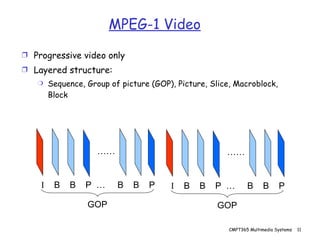
MPEG-1 Video Progressive video only Layered structure: Sequence, Group of picture (GOP), Picture, Slice, Macroblock, Block I   B  B  P  …  B  B  P …… GOP I   B  B  P  …  B  B  P …… GOP
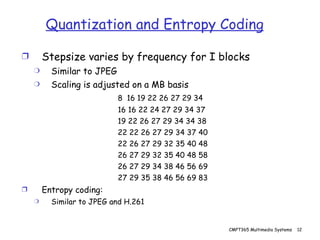
Quantization and Entropy Coding Stepsize varies by frequency for I blocks Similar to JPEG Scaling is adjusted on a MB basis 8  16 19 22 26 27 29 34 16 16 22 24 27 29 34 37 19 22 26 27 29 34 34 38 22 22 26 27 29 34 37 40 22 26 27 29 32 35 40 48 26 27 29 32 35 40 48 58 26 27 29 34 38 46 56 69 27 29 35 38 46 56 69 83 Entropy coding:  Similar to JPEG and H.261
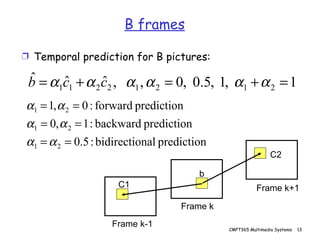
B frames Temporal prediction for B pictures: b C1 C2 Frame k-1 Frame k Frame k+1
Introduction Rate Control and in-loop deblocking filter H.261 MPEG-1 MPEG-2 H.263 MPEG-4 H.264
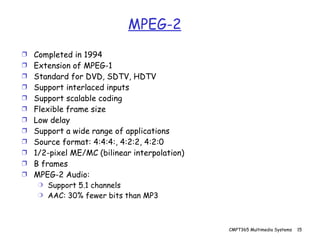
MPEG-2 Completed in 1994 Extension of MPEG-1 Standard for DVD, SDTV, HDTV Support interlaced inputs Support scalable coding Flexible frame size Low delay Support a wide range of applications Source format: 4:4:4:, 4:2:2, 4:2:0 1/2-pixel ME/MC (bilinear interpolation) B frames MPEG-2 Audio: Support 5.1 channels AAC: 30% fewer bits than MP3
Profiles and Levels Defined to manage the large number of coding tools and the broad range of formats and bit rates supported Profiles and levels define a set of conformance points, each targeting a class applications Maximize interoperability and limiting the complexity Profile : a subset of the entire bit stream syntax Levels : a specified set of constraints imposed on values of the syntax elements in the bit stream (maximum bit rate, buffer size, pic. resolution)
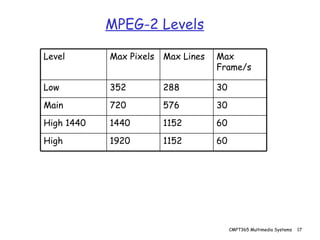
MPEG-2 Levels 60 1152 1920 High 60 1152 1440 High 1440 30 576 720 Main 30 288 352 Low Max Frame/s Max Lines Max Pixels Level
Introduction Rate Control and in-loop deblocking filter H.261 MPEG-1 MPEG-2 H.263 MPEG-4 H.264
H.263 Derived from H.261 Intended for very low bit-rate application Better quality at 18-24kbps than H.261 at 64 kbps Used in MS NetMeeting, Messenger … Can handle high resolution (up to 16CIF: 1408 x 1152) No loop filter 1/2-pixel ME/MC Optional coding modes (defined in 8 Annexes): Unrestricted motion vector (Annex D): MV can point outside of picture boundary by extrapolating the boundary pixels (repeat padding is usually used) MV range: [-31.5, 31.5] Arithmetic coding Advanced prediction (Annex F): Overlapped block motion compensation 4MV: 1 for each 8x8 block
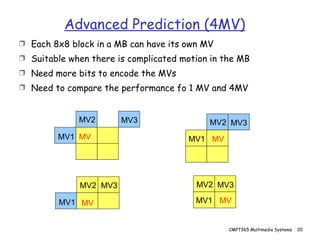
Advanced Prediction (4MV) Each 8x8 block in a MB can have its own MV Suitable when there is complicated motion in the MB Need more bits to encode the MVs Need to compare the performance fo 1 MV and 4MV MV2 MV1 MV MV3 MV2 MV1 MV MV3 MV2 MV1 MV MV3 MV1 MV MV2 MV3
Run-Level-Last Entropy Coding 3-D VLC: ( LAST , RUN, LEVEL): LAST: 1 for last non-zero coefficient of a block 0 otherwise RUN: number of zeros before the current coefficient LEVEL: value of the current non-zero coefficient No EOB as in JPEG
H.263+ and H.263++ H.263+: Second version of H.263 Some further optional features: Annex I to T. Annex J: in-loop deblocking filter H.263++: three more optional modes (2000) Annex V: Data partitioned slice mode  For enhanced resilience to transmission error
Introduction Rate Control and in-loop deblocking filter H.261 MPEG-1 MPEG-2 H.263 MPEG-4 H.264
MPEG-4 Based on H.263 A new concept rather than an improved algorithm Deal with a variety of multimedia contents: audio, visual , image, graphic. Part 2: Visual Based on H.263 Object-based coding Coding of animated objects Scalability: Fine Granular Scalability (FGS) Texture coding: wavelet-based Part 10: Advanced Video Coding H.264
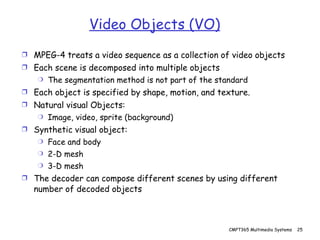
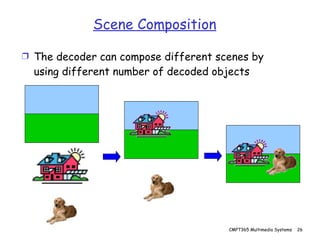
Video Objects (VO) MPEG-4 treats a video sequence as a collection of video objects Each scene is decomposed into multiple objects The segmentation method is not part of the standard Each object is specified by shape, motion, and texture. Natural visual Objects: Image, video, sprite (background) Synthetic visual object: Face and body 2-D mesh 3-D mesh The decoder can compose different scenes by using different number of decoded objects
Scene Composition The decoder can compose different scenes by using different number of decoded objects
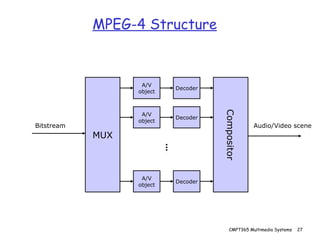
MPEG-4 Structure A/V object Decoder MUX Compositor Bitstream Audio/Video scene A/V object Decoder A/V object Decoder
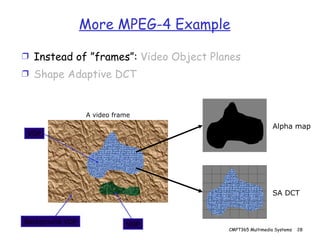
More MPEG-4 Example Instead of ”frames”:  Video Object Planes Shape Adaptive DCT A video frame Background VOP VOP VOP Alpha map SA DCT
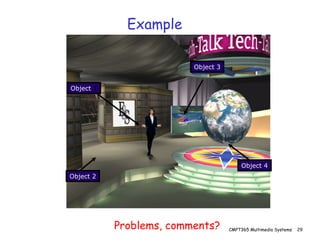
Example Problems, comments? Object 2 Object  1 Object 3 Object   4
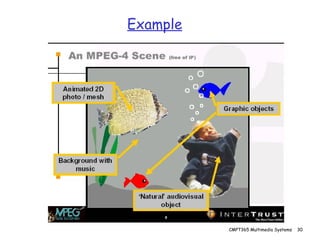
Example
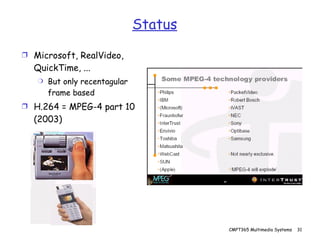
Status Microsoft, RealVideo, QuickTime, ... But only recentagular frame based H.264 = MPEG-4 part 10 (2003)
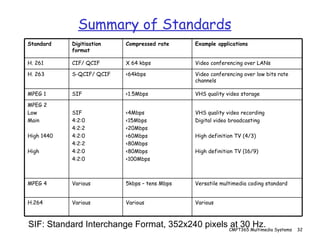
Summary of Standards SIF: Standard Interchange Format, 352x240 pixels at 30 Hz. Versatile multimedia coding standard 5kbps – tens Mbps Various MPEG 4 Various Various Various H.264 VHS quality video recording Digital video broadcasting High definition TV (4/3) High definition TV (16/9) <4Mbps <15Mbps <20Mbps <60Mbps <80Mbps <80Mbps <100Mbps SIF 4:2:0 4:2:2 4:2:0 4:2:2 4:2:0 4:2:0 MPEG 2 Low Main High 1440 High VHS quality video storage <1.5Mbps SIF MPEG 1 Video conferencing over low bits rate channels <64kbps S-QCIF/ QCIF H. 263 Video conferencing over LANs X 64 kbps CIF/ QCIF H. 261 Example applications Compressed rate Digitisation format Standard
What’s Next ?  - H.264 1998: Call for proposal for H.26L issued by ITU-T VCEG (Video Coding Expert Group) Objective:  50% bit rate savings compared to MPEG-2  High quality video at both low and high bit rates More error resilience tools Oct. 1999: First draft design Dec. 2001: VCEG and MPEG formed the Joint Video Team (JVT) Approved in 2003: ITU-T H.264 and ISO/IEC MPEG-4 Part 10 Advanced Video Coding (AVC)
Applications Bit rate: 64kbps to 240Mbps Broadcast over cable, satellite, DSL … Interactive/serial storage on optical/magnetic devices, DVD … Conversational services over network Video on demand, streaming media over network Multimedia messaging service over network Three Profiles: Baseline, Main, and Extended 15 levels Four new profiles in Fidelity Range Extenstions (FRExt): High, High 10, High 4:2:2, High 4:4:4
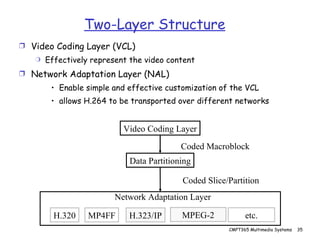
Two-Layer Structure Video Coding Layer (VCL) Effectively represent the video content Network Adaptation Layer (NAL) Enable simple and effective customization of the VCL allows H.264 to be transported over different networks Video Coding Layer Data Partitioning Network Adaptation Layer H.320 MP4FF H.323/IP MPEG-2 etc. Coded Macroblock Coded Slice/Partition
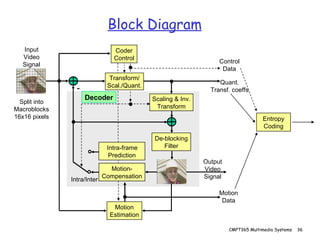
Block Diagram Entropy Coding Scaling & Inv. Transform Motion- Compensation Control Data Quant. Transf. coeffs Motion Data Intra/Inter Coder Control Decoder Motion Estimation Transform/ Scal./ Quant . - Input Video Signal Split into Macroblocks 16x16 pixels Intra-frame  Prediction De-blocking Filter Output Video Signal
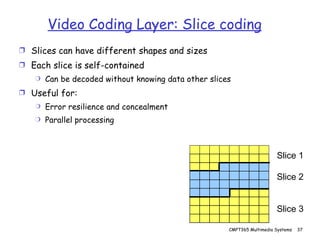
Video Coding Layer: Slice coding Slices can have different shapes and sizes Each slice is self-contained Can be decoded without knowing data other slices Useful for: Error resilience and concealment Parallel processing Slice 1 Slice 2 Slice 3
Intra-Picture Prediction Performed in spatial domain instead of in transform domain Two basic prediction modes: Intra 4x4: for areas with details Intra 16x16: for smooth areas I_PCM: No prediction, raw samples are sent directly. To limit the maximum number of bits for each block
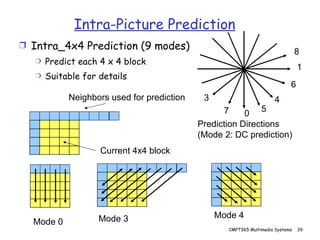
Intra-Picture Prediction Intra_4x4 Prediction (9 modes) Predict each 4 x 4 block Suitable for details Prediction Directions (Mode 2: DC prediction) Mode 0 Mode 3 Mode 4 8 1 6 4 5 0 7 3 Current 4x4 block Neighbors used for prediction
Intra-Picture Prediction  cont’d Intra_16x16 prediction (4 modes) Predict the entire 16 x 16 luma block Suitable for smooth areas
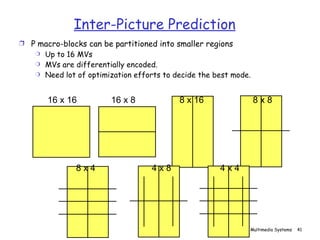
Inter-Picture Prediction P macro-blocks can be partitioned into smaller regions  Up to 16 MVs MVs are differentially encoded. Need lot of optimization efforts to decide the best mode. 16 x 16  16 x 8  8 x 16  8 x 8 8 x 4  4 x 8  4 x 4
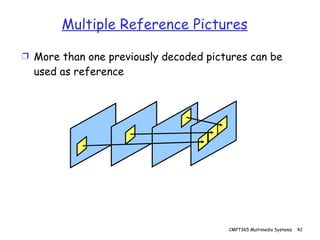
Multiple Reference Pictures More than one previously decoded pictures can be used as reference
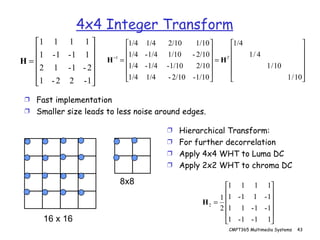
4x4 Integer Transform Fast implementation Smaller size leads to less noise around edges. 16 x 16 8x8 Hierarchical Transform: For further decorrelation Apply 4x4 WHT to Luma DC Apply 2x2 WHT to chroma DC
Entropy Coding CAVLC: Context-adaptive VLC CABAC: Context adaptive binary arithmetic coding 9-14% more efficient than CAVLC
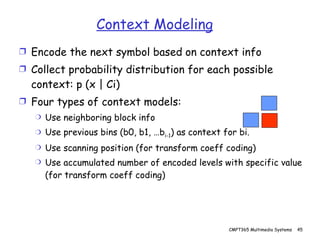
Context Modeling Encode the next symbol based on context info Collect probability distribution for each possible context: p (x | Ci) Four types of context models: Use neighboring block info Use previous bins (b0, b1, …b i-1 ) as context for bi. Use scanning position (for transform coeff coding) Use accumulated number of encoded levels with specific value (for transform coeff coding)
New Directions for H.264 SNR scalability Multi-view coding (3D Audio-visual coding)
Reference D. Marpe, H. Schwarz, T. Wiegand,  Context-based adaptive binary arithmetic coding in the H.264/AVC video compression standard,  IEEE Transactions on Circuits and Systems for Video Technology, Volume: 13 , Issue: 7 , July 2003, Pages: 620 – 636.

Video Coding Standard

  • 1.
    Media Compression -Video Coding Standards Fall 2005 CMPT 365 Multimedia Systems
  • 2.
  • 3.
    Coding Rate andStandards Mobile videophone Videophone over PSTN ISDN videophone Digital TV HDTV Video CD MPEG-4 MPEG-1 MPEG-2 H.261 H.263 8 16 64 384 1.5 5 20 kbit/s Mbit/s Very low bitrate Low bitrate Medium bitrate High bitrate
  • 4.
    Standardization Organizations ITU-TVCEG (Video Coding Experts Group) standards for advanced moving image coding methods appropriate for conversational and non-conversational audio/visual applications. ISO/IEC MPEG (Moving Picture Experts Group) standards for compression and coding, decompression, processing, and coded representation of moving pictures, audio, and their combination Relation ITU-T H.262~ISO/IEC 13818-2(mpeg2) Generic Coding of Moving Pictures and Associated Audio. ITU-T H.263~ISO/IEC 14496-2(mpeg4) WG - work group SG – sub group ISO/IEC JTC 1/SC 29/WG 1 Coding of Still Pictures ISO/IEC JTC 1/SC 29/WG 11
  • 5.
    Introduction H.261 MPEG-1MPEG-2 H.263 MPEG-4 H.264
  • 6.
    H.261 Earliest DCT-basedvideo standard: 1990 ITU Recommendation for videoconferencing and videophones over ISDN Targeted bit rate: p x 64 kbps (p=1, …, 30) Videophone: low rate, e.g., 64kbps Videoconferencing: high rate, e.g., 384kbps (p=6) Max: 1.92Mbps (p=30) Picture format: CIF (Common Intermediate Format, 352 x 288) QCIF (Quarter CIF): 176 x 144. Max delay: 150 ms (for bidirectional interactivity) Sequential search Amenable to low-cost VLSI implementation No B mode
  • 7.
    Layered Structure forVideo Data Video multiplex arrangement: Picture layer  GOB layer  MB layer  block layer Group of Blocks (GOB): 3 rows of 11 macroblocks (MBs) (Y: 176 x 48, UV: 88 x 24) QCIF: 3 GOBs CIF: 12 GOBs MB: 16 x 16 luma One GOB QCIF: 176 x 144 CIF: 352 x 288 Cr Cb MB Y1 Y2 Y3 Y4 8x8
  • 8.
    Entropy coding Similarto JPEG Zigzag scan (Run, Level) coding EOB
  • 9.
    Introduction H.261 MPEG-1MPEG-2 H.263 MPEG-4 H.264
  • 10.
    MPEG-1 Committee formedin 1988 Finalized in 1991 Used for VCD Random access, fast forward/reverse search Delay: 1 sec (for unidirectional video access) 1/2-pixel ME/MC No deblocking filter B frames Software-only decoding is possible MPEG-1 Audio coding: 3 layers of encoding: Layer 1: 4 : 1 compression ratio with CD quality Layer 2: 6 : 1 to 8 : 1 Layer 3 (MP3): 10 : 1 to 12 : 1
  • 11.
    MPEG-1 Video Progressivevideo only Layered structure: Sequence, Group of picture (GOP), Picture, Slice, Macroblock, Block I B B P … B B P …… GOP I B B P … B B P …… GOP
  • 12.
    Quantization and EntropyCoding Stepsize varies by frequency for I blocks Similar to JPEG Scaling is adjusted on a MB basis 8 16 19 22 26 27 29 34 16 16 22 24 27 29 34 37 19 22 26 27 29 34 34 38 22 22 26 27 29 34 37 40 22 26 27 29 32 35 40 48 26 27 29 32 35 40 48 58 26 27 29 34 38 46 56 69 27 29 35 38 46 56 69 83 Entropy coding: Similar to JPEG and H.261
  • 13.
    B frames Temporalprediction for B pictures: b C1 C2 Frame k-1 Frame k Frame k+1
  • 14.
    Introduction Rate Controland in-loop deblocking filter H.261 MPEG-1 MPEG-2 H.263 MPEG-4 H.264
  • 15.
    MPEG-2 Completed in1994 Extension of MPEG-1 Standard for DVD, SDTV, HDTV Support interlaced inputs Support scalable coding Flexible frame size Low delay Support a wide range of applications Source format: 4:4:4:, 4:2:2, 4:2:0 1/2-pixel ME/MC (bilinear interpolation) B frames MPEG-2 Audio: Support 5.1 channels AAC: 30% fewer bits than MP3
  • 16.
    Profiles and LevelsDefined to manage the large number of coding tools and the broad range of formats and bit rates supported Profiles and levels define a set of conformance points, each targeting a class applications Maximize interoperability and limiting the complexity Profile : a subset of the entire bit stream syntax Levels : a specified set of constraints imposed on values of the syntax elements in the bit stream (maximum bit rate, buffer size, pic. resolution)
  • 17.
    MPEG-2 Levels 601152 1920 High 60 1152 1440 High 1440 30 576 720 Main 30 288 352 Low Max Frame/s Max Lines Max Pixels Level
  • 18.
    Introduction Rate Controland in-loop deblocking filter H.261 MPEG-1 MPEG-2 H.263 MPEG-4 H.264
  • 19.
    H.263 Derived fromH.261 Intended for very low bit-rate application Better quality at 18-24kbps than H.261 at 64 kbps Used in MS NetMeeting, Messenger … Can handle high resolution (up to 16CIF: 1408 x 1152) No loop filter 1/2-pixel ME/MC Optional coding modes (defined in 8 Annexes): Unrestricted motion vector (Annex D): MV can point outside of picture boundary by extrapolating the boundary pixels (repeat padding is usually used) MV range: [-31.5, 31.5] Arithmetic coding Advanced prediction (Annex F): Overlapped block motion compensation 4MV: 1 for each 8x8 block
  • 20.
    Advanced Prediction (4MV)Each 8x8 block in a MB can have its own MV Suitable when there is complicated motion in the MB Need more bits to encode the MVs Need to compare the performance fo 1 MV and 4MV MV2 MV1 MV MV3 MV2 MV1 MV MV3 MV2 MV1 MV MV3 MV1 MV MV2 MV3
  • 21.
    Run-Level-Last Entropy Coding3-D VLC: ( LAST , RUN, LEVEL): LAST: 1 for last non-zero coefficient of a block 0 otherwise RUN: number of zeros before the current coefficient LEVEL: value of the current non-zero coefficient No EOB as in JPEG
  • 22.
    H.263+ and H.263++H.263+: Second version of H.263 Some further optional features: Annex I to T. Annex J: in-loop deblocking filter H.263++: three more optional modes (2000) Annex V: Data partitioned slice mode For enhanced resilience to transmission error
  • 23.
    Introduction Rate Controland in-loop deblocking filter H.261 MPEG-1 MPEG-2 H.263 MPEG-4 H.264
  • 24.
    MPEG-4 Based onH.263 A new concept rather than an improved algorithm Deal with a variety of multimedia contents: audio, visual , image, graphic. Part 2: Visual Based on H.263 Object-based coding Coding of animated objects Scalability: Fine Granular Scalability (FGS) Texture coding: wavelet-based Part 10: Advanced Video Coding H.264
  • 25.
    Video Objects (VO)MPEG-4 treats a video sequence as a collection of video objects Each scene is decomposed into multiple objects The segmentation method is not part of the standard Each object is specified by shape, motion, and texture. Natural visual Objects: Image, video, sprite (background) Synthetic visual object: Face and body 2-D mesh 3-D mesh The decoder can compose different scenes by using different number of decoded objects
  • 26.
    Scene Composition Thedecoder can compose different scenes by using different number of decoded objects
  • 27.
    MPEG-4 Structure A/Vobject Decoder MUX Compositor Bitstream Audio/Video scene A/V object Decoder A/V object Decoder
  • 28.
    More MPEG-4 ExampleInstead of ”frames”: Video Object Planes Shape Adaptive DCT A video frame Background VOP VOP VOP Alpha map SA DCT
  • 29.
    Example Problems, comments?Object 2 Object 1 Object 3 Object 4
  • 30.
  • 31.
    Status Microsoft, RealVideo,QuickTime, ... But only recentagular frame based H.264 = MPEG-4 part 10 (2003)
  • 32.
    Summary of StandardsSIF: Standard Interchange Format, 352x240 pixels at 30 Hz. Versatile multimedia coding standard 5kbps – tens Mbps Various MPEG 4 Various Various Various H.264 VHS quality video recording Digital video broadcasting High definition TV (4/3) High definition TV (16/9) <4Mbps <15Mbps <20Mbps <60Mbps <80Mbps <80Mbps <100Mbps SIF 4:2:0 4:2:2 4:2:0 4:2:2 4:2:0 4:2:0 MPEG 2 Low Main High 1440 High VHS quality video storage <1.5Mbps SIF MPEG 1 Video conferencing over low bits rate channels <64kbps S-QCIF/ QCIF H. 263 Video conferencing over LANs X 64 kbps CIF/ QCIF H. 261 Example applications Compressed rate Digitisation format Standard
  • 33.
    What’s Next ? - H.264 1998: Call for proposal for H.26L issued by ITU-T VCEG (Video Coding Expert Group) Objective: 50% bit rate savings compared to MPEG-2 High quality video at both low and high bit rates More error resilience tools Oct. 1999: First draft design Dec. 2001: VCEG and MPEG formed the Joint Video Team (JVT) Approved in 2003: ITU-T H.264 and ISO/IEC MPEG-4 Part 10 Advanced Video Coding (AVC)
  • 34.
    Applications Bit rate:64kbps to 240Mbps Broadcast over cable, satellite, DSL … Interactive/serial storage on optical/magnetic devices, DVD … Conversational services over network Video on demand, streaming media over network Multimedia messaging service over network Three Profiles: Baseline, Main, and Extended 15 levels Four new profiles in Fidelity Range Extenstions (FRExt): High, High 10, High 4:2:2, High 4:4:4
  • 35.
    Two-Layer Structure VideoCoding Layer (VCL) Effectively represent the video content Network Adaptation Layer (NAL) Enable simple and effective customization of the VCL allows H.264 to be transported over different networks Video Coding Layer Data Partitioning Network Adaptation Layer H.320 MP4FF H.323/IP MPEG-2 etc. Coded Macroblock Coded Slice/Partition
  • 36.
    Block Diagram EntropyCoding Scaling & Inv. Transform Motion- Compensation Control Data Quant. Transf. coeffs Motion Data Intra/Inter Coder Control Decoder Motion Estimation Transform/ Scal./ Quant . - Input Video Signal Split into Macroblocks 16x16 pixels Intra-frame Prediction De-blocking Filter Output Video Signal
  • 37.
    Video Coding Layer:Slice coding Slices can have different shapes and sizes Each slice is self-contained Can be decoded without knowing data other slices Useful for: Error resilience and concealment Parallel processing Slice 1 Slice 2 Slice 3
  • 38.
    Intra-Picture Prediction Performedin spatial domain instead of in transform domain Two basic prediction modes: Intra 4x4: for areas with details Intra 16x16: for smooth areas I_PCM: No prediction, raw samples are sent directly. To limit the maximum number of bits for each block
  • 39.
    Intra-Picture Prediction Intra_4x4Prediction (9 modes) Predict each 4 x 4 block Suitable for details Prediction Directions (Mode 2: DC prediction) Mode 0 Mode 3 Mode 4 8 1 6 4 5 0 7 3 Current 4x4 block Neighbors used for prediction
  • 40.
    Intra-Picture Prediction cont’d Intra_16x16 prediction (4 modes) Predict the entire 16 x 16 luma block Suitable for smooth areas
  • 41.
    Inter-Picture Prediction Pmacro-blocks can be partitioned into smaller regions Up to 16 MVs MVs are differentially encoded. Need lot of optimization efforts to decide the best mode. 16 x 16 16 x 8 8 x 16 8 x 8 8 x 4 4 x 8 4 x 4
  • 42.
    Multiple Reference PicturesMore than one previously decoded pictures can be used as reference
  • 43.
    4x4 Integer TransformFast implementation Smaller size leads to less noise around edges. 16 x 16 8x8 Hierarchical Transform: For further decorrelation Apply 4x4 WHT to Luma DC Apply 2x2 WHT to chroma DC
  • 44.
    Entropy Coding CAVLC:Context-adaptive VLC CABAC: Context adaptive binary arithmetic coding 9-14% more efficient than CAVLC
  • 45.
    Context Modeling Encodethe next symbol based on context info Collect probability distribution for each possible context: p (x | Ci) Four types of context models: Use neighboring block info Use previous bins (b0, b1, …b i-1 ) as context for bi. Use scanning position (for transform coeff coding) Use accumulated number of encoded levels with specific value (for transform coeff coding)
  • 46.
    New Directions forH.264 SNR scalability Multi-view coding (3D Audio-visual coding)
  • 47.
    Reference D. Marpe,H. Schwarz, T. Wiegand, Context-based adaptive binary arithmetic coding in the H.264/AVC video compression standard, IEEE Transactions on Circuits and Systems for Video Technology, Volume: 13 , Issue: 7 , July 2003, Pages: 620 – 636.