E-Research Adoption :
A Perspective of Collaboration, Openness and Sustainability
Riri Kusumarani
Committee Members:
Professor Hang-Jung Zo (Advisor)
Professor Jae-Jeung Rho
Professor Duk-Hee Lee
Presented for Master Theses Defense, KAIST @9th December 2013
1. Introduction
2. Literature Review
a) Introduction to E-Research
b) UTAUT Model
3. Research Model + Hypotheses
4. Methodology
5. Results & Discussions
6. Conclusion
Table of Contents
Introduction
Research
Is
Changing
Complex
Large Scale
DataSets
Dependent
ICT
Online

Distributed
Collaborative
Collaboration Openness Sustainability
Problem
Lack of Empirical
Studies
Gap In Research
Objectives
To explore Collaboration , Openness and Sustainability
effect to E-Research adoption
To empirically test the extended UTAUT model
on E-research adoption
1. Introduction
2. Literature Review
a) Introduction to E-Research
b) UTAUT Model
3. Research Model + Hypotheses
4. Methodology
5. Results & Discussions
6. Conclusion
Table of Contents
Literature
Review
E-Research UTAUT
Definition
Paradigm
(Shipp,2005)
Process
Framework
(Khatibi,Montazer 2012)
Definition
(Venkatesh,2003)
Previous
Studies
 Meyer & Schroeder,
 Fitzgerald
Terry & Kanuka
Large
Volume
of Data
Shared
Facilities
Digital
Curation
Commercial
Publication
Open
Access
Same Flow
(Trefil,2001)
Digital
Tool
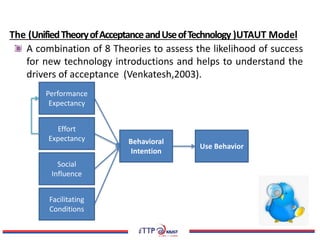
The (UnifiedTheoryofAcceptanceandUseofTechnology )UTAUT Model
A combination of 8 Theories to assess the likelihood of success
for new technology introductions and helps to understand the
drivers of acceptance (Venkatesh,2003).
Performance
Expectancy
Effort
Expectancy
Social
Influence
Facilitating
Conditions
Behavioral
Intention
Use Behavior
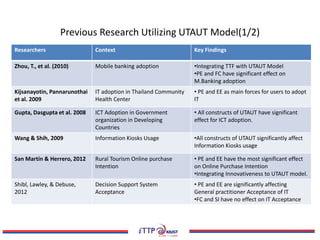
Previous Research Utilizing UTAUT Model(1/2)
Researchers Context Key Findings
Zhou, T., et al. (2010) Mobile banking adoption •Integrating TTF with UTAUT Model
•PE and FC have significant effect on
M.Banking adoption
Kijsanayotin, Pannarunothai
et al. 2009
IT adoption in Thailand Community
Health Center
• PE and EE as main forces for users to adopt
IT
Gupta, Dasgupta et al. 2008 ICT Adoption in Government
organization in Developing
Countries
• All constructs of UTAUT have significant
effect for ICT adoption.
Wang & Shih, 2009 Information Kiosks Usage •All constructs of UTAUT significantly affect
Information Kiosks usage
San Martín & Herrero, 2012 Rural Tourism Online purchase
Intention
• PE and EE have the most significant effect
on Online Purchase Intention
•Integrating Innovativeness to UTAUT model.
Shibl, Lawley, & Debuse,
2012
Decision Support System
Acceptance
• PE and EE are significantly affecting
General practitioner Acceptance of IT
•FC and SI have no effect on IT Acceptance
Previous Research Utilizing UTAUT Model(2/2)
Researchers Context Key Findings
Pynoo et al., 2011 Secondary school teachers’ acceptance
of a digital learning environment
•PE and SI as main predictors of
Teachers’ acceptance on DLE
•EE and FC have minor effect on
teachers’ acceptance of DLE
Escobar-Rodríguez &
Carvajal-Trujillo, 2013
Consumers purchase on website online
tickets
•Habit, price saving, performance and
facilitating conditions are the main
driver for consumer intention to
purchase.
Wei, Marthandan, Chong,
Ooi, & Arumugam, 2009
Malaysians’ M-Commerce Adoption •PE, SI, perceived financial cost and
trust are positively associated with
consumer IU m-commerce in Malaysia.
•EE has an insignificant effect on M-
commerce adoption
Gruzd, Staves, & Wilk, 2012 Social Media Usage in Research Practice
Faculty
• PE and SI positively influence
researchers intention to use social
media
• EE and FC negatively influence
researchers intention.
1. Introduction
2. Literature Review
a) Introduction to E-Research
b) UTAUT Model
3. Research Model + Hypotheses
4. Methodology
5. Results & Discussions
6. Conclusion
Table of ContentsTable of Contents
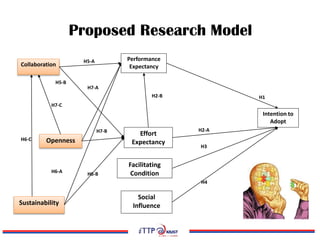
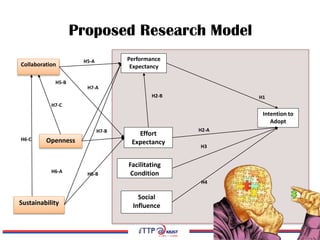
Proposed Research Model
Collaboration
Sustainability
Openness
Performance
Expectancy
Effort
Expectancy
Facilitating
Condition
Social
Influence
Intention to
Adopt
H5-A
H1
H2-A
H2-B
H3
H4
H5-B
H7-A
H7-B
H7-C
H6-BH6-A
H6-C
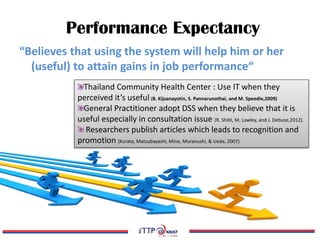
Performance Expectancy
“Believes that using the system will help him or her
(useful) to attain gains in job performance“
Thailand Community Health Center : Use IT when they
perceived it’s useful (B. Kijsanayotin, S. Pannarunothai, and M. Speedie,2009)
General Practitioner adopt DSS when they believe that it is
useful especially in consultation issue (R. Shibl, M. Lawley, and J. Debuse,2012).
Researchers publish articles which leads to recognition and
promotion (Kurata, Matsubayashi, Mine, Muranushi, & Ueda, 2007)
Effort Expectancy
“degree of ease associated with
the use of the system“
 Reluctance to adopt internet facilities due to it is
perceived to be difficult to use (F. A. Ehikhamenor,2003)
User friendliness is crucial in information kiosk
adoption, providing interfaces that is easier to use and
reducing steps need to take (Y.-S. Wang and Y.-W. Shih,2009)
If User s feel that a system is easy to use in which it does not
require them too much effort, users will have higher expectation
regarding their gained performance. (B. Susan A, A. R.Dennis, and V. Venkatesh,
2010 ; S. DASGUPTA, M. GRANGER, and N. MCGARRY, 2002)
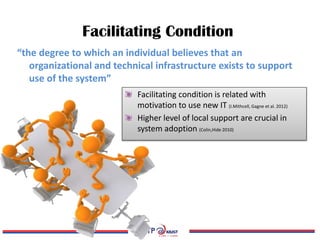
Facilitating Condition
Facilitating condition is related with
motivation to use new IT (I.Mithcell, Gagne et al. 2012)
Higher level of local support are crucial in
system adoption (Colin,Hide 2010)
“the degree to which an individual believes that an
organizational and technical infrastructure exists to support
use of the system”
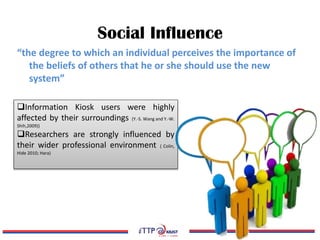
Social Influence
“the degree to which an individual perceives the importance of
the beliefs of others that he or she should use the new
system”
Information Kiosk users were highly
affected by their surroundings (Y.-S. Wang and Y.-W.
Shih,2009))
Researchers are strongly influenced by
their wider professional environment ( Colin,
Hide 2010; Hara)
Proposed Research Model
Collaboration
Sustainability
Openness
Performance
Expectancy
Effort
Expectancy
Facilitating
Condition
Social
Influence
Intention to
Adopt
H5-A
H1
H2-A
H2-B
H3
H4
H5-B
H7-A
H7-B
H7-C
H6-BH6-A
H6-C
Perceived Collaboration (1/2)
Collaboration means to connect groups of people interacted with each
other (MPH 2008)
Research collaboration is the cooperation of researchers in order to achieve
common goal of producing new scientific knowledge (Katz and Martin 1997)
“the degree to which an individual believes that an a technology can
provide higher cooperation and connect with other groups to
achieve common goal”
• Scientists use social media like Twitter to
collaborate and networking (Collins and Hide 2010,
America Geophysical Union article,Kea Giles)
• Collaboration can lead to scientists’ productivity ((Beaver 2001),
(Katz and Martin 1997), (DASGUPTA, GRANGER et al. 2002), (Lee and Bozeman
2005),(Melin 2000), (He, Geng et al. 2009), (Belkhodja and Landry 2007))
Perceived Collaboration (2/2)
Collaboration was done more frequent by more productive
scientists (Katz and Martin 2010)
Research would not be as effective without using e-mails as
tool for collaborating with other scientists (Beaver 2001)
Collaborating helped teachers in understanding and exploring
ideas about teaching and learning, especially in terms of effort
they have to spend (Blumenfeld, Krajcik et al. 1994).
Perceived Sustainability (1/2)
Sustainability means to create service that is
dependable and available in long-term, to share
knowledge throughout community and embed
infrastructure within research practices (Voss, Procter
et.al 2007)
“the degree to which an individual believes that an a
technology will be available long-times”
There’s a need for sustainability practices to support e-research
in a long term (Hey,Trefethen 2003)
E-Journal users concern about long-term accessibility of contents
that are only available digitally( Brennan,Hurd et al. 2002)
Perceived Sustainability (2/2)
Longer-time using a system will affect perception
that system is easy to use (Ke,Sun,Chiyang,2012),while
shorter time will affect the usefulness of that system
(Ke,Sun,Chiyang,2012).
E-Research grand vision is to accumulate research
data overtime (Kee,2010), therefore, if e-research is
available longer, it will be more useful to
researchers.
Gathering people to work together consumes more
time ( Atkinsons,2007)
Collaborative process is more effective in a long
term ( Atkinsons,2007)
Perceived Openness(1/2)
Facilities in this study refers to data, process, final
results of research, infrastructure (Stanford University
Research Policy Handbook)
“the degree to which an individual believes that an a technology can
provide the freedom to use shared facilities among others”
Researchers who share knowledge will gain benefits of enhanced reputation (Wasko &
Faraj 2005)
Researchers shared their knowledge to have recognition and want to be perceived as
expert (Boer, Berends et al. 2011)
Correlation between journal that is being made open with researcher productivity
((Steve Lawrence), (Antelman 2004), (Mann, von Walter et al. 2009))
Researchers also adopting open-access publishing because they believe it will be
easier to access scientific result(Mann, Von Walter 2009)
Proposed Research Model
Collaboration
Sustainability
Openness
Performance
Expectancy
Effort
Expectancy
Facilitating
Condition
Social
Influence
Intention to
Adopt
H5-A
H1
H2-A
H2-B
H3
H4
H5-B
H7-A
H7-B
H7-C
H6-BH6-A
H6-C
1. Introduction
2. Literature Review
a) Introduction to E-Research
b) UTAUT Model
3. Research Model + Hypotheses
4. Methodology
5. Results & Discussions
6. Conclusion
Table of ContentsTable of Contents
Measurement Items Tools
20
Pilot Study
Confirmatory Factor Analysis
Data Collection
1. Introduction
2. Literature Review
a) Introduction to E-Research
b) UTAUT Model
3. Research Model + Hypotheses
4. Methodology
5. Results & Discussions
6. Conclusion
Table of Contents
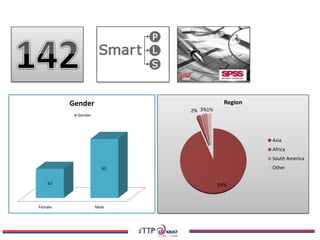
94%
2% 3%1%
Region
Asia
Africa
South America
Other
Female Male
47
95
Gender
Gender
22
40
49
23
8
Research Discipline
Natural
Applied
Social
Computer
Other
0
50
100
Junior Middle Senior
70 59
13
Level of Researcher
Level of Researcher
0
20
40
60
80
100
120
Small Medium Large
115
21
6
# of Project
# of Project
Collaboration
(R2 : 55.6%)
Sustainability
Openness
Performance
Expectancy (R2 :
69.9%)
Effort
Expectancy (R2
: 43.1%)
Facilitating
Condition
Social Influence
Intention to
Adopt (R2 :
63.2%)
3.956
2.876
2.318
5.547
2.207
2.477
3.528
0.366
2.392
4.111
1.579
2.989
7.583
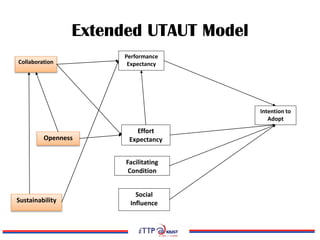
Extended UTAUT Model
Collaboration
Sustainability
Openness
Performance
Expectancy
Effort
Expectancy
Facilitating
Condition
Social
Influence
Intention to
Adopt
KEY
FINDINGS
UTAUT FOR E-
RESEARCH
CONTEXT
PE AS
STRONGEST
FACTOR
EASY TO USE
PERCEPTION
COLLABORATION
LEAD TO
PERFORMANCE
GAIN (Atkinson)
AFFECTED BY
OPENNESS AND
SUSTAINABILITY
SUSTAINABILITY
AFFECTING
PERFORMANCE
EXPECTANCY
NO EFFECT
ON EASY TO
USE
PERCEPTION
OPENNESS
NO EFFECT ON
PERFORMANCE
EXPECTANCY
MEDIATED BY
COLLABORATION
SUSTAINABILITY
NO EFFECT
ON EASY TO
USE
PERCEPTION
 Older System is associated with Greater Complexity
(Swanson and Dans 2000).
OPENNESS
NO EFFECT ON
PERFORMANCE
EXPECTANCY
Negating Previous Studies ( Lawrence 2001 , Antelman 2004)
 More Factors contribute to Researchers’ Performance
Expectancy(Pelz 1956)
MEDIATED BY
COLLABORATION
 Free shared facilities can be used for increasing
productivity if there’re lots of people collaborating to
use it.
1. Introduction
2. Literature Review
a) Introduction to E-Research
b) UTAUT Model
3. Research Model + Hypotheses
4. Methodology
5. Results & Discussions
6. Conclusion
Table of Contents
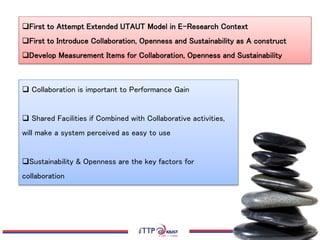
First to Attempt Extended UTAUT Model in E-Research Context
First to Introduce Collaboration, Openness and Sustainability as A construct
Develop Measurement Items for Collaboration, Openness and Sustainability
 Collaboration is important to Performance Gain
 Shared Facilities if Combined with Collaborative activities,
will make a system perceived as easy to use
Sustainability & Openness are the key factors for
collaboration
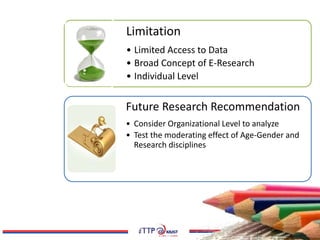
Limitation
• Limited Access to Data
• Broad Concept of E-Research
• Individual Level
Future Research Recommendation
• Consider Organizational Level to analyze
• Test the moderating effect of Age-Gender and
Research disciplines
Thank You
Terima Kasih
감사합니다

E-Research adoption : A perspective of Collaboration , openness and sustainability

  • 1.
    E-Research Adoption : APerspective of Collaboration, Openness and Sustainability Riri Kusumarani Committee Members: Professor Hang-Jung Zo (Advisor) Professor Jae-Jeung Rho Professor Duk-Hee Lee Presented for Master Theses Defense, KAIST @9th December 2013
  • 2.
    1. Introduction 2. LiteratureReview a) Introduction to E-Research b) UTAUT Model 3. Research Model + Hypotheses 4. Methodology 5. Results & Discussions 6. Conclusion Table of Contents
  • 3.
  • 4.
    To explore Collaboration, Openness and Sustainability effect to E-Research adoption To empirically test the extended UTAUT model on E-research adoption
  • 5.
    1. Introduction 2. LiteratureReview a) Introduction to E-Research b) UTAUT Model 3. Research Model + Hypotheses 4. Methodology 5. Results & Discussions 6. Conclusion Table of Contents
  • 6.
    Literature Review E-Research UTAUT Definition Paradigm (Shipp,2005) Process Framework (Khatibi,Montazer 2012) Definition (Venkatesh,2003) Previous Studies Meyer & Schroeder,  Fitzgerald Terry & Kanuka Large Volume of Data Shared Facilities Digital Curation Commercial Publication Open Access Same Flow (Trefil,2001) Digital Tool
  • 7.
    The (UnifiedTheoryofAcceptanceandUseofTechnology )UTAUTModel A combination of 8 Theories to assess the likelihood of success for new technology introductions and helps to understand the drivers of acceptance (Venkatesh,2003). Performance Expectancy Effort Expectancy Social Influence Facilitating Conditions Behavioral Intention Use Behavior
  • 8.
    Previous Research UtilizingUTAUT Model(1/2) Researchers Context Key Findings Zhou, T., et al. (2010) Mobile banking adoption •Integrating TTF with UTAUT Model •PE and FC have significant effect on M.Banking adoption Kijsanayotin, Pannarunothai et al. 2009 IT adoption in Thailand Community Health Center • PE and EE as main forces for users to adopt IT Gupta, Dasgupta et al. 2008 ICT Adoption in Government organization in Developing Countries • All constructs of UTAUT have significant effect for ICT adoption. Wang & Shih, 2009 Information Kiosks Usage •All constructs of UTAUT significantly affect Information Kiosks usage San Martín & Herrero, 2012 Rural Tourism Online purchase Intention • PE and EE have the most significant effect on Online Purchase Intention •Integrating Innovativeness to UTAUT model. Shibl, Lawley, & Debuse, 2012 Decision Support System Acceptance • PE and EE are significantly affecting General practitioner Acceptance of IT •FC and SI have no effect on IT Acceptance
  • 9.
    Previous Research UtilizingUTAUT Model(2/2) Researchers Context Key Findings Pynoo et al., 2011 Secondary school teachers’ acceptance of a digital learning environment •PE and SI as main predictors of Teachers’ acceptance on DLE •EE and FC have minor effect on teachers’ acceptance of DLE Escobar-Rodríguez & Carvajal-Trujillo, 2013 Consumers purchase on website online tickets •Habit, price saving, performance and facilitating conditions are the main driver for consumer intention to purchase. Wei, Marthandan, Chong, Ooi, & Arumugam, 2009 Malaysians’ M-Commerce Adoption •PE, SI, perceived financial cost and trust are positively associated with consumer IU m-commerce in Malaysia. •EE has an insignificant effect on M- commerce adoption Gruzd, Staves, & Wilk, 2012 Social Media Usage in Research Practice Faculty • PE and SI positively influence researchers intention to use social media • EE and FC negatively influence researchers intention.
  • 10.
    1. Introduction 2. LiteratureReview a) Introduction to E-Research b) UTAUT Model 3. Research Model + Hypotheses 4. Methodology 5. Results & Discussions 6. Conclusion Table of ContentsTable of Contents
  • 11.
  • 12.
    Performance Expectancy “Believes thatusing the system will help him or her (useful) to attain gains in job performance“ Thailand Community Health Center : Use IT when they perceived it’s useful (B. Kijsanayotin, S. Pannarunothai, and M. Speedie,2009) General Practitioner adopt DSS when they believe that it is useful especially in consultation issue (R. Shibl, M. Lawley, and J. Debuse,2012). Researchers publish articles which leads to recognition and promotion (Kurata, Matsubayashi, Mine, Muranushi, & Ueda, 2007)
  • 13.
    Effort Expectancy “degree ofease associated with the use of the system“  Reluctance to adopt internet facilities due to it is perceived to be difficult to use (F. A. Ehikhamenor,2003) User friendliness is crucial in information kiosk adoption, providing interfaces that is easier to use and reducing steps need to take (Y.-S. Wang and Y.-W. Shih,2009) If User s feel that a system is easy to use in which it does not require them too much effort, users will have higher expectation regarding their gained performance. (B. Susan A, A. R.Dennis, and V. Venkatesh, 2010 ; S. DASGUPTA, M. GRANGER, and N. MCGARRY, 2002)
  • 14.
    Facilitating Condition Facilitating conditionis related with motivation to use new IT (I.Mithcell, Gagne et al. 2012) Higher level of local support are crucial in system adoption (Colin,Hide 2010) “the degree to which an individual believes that an organizational and technical infrastructure exists to support use of the system”
  • 15.
    Social Influence “the degreeto which an individual perceives the importance of the beliefs of others that he or she should use the new system” Information Kiosk users were highly affected by their surroundings (Y.-S. Wang and Y.-W. Shih,2009)) Researchers are strongly influenced by their wider professional environment ( Colin, Hide 2010; Hara)
  • 16.
  • 17.
    Perceived Collaboration (1/2) Collaborationmeans to connect groups of people interacted with each other (MPH 2008) Research collaboration is the cooperation of researchers in order to achieve common goal of producing new scientific knowledge (Katz and Martin 1997) “the degree to which an individual believes that an a technology can provide higher cooperation and connect with other groups to achieve common goal” • Scientists use social media like Twitter to collaborate and networking (Collins and Hide 2010, America Geophysical Union article,Kea Giles) • Collaboration can lead to scientists’ productivity ((Beaver 2001), (Katz and Martin 1997), (DASGUPTA, GRANGER et al. 2002), (Lee and Bozeman 2005),(Melin 2000), (He, Geng et al. 2009), (Belkhodja and Landry 2007))
  • 18.
    Perceived Collaboration (2/2) Collaborationwas done more frequent by more productive scientists (Katz and Martin 2010) Research would not be as effective without using e-mails as tool for collaborating with other scientists (Beaver 2001) Collaborating helped teachers in understanding and exploring ideas about teaching and learning, especially in terms of effort they have to spend (Blumenfeld, Krajcik et al. 1994).
  • 19.
    Perceived Sustainability (1/2) Sustainabilitymeans to create service that is dependable and available in long-term, to share knowledge throughout community and embed infrastructure within research practices (Voss, Procter et.al 2007) “the degree to which an individual believes that an a technology will be available long-times” There’s a need for sustainability practices to support e-research in a long term (Hey,Trefethen 2003) E-Journal users concern about long-term accessibility of contents that are only available digitally( Brennan,Hurd et al. 2002)
  • 20.
    Perceived Sustainability (2/2) Longer-timeusing a system will affect perception that system is easy to use (Ke,Sun,Chiyang,2012),while shorter time will affect the usefulness of that system (Ke,Sun,Chiyang,2012). E-Research grand vision is to accumulate research data overtime (Kee,2010), therefore, if e-research is available longer, it will be more useful to researchers. Gathering people to work together consumes more time ( Atkinsons,2007) Collaborative process is more effective in a long term ( Atkinsons,2007)
  • 21.
    Perceived Openness(1/2) Facilities inthis study refers to data, process, final results of research, infrastructure (Stanford University Research Policy Handbook) “the degree to which an individual believes that an a technology can provide the freedom to use shared facilities among others” Researchers who share knowledge will gain benefits of enhanced reputation (Wasko & Faraj 2005) Researchers shared their knowledge to have recognition and want to be perceived as expert (Boer, Berends et al. 2011) Correlation between journal that is being made open with researcher productivity ((Steve Lawrence), (Antelman 2004), (Mann, von Walter et al. 2009)) Researchers also adopting open-access publishing because they believe it will be easier to access scientific result(Mann, Von Walter 2009)
  • 22.
  • 23.
    1. Introduction 2. LiteratureReview a) Introduction to E-Research b) UTAUT Model 3. Research Model + Hypotheses 4. Methodology 5. Results & Discussions 6. Conclusion Table of ContentsTable of Contents
  • 24.
    Measurement Items Tools 20 PilotStudy Confirmatory Factor Analysis Data Collection
  • 25.
    1. Introduction 2. LiteratureReview a) Introduction to E-Research b) UTAUT Model 3. Research Model + Hypotheses 4. Methodology 5. Results & Discussions 6. Conclusion Table of Contents
  • 26.
  • 27.
    22 40 49 23 8 Research Discipline Natural Applied Social Computer Other 0 50 100 Junior MiddleSenior 70 59 13 Level of Researcher Level of Researcher 0 20 40 60 80 100 120 Small Medium Large 115 21 6 # of Project # of Project
  • 28.
    Collaboration (R2 : 55.6%) Sustainability Openness Performance Expectancy(R2 : 69.9%) Effort Expectancy (R2 : 43.1%) Facilitating Condition Social Influence Intention to Adopt (R2 : 63.2%) 3.956 2.876 2.318 5.547 2.207 2.477 3.528 0.366 2.392 4.111 1.579 2.989 7.583
  • 29.
  • 30.
    KEY FINDINGS UTAUT FOR E- RESEARCH CONTEXT PEAS STRONGEST FACTOR EASY TO USE PERCEPTION COLLABORATION LEAD TO PERFORMANCE GAIN (Atkinson) AFFECTED BY OPENNESS AND SUSTAINABILITY SUSTAINABILITY AFFECTING PERFORMANCE EXPECTANCY NO EFFECT ON EASY TO USE PERCEPTION OPENNESS NO EFFECT ON PERFORMANCE EXPECTANCY MEDIATED BY COLLABORATION
  • 31.
    SUSTAINABILITY NO EFFECT ON EASYTO USE PERCEPTION  Older System is associated with Greater Complexity (Swanson and Dans 2000). OPENNESS NO EFFECT ON PERFORMANCE EXPECTANCY Negating Previous Studies ( Lawrence 2001 , Antelman 2004)  More Factors contribute to Researchers’ Performance Expectancy(Pelz 1956) MEDIATED BY COLLABORATION  Free shared facilities can be used for increasing productivity if there’re lots of people collaborating to use it.
  • 32.
    1. Introduction 2. LiteratureReview a) Introduction to E-Research b) UTAUT Model 3. Research Model + Hypotheses 4. Methodology 5. Results & Discussions 6. Conclusion Table of Contents
  • 33.
    First to AttemptExtended UTAUT Model in E-Research Context First to Introduce Collaboration, Openness and Sustainability as A construct Develop Measurement Items for Collaboration, Openness and Sustainability  Collaboration is important to Performance Gain  Shared Facilities if Combined with Collaborative activities, will make a system perceived as easy to use Sustainability & Openness are the key factors for collaboration
  • 34.
    Limitation • Limited Accessto Data • Broad Concept of E-Research • Individual Level Future Research Recommendation • Consider Organizational Level to analyze • Test the moderating effect of Age-Gender and Research disciplines
  • 36.