PRESENTED BY :
AMAR BORKUTE
INTRODUCTION
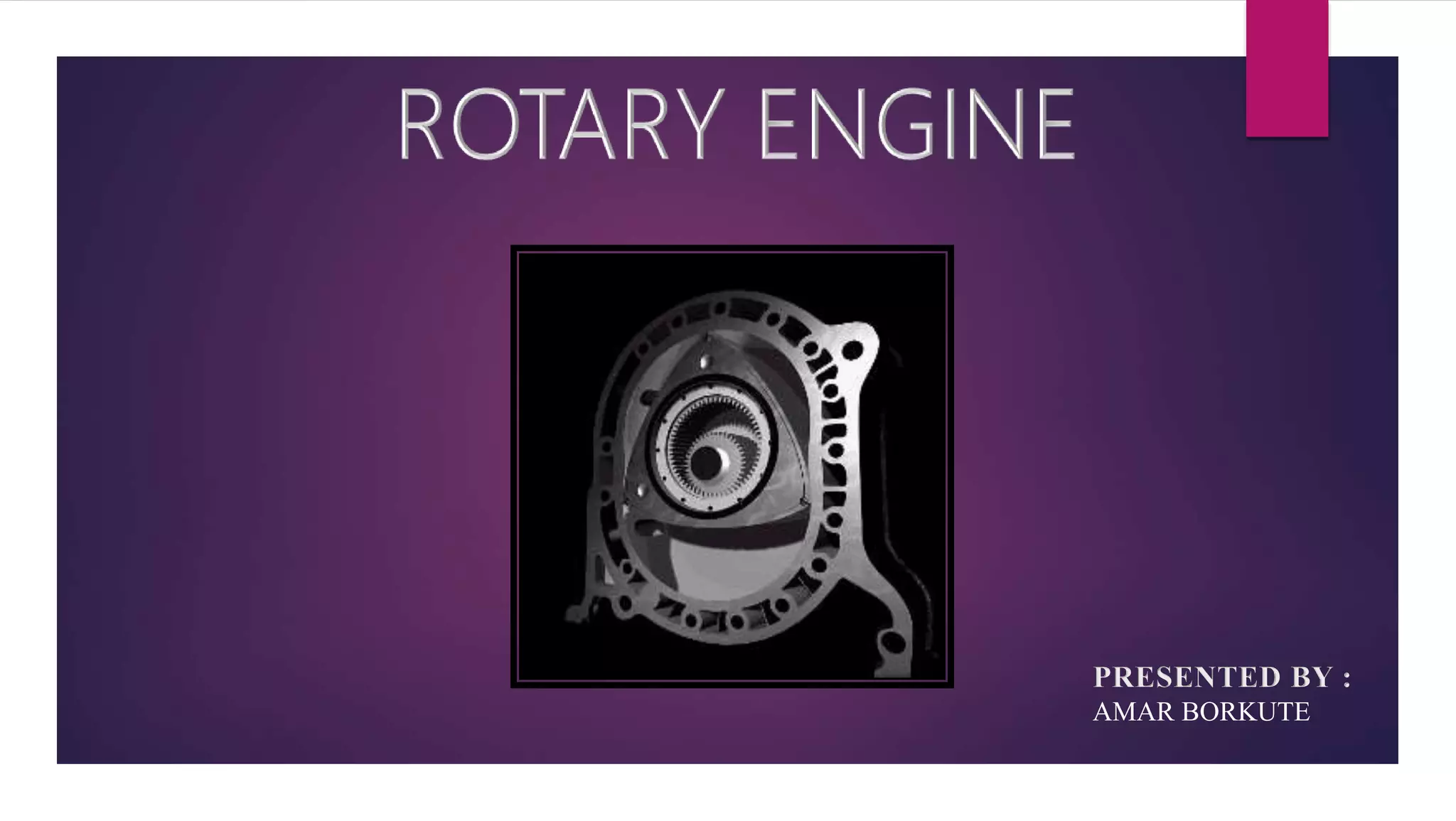
 The Wankel engine is a type of internal combustion
engine using an eccentric rotary design to convert pressure
into rotating motion. Over the commonly
used reciprocating piston designs, the Wankel engine
delivers advantages of: simplicity, smoothness,
compactness, high revolutions per minute, and a high
power-to-weight ratio.
 All parts rotate moving in one direction as opposed to the
common piston engine which has pistons violently
changing direction.
BACKGROUND
 The concept of the engine was conceived by German engineer Felix
Wankel.
 Wankel received his first patent for the engine in 1929, began
development in the early 1950s at NSU, and completed a working
prototype in 1957.
 NSU subsequently licensed the design to companies around the
world, which have continually added improvements.
Engineer Felix Wankel
DESIGN OF WANKEL ENGINE
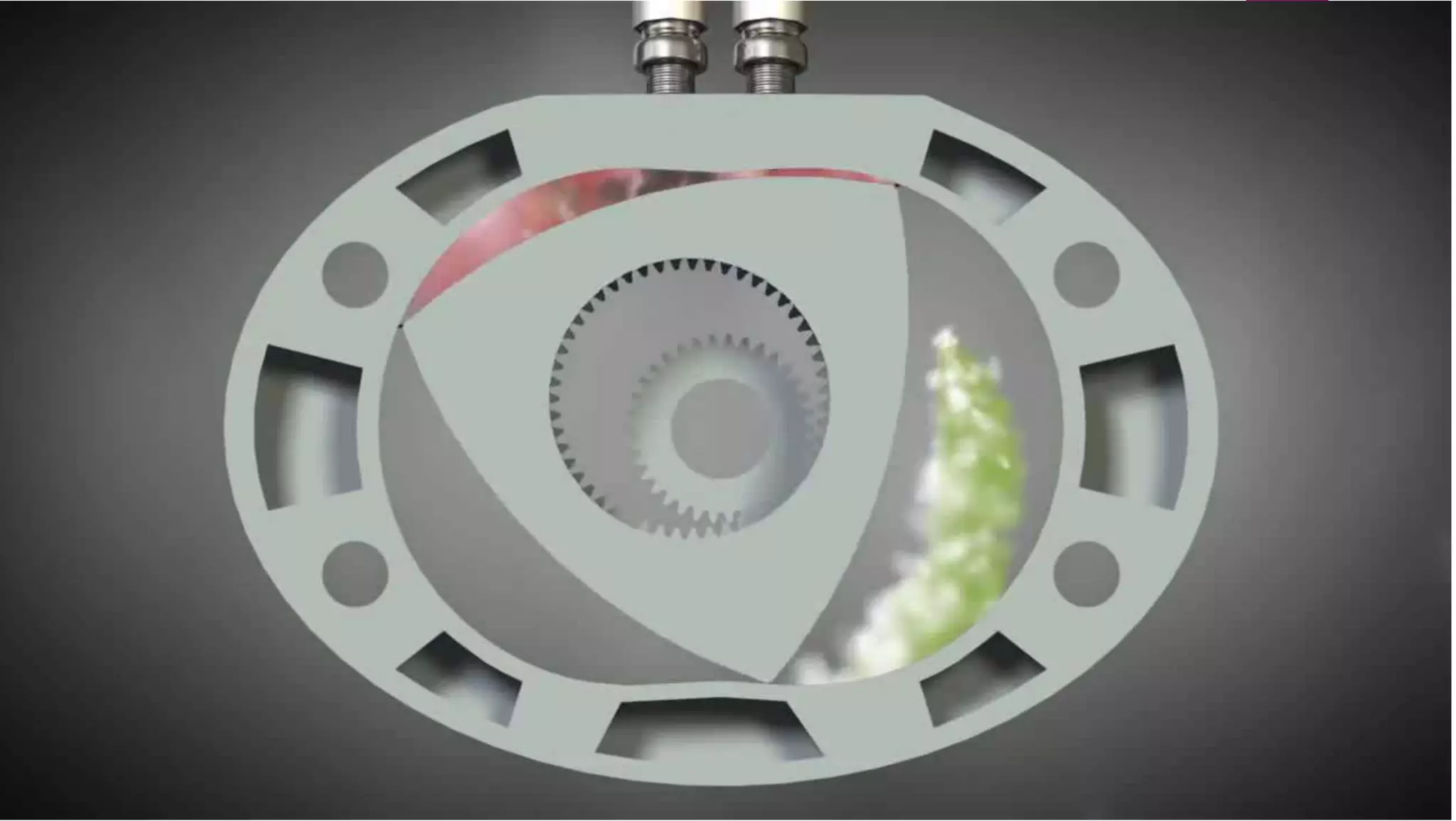
 In the Wankel engine, the four strokes of a Otto cycle piston engine occur in the
space between a three-sided symmetric rotor and the inside of a housing. In each
rotor of the Wankel engine, the oval-like epitrochoid-shaped housing surrounds a
rotor which is triangular with bow-shaped flanks (often confused with a Reuleaux
triangle, a three-pointed curve of constant width, but with the bulge in the middle of
each side a bit more flattened).
 The central drive shaft, called the "eccentric shaft" or "E-shaft", passes through the
center of the rotor and is supported by fixed bearings. The rotors ride
on eccentrics (analogous to crankpins) integral to the eccentric shaft (analogous to a
crankshaft). The rotors both rotate around the eccentrics and make orbital
revolutions around the eccentric shaft. Seals at the corners of the rotor seal against
the periphery of the housing, dividing it into three moving combustion chambers.
Fig. Design of Wankel Engine
HOUSING
ENGINE INLET
COMBUSTION
CHAMBER
ECCENTRIC
SHAFT
SPARK PLUG
STATIONARY
GEAR
ROTOR
APEX
INTERNAL
GEAR
EXHAUST
OUTLET
WORKING
 Rotor Wankel engine, a single oval (technically a epitrochoid)
housing surrounds a three-sided rotor (a Reuleaux triangle)
which turns and moves within the housing.
 It works on otto cycle. As the rotor rotates orbitally revolving,
each side of the rotor is brought closer to and then away from the
wall of the housing, compressing and expanding the combustion
chamber like the strokes of a piston in a reciprocating piston
engine. The power vector of the combustion stage goes through
the center of the offset lobe.
 Its working consist of four Strokes Which are shown in fig.
MATERIAL
 Unlike a piston engine, where the cylinder is cooled by the incoming charge
after being heated by combustion, Wankel rotor housings are constantly
heated on one side and cooled on the other, leading to high local
temperatures and unequal thermal expansion. While this places high
demands on the materials used, the simplicity of the Wankel makes it easier
to use alternative materials, such as exotic alloys and ceramics.
 For the apex seals, the choice of materials has evolved along with the
experience gained, from carbon alloys, to steel, FerroTiC, and others. The
combination between housing plating and apex and side seals materials
was determined experimentally, to obtain the best duration of both seals
and housing cover. For the shaft, steel alloys with little deformation on load
are preferred, the use of Maraging steel has been proposed for this.
High temperature region
Low temperature region
SEALING
 Early engine designs had a high incidence of sealing loss, both between the rotor and the
housing and also between the various pieces making up the housing. Also, in earlier model
Wankel engines, carbon particles could become trapped between the seal and the casing,
jamming the engine and requiring a partial rebuild. It was common for very early Mazda engines
to require rebuilding after 50,000 miles (80,000 km).
 Further sealing problems arise from the uneven thermal distribution within the housings
causing distortion and loss of sealing and compression. This thermal distortion also causes
uneven wear between the apex seal and the rotor housing, evident on higher mileage engines.
The problem is enhanced when the engine is stressed before reaching operating temperature.
However, Mazda Wankel engines have solved these problems. Current engines have nearly 100
seal-related parts.
FUEL ECONOMY AND EMISSION
 The shape of the Wankel combustion chamber is more resistant to preignition operating on lower-
octane rating gasoline than a comparable piston engine. The combustion chamber shape also leads to
relatively incomplete combustion of the air-fuel charge, with a larger amount of unburned
hydrocarbons released into the exhaust.
 The exhaust is, however, relatively low in NOx emissions, as combustion temperatures are lower than
in other engines, and also because of some inherent exhaust gas recirculation (EGR) in early engines.
By decreasing the air-fuel ratio until unburned hydrocarbons (HC) in the exhaust would support
combustion in the thermal reactor. Piston-engine cars required expensive catalytic converters to deal
with both unburned hydrocarbons and NOx emissions. This inexpensive solution improved fuel
consumption, which was already a weak point for the Wankel engine, at the same time that the oil
crisis of 1973 raised the price of gasoline.
ADVANTAGES
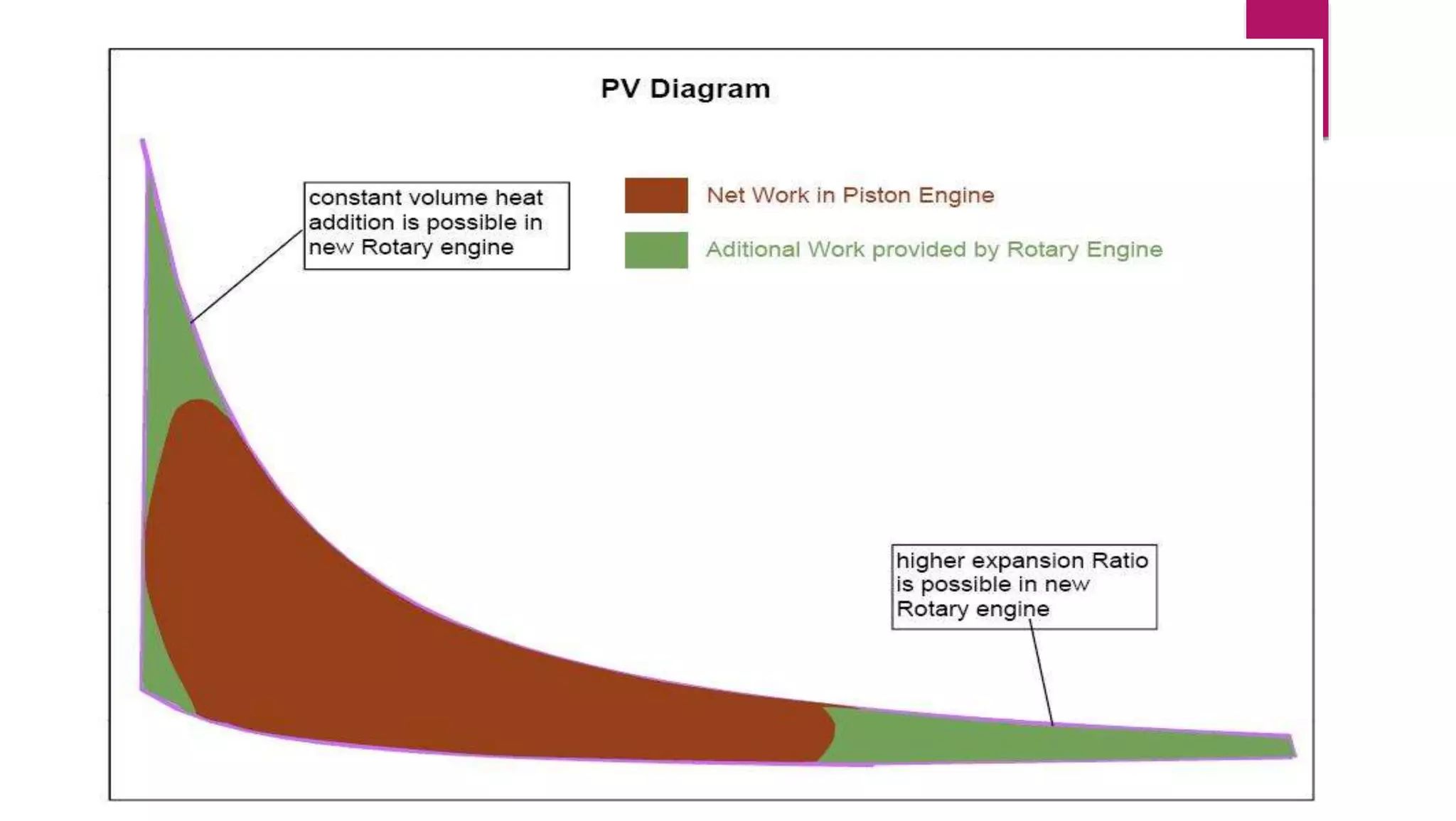
 Have higher output for similar displacement and physical size.
 It is simple and have fewer moving parts. No need for connecting rods, a conventional crankshaft,
crankshaft balance weights, etc.
 Smoother flow of power but also the ability to produce more power by running at higher rpm.
 Fuel of very low octane number can be used without preignition or knock.
 A far higher power to weight ratio than a piston engine (it is approximately one third of the weight
of a piston engine of equivalent power output).
DISADVANTAGES
 High Sealing loss & Low efficiency.
 Slow combustion.
 Emission of toxic fumes.
 In terms of fuel economy, Wankel engines are generally less efficient than four
stroke piston engines.
 It’s difficult to have more than two rotors.
APPLICATIONS
 For mini, micro, and micro-mini engine designs.
 The most recent use of the Wankel design is in the seat belt pre-tensioner system of some
Mercedes-Benz.
 It is used in mazda cars.
 The Wankel engine have applications in a variety of vehicles and devices,
including: automobiles, motorcycles, racing cars, aircraft, go-karts, jet skis, snowmobiles, chain
saws, and auxiliary power units.
 Its used in DRDO Nishant UAV used by INDIAN Army.
..….?
Wankel engine

Wankel engine

  • 1.
  • 2.
    INTRODUCTION  The Wankelengine is a type of internal combustion engine using an eccentric rotary design to convert pressure into rotating motion. Over the commonly used reciprocating piston designs, the Wankel engine delivers advantages of: simplicity, smoothness, compactness, high revolutions per minute, and a high power-to-weight ratio.  All parts rotate moving in one direction as opposed to the common piston engine which has pistons violently changing direction.
  • 3.
    BACKGROUND  The conceptof the engine was conceived by German engineer Felix Wankel.  Wankel received his first patent for the engine in 1929, began development in the early 1950s at NSU, and completed a working prototype in 1957.  NSU subsequently licensed the design to companies around the world, which have continually added improvements. Engineer Felix Wankel
  • 4.
    DESIGN OF WANKELENGINE  In the Wankel engine, the four strokes of a Otto cycle piston engine occur in the space between a three-sided symmetric rotor and the inside of a housing. In each rotor of the Wankel engine, the oval-like epitrochoid-shaped housing surrounds a rotor which is triangular with bow-shaped flanks (often confused with a Reuleaux triangle, a three-pointed curve of constant width, but with the bulge in the middle of each side a bit more flattened).  The central drive shaft, called the "eccentric shaft" or "E-shaft", passes through the center of the rotor and is supported by fixed bearings. The rotors ride on eccentrics (analogous to crankpins) integral to the eccentric shaft (analogous to a crankshaft). The rotors both rotate around the eccentrics and make orbital revolutions around the eccentric shaft. Seals at the corners of the rotor seal against the periphery of the housing, dividing it into three moving combustion chambers.
  • 5.
    Fig. Design ofWankel Engine HOUSING ENGINE INLET COMBUSTION CHAMBER ECCENTRIC SHAFT SPARK PLUG STATIONARY GEAR ROTOR APEX INTERNAL GEAR EXHAUST OUTLET
  • 6.
    WORKING  Rotor Wankelengine, a single oval (technically a epitrochoid) housing surrounds a three-sided rotor (a Reuleaux triangle) which turns and moves within the housing.  It works on otto cycle. As the rotor rotates orbitally revolving, each side of the rotor is brought closer to and then away from the wall of the housing, compressing and expanding the combustion chamber like the strokes of a piston in a reciprocating piston engine. The power vector of the combustion stage goes through the center of the offset lobe.  Its working consist of four Strokes Which are shown in fig.
  • 9.
    MATERIAL  Unlike apiston engine, where the cylinder is cooled by the incoming charge after being heated by combustion, Wankel rotor housings are constantly heated on one side and cooled on the other, leading to high local temperatures and unequal thermal expansion. While this places high demands on the materials used, the simplicity of the Wankel makes it easier to use alternative materials, such as exotic alloys and ceramics.  For the apex seals, the choice of materials has evolved along with the experience gained, from carbon alloys, to steel, FerroTiC, and others. The combination between housing plating and apex and side seals materials was determined experimentally, to obtain the best duration of both seals and housing cover. For the shaft, steel alloys with little deformation on load are preferred, the use of Maraging steel has been proposed for this. High temperature region Low temperature region
  • 10.
    SEALING  Early enginedesigns had a high incidence of sealing loss, both between the rotor and the housing and also between the various pieces making up the housing. Also, in earlier model Wankel engines, carbon particles could become trapped between the seal and the casing, jamming the engine and requiring a partial rebuild. It was common for very early Mazda engines to require rebuilding after 50,000 miles (80,000 km).  Further sealing problems arise from the uneven thermal distribution within the housings causing distortion and loss of sealing and compression. This thermal distortion also causes uneven wear between the apex seal and the rotor housing, evident on higher mileage engines. The problem is enhanced when the engine is stressed before reaching operating temperature. However, Mazda Wankel engines have solved these problems. Current engines have nearly 100 seal-related parts.
  • 11.
    FUEL ECONOMY ANDEMISSION  The shape of the Wankel combustion chamber is more resistant to preignition operating on lower- octane rating gasoline than a comparable piston engine. The combustion chamber shape also leads to relatively incomplete combustion of the air-fuel charge, with a larger amount of unburned hydrocarbons released into the exhaust.  The exhaust is, however, relatively low in NOx emissions, as combustion temperatures are lower than in other engines, and also because of some inherent exhaust gas recirculation (EGR) in early engines. By decreasing the air-fuel ratio until unburned hydrocarbons (HC) in the exhaust would support combustion in the thermal reactor. Piston-engine cars required expensive catalytic converters to deal with both unburned hydrocarbons and NOx emissions. This inexpensive solution improved fuel consumption, which was already a weak point for the Wankel engine, at the same time that the oil crisis of 1973 raised the price of gasoline.
  • 12.
    ADVANTAGES  Have higheroutput for similar displacement and physical size.  It is simple and have fewer moving parts. No need for connecting rods, a conventional crankshaft, crankshaft balance weights, etc.  Smoother flow of power but also the ability to produce more power by running at higher rpm.  Fuel of very low octane number can be used without preignition or knock.  A far higher power to weight ratio than a piston engine (it is approximately one third of the weight of a piston engine of equivalent power output).
  • 14.
    DISADVANTAGES  High Sealingloss & Low efficiency.  Slow combustion.  Emission of toxic fumes.  In terms of fuel economy, Wankel engines are generally less efficient than four stroke piston engines.  It’s difficult to have more than two rotors.
  • 15.
    APPLICATIONS  For mini,micro, and micro-mini engine designs.  The most recent use of the Wankel design is in the seat belt pre-tensioner system of some Mercedes-Benz.  It is used in mazda cars.  The Wankel engine have applications in a variety of vehicles and devices, including: automobiles, motorcycles, racing cars, aircraft, go-karts, jet skis, snowmobiles, chain saws, and auxiliary power units.  Its used in DRDO Nishant UAV used by INDIAN Army.
  • 16.