UNIT –II
GEARS AND GEAR TRAIN
CHAPTER 4 - GEARS
Introduction
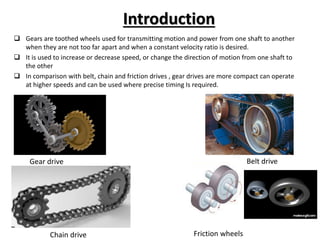
 Gears are toothed wheels used for transmitting motion and power from one shaft to another
when they are not too far apart and when a constant velocity ratio is desired.
 It is used to increase or decrease speed, or change the direction of motion from one shaft to
the other
 In comparison with belt, chain and friction drives , gear drives are more compact can operate
at higher speeds and can be used where precise timing Is required.
Gear drive Belt drive
Chain drive Friction wheels
Introduction
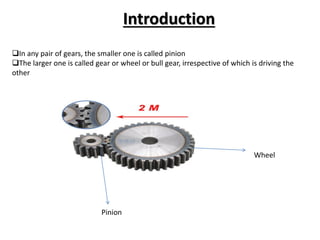
In any pair of gears, the smaller one is called pinion
The larger one is called gear or wheel or bull gear, irrespective of which is driving the
other
Wheel
Pinion
 Advantages of gear drive over belt and chain drive
 Since there is no slip, so exact velocity ratio is obtained
 It is capable of transmitting larger power (than that of belt and chain drive)
 It is more efficient and effective means of power transmission
 Disadvantages of gear drive over belt and chain drive
• The manufacture of gears require special tools and equipment and hence manufacturing cost of
gears is high
• The maintenance cost of gear drive is comparatively high
• The error in cutting teeth may cause vibration and noise during operation
******Tooth vs Teeth******
Tooth is used in singular form while teeth is plural i.e., if it is one then ‘tooth’ and if it is more than
one then teeth
GEAR CLASSIFICATION
I.CLASSIFICATION BASED ON RELATIVE POSTION OF TWO SHAFTS CARRYING
GEARS
A.Parallel Axes Gears
1.Spur gears
2.Helical gears
3.Herringbone gears
4.Rack and pinion
B.Intersecting Axes
1.Straight bevel gears
2.Spiral bevel gears
C.Non-Parallel and Non-Intersecting axes gears
1.Hypoid gears
2.Worm and worm wheel
3.Spiral or crossed helical gears
GEAR CLASSIFICATION
A.Parallel Axes Gears
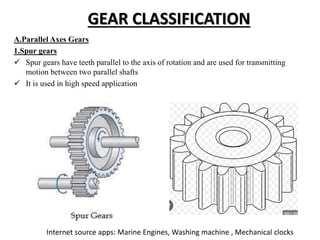
1.Spur gears
 Spur gears have teeth parallel to the axis of rotation and are used for transmitting
motion between two parallel shafts
 It is used in high speed application
Internet source apps: Marine Engines, Washing machine , Mechanical clocks
GEAR CLASSIFICATION
A.Parallel Axes Gears
2.Helical gears
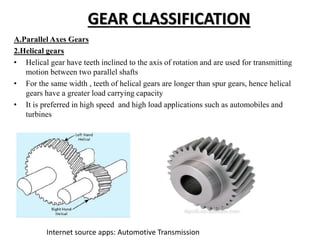
• Helical gear have teeth inclined to the axis of rotation and are used for transmitting
motion between two parallel shafts
• For the same width , teeth of helical gears are longer than spur gears, hence helical
gears have a greater load carrying capacity
• It is preferred in high speed and high load applications such as automobiles and
turbines
Internet source apps: Automotive Transmission
GEAR CLASSIFICATION
A.Parallel Axes Gears
3.Herringbone gears
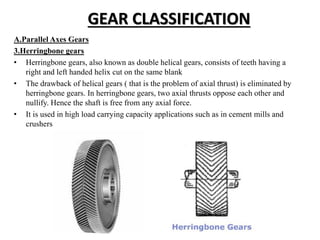
• Herringbone gears, also known as double helical gears, consists of teeth having a
right and left handed helix cut on the same blank
• The drawback of helical gears ( that is the problem of axial thrust) is eliminated by
herringbone gears. In herringbone gears, two axial thrusts oppose each other and
nullify. Hence the shaft is free from any axial force.
• It is used in high load carrying capacity applications such as in cement mills and
crushers
GEAR CLASSIFICATION
A.Parallel Axes Gears
4.Rack and pinion
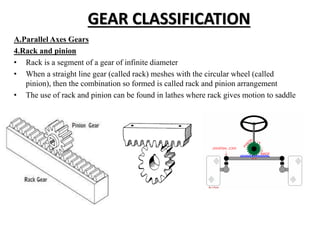
• Rack is a segment of a gear of infinite diameter
• When a straight line gear (called rack) meshes with the circular wheel (called
pinion), then the combination so formed is called rack and pinion arrangement
• The use of rack and pinion can be found in lathes where rack gives motion to saddle
GEAR CLASSIFICATION
B.Intersecting Axes
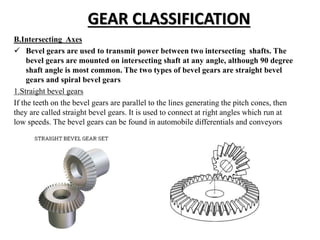
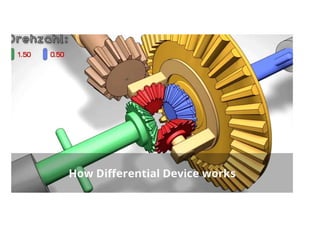
 Bevel gears are used to transmit power between two intersecting shafts. The
bevel gears are mounted on intersecting shaft at any angle, although 90 degree
shaft angle is most common. The two types of bevel gears are straight bevel
gears and spiral bevel gears
1.Straight bevel gears
If the teeth on the bevel gears are parallel to the lines generating the pitch cones, then
they are called straight bevel gears. It is used to connect at right angles which run at
low speeds. The bevel gears can be found in automobile differentials and conveyors
GEAR CLASSIFICATION
B.Intersecting Axes
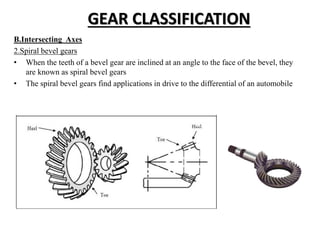
2.Spiral bevel gears
• When the teeth of a bevel gear are inclined at an angle to the face of the bevel, they
are known as spiral bevel gears
• The spiral bevel gears find applications in drive to the differential of an automobile
GEAR CLASSIFICATION
C.Non-Parallel and Non-Intersecting axes gears
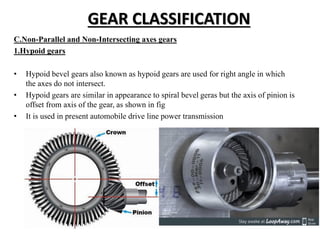
1.Hypoid gears
• Hypoid bevel gears also known as hypoid gears are used for right angle in which
the axes do not intersect.
• Hypoid gears are similar in appearance to spiral bevel geras but the axis of pinion is
offset from axis of the gear, as shown in fig
• It is used in present automobile drive line power transmission
GEAR CLASSIFICATION
C.Non-Parallel and Non-Intersecting axes gears
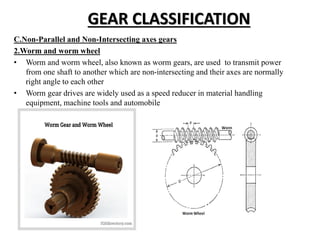
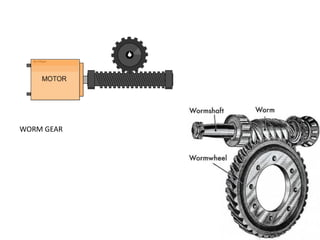
2.Worm and worm wheel
• Worm and worm wheel, also known as worm gears, are used to transmit power
from one shaft to another which are non-intersecting and their axes are normally
right angle to each other
• Worm gear drives are widely used as a speed reducer in material handling
equipment, machine tools and automobile
WORM GEAR
GEAR CLASSIFICATION
C.Non-Parallel and Non-Intersecting axes gears
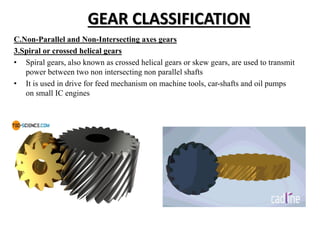
3.Spiral or crossed helical gears
• Spiral gears, also known as crossed helical gears or skew gears, are used to transmit
power between two non intersecting non parallel shafts
• It is used in drive for feed mechanism on machine tools, car-shafts and oil pumps
on small IC engines
GEAR CLASSIFICATION
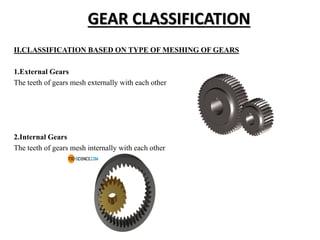
II.CLASSIFICATION BASED ON TYPE OF MESHING OF GEARS
1.External Gears
The teeth of gears mesh externally with each other
2.Internal Gears
The teeth of gears mesh internally with each other
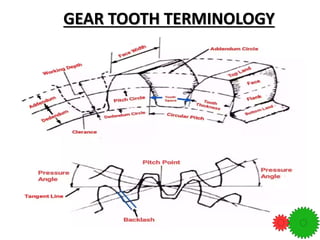
GEAR TOOTH TERMINOLOGY
Important terms
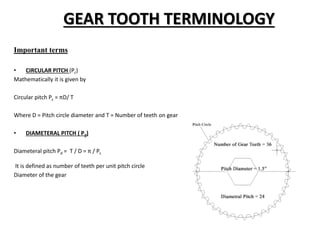
• CIRCULAR PITCH (Pc)
Mathematically it is given by
Circular pitch Pc = πD/ T
Where D = Pitch circle diameter and T = Number of teeth on gear
• DIAMETERAL PITCH ( Pd)
Diameteral pitch Pd = T / D = π / Pc
It is defined as number of teeth per unit pitch circle
Diameter of the gear
GEAR TOOTH TERMINOLOGY
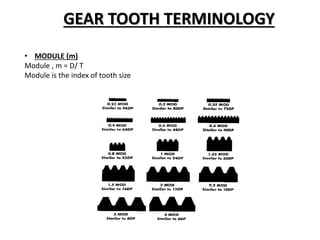
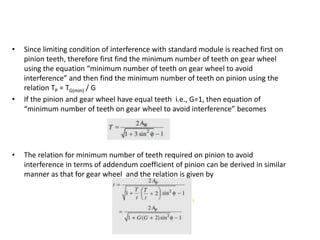
• MODULE (m)
Module , m = D/ T
Module is the index of tooth size
GEAR TOOTH TERMINOLOGY
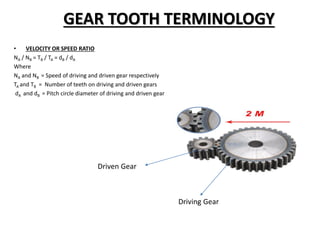
• VELOCITY OR SPEED RATIO
NA / NB = TB / TA = dB / dA
Where
NA and NB = Speed of driving and driven gear respectively
TA and TB = Number of teeth on driving and driven gears
dA and dB = Pitch circle diameter of driving and driven gear
Driven Gear
Driving Gear
GEAR TOOTH TERMINOLOGY
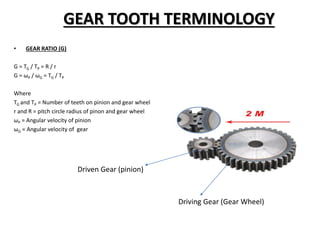
• GEAR RATIO (G)
G = TG / TP = R / r
G = ωP / ωG = TG / TP
Where
TG and TP = Number of teeth on pinion and gear wheel
r and R = pitch circle radius of pinon and gear wheel
ωP = Angular velocity of pinion
ωG = Angular velocity of gear
Driven Gear (pinion)
Driving Gear (Gear Wheel)
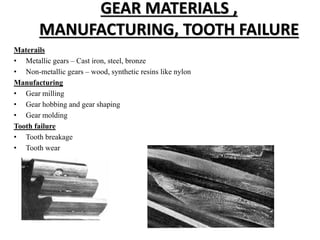
GEAR MATERIALS ,
MANUFACTURING, TOOTH FAILURE
Materails
• Metallic gears – Cast iron, steel, bronze
• Non-metallic gears – wood, synthetic resins like nylon
Manufacturing
• Gear milling
• Gear hobbing and gear shaping
• Gear molding
Tooth failure
• Tooth breakage
• Tooth wear
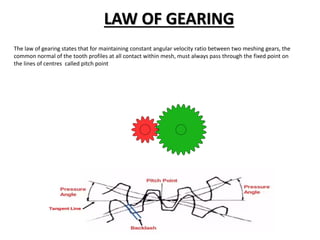
LAW OF GEARING
The law of gearing states that for maintaining constant angular velocity ratio between two meshing gears, the
common normal of the tooth profiles at all contact within mesh, must always pass through the fixed point on
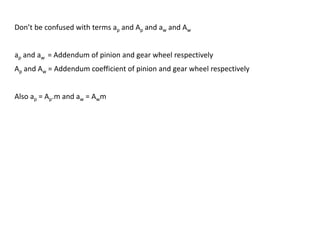
the lines of centres called pitch point
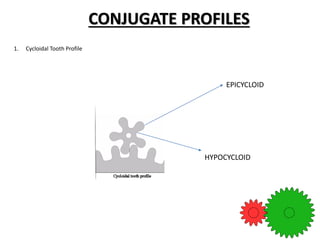
CONJUGATE PROFILES
1. Cycloidal Tooth Profile
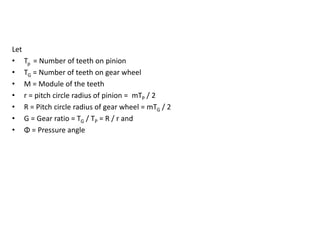
EPICYCLOID
HYPOCYCLOID
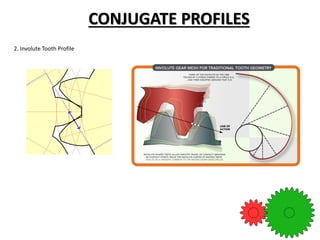
CONJUGATE PROFILES
2. Involute Tooth Profile
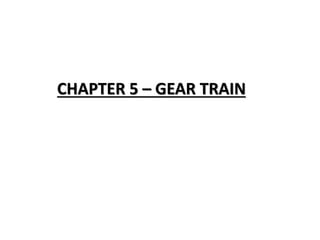
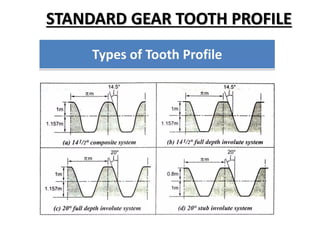
STANDARD GEAR TOOTH PROFILE
INTERFERENCE AND UNDERCUTTING OF
INVOLUTE GEARS
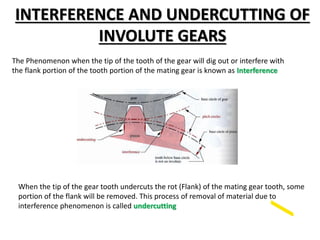
The Phenomenon when the tip of the tooth of the gear will dig out or interfere with
the flank portion of the tooth portion of the mating gear is known as Interference
When the tip of the gear tooth undercuts the rot (Flank) of the mating gear tooth, some
portion of the flank will be removed. This process of removal of material due to
interference phenomenon is called undercutting
CONDITION TO AVOID INTERFERENCE
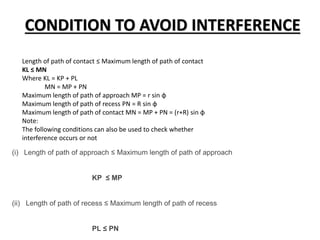
Length of path of contact ≤ Maximum length of path of contact
KL ≤ MN
Where KL = KP + PL
MN = MP + PN
Maximum length of path of approach MP = r sin ϕ
Maximum length of path of recess PN = R sin ϕ
Maximum length of path of contact MN = MP + PN = (r+R) sin ϕ
Note:
The following conditions can also be used to check whether
interference occurs or not
(i) Length of path of approach ≤ Maximum length of path of approach
KP ≤ MP
(ii) Length of path of recess ≤ Maximum length of path of recess
PL ≤ PN
METHODS TO AVOID INTERFERENCE
• By modifying addendum
• By increasing pressure angle
• By modifying tooth profile
• By increasing the centre distance
• By increasing number of teeth on the mating pinion
• By undercutting the radial flank of the pinion
MINIMUM NUMBER OF TEETH TO AVOID
INTERFERENCE
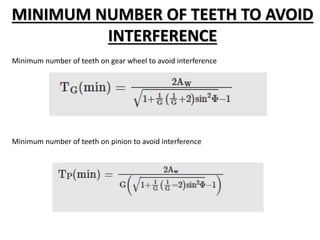
Minimum number of teeth on gear wheel to avoid interference
Minimum number of teeth on pinion to avoid interference
• Since limiting condition of interference with standard module is reached first on
pinion teeth, therefore first find the minimum number of teeth on gear wheel
using the equation “minimum number of teeth on gear wheel to avoid
interference” and then find the minimum number of teeth on pinion using the
relation TP = TG(min) / G
• If the pinion and gear wheel have equal teeth i.e., G=1, then equation of
“minimum number of teeth on gear wheel to avoid interference” becomes
• The relation for minimum number of teeth required on pinion to avoid
interference in terms of addendum coefficient of pinion can be derived in similar
manner as that for gear wheel and the relation is given by
Don’t be confused with terms ap and Ap and aw and Aw
ap and aw = Addendum of pinion and gear wheel respectively
Ap and Aw = Addendum coefficient of pinion and gear wheel respectively
Also ap = Ap.m and aw = Awm
Let
• Tp = Number of teeth on pinion
• TG = Number of teeth on gear wheel
• M = Module of the teeth
• r = pitch circle radius of pinion = mTP / 2
• R = Pitch circle radius of gear wheel = mTG / 2
• G = Gear ratio = TG / TP = R / r and
• Φ = Pressure angle
CHAPTER 5 – GEAR TRAIN
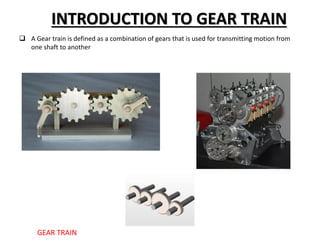
INTRODUCTION TO GEAR TRAIN
 A Gear train is defined as a combination of gears that is used for transmitting motion from
one shaft to another
GEAR TRAIN
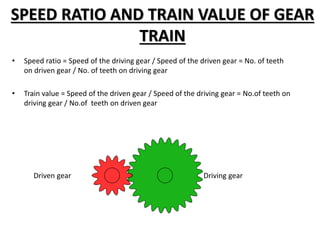
SPEED RATIO AND TRAIN VALUE OF GEAR
TRAIN
• Speed ratio = Speed of the driving gear / Speed of the driven gear = No. of teeth
on driven gear / No. of teeth on driving gear
• Train value = Speed of the driven gear / Speed of the driving gear = No.of teeth on
driving gear / No.of teeth on driven gear
Driving gear
Driven gear
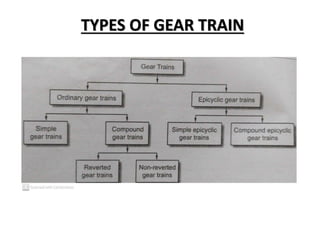
TYPES OF GEAR TRAIN
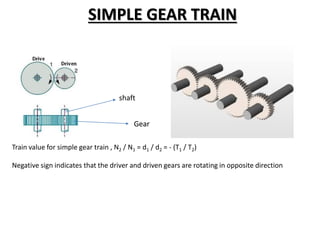
SIMPLE GEAR TRAIN
Train value for simple gear train , N2 / N1 = d1 / d2 = - (T1 / T2)
Negative sign indicates that the driver and driven gears are rotating in opposite direction
shaft
Gear
Gear
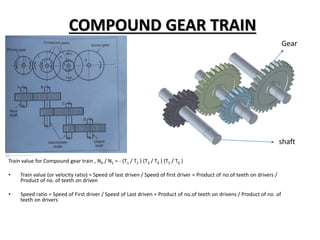
COMPOUND GEAR TRAIN
Train value for Compound gear train , N6 / N1 = - (T1 / T2 ) (T3 / T4 ) (T5 / T6 )
• Train value (or velocity ratio) = Speed of last driven / Speed of first driver = Product of no.of teeth on drivers /
Product of no. of teeth on driven
• Speed ratio = Speed of First driver / Speed of Last driven = Product of no.of teeth on drivens / Product of no. of
teeth on drivers
shaft
Gear
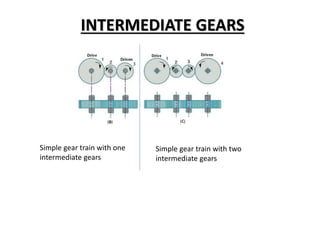
INTERMEDIATE GEARS
Simple gear train with one
intermediate gears
Simple gear train with two
intermediate gears
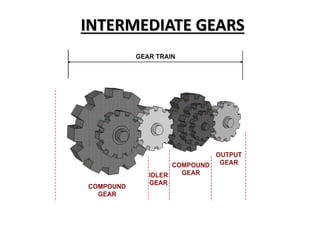
INTERMEDIATE GEARS
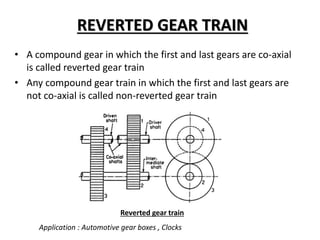
REVERTED GEAR TRAIN
• A compound gear in which the first and last gears are co-axial
is called reverted gear train
• Any compound gear train in which the first and last gears are
not co-axial is called non-reverted gear train
Reverted gear train
Application : Automotive gear boxes , Clocks
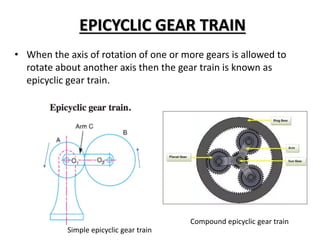
EPICYCLIC GEAR TRAIN
• When the axis of rotation of one or more gears is allowed to
rotate about another axis then the gear train is known as
epicyclic gear train.
Simple epicyclic gear train
Compound epicyclic gear train

ME3491 TOM UNIT –II -PPTX

  • 1.
  • 3.
  • 4.
    Introduction  Gears aretoothed wheels used for transmitting motion and power from one shaft to another when they are not too far apart and when a constant velocity ratio is desired.  It is used to increase or decrease speed, or change the direction of motion from one shaft to the other  In comparison with belt, chain and friction drives , gear drives are more compact can operate at higher speeds and can be used where precise timing Is required. Gear drive Belt drive Chain drive Friction wheels
  • 5.
    Introduction In any pairof gears, the smaller one is called pinion The larger one is called gear or wheel or bull gear, irrespective of which is driving the other Wheel Pinion
  • 6.
     Advantages ofgear drive over belt and chain drive  Since there is no slip, so exact velocity ratio is obtained  It is capable of transmitting larger power (than that of belt and chain drive)  It is more efficient and effective means of power transmission  Disadvantages of gear drive over belt and chain drive • The manufacture of gears require special tools and equipment and hence manufacturing cost of gears is high • The maintenance cost of gear drive is comparatively high • The error in cutting teeth may cause vibration and noise during operation ******Tooth vs Teeth****** Tooth is used in singular form while teeth is plural i.e., if it is one then ‘tooth’ and if it is more than one then teeth
  • 7.
    GEAR CLASSIFICATION I.CLASSIFICATION BASEDON RELATIVE POSTION OF TWO SHAFTS CARRYING GEARS A.Parallel Axes Gears 1.Spur gears 2.Helical gears 3.Herringbone gears 4.Rack and pinion B.Intersecting Axes 1.Straight bevel gears 2.Spiral bevel gears C.Non-Parallel and Non-Intersecting axes gears 1.Hypoid gears 2.Worm and worm wheel 3.Spiral or crossed helical gears
  • 8.
    GEAR CLASSIFICATION A.Parallel AxesGears 1.Spur gears  Spur gears have teeth parallel to the axis of rotation and are used for transmitting motion between two parallel shafts  It is used in high speed application Internet source apps: Marine Engines, Washing machine , Mechanical clocks
  • 9.
    GEAR CLASSIFICATION A.Parallel AxesGears 2.Helical gears • Helical gear have teeth inclined to the axis of rotation and are used for transmitting motion between two parallel shafts • For the same width , teeth of helical gears are longer than spur gears, hence helical gears have a greater load carrying capacity • It is preferred in high speed and high load applications such as automobiles and turbines Internet source apps: Automotive Transmission
  • 10.
    GEAR CLASSIFICATION A.Parallel AxesGears 3.Herringbone gears • Herringbone gears, also known as double helical gears, consists of teeth having a right and left handed helix cut on the same blank • The drawback of helical gears ( that is the problem of axial thrust) is eliminated by herringbone gears. In herringbone gears, two axial thrusts oppose each other and nullify. Hence the shaft is free from any axial force. • It is used in high load carrying capacity applications such as in cement mills and crushers
  • 11.
    GEAR CLASSIFICATION A.Parallel AxesGears 4.Rack and pinion • Rack is a segment of a gear of infinite diameter • When a straight line gear (called rack) meshes with the circular wheel (called pinion), then the combination so formed is called rack and pinion arrangement • The use of rack and pinion can be found in lathes where rack gives motion to saddle
  • 12.
    GEAR CLASSIFICATION B.Intersecting Axes Bevel gears are used to transmit power between two intersecting shafts. The bevel gears are mounted on intersecting shaft at any angle, although 90 degree shaft angle is most common. The two types of bevel gears are straight bevel gears and spiral bevel gears 1.Straight bevel gears If the teeth on the bevel gears are parallel to the lines generating the pitch cones, then they are called straight bevel gears. It is used to connect at right angles which run at low speeds. The bevel gears can be found in automobile differentials and conveyors
  • 14.
    GEAR CLASSIFICATION B.Intersecting Axes 2.Spiralbevel gears • When the teeth of a bevel gear are inclined at an angle to the face of the bevel, they are known as spiral bevel gears • The spiral bevel gears find applications in drive to the differential of an automobile
  • 15.
    GEAR CLASSIFICATION C.Non-Parallel andNon-Intersecting axes gears 1.Hypoid gears • Hypoid bevel gears also known as hypoid gears are used for right angle in which the axes do not intersect. • Hypoid gears are similar in appearance to spiral bevel geras but the axis of pinion is offset from axis of the gear, as shown in fig • It is used in present automobile drive line power transmission
  • 16.
    GEAR CLASSIFICATION C.Non-Parallel andNon-Intersecting axes gears 2.Worm and worm wheel • Worm and worm wheel, also known as worm gears, are used to transmit power from one shaft to another which are non-intersecting and their axes are normally right angle to each other • Worm gear drives are widely used as a speed reducer in material handling equipment, machine tools and automobile
  • 17.
  • 18.
    GEAR CLASSIFICATION C.Non-Parallel andNon-Intersecting axes gears 3.Spiral or crossed helical gears • Spiral gears, also known as crossed helical gears or skew gears, are used to transmit power between two non intersecting non parallel shafts • It is used in drive for feed mechanism on machine tools, car-shafts and oil pumps on small IC engines
  • 19.
    GEAR CLASSIFICATION II.CLASSIFICATION BASEDON TYPE OF MESHING OF GEARS 1.External Gears The teeth of gears mesh externally with each other 2.Internal Gears The teeth of gears mesh internally with each other
  • 20.
  • 21.
    GEAR TOOTH TERMINOLOGY Importantterms • CIRCULAR PITCH (Pc) Mathematically it is given by Circular pitch Pc = πD/ T Where D = Pitch circle diameter and T = Number of teeth on gear • DIAMETERAL PITCH ( Pd) Diameteral pitch Pd = T / D = π / Pc It is defined as number of teeth per unit pitch circle Diameter of the gear
  • 22.
    GEAR TOOTH TERMINOLOGY •MODULE (m) Module , m = D/ T Module is the index of tooth size
  • 23.
    GEAR TOOTH TERMINOLOGY •VELOCITY OR SPEED RATIO NA / NB = TB / TA = dB / dA Where NA and NB = Speed of driving and driven gear respectively TA and TB = Number of teeth on driving and driven gears dA and dB = Pitch circle diameter of driving and driven gear Driven Gear Driving Gear
  • 24.
    GEAR TOOTH TERMINOLOGY •GEAR RATIO (G) G = TG / TP = R / r G = ωP / ωG = TG / TP Where TG and TP = Number of teeth on pinion and gear wheel r and R = pitch circle radius of pinon and gear wheel ωP = Angular velocity of pinion ωG = Angular velocity of gear Driven Gear (pinion) Driving Gear (Gear Wheel)
  • 25.
    GEAR MATERIALS , MANUFACTURING,TOOTH FAILURE Materails • Metallic gears – Cast iron, steel, bronze • Non-metallic gears – wood, synthetic resins like nylon Manufacturing • Gear milling • Gear hobbing and gear shaping • Gear molding Tooth failure • Tooth breakage • Tooth wear
  • 26.
    LAW OF GEARING Thelaw of gearing states that for maintaining constant angular velocity ratio between two meshing gears, the common normal of the tooth profiles at all contact within mesh, must always pass through the fixed point on the lines of centres called pitch point
  • 27.
    CONJUGATE PROFILES 1. CycloidalTooth Profile EPICYCLOID HYPOCYCLOID
  • 28.
  • 29.
  • 30.
    INTERFERENCE AND UNDERCUTTINGOF INVOLUTE GEARS The Phenomenon when the tip of the tooth of the gear will dig out or interfere with the flank portion of the tooth portion of the mating gear is known as Interference When the tip of the gear tooth undercuts the rot (Flank) of the mating gear tooth, some portion of the flank will be removed. This process of removal of material due to interference phenomenon is called undercutting
  • 31.
    CONDITION TO AVOIDINTERFERENCE Length of path of contact ≤ Maximum length of path of contact KL ≤ MN Where KL = KP + PL MN = MP + PN Maximum length of path of approach MP = r sin ϕ Maximum length of path of recess PN = R sin ϕ Maximum length of path of contact MN = MP + PN = (r+R) sin ϕ Note: The following conditions can also be used to check whether interference occurs or not (i) Length of path of approach ≤ Maximum length of path of approach KP ≤ MP (ii) Length of path of recess ≤ Maximum length of path of recess PL ≤ PN
  • 32.
    METHODS TO AVOIDINTERFERENCE • By modifying addendum • By increasing pressure angle • By modifying tooth profile • By increasing the centre distance • By increasing number of teeth on the mating pinion • By undercutting the radial flank of the pinion
  • 33.
    MINIMUM NUMBER OFTEETH TO AVOID INTERFERENCE Minimum number of teeth on gear wheel to avoid interference Minimum number of teeth on pinion to avoid interference
  • 34.
    • Since limitingcondition of interference with standard module is reached first on pinion teeth, therefore first find the minimum number of teeth on gear wheel using the equation “minimum number of teeth on gear wheel to avoid interference” and then find the minimum number of teeth on pinion using the relation TP = TG(min) / G • If the pinion and gear wheel have equal teeth i.e., G=1, then equation of “minimum number of teeth on gear wheel to avoid interference” becomes • The relation for minimum number of teeth required on pinion to avoid interference in terms of addendum coefficient of pinion can be derived in similar manner as that for gear wheel and the relation is given by
  • 35.
    Don’t be confusedwith terms ap and Ap and aw and Aw ap and aw = Addendum of pinion and gear wheel respectively Ap and Aw = Addendum coefficient of pinion and gear wheel respectively Also ap = Ap.m and aw = Awm
  • 36.
    Let • Tp =Number of teeth on pinion • TG = Number of teeth on gear wheel • M = Module of the teeth • r = pitch circle radius of pinion = mTP / 2 • R = Pitch circle radius of gear wheel = mTG / 2 • G = Gear ratio = TG / TP = R / r and • Φ = Pressure angle
  • 37.
    CHAPTER 5 –GEAR TRAIN
  • 38.
    INTRODUCTION TO GEARTRAIN  A Gear train is defined as a combination of gears that is used for transmitting motion from one shaft to another GEAR TRAIN
  • 39.
    SPEED RATIO ANDTRAIN VALUE OF GEAR TRAIN • Speed ratio = Speed of the driving gear / Speed of the driven gear = No. of teeth on driven gear / No. of teeth on driving gear • Train value = Speed of the driven gear / Speed of the driving gear = No.of teeth on driving gear / No.of teeth on driven gear Driving gear Driven gear
  • 40.
  • 41.
    SIMPLE GEAR TRAIN Trainvalue for simple gear train , N2 / N1 = d1 / d2 = - (T1 / T2) Negative sign indicates that the driver and driven gears are rotating in opposite direction shaft Gear Gear
  • 42.
    COMPOUND GEAR TRAIN Trainvalue for Compound gear train , N6 / N1 = - (T1 / T2 ) (T3 / T4 ) (T5 / T6 ) • Train value (or velocity ratio) = Speed of last driven / Speed of first driver = Product of no.of teeth on drivers / Product of no. of teeth on driven • Speed ratio = Speed of First driver / Speed of Last driven = Product of no.of teeth on drivens / Product of no. of teeth on drivers shaft Gear
  • 43.
    INTERMEDIATE GEARS Simple geartrain with one intermediate gears Simple gear train with two intermediate gears
  • 44.
  • 45.
    REVERTED GEAR TRAIN •A compound gear in which the first and last gears are co-axial is called reverted gear train • Any compound gear train in which the first and last gears are not co-axial is called non-reverted gear train Reverted gear train Application : Automotive gear boxes , Clocks
  • 46.
    EPICYCLIC GEAR TRAIN •When the axis of rotation of one or more gears is allowed to rotate about another axis then the gear train is known as epicyclic gear train. Simple epicyclic gear train Compound epicyclic gear train