PRESENTATION ON
VARIOUS DATA
COLLECTION METHODS
ID:30180120020
What is data?
 Data are observations or evidences about the social world
 data collection is a term used to describe a process of preparing
and collecting data.
 Systematic gathering of data for a particular purpose from
various sources, that has been systematically observed ,
recorded, organized.
 Data are the basic inputs to any decision making process in
business
PURPOSE OF DATA COLLECTION
 To obtain information
 To keep on record
 To make decisions about important issues
 To pass information on to others
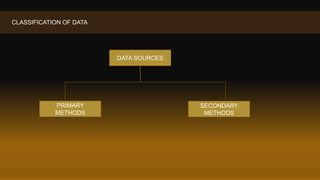
CLASSIFICATION OF DATA
DATA SOURCES
PRIMARY
METHODS
SECONDARY
METHODS
SECONDARY DATA
introduction
characteristics
importance
Factors to be considered
sources
Advantages
Disadvantages
Example
INDEX
SECONDARY DATA
Secondary data means data that are already available i.e., they refer to the data which have
already been collected and analysed by someone else. When the researcher utilizes
secondary data, then he has look into various sources secondary from where he can obtain
them.
PURPOSE OF SECONDARY DATA
• Extracting the relevant information from other sources , previous studies.
• Fact findings: descriptive information to support research
• Model building: specifying relationship between two or more variables
• Data mining: exploring data through computer . Using computer technology to go
through volumes of data to discover trends about an organization’s sales
customers and products.
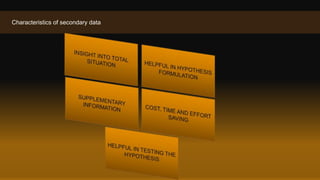
Characteristics of secondary data
INSIGHT INTO TOTAL SITUATION:
The purpose of the available materials is to explore the nature of the data
and the subjects to get an insight into the total situation. While looking for
the data required by the researcher, he mar uncover more available data
than are often assumed to exist. This contributes significantly to the
unfolding of hidden information.
HELPFUL IN HYPOTHESIS FORMULATION:
The secondary data helps in the formulation of research hypothesis. While an investigator
may have one or two hypothesis, which he might have deduced from theory, the study of
available materials may suggest further hypothesis.
SUPPLEMENTARY INFORMATION:
Available documents may be used to supplement or to check information
gathered specifically for the purposes of a given investigation.
COST, TIME AND EFFORT SAVING:
The secondary data is the information that is already created by someone
else. Therefore, it saves cost, time and effort. The researcher gets accurate
and ready data.
HELPS IN TESTING THE HYPOTHESIS
The available records may help in testing the hypothesis.
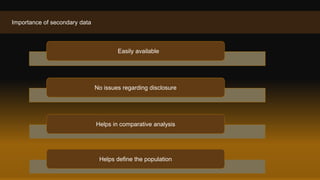
Importance of secondary data
No issues regarding disclosure
Helps in comparative analysis
Helps define the population
Easily available
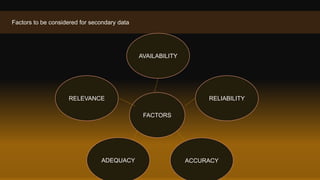
Factors to be considered for secondary data
AVAILABILITY
FACTORS
RELEVANCE RELIABILITY
ADEQUACY ACCURACY
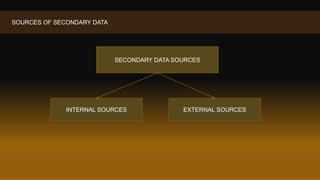
SOURCES OF SECONDARY DATA
SECONDARY DATA SOURCES
INTERNAL SOURCES EXTERNAL SOURCES
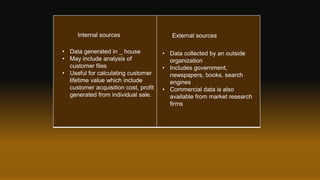
Internal sources External sources
• Data generated in _ house
• May include analysis of
customer files
• Useful for calculating customer
lifetime value which include
customer acquisition cost, profit
generated from individual sale.
• Data collected by an outside
organization
• Includes government,
newspapers, books, search
engines
• Commercial data is also
available from market research
firms
ADVANTGES OF SECONDARY DATA
 It saves efforts & expanses
 It is time saving
 It helps to make primary data collection more specific since with the help of secondary data.
 It helps to improve the understanding of the problem.
 It provides a basis for comparison for the data that is collected by the researcher.
 Ease of access
 Low cost to acquire
 Clarification of research question
 May answer research question
DISADVANTGES OF SECONDARY DATA
 Secondary data is something that seldom fits in the frame work of marketing research factors.
 Accuracy of secondary data is not known
 Data may be outdated( one can only hope that the data is of good quality)
 Not specific to researcher’s needs
 Incomplete information
 Not timely
 Quality of research
PROCCEDURE/EXAMPLE
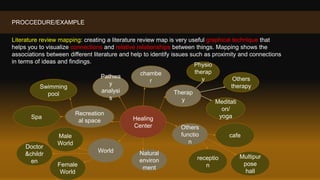
Literature review mapping: creating a literature review map is very useful graphical technique that
helps you to visualize connections and relative relationships between things. Mapping shows the
associations between different literature and help to identify issues such as proximity and connections
in terms of ideas and findings.
Healing
Center
Therap
y
chambe
r
Natural
environ
ment
Pathwa
y
analysi
s
Recreation
al space
Others
functio
n
Physio
therap
y
Meditati
on/
yoga
Others
therapy
Multipur
pose
hall
receptio
n
cafe
Swimming
pool
Spa
World
Male
World
Female
World
Doctor
&childr
en
THANK YOU

Survey data collection_assignment

  • 1.
  • 2.
    What is data? Data are observations or evidences about the social world  data collection is a term used to describe a process of preparing and collecting data.  Systematic gathering of data for a particular purpose from various sources, that has been systematically observed , recorded, organized.  Data are the basic inputs to any decision making process in business PURPOSE OF DATA COLLECTION  To obtain information  To keep on record  To make decisions about important issues  To pass information on to others
  • 3.
    CLASSIFICATION OF DATA DATASOURCES PRIMARY METHODS SECONDARY METHODS
  • 4.
  • 5.
    introduction characteristics importance Factors to beconsidered sources Advantages Disadvantages Example INDEX
  • 6.
    SECONDARY DATA Secondary datameans data that are already available i.e., they refer to the data which have already been collected and analysed by someone else. When the researcher utilizes secondary data, then he has look into various sources secondary from where he can obtain them. PURPOSE OF SECONDARY DATA • Extracting the relevant information from other sources , previous studies. • Fact findings: descriptive information to support research • Model building: specifying relationship between two or more variables • Data mining: exploring data through computer . Using computer technology to go through volumes of data to discover trends about an organization’s sales customers and products.
  • 7.
  • 8.
    INSIGHT INTO TOTALSITUATION: The purpose of the available materials is to explore the nature of the data and the subjects to get an insight into the total situation. While looking for the data required by the researcher, he mar uncover more available data than are often assumed to exist. This contributes significantly to the unfolding of hidden information. HELPFUL IN HYPOTHESIS FORMULATION: The secondary data helps in the formulation of research hypothesis. While an investigator may have one or two hypothesis, which he might have deduced from theory, the study of available materials may suggest further hypothesis.
  • 9.
    SUPPLEMENTARY INFORMATION: Available documentsmay be used to supplement or to check information gathered specifically for the purposes of a given investigation. COST, TIME AND EFFORT SAVING: The secondary data is the information that is already created by someone else. Therefore, it saves cost, time and effort. The researcher gets accurate and ready data. HELPS IN TESTING THE HYPOTHESIS The available records may help in testing the hypothesis.
  • 10.
    Importance of secondarydata No issues regarding disclosure Helps in comparative analysis Helps define the population Easily available
  • 11.
    Factors to beconsidered for secondary data AVAILABILITY FACTORS RELEVANCE RELIABILITY ADEQUACY ACCURACY
  • 12.
    SOURCES OF SECONDARYDATA SECONDARY DATA SOURCES INTERNAL SOURCES EXTERNAL SOURCES
  • 13.
    Internal sources Externalsources • Data generated in _ house • May include analysis of customer files • Useful for calculating customer lifetime value which include customer acquisition cost, profit generated from individual sale. • Data collected by an outside organization • Includes government, newspapers, books, search engines • Commercial data is also available from market research firms
  • 14.
    ADVANTGES OF SECONDARYDATA  It saves efforts & expanses  It is time saving  It helps to make primary data collection more specific since with the help of secondary data.  It helps to improve the understanding of the problem.  It provides a basis for comparison for the data that is collected by the researcher.  Ease of access  Low cost to acquire  Clarification of research question  May answer research question
  • 15.
    DISADVANTGES OF SECONDARYDATA  Secondary data is something that seldom fits in the frame work of marketing research factors.  Accuracy of secondary data is not known  Data may be outdated( one can only hope that the data is of good quality)  Not specific to researcher’s needs  Incomplete information  Not timely  Quality of research
  • 16.
    PROCCEDURE/EXAMPLE Literature review mapping:creating a literature review map is very useful graphical technique that helps you to visualize connections and relative relationships between things. Mapping shows the associations between different literature and help to identify issues such as proximity and connections in terms of ideas and findings. Healing Center Therap y chambe r Natural environ ment Pathwa y analysi s Recreation al space Others functio n Physio therap y Meditati on/ yoga Others therapy Multipur pose hall receptio n cafe Swimming pool Spa World Male World Female World Doctor &childr en
  • 17.