FILE 1A

   PRESENT SIMPLE
   AND CONTINUOUS.
   ACTION AND NON-
   ACTION VERBS
USE THE PRESENT SIMPLE FOR:
1. Habits/routines.
         e.g.: John starts work at eight o’clock.
2. Things that are always true/permanent.
         e.g.: Spain is a hot country.
3. Describing a state.
         e.g.: Dimitri is really happy about his job.
4. With the present simple use the following time expressions:
         e.g. every day, once a month, sometimes, never, and
     other adverbs of frequency ( before the main verb and after
     be)
3RD PERSON PRONUNCIATION
    -s can be pronounced in different ways:

   / s/- with verbs ending in an unvoiced consonant.
           e.g. cooks, eats

   / z / - with verbs ending in a vowel sound or voiced consonant.
            e.g. plays, has

   / iz /- with verbs where you add –es
            e.g. watches, finishes
USE THE PRESENT CONTINUOUS
FOR:

1.  Things that are happening now, at this moment.
       e.g. Janet is having a shower.
2. Temporary situations that are happening around now
    ( but not at this exact moment).
       e.g. I am learning Spanish for my job.
3. For future arrangements.
       e.g.What are you doing after class?
               - I’m going to the cinema.
4. Time expressions used with the present continuous:
       e.g. now, at the moment, this week, today…
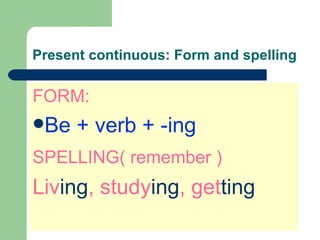
Present continuous: Form and spelling

FORM:
Be   + verb + -ing
SPELLING( remember )
Living, studying, getting
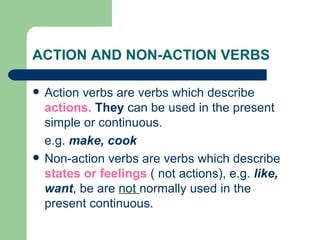
ACTION AND NON-ACTION VERBS

   Action verbs are verbs which describe
    actions. They can be used in the present
    simple or continuous.
    e.g. make, cook
   Non-action verbs are verbs which describe
    states or feelings ( not actions), e.g. like,
    want, be are not normally used in the
    present continuous.
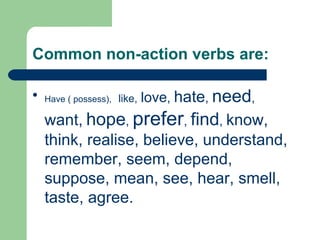
Common non-action verbs are:


    Have ( possess), like,   love, hate, need,
    want, hope, prefer, find, know,
    think, realise, believe, understand,
    remember, seem, depend,
    suppose, mean, see, hear, smell,
    taste, agree.
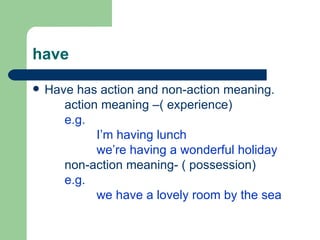
have

   Have has action and non-action meaning.
       action meaning –( experience)
       e.g.
             I’m having lunch
             we’re having a wonderful holiday
       non-action meaning- ( possession)
       e.g.
             we have a lovely room by the sea
Listening

            http://www.english-
            test.net/esl/lesson-
            plans/grammar_tenses.html
 Let's practise some more. Listen to the following conversation and
find out which tenses are used:
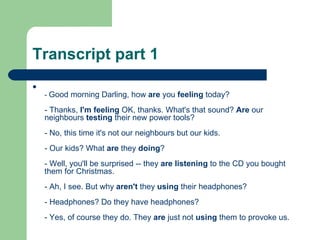
Transcript part 1

    - Good morning Darling, how are you feeling today?

    - Thanks, I'm feeling OK, thanks. What's that sound? Are our
    neighbours testing their new power tools?
    - No, this time it's not our neighbours but our kids.
    - Our kids? What are they doing?
    - Well, you'll be surprised -- they are listening to the CD you bought
    them for Christmas.
    - Ah, I see. But why aren't they using their headphones?
    - Headphones? Do they have headphones?
    - Yes, of course they do. They are just not using them to provoke us.
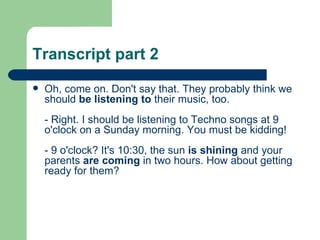
Transcript part 2
   Oh, come on. Don't say that. They probably think we
    should be listening to their music, too.
    - Right. I should be listening to Techno songs at 9
    o'clock on a Sunday morning. You must be kidding!
    - 9 o'clock? It's 10:30, the sun is shining and your
    parents are coming in two hours. How about getting
    ready for them?
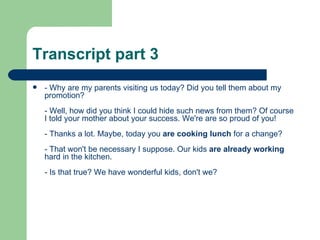
Transcript part 3
   - Why are my parents visiting us today? Did you tell them about my
    promotion?
    - Well, how did you think I could hide such news from them? Of course
    I told your mother about your success. We're are so proud of you!
    - Thanks a lot. Maybe, today you are cooking lunch for a change?
    - That won't be necessary I suppose. Our kids are already working
    hard in the kitchen.
    - Is that true? We have wonderful kids, don't we?
Thanks to:

   Face2face intermediate
   New English File intermediate
   http://www.english-test.net/esl/lesson-plans/gramm


   By Elena Gómez

Ppt pres.continuous vs simple

  • 1.
    FILE 1A PRESENT SIMPLE AND CONTINUOUS. ACTION AND NON- ACTION VERBS
  • 2.
    USE THE PRESENTSIMPLE FOR: 1. Habits/routines. e.g.: John starts work at eight o’clock. 2. Things that are always true/permanent. e.g.: Spain is a hot country. 3. Describing a state. e.g.: Dimitri is really happy about his job. 4. With the present simple use the following time expressions: e.g. every day, once a month, sometimes, never, and other adverbs of frequency ( before the main verb and after be)
  • 3.
    3RD PERSON PRONUNCIATION -s can be pronounced in different ways:  / s/- with verbs ending in an unvoiced consonant. e.g. cooks, eats  / z / - with verbs ending in a vowel sound or voiced consonant. e.g. plays, has  / iz /- with verbs where you add –es e.g. watches, finishes
  • 4.
    USE THE PRESENTCONTINUOUS FOR: 1. Things that are happening now, at this moment. e.g. Janet is having a shower. 2. Temporary situations that are happening around now ( but not at this exact moment). e.g. I am learning Spanish for my job. 3. For future arrangements. e.g.What are you doing after class? - I’m going to the cinema. 4. Time expressions used with the present continuous: e.g. now, at the moment, this week, today…
  • 5.
    Present continuous: Formand spelling FORM: Be + verb + -ing SPELLING( remember ) Living, studying, getting
  • 6.
    ACTION AND NON-ACTIONVERBS  Action verbs are verbs which describe actions. They can be used in the present simple or continuous. e.g. make, cook  Non-action verbs are verbs which describe states or feelings ( not actions), e.g. like, want, be are not normally used in the present continuous.
  • 7.
    Common non-action verbsare:  Have ( possess), like, love, hate, need, want, hope, prefer, find, know, think, realise, believe, understand, remember, seem, depend, suppose, mean, see, hear, smell, taste, agree.
  • 8.
    have  Have has action and non-action meaning. action meaning –( experience) e.g. I’m having lunch we’re having a wonderful holiday non-action meaning- ( possession) e.g. we have a lovely room by the sea
  • 9.
    Listening http://www.english- test.net/esl/lesson- plans/grammar_tenses.html Let's practise some more. Listen to the following conversation and find out which tenses are used:
  • 10.
    Transcript part 1  - Good morning Darling, how are you feeling today? - Thanks, I'm feeling OK, thanks. What's that sound? Are our neighbours testing their new power tools? - No, this time it's not our neighbours but our kids. - Our kids? What are they doing? - Well, you'll be surprised -- they are listening to the CD you bought them for Christmas. - Ah, I see. But why aren't they using their headphones? - Headphones? Do they have headphones? - Yes, of course they do. They are just not using them to provoke us.
  • 11.
    Transcript part 2  Oh, come on. Don't say that. They probably think we should be listening to their music, too. - Right. I should be listening to Techno songs at 9 o'clock on a Sunday morning. You must be kidding! - 9 o'clock? It's 10:30, the sun is shining and your parents are coming in two hours. How about getting ready for them?
  • 12.
    Transcript part 3  - Why are my parents visiting us today? Did you tell them about my promotion? - Well, how did you think I could hide such news from them? Of course I told your mother about your success. We're are so proud of you! - Thanks a lot. Maybe, today you are cooking lunch for a change? - That won't be necessary I suppose. Our kids are already working hard in the kitchen. - Is that true? We have wonderful kids, don't we?
  • 13.
    Thanks to:  Face2face intermediate  New English File intermediate  http://www.english-test.net/esl/lesson-plans/gramm  By Elena Gómez