Newspaper Articles Objective: To improve your newspaper articles by writing interesting headlines, subheadings and lead paragraphs.
Starter List as many features of newspaper articles as you can remember.
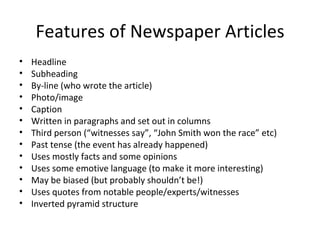
Features of Newspaper Articles Headline Subheading By-line (who wrote the article) Photo/image Caption  Written in paragraphs and set out in columns Third person (“witnesses say”, “John Smith won the race” etc) Past tense (the event has already happened) Uses mostly facts and some opinions Uses some emotive language (to make it more interesting) May be biased (but probably shouldn’t be!) Uses quotes from notable people/experts/witnesses Inverted pyramid structure
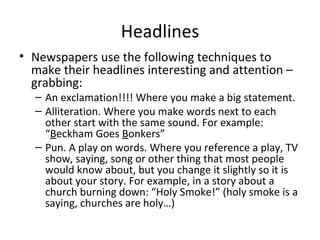
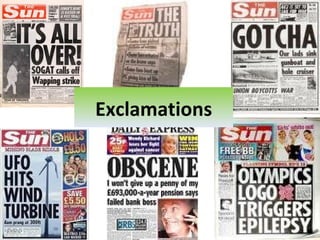
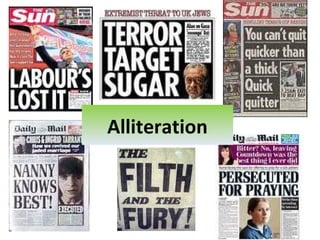
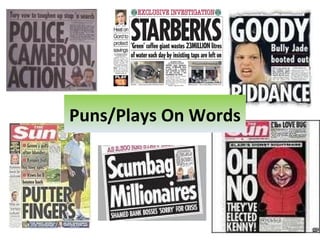
Headlines Newspapers use the following techniques to make their headlines interesting and attention –grabbing: An exclamation!!!! Where you make a big statement. Alliteration. Where you make words next to each other start with the same sound. For example: “ B eckham Goes  B onkers” Pun. A play on words. Where you reference a play, TV show, saying, song or other thing that most people would know about, but you change it slightly so it is about your story. For example, in a story about a church burning down: “Holy Smoke!” (holy smoke is a saying, churches are holy…)
Exclamations
Alliteration
Puns/Plays On Words
Task 1 Complete the headlines worksheet with a partner. You have 5 minutes!
Task 2 Come up with a headline of your own for your article, using one of the three techniques we discussed. Exclamations are easiest Alliteration is a bit trickier Puns are the hardest of all Often when headlines make jokes or are very short exclamations, they need more information to make sense. A subheading provides that extra information, often in a more straightforward way. Come up with a subheading for your article.
Lead Paragraphs A lead paragraph is the first paragraph of an article. It summarises the story very briefly, by covering the what, who, when, where, why information. Why do you think it does this, in a newspaper full of stories? It wont give every detail away. It is usually only one or two sentences long. It is often in bold font, so it stands out.
Task 3 Write the lead paragraph of your article. Use the following examples to help you: “ SUPERMODEL KATE MOSS is engaged to marry her rock star boyfriend JAMIE HINCE, The Sun can reveal.” “ MEGABUCKS striker Fernando Torres was summoned to dinner with Chelsea owner Roman Abramovich's enforcer on his first night as a Blues player.”
Remember emotive language? Using emotive language makes a story/headline/lead more interesting. “ Model Kate Moss is engaged to her boyfriend, singer, Jamie Hince.” OR “ SUPER MODEL KATE MOSS is engaged to marry her  rock star  boyfriend JAMIE HINCE, The Sun can reveal.”
“ MEGABUCKS  striker Fernando Torres was  summoned  to dinner with Chelsea owner Roman Abramovich's  enforcer  on his first night as a Blues player.”
Plenary Swap books. Read the headline, subheading and lead paragraph. Check: Does the headline use an exclamation, alliteration or a pun? Does the subheading explain the story in more detail? Is there emotive language to make it more interesting and attention grabbing? Does the headline, subheading and lead make you want to read the rest of the story?

Newspaper headlines and leads

  • 1.
    Newspaper Articles Objective:To improve your newspaper articles by writing interesting headlines, subheadings and lead paragraphs.
  • 2.
    Starter List asmany features of newspaper articles as you can remember.
  • 3.
    Features of NewspaperArticles Headline Subheading By-line (who wrote the article) Photo/image Caption Written in paragraphs and set out in columns Third person (“witnesses say”, “John Smith won the race” etc) Past tense (the event has already happened) Uses mostly facts and some opinions Uses some emotive language (to make it more interesting) May be biased (but probably shouldn’t be!) Uses quotes from notable people/experts/witnesses Inverted pyramid structure
  • 4.
    Headlines Newspapers usethe following techniques to make their headlines interesting and attention –grabbing: An exclamation!!!! Where you make a big statement. Alliteration. Where you make words next to each other start with the same sound. For example: “ B eckham Goes B onkers” Pun. A play on words. Where you reference a play, TV show, saying, song or other thing that most people would know about, but you change it slightly so it is about your story. For example, in a story about a church burning down: “Holy Smoke!” (holy smoke is a saying, churches are holy…)
  • 5.
  • 6.
  • 7.
  • 8.
    Task 1 Completethe headlines worksheet with a partner. You have 5 minutes!
  • 9.
    Task 2 Comeup with a headline of your own for your article, using one of the three techniques we discussed. Exclamations are easiest Alliteration is a bit trickier Puns are the hardest of all Often when headlines make jokes or are very short exclamations, they need more information to make sense. A subheading provides that extra information, often in a more straightforward way. Come up with a subheading for your article.
  • 10.
    Lead Paragraphs Alead paragraph is the first paragraph of an article. It summarises the story very briefly, by covering the what, who, when, where, why information. Why do you think it does this, in a newspaper full of stories? It wont give every detail away. It is usually only one or two sentences long. It is often in bold font, so it stands out.
  • 11.
    Task 3 Writethe lead paragraph of your article. Use the following examples to help you: “ SUPERMODEL KATE MOSS is engaged to marry her rock star boyfriend JAMIE HINCE, The Sun can reveal.” “ MEGABUCKS striker Fernando Torres was summoned to dinner with Chelsea owner Roman Abramovich's enforcer on his first night as a Blues player.”
  • 12.
    Remember emotive language?Using emotive language makes a story/headline/lead more interesting. “ Model Kate Moss is engaged to her boyfriend, singer, Jamie Hince.” OR “ SUPER MODEL KATE MOSS is engaged to marry her rock star boyfriend JAMIE HINCE, The Sun can reveal.”
  • 13.
    “ MEGABUCKS striker Fernando Torres was summoned to dinner with Chelsea owner Roman Abramovich's enforcer on his first night as a Blues player.”
  • 14.
    Plenary Swap books.Read the headline, subheading and lead paragraph. Check: Does the headline use an exclamation, alliteration or a pun? Does the subheading explain the story in more detail? Is there emotive language to make it more interesting and attention grabbing? Does the headline, subheading and lead make you want to read the rest of the story?