REVIEW OF VERBS TENSES – P.12
TEACHER REGINA
SIMPLE PRESENT
O “Simple Present”, ou, presente simples no
português, é usado para se referir a coisas
feitas no dia a dia, coisas que você gosta ou
não, ou apenas para constatar fatos…
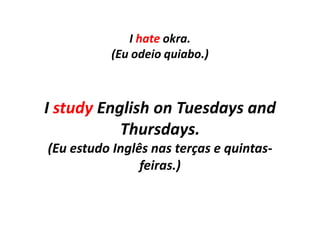
I hate okra.
(Eu odeio quiabo.)
I study English on Tuesdays and
Thursdays.
(Eu estudo Inglês nas terças e quintas-
feiras.)
Para os pronomes I, You, We e They
devemos usar o verbo na forma infinitiva
junto ao sujeito.
Já para a terceira pessoa do singular, He,
She, It, devemos acrescentar um “s” no
final e pronto!
TO WORK - Affirmative form
I WORK.
YOU WORK.
HE WORKS.
SHE WORKS.
IT WORKS.
WE WORK.
YOU WORK.
THEY WORK.
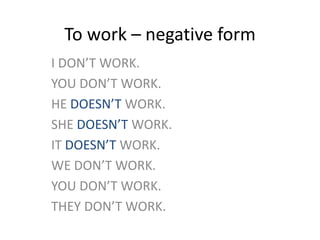
To work – negative form
I DON’T WORK.
YOU DON’T WORK.
HE DOESN’T WORK.
SHE DOESN’T WORK.
IT DOESN’T WORK.
WE DON’T WORK.
YOU DON’T WORK.
THEY DON’T WORK.
TO WORK – INTERROGATIVE FORM
DO I WORK?
DO YOU WORK?
DOES HE WORK?
DOES SHE WORK?
DOES IT WORK?
DO WE WORK?
DO YOU WORK?
DO THEY WORK?
COMO TRANSFORMAR O VERBO NA 3ª
PESSOA DO SINGULAR: HE/SHE/IT?
Regra geral
Acrescenta-se -s ao verbo:
Work – he works (ele trabalha)
Sleep – he sleeps (ele dorme)
Live – he lives (ele mora, vive)
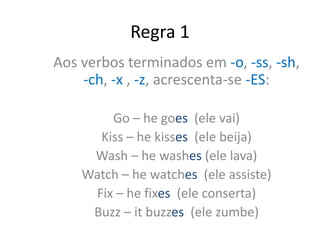
Regra 1
Aos verbos terminados em -o, -ss, -sh,
-ch, -x , -z, acrescenta-se -ES:
Go – he goes (ele vai)
Kiss – he kisses (ele beija)
Wash – he washes (ele lava)
Watch – he watches (ele assiste)
Fix – he fixes (ele conserta)
Buzz – it buzzes (ele zumbe)
Regra 2
Aos verbos terminados em consoante + y,
elimina-se o y e acrescenta-se -IES.
STUDY – He studies. (Ele estuda.)
CRY – He cries. (Ele chora.)
SHORT ANSWERS
(RESPOSTAS CURTAS)
DO THEY PLAY BASKETBALL?
YES, THEY DO.
NO, THEY DON’T.
DOES MARY CLEAN THE HOUSE?
YES, SHE DOES.
NO, SHE DOESN’T.
EXPRESSÕES QUE ACOMPANHAM O
SIMPLE PRESENT
ALWAYS – sempre
SOMETIMES – às vezes
USUALLY – geralmente
NEVER – nunca
OFTEN – frequentemente
ONCE A WEEK – uma vez por semana
ON SUNDAY(S) – aos domingos
EVERY DAY – todo dia
AT 10 O’CLOCK – às 10 horas
PRESENT CONTINUOUS
•TEMPO VERBAL EMPREGADO PARA
INDICAR AÇÕES EM DESENVOLVIMENTO.
•É O GERÚNDIO EM PORTUGUÊS: -ANDO,
-ENDO, -INDO.
•EM INGLÊS, É O –ING.
TO BE + VERBO PRINCIPAL + ING
TO BE (SER/ ESTAR)
I AM → I’M (Eu sou, estou)
YOU ARE → YOU’RE (Você é, está)
HE IS → HE’S (ele é, está)
SHE IS → SHE’S
IT IS → IT’S
WE ARE → WE’RE (Nós somos, estamos)
YOU ARE → YOU’RE (Vocês são, estão)
THEY ARE → THEY’RE (Eles/Elas são, estão)
We are listening to music.
We’re listening to music.
(Nós estamos ouvindo música.)
We are not listening to music.
We aren’t listening to music.
Are we listening to music?
Yes, we are. (Sim, nós estamos.)
No, you aren’t. (Não, nós não estamos.)
COMO ACRESCENTAR –ING AO
VERBO?
WORK – WORKING
LIVE – LIVING
BE- BEING
RUN – RUNNING (esquema CVC
CONSOANTE, VOGAL, CONSOANTE, dobra-se
a última consoante).
DIE – DYING (morrendo)
LIE – LYING (mentindo)
Expressões que acompanham o
PRESENT CONTINUOUS
NOW – agora
AT THE MOMENT – no momento
RIGHT NOW – agora mesmo
PAST CONTINUOUS
INDICA AÇÃO EM
DESENVOLVIMENTO NO PASSADO.
To be + verbo + ing
I was (eu estava)
You were (você estava)
He was (ele estava)
She was (ela estava)
It was (ele, ela estava)
We were (nós estávamos)
You were (vocês estavam)
They were (eles, elas estavam)
We were listening to music.
(Nós estávamos ouvindo música.)
We were not listening to music.
We weren’t listening to music.
Were we listening to music?
Yes, we were.
No, we weren’t.
GOING TO (FUTURE)
Expressar intenções ou planos
futuros e previsões.
Falar sobre eventos ou situações
que acontecerão no futuro com
base em evidências do presente.
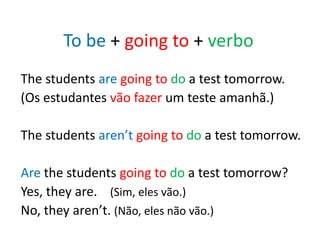
To be + going to + verbo
The students are going to do a test tomorrow.
(Os estudantes vão fazer um teste amanhã.)
The students aren’t going to do a test tomorrow.
Are the students going to do a test tomorrow?
Yes, they are. (Sim, eles vão.)
No, they aren’t. (Não, eles não vão.)
IMPERATIVES
O Imperative é usado para:
• Expressar uma ordem.
• Fazer pedidos.
• Dar instruçoes.
Imperativo afirmativo
Open that door, please.
(Abra aquela porta, por favor.)
Imperativo negativo
Don’t call Jimmy now. He’s studying.
(Não telefone para o Jimmy agora. Ele está estudando.)
SIMPLE PAST
REGULAR VERBS
Aos verbos regulares no passado, acrescenta-se –ED:
Work – worked - worked
Live – lived - lived
Play – played - played
Study – studied - studied
Stop – stopped - stopped (esquema CVC – consoante,
vogal, consoante, dobra-se a última consoante)
IRREGULAR VERBS
Consultar lista de irregular verbs no final do
livro.
Be – was/were – been – ser/estar
Come – came – come - vir
Do – did – done – fazer
Go – went – gone
Read – read – read – ler
Write – wrote – written - escrever
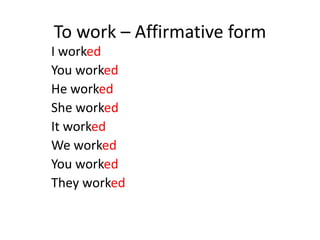
To work – Affirmative form
I worked
You worked
He worked
She worked
It worked
We worked
You worked
They worked
To work – Negative form
I didn’t work. (Eu não trabalhei.)
You didn’t work. (Você não trabalhou.)
He didn’t work. (Ele não trabalhou.)
She didn’t work.
It didn’t work.
We didn’t work.
You didn’t work.
They didn’t work.
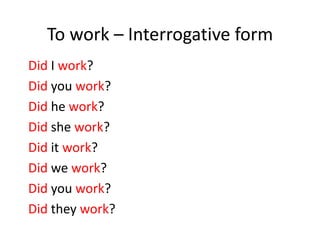
To work – Interrogative form
Did I work?
Did you work?
Did he work?
Did she work?
Did it work?
Did we work?
Did you work?
Did they work?
The students studied for the test yesterday.
(Os estudantes estudaram para o teste ontem.)
The students didn’t study for the test yesterday.
Did the students study for the test yesterday?
Yes, they did. (Sim, eles estudaram.)
No, they didn’t. (Não, eles não estudaram.)
teachermerchan.blogspot.com.br

Verbal tenses

  • 1.
    REVIEW OF VERBSTENSES – P.12 TEACHER REGINA
  • 2.
    SIMPLE PRESENT O “SimplePresent”, ou, presente simples no português, é usado para se referir a coisas feitas no dia a dia, coisas que você gosta ou não, ou apenas para constatar fatos…
  • 3.
    I hate okra. (Euodeio quiabo.) I study English on Tuesdays and Thursdays. (Eu estudo Inglês nas terças e quintas- feiras.)
  • 4.
    Para os pronomesI, You, We e They devemos usar o verbo na forma infinitiva junto ao sujeito. Já para a terceira pessoa do singular, He, She, It, devemos acrescentar um “s” no final e pronto!
  • 5.
    TO WORK -Affirmative form I WORK. YOU WORK. HE WORKS. SHE WORKS. IT WORKS. WE WORK. YOU WORK. THEY WORK.
  • 6.
    To work –negative form I DON’T WORK. YOU DON’T WORK. HE DOESN’T WORK. SHE DOESN’T WORK. IT DOESN’T WORK. WE DON’T WORK. YOU DON’T WORK. THEY DON’T WORK.
  • 7.
    TO WORK –INTERROGATIVE FORM DO I WORK? DO YOU WORK? DOES HE WORK? DOES SHE WORK? DOES IT WORK? DO WE WORK? DO YOU WORK? DO THEY WORK?
  • 8.
    COMO TRANSFORMAR OVERBO NA 3ª PESSOA DO SINGULAR: HE/SHE/IT? Regra geral Acrescenta-se -s ao verbo: Work – he works (ele trabalha) Sleep – he sleeps (ele dorme) Live – he lives (ele mora, vive)
  • 9.
    Regra 1 Aos verbosterminados em -o, -ss, -sh, -ch, -x , -z, acrescenta-se -ES: Go – he goes (ele vai) Kiss – he kisses (ele beija) Wash – he washes (ele lava) Watch – he watches (ele assiste) Fix – he fixes (ele conserta) Buzz – it buzzes (ele zumbe)
  • 10.
    Regra 2 Aos verbosterminados em consoante + y, elimina-se o y e acrescenta-se -IES. STUDY – He studies. (Ele estuda.) CRY – He cries. (Ele chora.)
  • 11.
    SHORT ANSWERS (RESPOSTAS CURTAS) DOTHEY PLAY BASKETBALL? YES, THEY DO. NO, THEY DON’T. DOES MARY CLEAN THE HOUSE? YES, SHE DOES. NO, SHE DOESN’T.
  • 12.
    EXPRESSÕES QUE ACOMPANHAMO SIMPLE PRESENT ALWAYS – sempre SOMETIMES – às vezes USUALLY – geralmente NEVER – nunca OFTEN – frequentemente ONCE A WEEK – uma vez por semana ON SUNDAY(S) – aos domingos EVERY DAY – todo dia AT 10 O’CLOCK – às 10 horas
  • 13.
    PRESENT CONTINUOUS •TEMPO VERBALEMPREGADO PARA INDICAR AÇÕES EM DESENVOLVIMENTO. •É O GERÚNDIO EM PORTUGUÊS: -ANDO, -ENDO, -INDO. •EM INGLÊS, É O –ING.
  • 14.
    TO BE +VERBO PRINCIPAL + ING TO BE (SER/ ESTAR) I AM → I’M (Eu sou, estou) YOU ARE → YOU’RE (Você é, está) HE IS → HE’S (ele é, está) SHE IS → SHE’S IT IS → IT’S WE ARE → WE’RE (Nós somos, estamos) YOU ARE → YOU’RE (Vocês são, estão) THEY ARE → THEY’RE (Eles/Elas são, estão)
  • 15.
    We are listeningto music. We’re listening to music. (Nós estamos ouvindo música.) We are not listening to music. We aren’t listening to music. Are we listening to music? Yes, we are. (Sim, nós estamos.) No, you aren’t. (Não, nós não estamos.)
  • 16.
    COMO ACRESCENTAR –INGAO VERBO? WORK – WORKING LIVE – LIVING BE- BEING RUN – RUNNING (esquema CVC CONSOANTE, VOGAL, CONSOANTE, dobra-se a última consoante). DIE – DYING (morrendo) LIE – LYING (mentindo)
  • 17.
    Expressões que acompanhamo PRESENT CONTINUOUS NOW – agora AT THE MOMENT – no momento RIGHT NOW – agora mesmo
  • 18.
    PAST CONTINUOUS INDICA AÇÃOEM DESENVOLVIMENTO NO PASSADO.
  • 19.
    To be +verbo + ing I was (eu estava) You were (você estava) He was (ele estava) She was (ela estava) It was (ele, ela estava) We were (nós estávamos) You were (vocês estavam) They were (eles, elas estavam)
  • 20.
    We were listeningto music. (Nós estávamos ouvindo música.) We were not listening to music. We weren’t listening to music. Were we listening to music? Yes, we were. No, we weren’t.
  • 21.
    GOING TO (FUTURE) Expressarintenções ou planos futuros e previsões. Falar sobre eventos ou situações que acontecerão no futuro com base em evidências do presente.
  • 22.
    To be +going to + verbo The students are going to do a test tomorrow. (Os estudantes vão fazer um teste amanhã.) The students aren’t going to do a test tomorrow. Are the students going to do a test tomorrow? Yes, they are. (Sim, eles vão.) No, they aren’t. (Não, eles não vão.)
  • 23.
    IMPERATIVES O Imperative éusado para: • Expressar uma ordem. • Fazer pedidos. • Dar instruçoes.
  • 24.
    Imperativo afirmativo Open thatdoor, please. (Abra aquela porta, por favor.) Imperativo negativo Don’t call Jimmy now. He’s studying. (Não telefone para o Jimmy agora. Ele está estudando.)
  • 25.
  • 26.
    REGULAR VERBS Aos verbosregulares no passado, acrescenta-se –ED: Work – worked - worked Live – lived - lived Play – played - played Study – studied - studied Stop – stopped - stopped (esquema CVC – consoante, vogal, consoante, dobra-se a última consoante)
  • 27.
    IRREGULAR VERBS Consultar listade irregular verbs no final do livro. Be – was/were – been – ser/estar Come – came – come - vir Do – did – done – fazer Go – went – gone Read – read – read – ler Write – wrote – written - escrever
  • 28.
    To work –Affirmative form I worked You worked He worked She worked It worked We worked You worked They worked
  • 29.
    To work –Negative form I didn’t work. (Eu não trabalhei.) You didn’t work. (Você não trabalhou.) He didn’t work. (Ele não trabalhou.) She didn’t work. It didn’t work. We didn’t work. You didn’t work. They didn’t work.
  • 30.
    To work –Interrogative form Did I work? Did you work? Did he work? Did she work? Did it work? Did we work? Did you work? Did they work?
  • 31.
    The students studiedfor the test yesterday. (Os estudantes estudaram para o teste ontem.) The students didn’t study for the test yesterday. Did the students study for the test yesterday? Yes, they did. (Sim, eles estudaram.) No, they didn’t. (Não, eles não estudaram.)
  • 32.