SIMPLE AND CONTINUOUS
TENSES
Anamely Puentes Urdaneta
Facultad de Humanidades
Información y Documentación a Distancia
BASIC
SIMPLE TENSES
(present, past and future)
The basic or simple
tenses are the three
tenses which are the
simplest in the English
language--past, present,
future, without any other
Simple Present
The basic present tense uses the same verb as the verb part of the
infinitive. In the third person singular an -s or -es is added. There
are a number of irregular verbs, but they all have an s or z sound at
the end of the third person singular.
Jane doesn't work hard at all!
(¡Jane no trabaja duro para nada!)
They play basketball every Sunday.
(Juegan baloncesto todos los domingos.)
EXAMPLE
Simple Past
The basic past tense is a single word. Usually a -d or -ed is added to
the root verb to put it in the past. However, there are many irregular
verbs. All persons, singular and plural are the same except for the
verb to be in which all persons are were but first and third person
singular are was.
Did you move here in 1991?
(¿Se mudaron aquí en 1991?)
Sophia and I met yesterday.
(Sophia y yo nos conocimos ayer.)
Simple Future
The future tense is formed by adding the present form to the auxiliary
verb will or shall. All persons, singular and plural, are the same.
You are going to meet Jane
tonight.
Are you going to meet Jane
tonight?
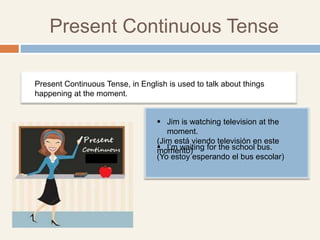
Present Continuous Tense
 Jim is watching television at the
moment.
(Jim está viendo televisión en este
momento)
Present Continuous Tense, in English is used to talk about things
happening at the moment.
 I’m waiting for the school bus.
(Yo estoy esperando el bus escolar)
Past Continuous Tense
 I was making breakfast when she
arrived.
(Jim está viendo televisión en este
momento)
Past Continuous Tense, in English is used: to talk about two actions
in the past; one continues for a period, and the other stars and
ends.
To talk about a temporary activity taking place over a limited time.
 I was working on my computer and you
were watching a movie.
(Yo estaba trabajando en mi computadora
y tú estabas viendo una película)
Future Continuous Tense
 They will be playing football.
(Ellos estarán jugando futbol)
 You will be going for picnic this month.
(You estarás yendo al picnic este mes )
The future continuous tense is used when talking about fixed
appointments and/ or events that we have scheduled in the future.

Simple and continuous tenses

  • 1.
    SIMPLE AND CONTINUOUS TENSES AnamelyPuentes Urdaneta Facultad de Humanidades Información y Documentación a Distancia BASIC
  • 2.
    SIMPLE TENSES (present, pastand future) The basic or simple tenses are the three tenses which are the simplest in the English language--past, present, future, without any other
  • 3.
    Simple Present The basicpresent tense uses the same verb as the verb part of the infinitive. In the third person singular an -s or -es is added. There are a number of irregular verbs, but they all have an s or z sound at the end of the third person singular. Jane doesn't work hard at all! (¡Jane no trabaja duro para nada!) They play basketball every Sunday. (Juegan baloncesto todos los domingos.) EXAMPLE
  • 4.
    Simple Past The basicpast tense is a single word. Usually a -d or -ed is added to the root verb to put it in the past. However, there are many irregular verbs. All persons, singular and plural are the same except for the verb to be in which all persons are were but first and third person singular are was. Did you move here in 1991? (¿Se mudaron aquí en 1991?) Sophia and I met yesterday. (Sophia y yo nos conocimos ayer.)
  • 5.
    Simple Future The futuretense is formed by adding the present form to the auxiliary verb will or shall. All persons, singular and plural, are the same. You are going to meet Jane tonight. Are you going to meet Jane tonight?
  • 6.
    Present Continuous Tense Jim is watching television at the moment. (Jim está viendo televisión en este momento) Present Continuous Tense, in English is used to talk about things happening at the moment.  I’m waiting for the school bus. (Yo estoy esperando el bus escolar)
  • 7.
    Past Continuous Tense I was making breakfast when she arrived. (Jim está viendo televisión en este momento) Past Continuous Tense, in English is used: to talk about two actions in the past; one continues for a period, and the other stars and ends. To talk about a temporary activity taking place over a limited time.  I was working on my computer and you were watching a movie. (Yo estaba trabajando en mi computadora y tú estabas viendo una película)
  • 8.
    Future Continuous Tense They will be playing football. (Ellos estarán jugando futbol)  You will be going for picnic this month. (You estarás yendo al picnic este mes ) The future continuous tense is used when talking about fixed appointments and/ or events that we have scheduled in the future.