FILE 2 C

ADVERBS AND ADVERBIAL
       CLAUSES
DEFINITION
• Definition-
Adverbs are words that modify:
• a verb (He drove slowly. — How did he
  drive?)
• an adjective (He drove a very fast car. —
  How fast was his car?)
• another adverb (She moved quite slowly
  down the aisle. — How slowly did she
  move?)
• As we will see, adverbs often tell when,
  where, why, or under what conditions
  something happens or happened.
• Adverbs frequently end in –ly.
• However, many words and phrases not
  ending in -ly serve an adverbial function
  and an -ly ending is not a guarantee that a
  word is an adverb. The words lovely, lonely,
  motherly, friendly, neighborly, for
  instance, are adjectives:

That lovely woman lives in a friendly
 neighborhood.
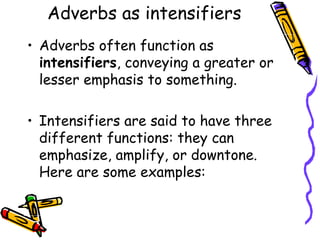
Adverbs as intensifiers
• Adverbs often function as
  intensifiers, conveying a greater or
  lesser emphasis to something.

• Intensifiers are said to have three
  different functions: they can
  emphasize, amplify, or downtone.
  Here are some examples:
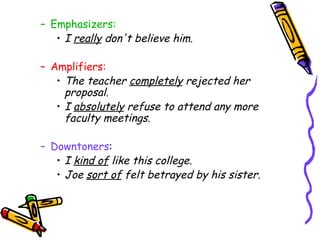
– Emphasizers:
   • I really don't believe him.

– Amplifiers:
   • The teacher completely rejected her
     proposal.
   • I absolutely refuse to attend any more
     faculty meetings.

– Downtoners:
   • I kind of like this college.
   • Joe sort of felt betrayed by his sister.
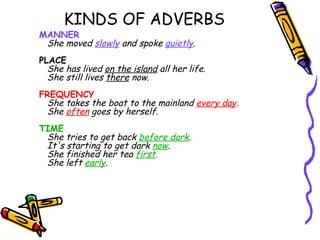
KINDS OF ADVERBS
MANNER
   She moved slowly and spoke quietly.
PLACE
   She has lived on the island all her life.
   She still lives there now.
FREQUENCY
   She takes the boat to the mainland every day.
   She often goes by herself.
TIME
   She tries to get back before dark.
   It's starting to get dark now.
   She finished her tea first.
   She left early.
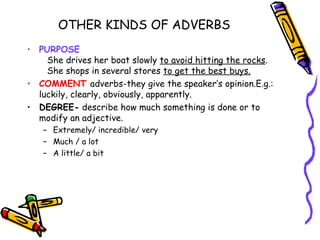
OTHER KINDS OF ADVERBS
• PURPOSE
     She drives her boat slowly to avoid hitting the rocks.
     She shops in several stores to get the best buys.
• COMMENT adverbs-they give the speaker’s opinion.E.g.:
  luckily, clearly, obviously, apparently.
• DEGREE- describe how much something is done or to
  modify an adjective.
   – Extremely/ incredible/ very
   – Much / a lot
   – A little/ a bit
POSITIONS OF ADVERBS


One of the hallmarks of adverbs is
 their ability to move around in a
 sentence.
ADVERBS OF MANNER
• They are particularly flexible in this regard.

   – Solemnly the minister addressed her
     congregation.
   – The minister solemnly addressed her
     congregation.
   – The minister addressed her congregation
     solemnly.

• They usually go after the verb or phrase.
• With passive verbs they usually go in mid-position
  ( before the main verb but after an auxiliary
  verb). E.g:
ADVERBS OF FREQUENCY
The following adverbs of frequency appear in
  various points in these sentences:
   – Before the main verb:
      I never get up before nine o'clock.
   – Between the auxiliary verb and the main verb:
      I have rarely written to my brother without a
  good reason.
   – Before the verb used to:
      I always used to see him at his summer home.
   – However, they go after the verb to be.
      He is always late.
INDEFINITE ADBERBS

Indefinite adverbs of time can appear:
• either before the verb
• or between the auxiliary and the main verb:

  He finally showed up for batting practice.

  She has recently retired
COMMENT ADVERBS


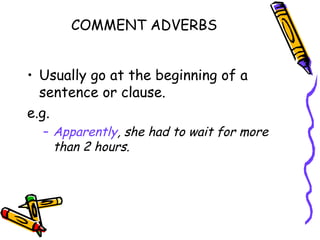
• Usually go at the beginning of a
  sentence or clause.
e.g.
  – Apparently, she had to wait for more
    than 2 hours.
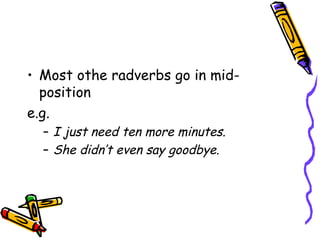
• Most othe radverbs go in mid-
  position
e.g.
  – I just need ten more minutes.
  – She didn’t even say goodbye.
ORDER OF ADVERBS


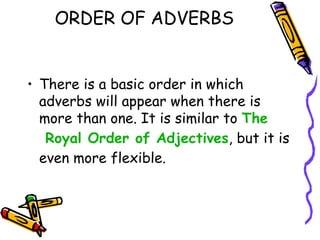
• There is a basic order in which
  adverbs will appear when there is
  more than one. It is similar to The
   Royal Order of Adjectives, but it is
  even more flexible.
Beth swims enthusiastically in the pool every morning
  before dawn to keep in shape.

Dad walks impatiently into town every afternoon before
  supper to get a newspaper.
EXERCISES
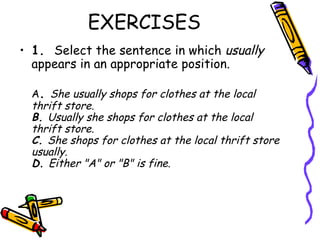
• 1.  Select the sentence in which usually
  appears in an appropriate position.

  A. She usually shops for clothes at the local
  thrift store.
  B. Usually she shops for clothes at the local
  thrift store.
  C. She shops for clothes at the local thrift store
  usually.
  D. Either "A" or "B" is fine.
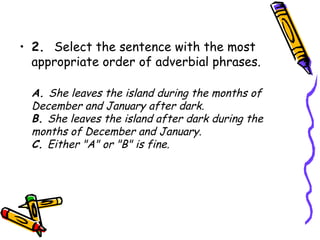
• 2.  Select the sentence with the most
  appropriate order of adverbial phrases.

  A. She leaves the island during the months of
  December and January after dark.
  B. She leaves the island after dark during the
  months of December and January.
  C. Either "A" or "B" is fine.
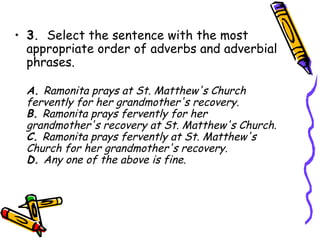
• 3.  Select the sentence with the most
  appropriate order of adverbs and adverbial
  phrases.

  A. Ramonita prays at St. Matthew's Church
  fervently for her grandmother's recovery.
  B. Ramonita prays fervently for her
  grandmother's recovery at St. Matthew's Church.
  C. Ramonita prays fervently at St. Matthew's
  Church for her grandmother's recovery.
  D. Any one of the above is fine.
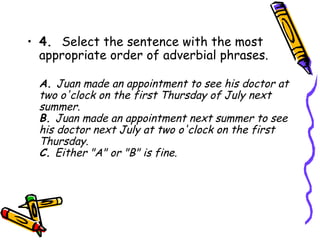
• 4.  Select the sentence with the most
  appropriate order of adverbial phrases.

  A. Juan made an appointment to see his doctor at
  two o'clock on the first Thursday of July next
  summer.
  B. Juan made an appointment next summer to see
  his doctor next July at two o'clock on the first
  Thursday.
  C. Either "A" or "B" is fine.
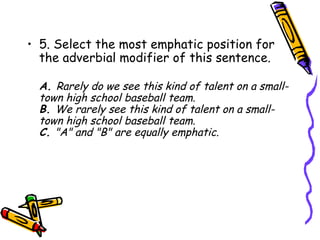
• 5. Select the most emphatic position for
  the adverbial modifier of this sentence.

  A. Rarely do we see this kind of talent on a small-
  town high school baseball team.
  B. We rarely see this kind of talent on a small-
  town high school baseball team.
  C. "A" and "B" are equally emphatic.
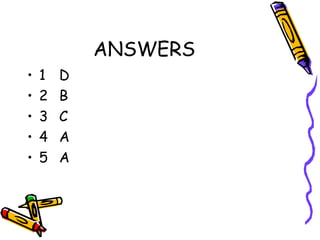
ANSWERS
•   1   D
•   2   B
•   3   C
•   4   A
•   5   A
THE END
• Thanks to
• http://grammar.ccc.commnet.edu/grammar/cgi-shl/quiz.pl/adverbs_
• New English File upper-intermediate, Oxford University
  Press

Adverbs and adverbial clauses

  • 1.
    FILE 2 C ADVERBSAND ADVERBIAL CLAUSES
  • 2.
    DEFINITION • Definition- Adverbs arewords that modify: • a verb (He drove slowly. — How did he drive?) • an adjective (He drove a very fast car. — How fast was his car?) • another adverb (She moved quite slowly down the aisle. — How slowly did she move?)
  • 3.
    • As wewill see, adverbs often tell when, where, why, or under what conditions something happens or happened. • Adverbs frequently end in –ly. • However, many words and phrases not ending in -ly serve an adverbial function and an -ly ending is not a guarantee that a word is an adverb. The words lovely, lonely, motherly, friendly, neighborly, for instance, are adjectives: That lovely woman lives in a friendly neighborhood.
  • 4.
    Adverbs as intensifiers •Adverbs often function as intensifiers, conveying a greater or lesser emphasis to something. • Intensifiers are said to have three different functions: they can emphasize, amplify, or downtone. Here are some examples:
  • 5.
    – Emphasizers: • I really don't believe him. – Amplifiers: • The teacher completely rejected her proposal. • I absolutely refuse to attend any more faculty meetings. – Downtoners: • I kind of like this college. • Joe sort of felt betrayed by his sister.
  • 6.
    KINDS OF ADVERBS MANNER    Shemoved slowly and spoke quietly. PLACE    She has lived on the island all her life.    She still lives there now. FREQUENCY    She takes the boat to the mainland every day.    She often goes by herself. TIME    She tries to get back before dark.    It's starting to get dark now.    She finished her tea first.    She left early.
  • 7.
    OTHER KINDS OFADVERBS • PURPOSE    She drives her boat slowly to avoid hitting the rocks.    She shops in several stores to get the best buys. • COMMENT adverbs-they give the speaker’s opinion.E.g.: luckily, clearly, obviously, apparently. • DEGREE- describe how much something is done or to modify an adjective. – Extremely/ incredible/ very – Much / a lot – A little/ a bit
  • 8.
    POSITIONS OF ADVERBS Oneof the hallmarks of adverbs is their ability to move around in a sentence.
  • 9.
    ADVERBS OF MANNER •They are particularly flexible in this regard. – Solemnly the minister addressed her congregation. – The minister solemnly addressed her congregation. – The minister addressed her congregation solemnly. • They usually go after the verb or phrase. • With passive verbs they usually go in mid-position ( before the main verb but after an auxiliary verb). E.g:
  • 10.
    ADVERBS OF FREQUENCY Thefollowing adverbs of frequency appear in various points in these sentences: – Before the main verb: I never get up before nine o'clock. – Between the auxiliary verb and the main verb: I have rarely written to my brother without a good reason. – Before the verb used to: I always used to see him at his summer home. – However, they go after the verb to be. He is always late.
  • 11.
    INDEFINITE ADBERBS Indefinite adverbsof time can appear: • either before the verb • or between the auxiliary and the main verb: He finally showed up for batting practice. She has recently retired
  • 12.
    COMMENT ADVERBS • Usuallygo at the beginning of a sentence or clause. e.g. – Apparently, she had to wait for more than 2 hours.
  • 13.
    • Most otheradverbs go in mid- position e.g. – I just need ten more minutes. – She didn’t even say goodbye.
  • 14.
    ORDER OF ADVERBS •There is a basic order in which adverbs will appear when there is more than one. It is similar to The Royal Order of Adjectives, but it is even more flexible.
  • 15.
    Beth swims enthusiasticallyin the pool every morning before dawn to keep in shape. Dad walks impatiently into town every afternoon before supper to get a newspaper.
  • 16.
    EXERCISES • 1.  Selectthe sentence in which usually appears in an appropriate position. A. She usually shops for clothes at the local thrift store. B. Usually she shops for clothes at the local thrift store. C. She shops for clothes at the local thrift store usually. D. Either "A" or "B" is fine.
  • 17.
    • 2.  Selectthe sentence with the most appropriate order of adverbial phrases. A. She leaves the island during the months of December and January after dark. B. She leaves the island after dark during the months of December and January. C. Either "A" or "B" is fine.
  • 18.
    • 3.  Selectthe sentence with the most appropriate order of adverbs and adverbial phrases. A. Ramonita prays at St. Matthew's Church fervently for her grandmother's recovery. B. Ramonita prays fervently for her grandmother's recovery at St. Matthew's Church. C. Ramonita prays fervently at St. Matthew's Church for her grandmother's recovery. D. Any one of the above is fine.
  • 19.
    • 4.  Selectthe sentence with the most appropriate order of adverbial phrases. A. Juan made an appointment to see his doctor at two o'clock on the first Thursday of July next summer. B. Juan made an appointment next summer to see his doctor next July at two o'clock on the first Thursday. C. Either "A" or "B" is fine.
  • 20.
    • 5. Selectthe most emphatic position for the adverbial modifier of this sentence. A. Rarely do we see this kind of talent on a small- town high school baseball team. B. We rarely see this kind of talent on a small- town high school baseball team. C. "A" and "B" are equally emphatic.
  • 21.
    ANSWERS • 1 D • 2 B • 3 C • 4 A • 5 A
  • 22.
    THE END • Thanksto • http://grammar.ccc.commnet.edu/grammar/cgi-shl/quiz.pl/adverbs_ • New English File upper-intermediate, Oxford University Press