Healthcare Quality Assurance
Prof. Amal Khalifa
By the end of this lecture attendants will be able to:
•Define Quality
•Differentiate between the three aspects of Quality
•Identify key dimensions of Quality
•Know the difference between limited and total Quality
The application of medical science and technology in a way
that maximizes its benefits to health without correspondingly
increasing its risks.
The degree of quality is, therefore, the extent to which the care
provided is expected to achieve the most favorable balance
of risks and benefits.
Avedis Donabedian, M.D., 1980
What is Quality?
What is Quality?
Proper performance (according to standards) of interventions
that are known to be safe, that are affordable to the society in
question, and that have the ability to produce an impact on
mortality, morbidity, disability, and malnutrition.
WHO, 1988
What is Quality?
Doing the right thing right , the first time and every time
to ensure:
•The best possible outcome for patients.
• Satisfaction for all our customers.
• Retention of talented staff.
• Sound financial performance.
To do what is
right
you need to know what is
right
Today’s Challenge in Healthcare
 Improve care quality
 Decrease cost
 Improve outcomes
 Increase Patient satisfaction
And to do it all at the same time!!!
Why Quality in Healthcare?
Increasing costs of healthcare in presence of
rising demands and limited resources
Variation in quality of medical performance and
outcomes in similar health organizations
Is Quality Costly?
Poor quality is
costly
Cost of Quality
Quality is free
What costs is Non-Quality production
• Non-conformance----- Cost to fix it
• Conformance ----- Cost to evaluate and improve
Cost of Good Quality
 The cost of planning (PREVENTIVE COST)
 The cost of doing QC (APPRAISAL COST)
•Both are associated with finding errors BEFORE customers
are affected by them
Cost of Bad Quality
 Internal failure cost: cost of our efforts to prevent,
detect and react to quality problems. The customer
does not see the associated deficiency directly but
customer service may be impaired.
 External failure cost: Those that directly affect the
customer and most expensive to correct.
$1 $10 $100
Prevention Appraisal Failure
Comparative Cost of Quality
Defect prevention
Efforts/ CQI.
Cost of correcting
at once
Inspection & testing to
catch and correct Defects.
Cost of Correcting errors
while patient is still at
healthcare facility.
Customer finds d
or is dissatisfied
with the service.
Cost of getting
patient to come
back from home
Standards
Customers Vs Providers
(recipients)
Services Vs Products
Customer
Requirements
1- Satisfaction
2- Understand
his
requirements
3- Do it right
first time and
every time
4- Continually
improve
Definition of a Quality
Standards
QS are a set of specific, concise statements that:
 Make a statement of expectation defining the capacity to
deliver value to perform as expected
 Act as markers of high-quality, cost-effective patient care
across a pathway or clinical area
 Are derived from the best available evidence
 Are produced collaboratively with the health services and
social care, along with their partners and service users
Fitness for use
Free from deficiencies
Meeting customer needsJoseph M. Juran: 1904 – 2008
Juran’s perception of quality
The 3 Aspects of Quality
 Measurable Quality
 Appreciative Quality
 Perceptive Quality
The 3 Aspects of Quality
 Measurable Quality is the ……
 Appreciative Quality is the ……..
 Perceptive Quality is the ………
Provider’s Aspect of Care
Peer Review Bodies Aspect of Care
Recipient's Aspect of Care
20
Quality System Goals
 Develop, implement, maintain & continually
improve healthcare quality management system
 Enhance patient safety & error prevention
 Increase effectiveness and efficiency
 Conform to established health care industry
requirements and standards
 Reduce variation and waste
 Increase patient satisfaction
Dimensions of Quality
Technical
Competence
Access to
Service
Effectiveness
Interpersonal
Relations
Efficiency Continuity
Safety Amenities Affordable
o QA is oriented toward meeting the needs and expectations
of the patient and the community.
o QA focuses on systems and processes.
o QA uses data to analyze service delivery processes.
o QA encourages a team approach to problem solving and
quality improvement.
The Four Tenets of Quality Assurance
ProcessStructure Outcome
Donabedian Paradigm
GIGO theory
1. Planning for quality assurance
2. Developing guidelines and setting standards
3. Communicating standards and specifications
4. Monitoring quality
5. Identifying problems and selecting opportunities for improvement
6. Defining the problem operationally
7. Choosing a team
8. Analyzing and studying the problem to identify its root causes
9. Developing solutions and actions for improvement
10. Implementing and evaluating quality improvement efforts
Quality Assurance Process (QAP’s)
Quality Assurance Cycle
Assess
Monitor
Improve
Assess
Monitor
Improve
% of women above 50yrs who had a mammogram in screening program
Breast cancer death rate per 100,000 women, all ages
Quality
Assurance
QA Vs CQI
Continuous Quality
Improvement
Focus
Problems
Responsibility
Prevention
System
All Involved
Inspection
People
Department
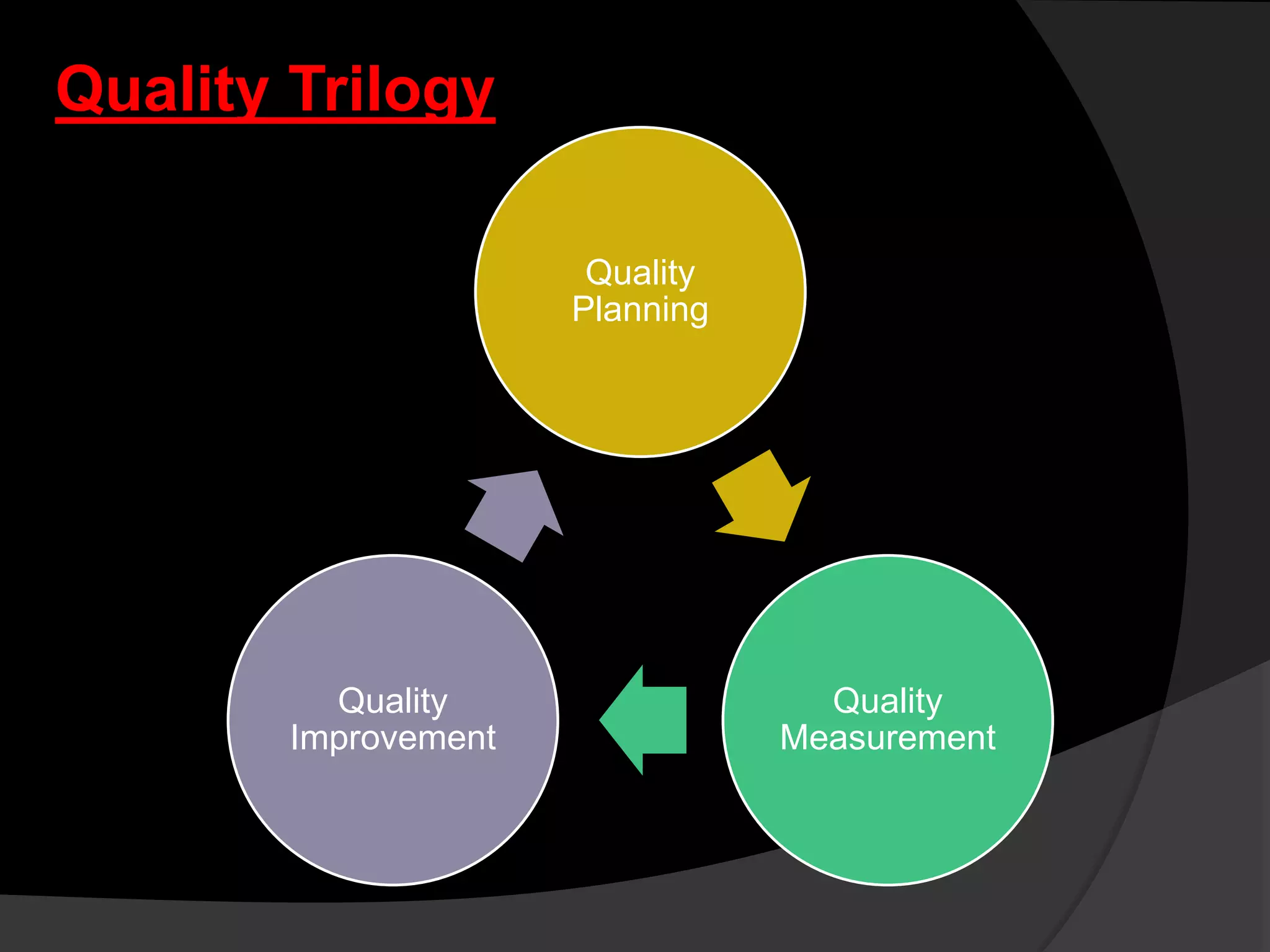
Quality
Planning
Quality
Measurement
Quality
Improvement
Quality Trilogy
Quality Planning
Enables organizations to create a service or process
that will be able to meet established goals and to do so
under operating conditions
Quality Planning Roadmap
Establish Project
Identify Customers
Discover customers needs
Develop product/process
Develop Process controls/
Transfer to operations
M
E
A
S
U
R
E
S
Quality Control
Depends on a feedback loop.
Always asks:
What happened to cause the results to become worse?
Measure actual
performance
Compare
to
Standards
Regulate
Process
Established
Standards
OK
Not OK
Quality Improvement
Quality Improvement Includes:
 Analyzing causes of process failure,
dysfunction, and/or inefficiency
 Systematically developing optimal solutions
to chronic problems
Focuses on the reasons for chronic, continuing
problems
Strategy for Quality Improvement
Six Sigma Strategy
 Define
 Measure
 Analyze
 Improve
 Control
 Replicate
Thank You
Any Questions??

Healthcare quality assurance

  • 1.
  • 2.
    By the endof this lecture attendants will be able to: •Define Quality •Differentiate between the three aspects of Quality •Identify key dimensions of Quality •Know the difference between limited and total Quality
  • 3.
    The application ofmedical science and technology in a way that maximizes its benefits to health without correspondingly increasing its risks. The degree of quality is, therefore, the extent to which the care provided is expected to achieve the most favorable balance of risks and benefits. Avedis Donabedian, M.D., 1980 What is Quality?
  • 4.
    What is Quality? Properperformance (according to standards) of interventions that are known to be safe, that are affordable to the society in question, and that have the ability to produce an impact on mortality, morbidity, disability, and malnutrition. WHO, 1988
  • 5.
    What is Quality? Doingthe right thing right , the first time and every time to ensure: •The best possible outcome for patients. • Satisfaction for all our customers. • Retention of talented staff. • Sound financial performance.
  • 6.
    To do whatis right you need to know what is right
  • 7.
    Today’s Challenge inHealthcare  Improve care quality  Decrease cost  Improve outcomes  Increase Patient satisfaction And to do it all at the same time!!!
  • 8.
    Why Quality inHealthcare? Increasing costs of healthcare in presence of rising demands and limited resources Variation in quality of medical performance and outcomes in similar health organizations
  • 9.
    Is Quality Costly? Poorquality is costly
  • 10.
    Cost of Quality Qualityis free What costs is Non-Quality production • Non-conformance----- Cost to fix it • Conformance ----- Cost to evaluate and improve
  • 11.
    Cost of GoodQuality  The cost of planning (PREVENTIVE COST)  The cost of doing QC (APPRAISAL COST) •Both are associated with finding errors BEFORE customers are affected by them
  • 12.
    Cost of BadQuality  Internal failure cost: cost of our efforts to prevent, detect and react to quality problems. The customer does not see the associated deficiency directly but customer service may be impaired.  External failure cost: Those that directly affect the customer and most expensive to correct.
  • 13.
    $1 $10 $100 PreventionAppraisal Failure Comparative Cost of Quality Defect prevention Efforts/ CQI. Cost of correcting at once Inspection & testing to catch and correct Defects. Cost of Correcting errors while patient is still at healthcare facility. Customer finds d or is dissatisfied with the service. Cost of getting patient to come back from home
  • 14.
  • 15.
    Customer Requirements 1- Satisfaction 2- Understand his requirements 3-Do it right first time and every time 4- Continually improve
  • 16.
    Definition of aQuality Standards QS are a set of specific, concise statements that:  Make a statement of expectation defining the capacity to deliver value to perform as expected  Act as markers of high-quality, cost-effective patient care across a pathway or clinical area  Are derived from the best available evidence  Are produced collaboratively with the health services and social care, along with their partners and service users
  • 17.
    Fitness for use Freefrom deficiencies Meeting customer needsJoseph M. Juran: 1904 – 2008 Juran’s perception of quality
  • 18.
    The 3 Aspectsof Quality  Measurable Quality  Appreciative Quality  Perceptive Quality
  • 19.
    The 3 Aspectsof Quality  Measurable Quality is the ……  Appreciative Quality is the ……..  Perceptive Quality is the ……… Provider’s Aspect of Care Peer Review Bodies Aspect of Care Recipient's Aspect of Care
  • 20.
    20 Quality System Goals Develop, implement, maintain & continually improve healthcare quality management system  Enhance patient safety & error prevention  Increase effectiveness and efficiency  Conform to established health care industry requirements and standards  Reduce variation and waste  Increase patient satisfaction
  • 21.
    Dimensions of Quality Technical Competence Accessto Service Effectiveness Interpersonal Relations Efficiency Continuity Safety Amenities Affordable
  • 22.
    o QA isoriented toward meeting the needs and expectations of the patient and the community. o QA focuses on systems and processes. o QA uses data to analyze service delivery processes. o QA encourages a team approach to problem solving and quality improvement. The Four Tenets of Quality Assurance
  • 23.
  • 24.
    1. Planning forquality assurance 2. Developing guidelines and setting standards 3. Communicating standards and specifications 4. Monitoring quality 5. Identifying problems and selecting opportunities for improvement 6. Defining the problem operationally 7. Choosing a team 8. Analyzing and studying the problem to identify its root causes 9. Developing solutions and actions for improvement 10. Implementing and evaluating quality improvement efforts Quality Assurance Process (QAP’s)
  • 25.
  • 26.
    % of womenabove 50yrs who had a mammogram in screening program
  • 27.
    Breast cancer deathrate per 100,000 women, all ages
  • 28.
    Quality Assurance QA Vs CQI ContinuousQuality Improvement Focus Problems Responsibility Prevention System All Involved Inspection People Department
  • 29.
  • 30.
    Quality Planning Enables organizationsto create a service or process that will be able to meet established goals and to do so under operating conditions
  • 31.
    Quality Planning Roadmap EstablishProject Identify Customers Discover customers needs Develop product/process Develop Process controls/ Transfer to operations M E A S U R E S
  • 32.
    Quality Control Depends ona feedback loop. Always asks: What happened to cause the results to become worse? Measure actual performance Compare to Standards Regulate Process Established Standards OK Not OK
  • 33.
    Quality Improvement Quality ImprovementIncludes:  Analyzing causes of process failure, dysfunction, and/or inefficiency  Systematically developing optimal solutions to chronic problems Focuses on the reasons for chronic, continuing problems
  • 34.
    Strategy for QualityImprovement Six Sigma Strategy  Define  Measure  Analyze  Improve  Control  Replicate
  • 35.