Quality of Care
Introduction
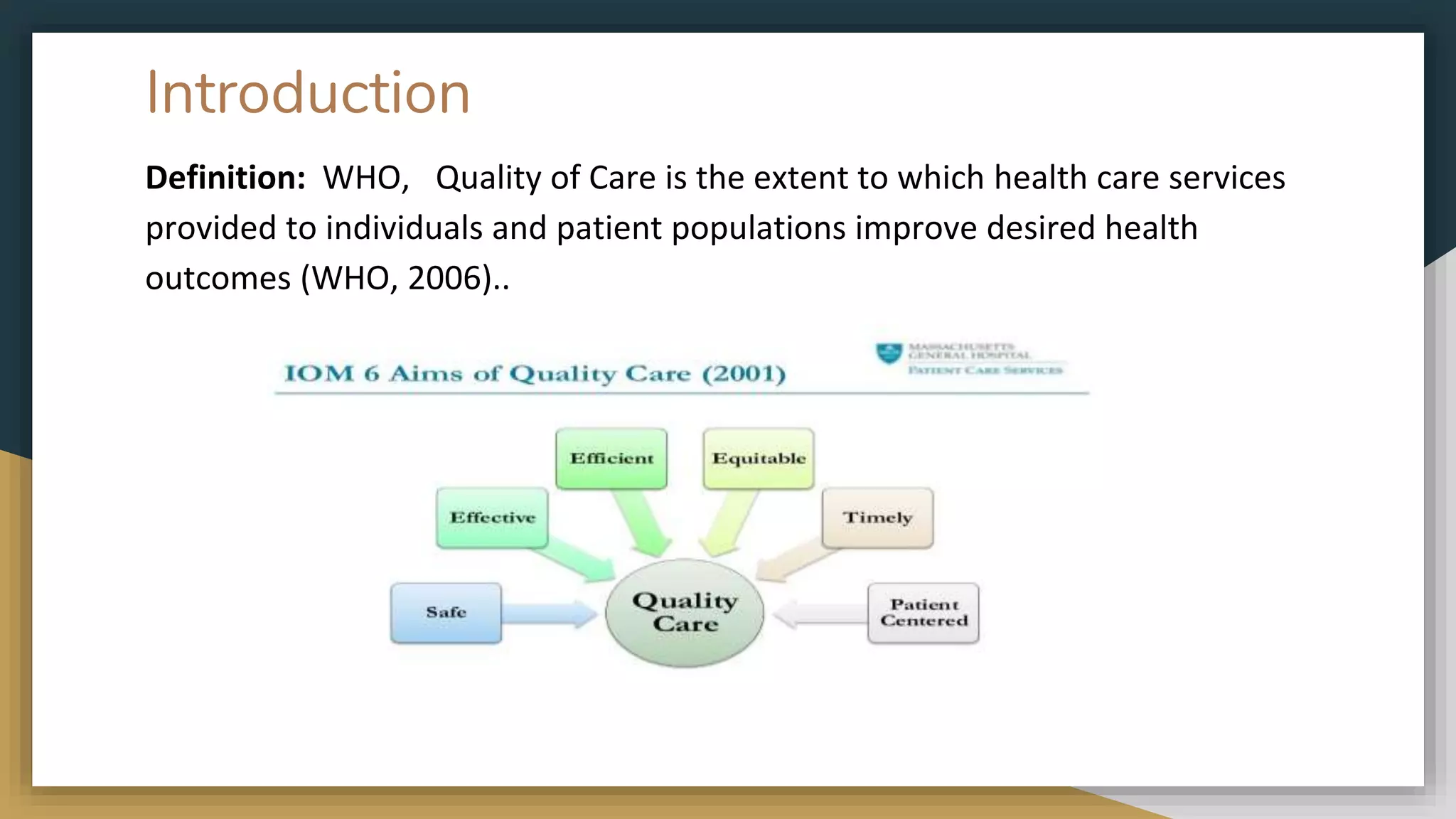
Definition: WHO, Quality of Care is the extent to which health care services
provided to individuals and patient populations improve desired health
outcomes (WHO, 2006)..
Aims:
- Safe Care. Delivering health care that minimizes risks and harm to service
users, including avoiding preventable injuries and reducing medical errors
- Effective Care. Providing services based on scientific knowledge and
evidence-based guidelines.
- Timely Care. Reducing delays in providing and receiving health care.
- Efficient Care. Delivering health care in a manner that maximizes
resource use and avoids waste. Equitable Care, People-centred Care
(IOM,2001).
Overview
In 2015, WHO made improvement in the quality of care for women and
children a priority for reducing preventable maternal and child deaths.
Elaborated vision in which “Every mother and newborn receives quality
care throughout pregnancy, childbirth and early postnatal period”(WHO,
2018) SDG& WHO visions.
Key Indicators
. Key indicators are resident outcomes that suggest the presence of either good or
bad care. They should be chosen because they indicate the extent of a facility's
compliance with regulatory criteria, that is, the elements, standards, and
conditions of participation.
. Key indicators of inadequate care are prima facie evidence of a problem, but
further investigation is required to determine whether the problem stems from
bad care or from factors that are not within the facility's control.
. Key indicators can be used to distinguish between adequate and poor-quality
care and between adequate and good or excellent care
••Medications. Excessive use of tranquilizers and antipsychotic drugs, medication errors, and
adverse drug interactions are evidence of poor quality in nursing homes.
•Decubitus Ulcers. Another potential indicator of poor quality of care is the development of bed
sores. Protocols have been developed for identifying and measuring the severity of such skin
breakdowns and pressure sores.
•Urinary Tract Infections. The development of infections among nursing home residents with
indwelling urinary catheters may also be a sign of poor care. One measure of quality, for purposes of
comparing facility performance, would be the incidence of urinary tract infections among the
residents in the facility who are catheterized.
•Management of Urinary Incontinence: Another indicator of quality might be the use of indwelling
catheters as opposed to bladder training programs and prompt staff attention to individuals when they
need to urinate. Many view the excessive use of indwelling catheters as a sign of poor care, and
protocols have been developed for their proper use.
. •Dehydration. Dehydration among nursing home residents is frequently cited
by physicians in admitting hospitals as a major problem. It is also a predictor of
poor care and has been proposed as one of the sentinel health events that
should be preventable, given adequate care.
•Other Examples of Medical, Nursing, and Rehabilitative Care Indicators. Other key indicators of
medical and rehabilitative care include the blood pressure of hypertensive residents (because elevated
diastolic pressure has been shown to correlate directly with events such as heart attack and stroke),
changes in weight, contractures, existence of physical restraints, decline in functional status, and the
ability to perform the activities of daily living.
Advantages
1. Patient centered: Providing care that is responsive and respectful to individual patient
preferences, needs and values, and ensuring that patient value guides all clinical decisions.
2. Equitable: Providing care that doesn’t compromise with quality because of personal
characteristics like gender, ethnicity, race, sexes and socioeconomic status.
3. Specialised staff trainings are done
4. Maximum use of resources provided
5. Reduced cost, increased profit
6. Increasing staff productivity of the worker with the standardization of work process
7. Accessible : This makes it accessible for all classes of people to at least get their basic
treatment done.
8. Question of accountability:they have to be accountable for the quality or poor services
when provided.
Negative Experiences
Non consented care:
● Drugs or procedures are administered without client’s knowledge
● Clients are not provided full and accurate information
Non dignified care:
● Clients experience humiliating treatment such as yelling, name-
calling, threatening, scolding, or being insulted.
● Clients experience psychological abuse such as being ignored
● Told inaccurate information to frighten or shame them
Non confidential care:
● Services are provided without visual or auditory privacy.
● Clients’ information is not kept confidential either by staff or
providers
Discrimination:
● Clients experience differential treatment on the basis of personal
characteristics (such as ethnicity, socioeconomic status, age,
marital status, family status, sex, and disability)
Improving Quality of Care for FP services
● More than 289,000 maternal deaths occurred in 2013 of which
nearly 99% (286,000) women died in developing countries.
Studies have shown that up to 40% of maternal deaths could
have been avoided through use of family planning services.
Improving Quality of care by:
➢ Attracting new contraceptive users and maintaining existing
users
➢ Addressing the factors that determine the quality of care in
family planning services, from the perspective of clients and
health care providers
Improving Quality of Care for FP services
➢ Enhancing quality of care for providers by identifying their
motivations, addressing their needs, and helping them to better
understand and address clients’ concepts of quality
➢ Identifying the needs of clients who may need family planning
and reproductive health services but who are not receiving care
due to a variety of barriers.
➢ Improving providers’ performance; training, job aids, self-
assessment tools, enhanced supervision and ongoing evaluation,
and improved infrastructure and facilities
➢ Providing better reproductive health services at reasonable
prices to increases contraceptive use
Conclusion
This programme has met its aim that designed, develop and evaluate
innovative interventions to engage patients and services.
1. Assessing risk
2. Reporting incidents
3. Direct engagement in preventing harm
4. Education and training.
Work cited:
1. Harris, S., Reichenbach, L., & Hardee, K. (2016). Measuring and monitoring quality of care in family
planning: are we ignoring negative experiences?. Open access journal of contraception, 7, 97–108.
doi:10.2147/OAJC.S101281
2. Institute of Medicine. (2001). Crossing the quality chasm: the IOM Health Care Quality Initiative.
3. Tessema, G. A., Streak Gomersall, J., Mahmood, M. A., & Laurence, C. O. (2016). Factors
Determining Quality of Care in Family Planning Services in Africa: A Systematic Review of Mixed
Evidence. PloS one, 11(11), e0165627. doi:10.1371/journal.pone.0165627
4. World Health Organization. (1995). Health Benefits of family planning, Family planning and population
of division of family health, 1-39.
5. World Health Organization. (2000). Improving access to quality care in family planning: medical
eligibility criteria for contraceptive use (No. WHO/RHR/00.02). Geneva: World Health Organization.
6. World Health Organization. (2006). Quality of care: a process for making strategic choices in health
systems

Quality of care

  • 1.
  • 2.
    Introduction Definition: WHO, Qualityof Care is the extent to which health care services provided to individuals and patient populations improve desired health outcomes (WHO, 2006)..
  • 3.
    Aims: - Safe Care.Delivering health care that minimizes risks and harm to service users, including avoiding preventable injuries and reducing medical errors - Effective Care. Providing services based on scientific knowledge and evidence-based guidelines. - Timely Care. Reducing delays in providing and receiving health care. - Efficient Care. Delivering health care in a manner that maximizes resource use and avoids waste. Equitable Care, People-centred Care (IOM,2001).
  • 4.
    Overview In 2015, WHOmade improvement in the quality of care for women and children a priority for reducing preventable maternal and child deaths. Elaborated vision in which “Every mother and newborn receives quality care throughout pregnancy, childbirth and early postnatal period”(WHO, 2018) SDG& WHO visions.
  • 5.
    Key Indicators . Keyindicators are resident outcomes that suggest the presence of either good or bad care. They should be chosen because they indicate the extent of a facility's compliance with regulatory criteria, that is, the elements, standards, and conditions of participation. . Key indicators of inadequate care are prima facie evidence of a problem, but further investigation is required to determine whether the problem stems from bad care or from factors that are not within the facility's control. . Key indicators can be used to distinguish between adequate and poor-quality care and between adequate and good or excellent care
  • 6.
    ••Medications. Excessive useof tranquilizers and antipsychotic drugs, medication errors, and adverse drug interactions are evidence of poor quality in nursing homes. •Decubitus Ulcers. Another potential indicator of poor quality of care is the development of bed sores. Protocols have been developed for identifying and measuring the severity of such skin breakdowns and pressure sores. •Urinary Tract Infections. The development of infections among nursing home residents with indwelling urinary catheters may also be a sign of poor care. One measure of quality, for purposes of comparing facility performance, would be the incidence of urinary tract infections among the residents in the facility who are catheterized. •Management of Urinary Incontinence: Another indicator of quality might be the use of indwelling catheters as opposed to bladder training programs and prompt staff attention to individuals when they need to urinate. Many view the excessive use of indwelling catheters as a sign of poor care, and protocols have been developed for their proper use.
  • 7.
    . •Dehydration. Dehydrationamong nursing home residents is frequently cited by physicians in admitting hospitals as a major problem. It is also a predictor of poor care and has been proposed as one of the sentinel health events that should be preventable, given adequate care. •Other Examples of Medical, Nursing, and Rehabilitative Care Indicators. Other key indicators of medical and rehabilitative care include the blood pressure of hypertensive residents (because elevated diastolic pressure has been shown to correlate directly with events such as heart attack and stroke), changes in weight, contractures, existence of physical restraints, decline in functional status, and the ability to perform the activities of daily living.
  • 8.
    Advantages 1. Patient centered:Providing care that is responsive and respectful to individual patient preferences, needs and values, and ensuring that patient value guides all clinical decisions. 2. Equitable: Providing care that doesn’t compromise with quality because of personal characteristics like gender, ethnicity, race, sexes and socioeconomic status. 3. Specialised staff trainings are done 4. Maximum use of resources provided 5. Reduced cost, increased profit 6. Increasing staff productivity of the worker with the standardization of work process 7. Accessible : This makes it accessible for all classes of people to at least get their basic treatment done. 8. Question of accountability:they have to be accountable for the quality or poor services when provided.
  • 9.
    Negative Experiences Non consentedcare: ● Drugs or procedures are administered without client’s knowledge ● Clients are not provided full and accurate information Non dignified care: ● Clients experience humiliating treatment such as yelling, name- calling, threatening, scolding, or being insulted. ● Clients experience psychological abuse such as being ignored ● Told inaccurate information to frighten or shame them
  • 10.
    Non confidential care: ●Services are provided without visual or auditory privacy. ● Clients’ information is not kept confidential either by staff or providers Discrimination: ● Clients experience differential treatment on the basis of personal characteristics (such as ethnicity, socioeconomic status, age, marital status, family status, sex, and disability)
  • 11.
    Improving Quality ofCare for FP services ● More than 289,000 maternal deaths occurred in 2013 of which nearly 99% (286,000) women died in developing countries. Studies have shown that up to 40% of maternal deaths could have been avoided through use of family planning services. Improving Quality of care by: ➢ Attracting new contraceptive users and maintaining existing users ➢ Addressing the factors that determine the quality of care in family planning services, from the perspective of clients and health care providers
  • 12.
    Improving Quality ofCare for FP services ➢ Enhancing quality of care for providers by identifying their motivations, addressing their needs, and helping them to better understand and address clients’ concepts of quality ➢ Identifying the needs of clients who may need family planning and reproductive health services but who are not receiving care due to a variety of barriers. ➢ Improving providers’ performance; training, job aids, self- assessment tools, enhanced supervision and ongoing evaluation, and improved infrastructure and facilities ➢ Providing better reproductive health services at reasonable prices to increases contraceptive use
  • 13.
    Conclusion This programme hasmet its aim that designed, develop and evaluate innovative interventions to engage patients and services. 1. Assessing risk 2. Reporting incidents 3. Direct engagement in preventing harm 4. Education and training.
  • 16.
    Work cited: 1. Harris,S., Reichenbach, L., & Hardee, K. (2016). Measuring and monitoring quality of care in family planning: are we ignoring negative experiences?. Open access journal of contraception, 7, 97–108. doi:10.2147/OAJC.S101281 2. Institute of Medicine. (2001). Crossing the quality chasm: the IOM Health Care Quality Initiative. 3. Tessema, G. A., Streak Gomersall, J., Mahmood, M. A., & Laurence, C. O. (2016). Factors Determining Quality of Care in Family Planning Services in Africa: A Systematic Review of Mixed Evidence. PloS one, 11(11), e0165627. doi:10.1371/journal.pone.0165627 4. World Health Organization. (1995). Health Benefits of family planning, Family planning and population of division of family health, 1-39. 5. World Health Organization. (2000). Improving access to quality care in family planning: medical eligibility criteria for contraceptive use (No. WHO/RHR/00.02). Geneva: World Health Organization. 6. World Health Organization. (2006). Quality of care: a process for making strategic choices in health systems