Teaching Pronunciation 
Julieta Hernandez 
Carolina R Torres 
Cecilia Sosa 
Language and its Teaching III
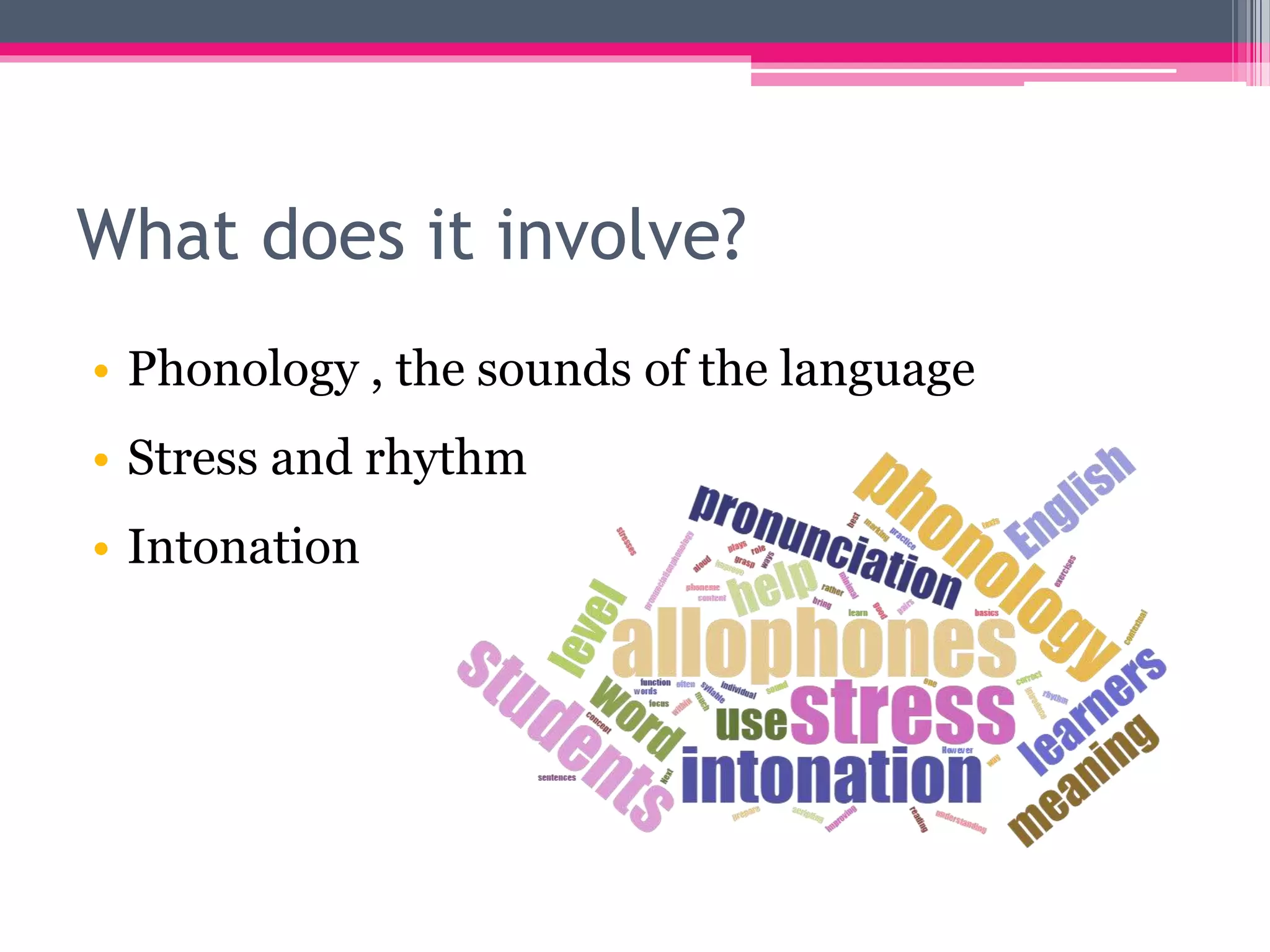
What does it involve? 
• Phonology , the sounds of the language 
• Stress and rhythm 
• Intonation
Sounds 
• IPA: symbols for all the sounds in all the languages 
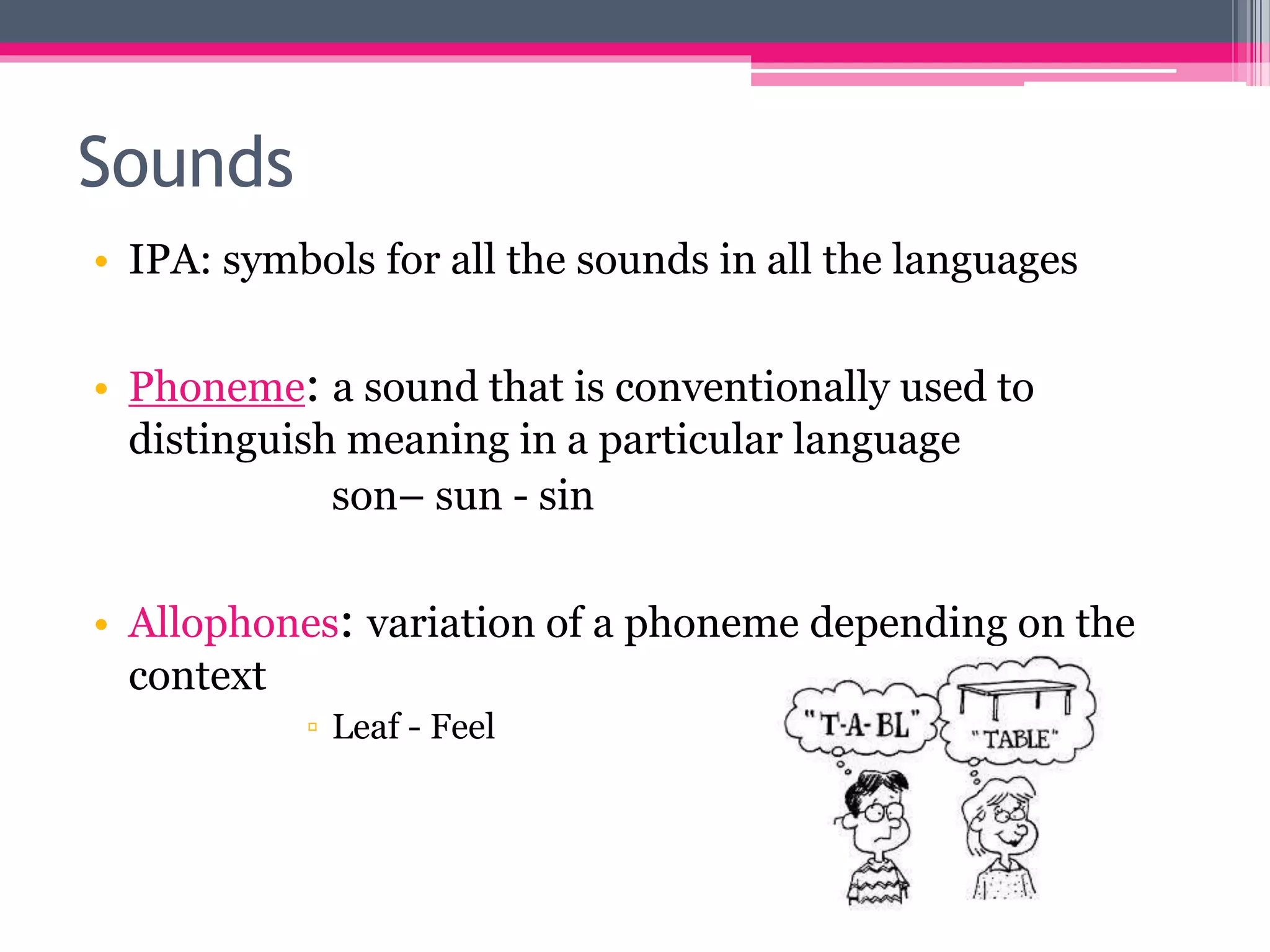
• Phoneme: a sound that is conventionally used to 
distinguish meaning in a particular language 
son– sun - sin 
• Allophones: variation of a phoneme depending on the 
context 
▫ Leaf - Feel
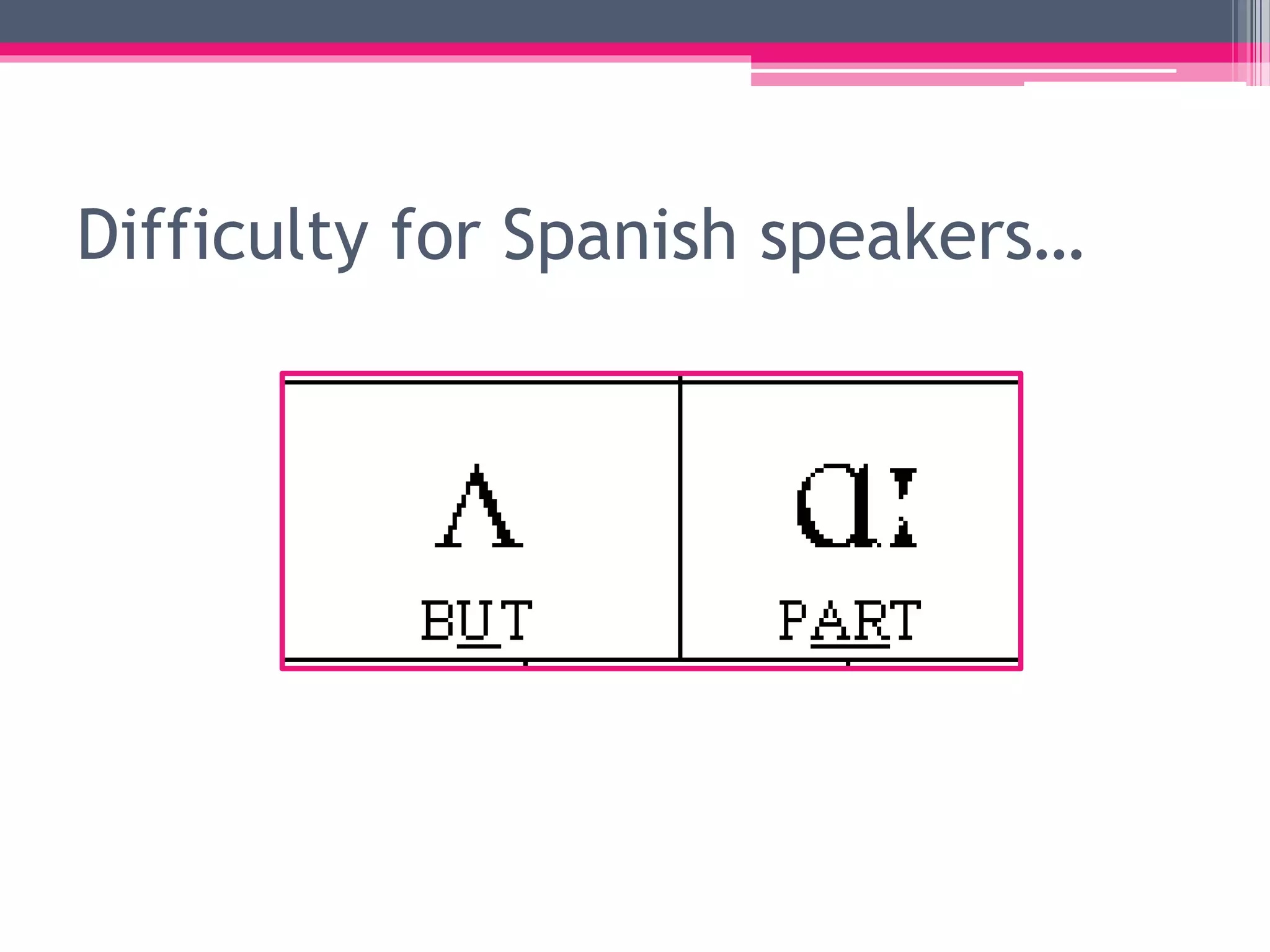
Difficulty for Spanish speakers…
SPANISH 
• poder bajar [po̞ˈðe̞ɾ βaˈxaɾ], 
• el delfín [e̞l de̞lˈfin] 
• Alveolar trill [r] and the alveolar tap [ɾ] are in 
phonemic contrast word-internally between 
vowels carro 'car' [r] 
caro 'expensive‘[ɾ] 
• In final position the rothic will usually be [ɾ]
GERMAN 
German consonant –d- 
At the start or in the middle /d/ 
In final position /t/ 
Cluster –dt- /t/
JAPANESE 
Japanese possesses one liquid consonant: 
A flap that varies between /r/ to /l/ 
Right Light 
Red Led 
Crime Climb 
Froze Flows 
Arrive Alive
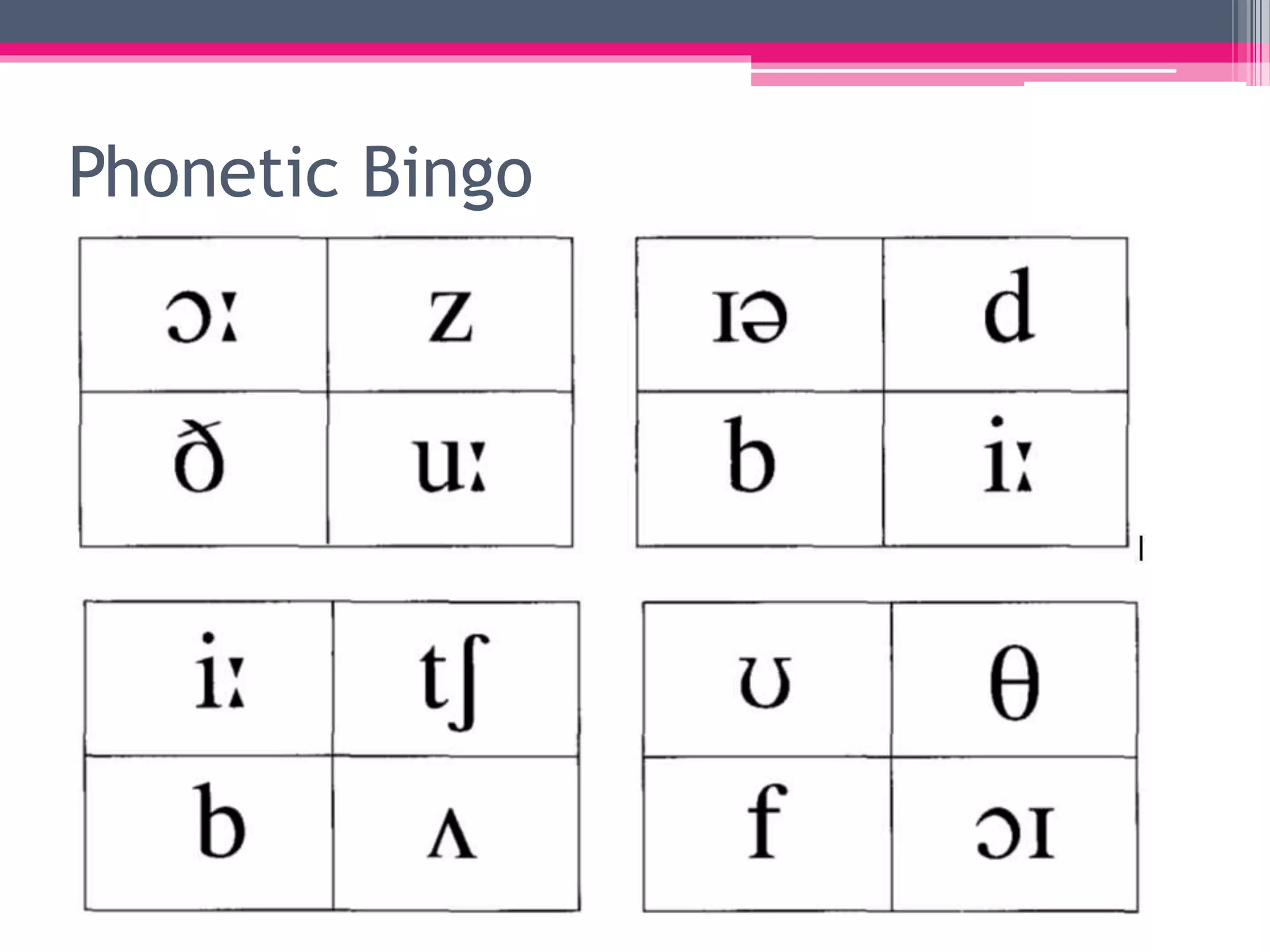
Phonetic Bingo
Rhythm and stress 
English is a very rhythmical language. 
The two components of the system which have the 
greatest influence on rhythm are: 
• sentence stress 
and 
• the various features of connected speech
Teachers should: 
• Provide natural models of new target language 
before introducing the written form. 
• Use natural language themselves in the classroom. 
• Encourage learners to listen carefully to authentic 
speech. 
• Teach recognition before production. 
• Integrate rhythm and other aspects of phonology 
into grammar, vocabulary and functional language 
lessons as well as listening and speaking activities.
Intonation 
• The systematic rise and fall in the pitch of the 
voice during speech (the way that the pitch of 
the voice goes up and down during speech).
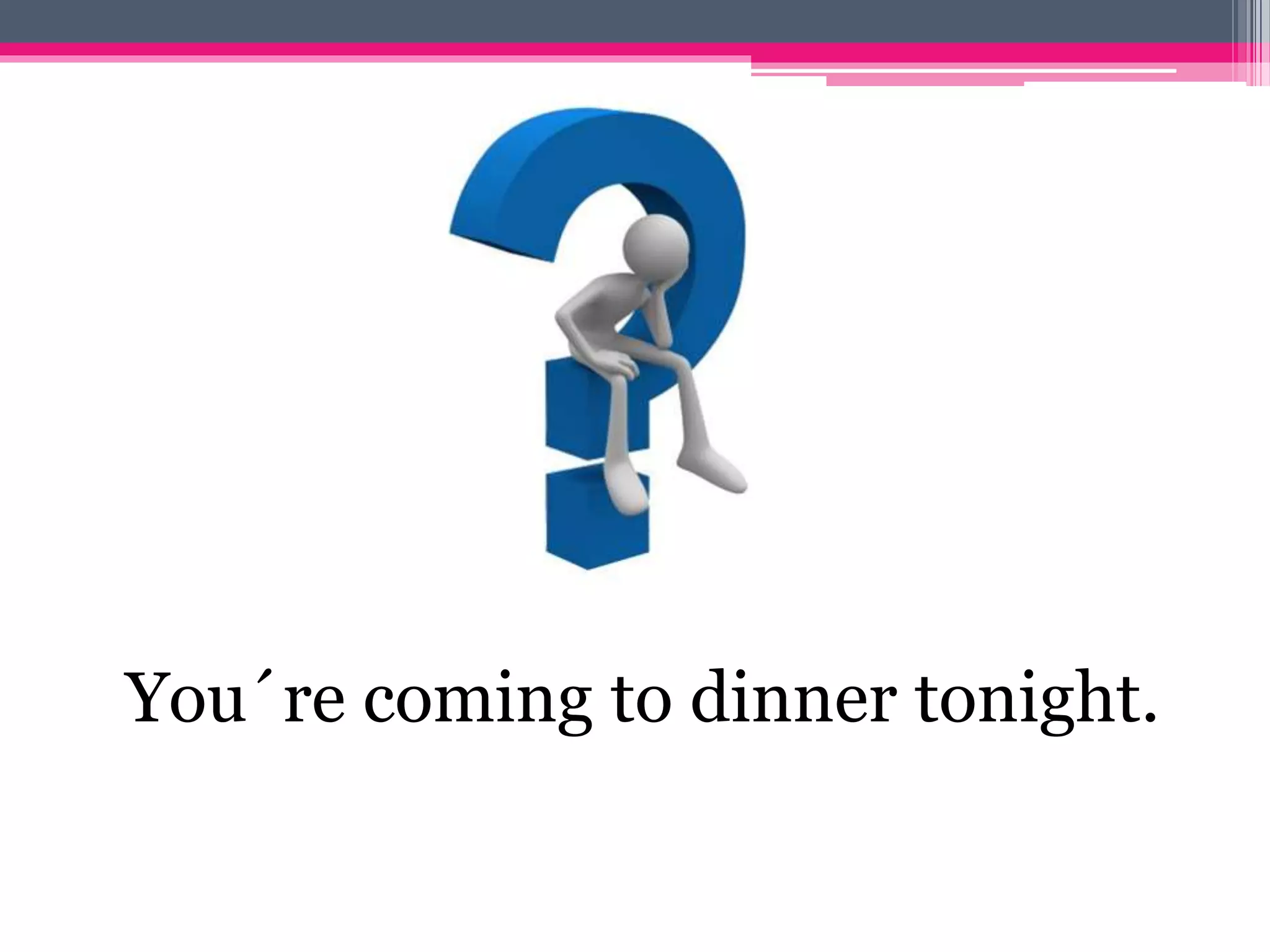
You´re coming to dinner tonight.
INTONATION LANGUAGE 
(shows grammar, attitude and so on) 
OR 
TONE LANGUAGE 
(intonation shows difference in lexical 
meaning)
Teaching pronunciation 
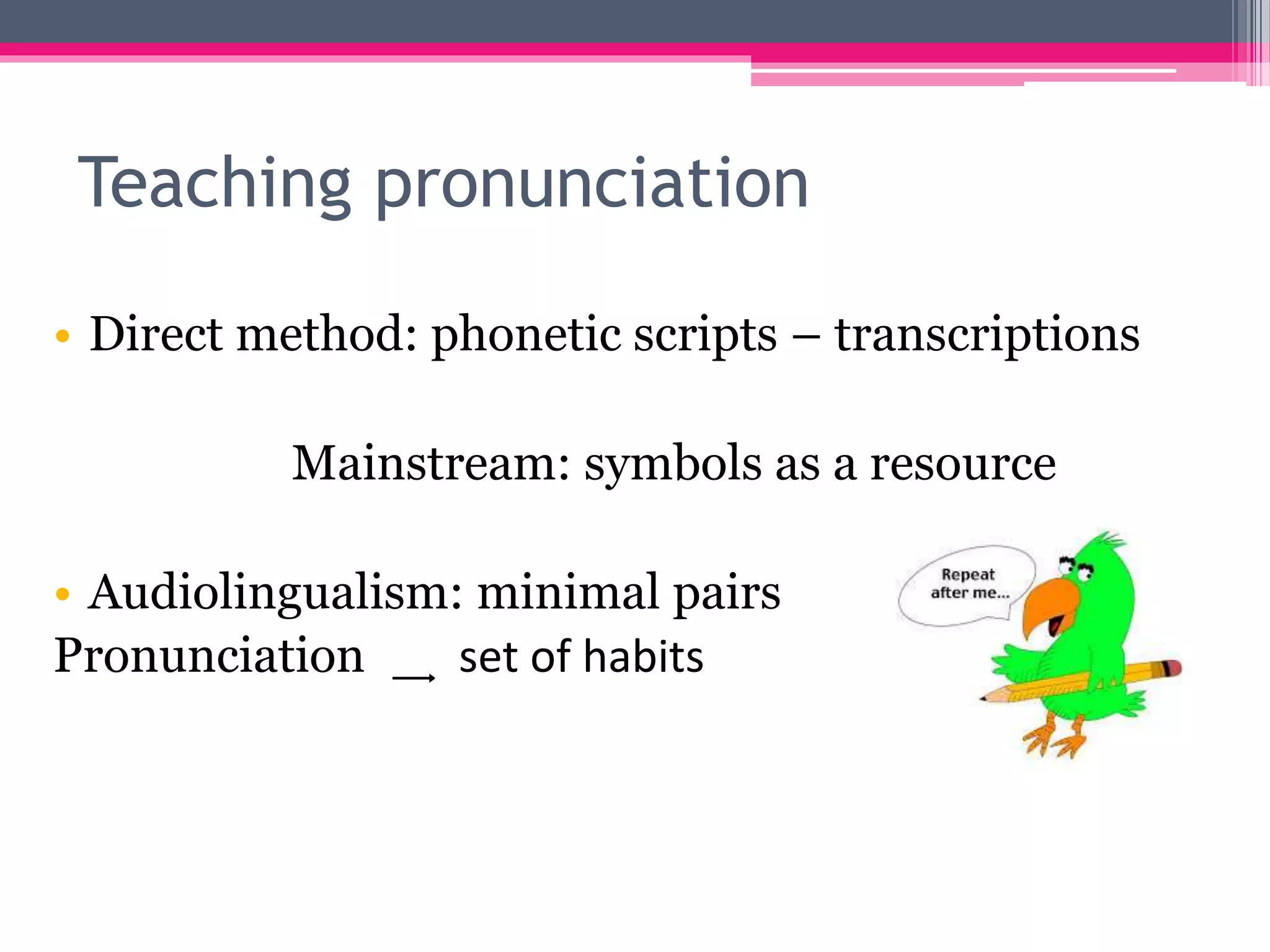
• Direct method: phonetic scripts – transcriptions 
Mainstream: symbols as a resource 
• Audiolingualism: minimal pairs 
Pronunciation ͢ set of habits
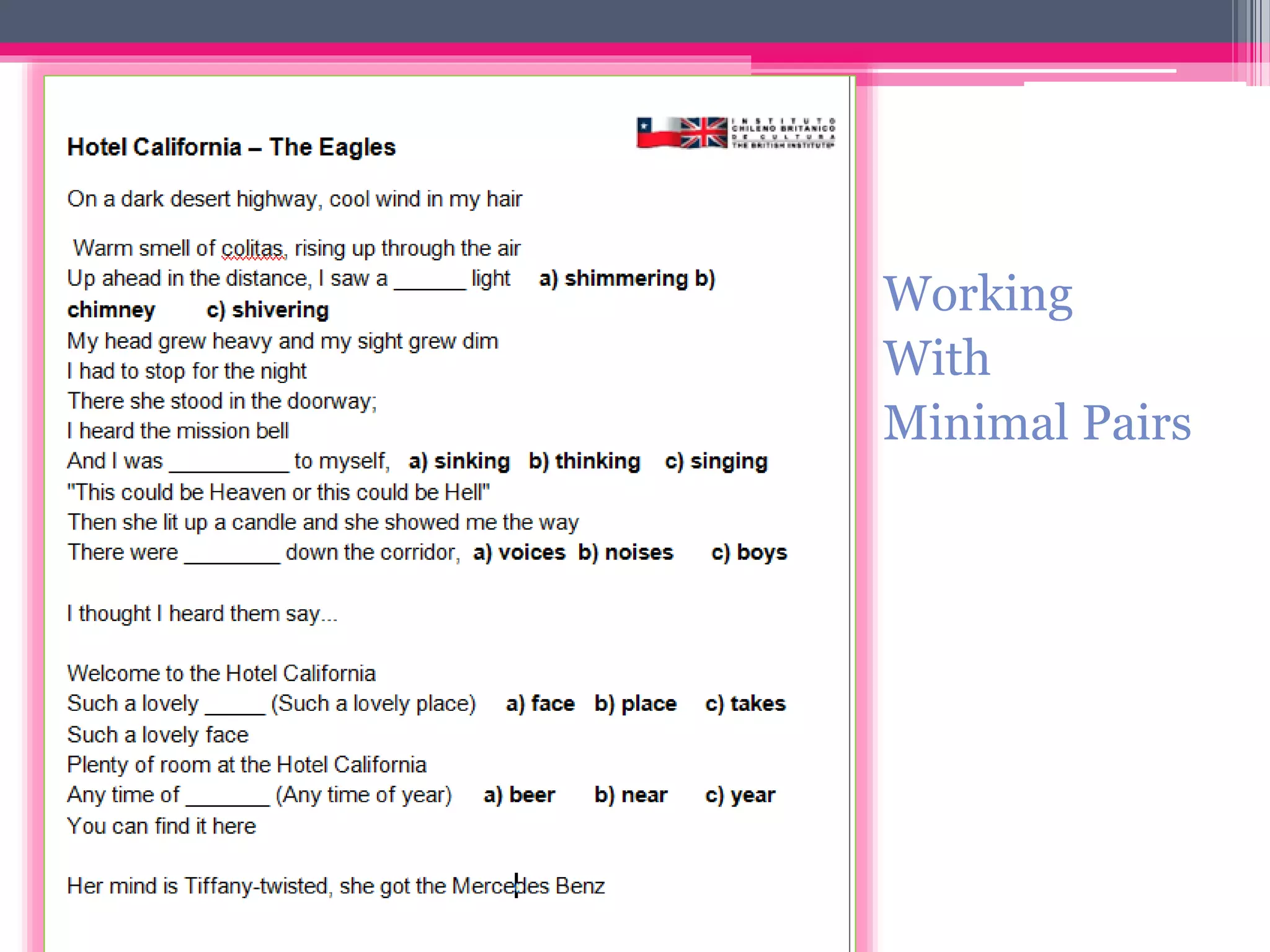
Working 
With 
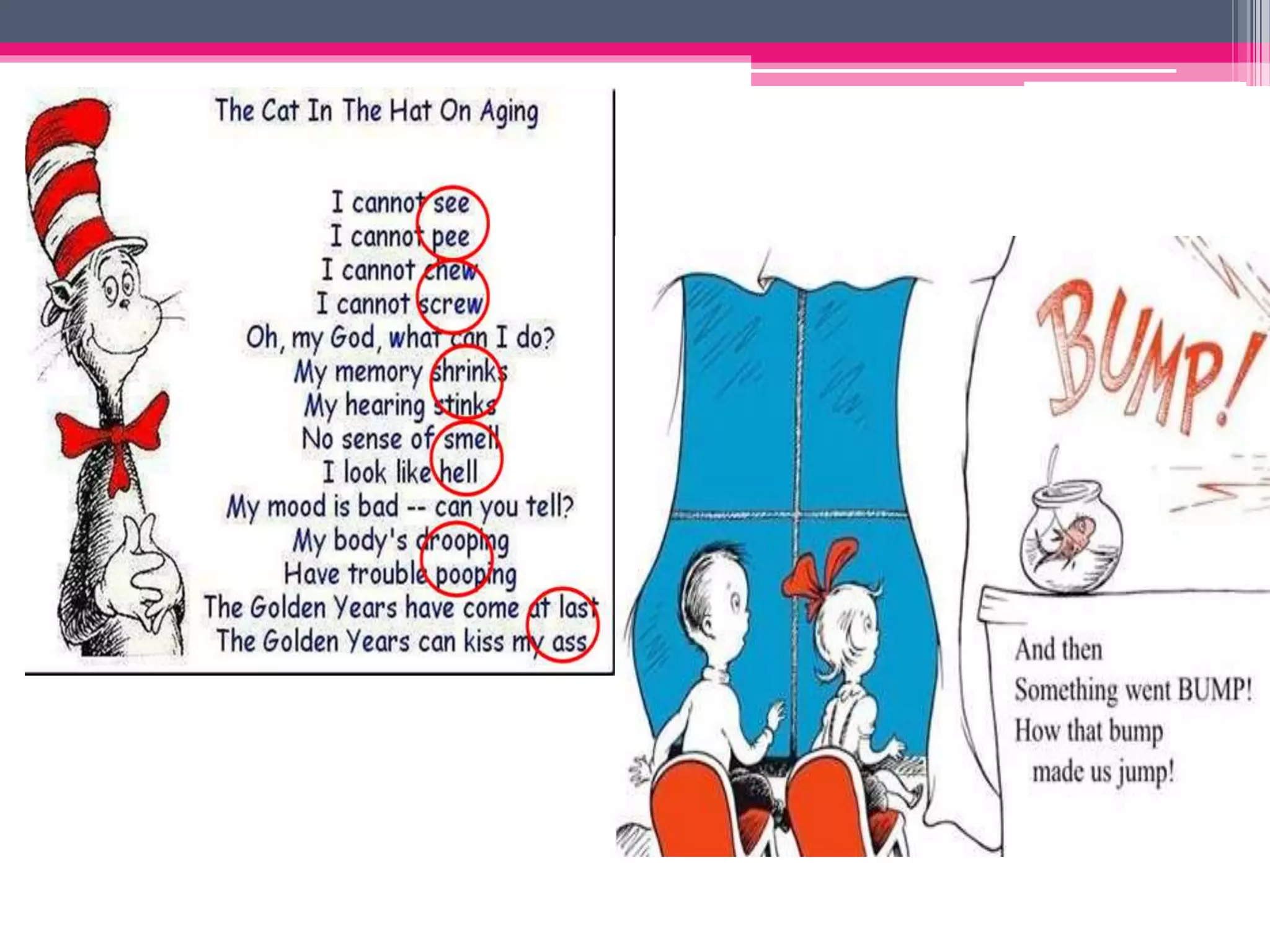
Minimal Pairs
WHAT IS IT?
SHIP
SHEEP
BET
VET
SINK
THINK
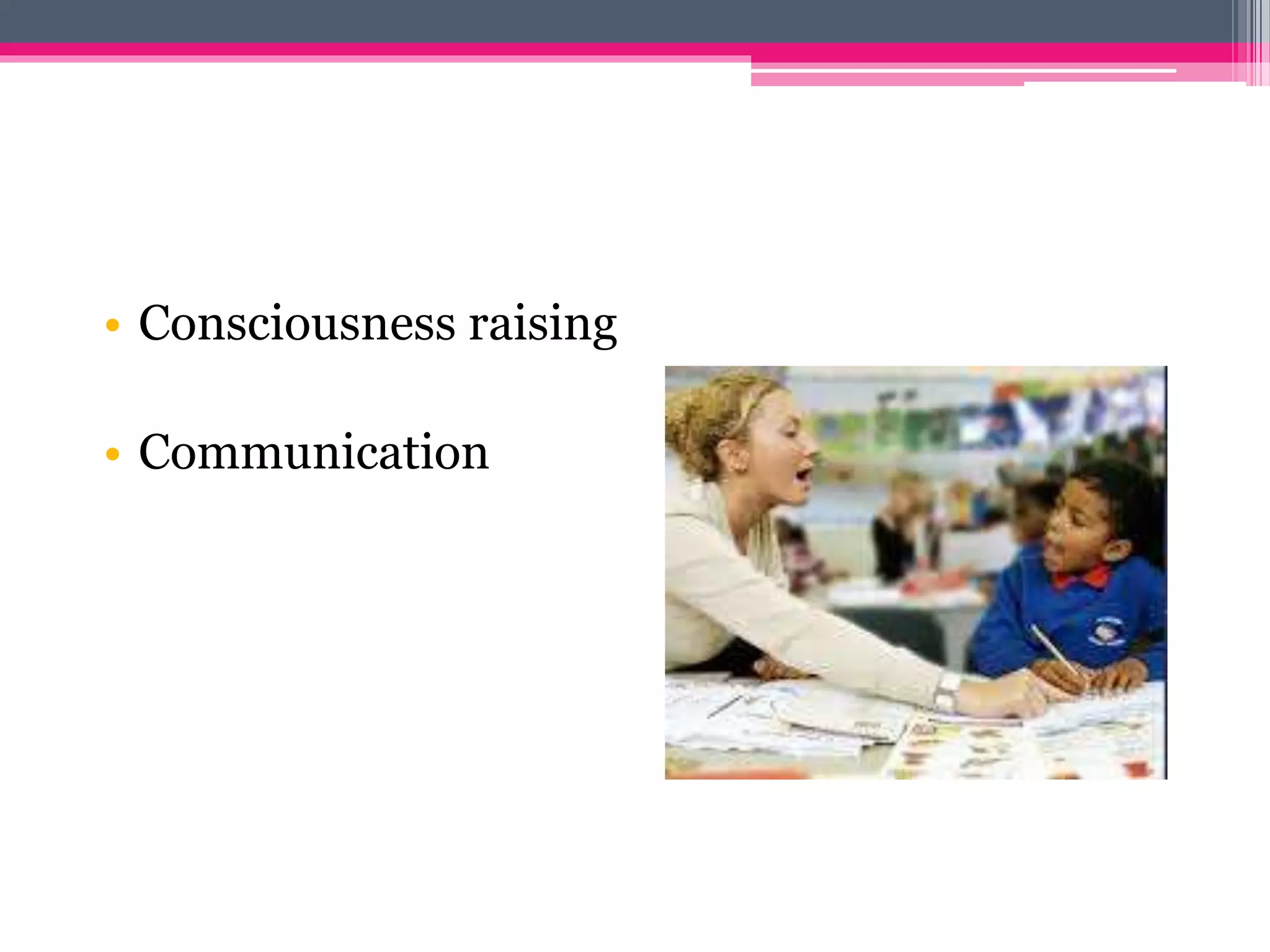
• Consciousness raising 
• Communication
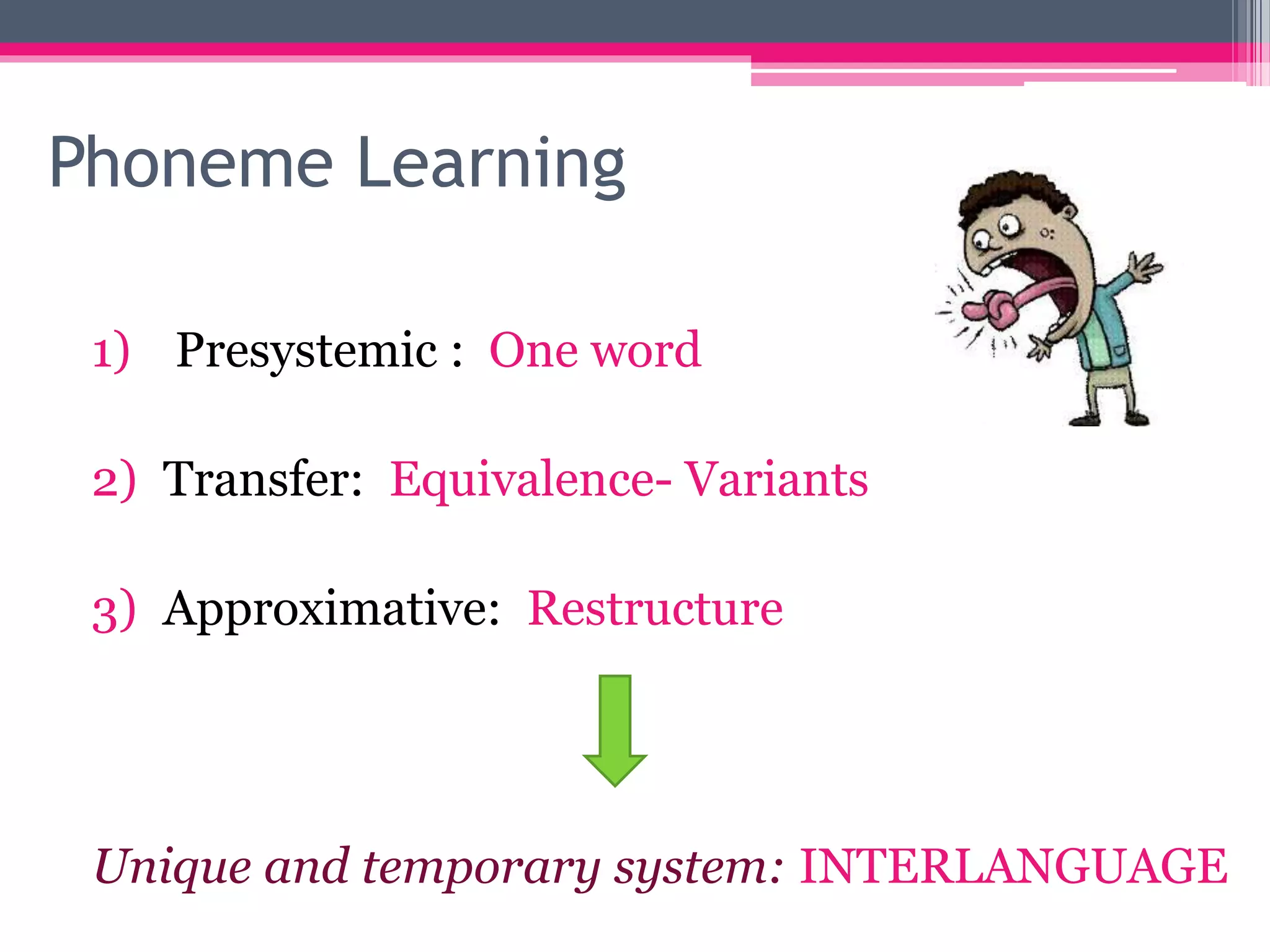
Phoneme Learning 
1) Presystemic : One word 
2) Transfer: Equivalence- Variants 
3) Approximative: Restructure 
Unique and temporary system: INTERLANGUAGE
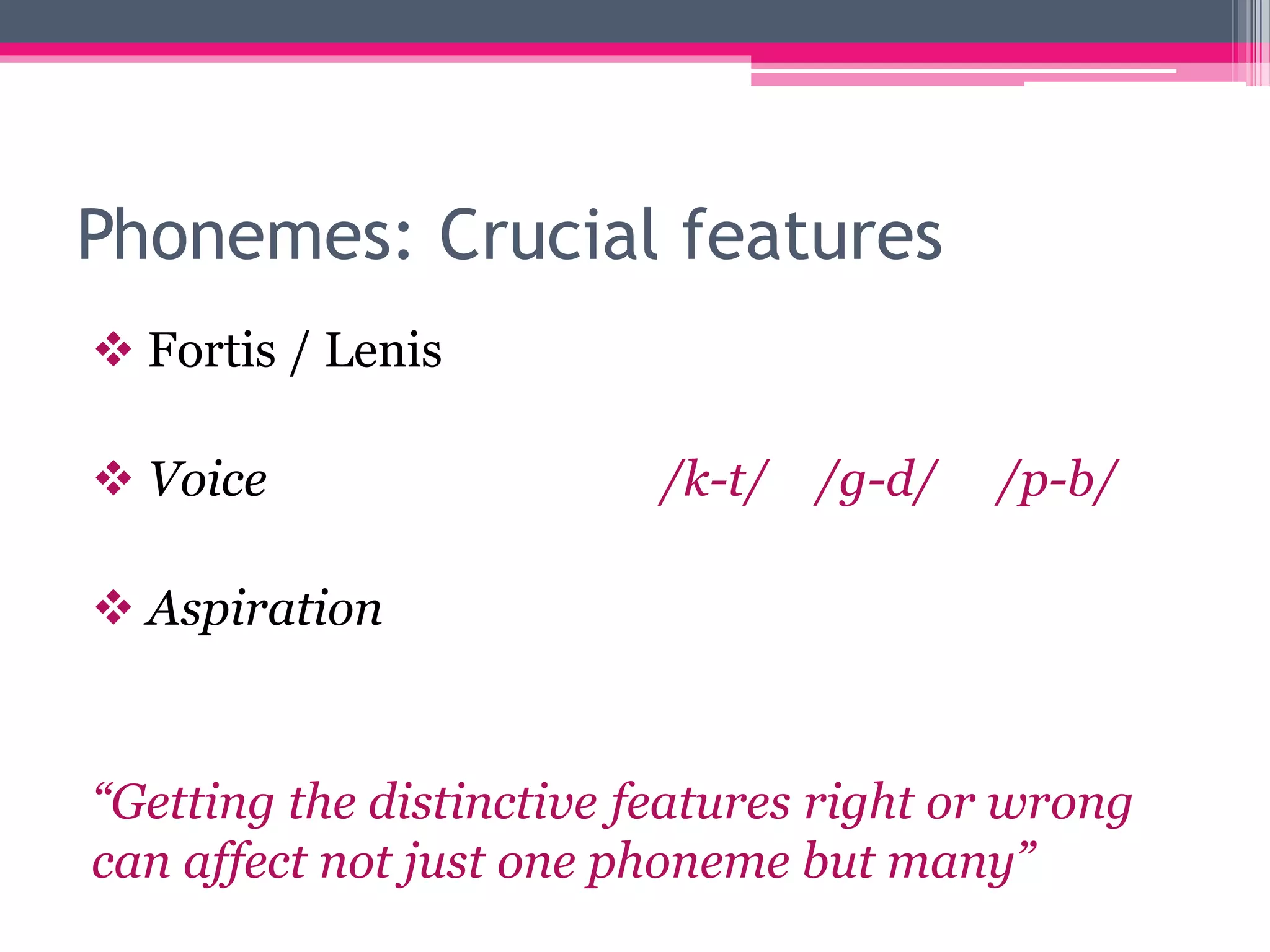
Phonemes: Crucial features 
 Fortis / Lenis 
 Voice /k-t/ /g-d/ /p-b/ 
 Aspiration 
“Getting the distinctive features right or wrong 
can affect not just one phoneme but many”
General ideas about phonology and 
learning 
I. L1 AND TRANSFER 
II. L2 AND UNIVERSAL PROCESS OF 
ACQUISITION
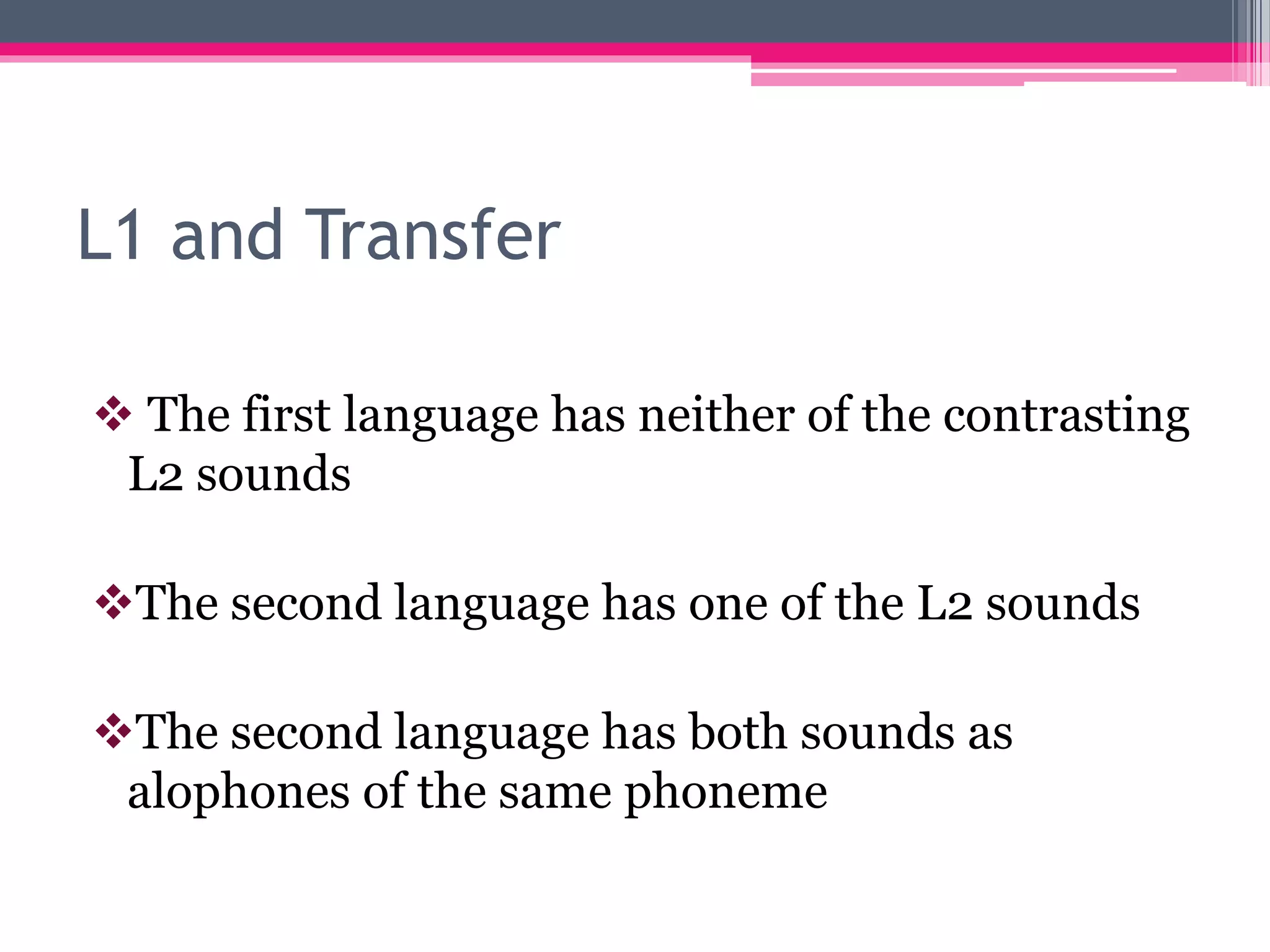
L1 and Transfer 
 The first language has neither of the contrasting 
L2 sounds 
The second language has one of the L2 sounds 
The second language has both sounds as 
alophones of the same phoneme
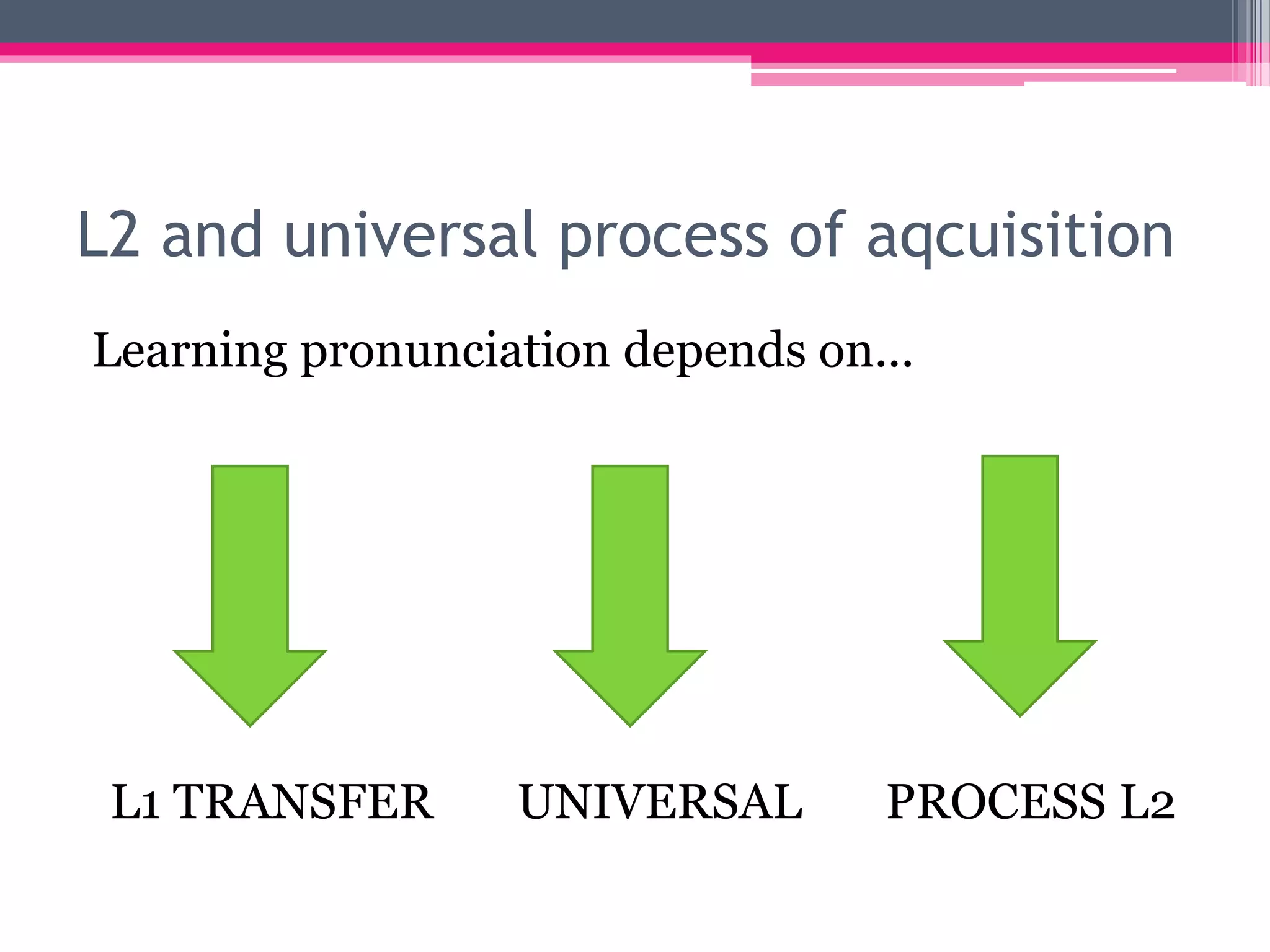
L2 and universal process of aqcuisition 
Learning pronunciation depends on... 
L1 TRANSFER UNIVERSAL PROCESS L2
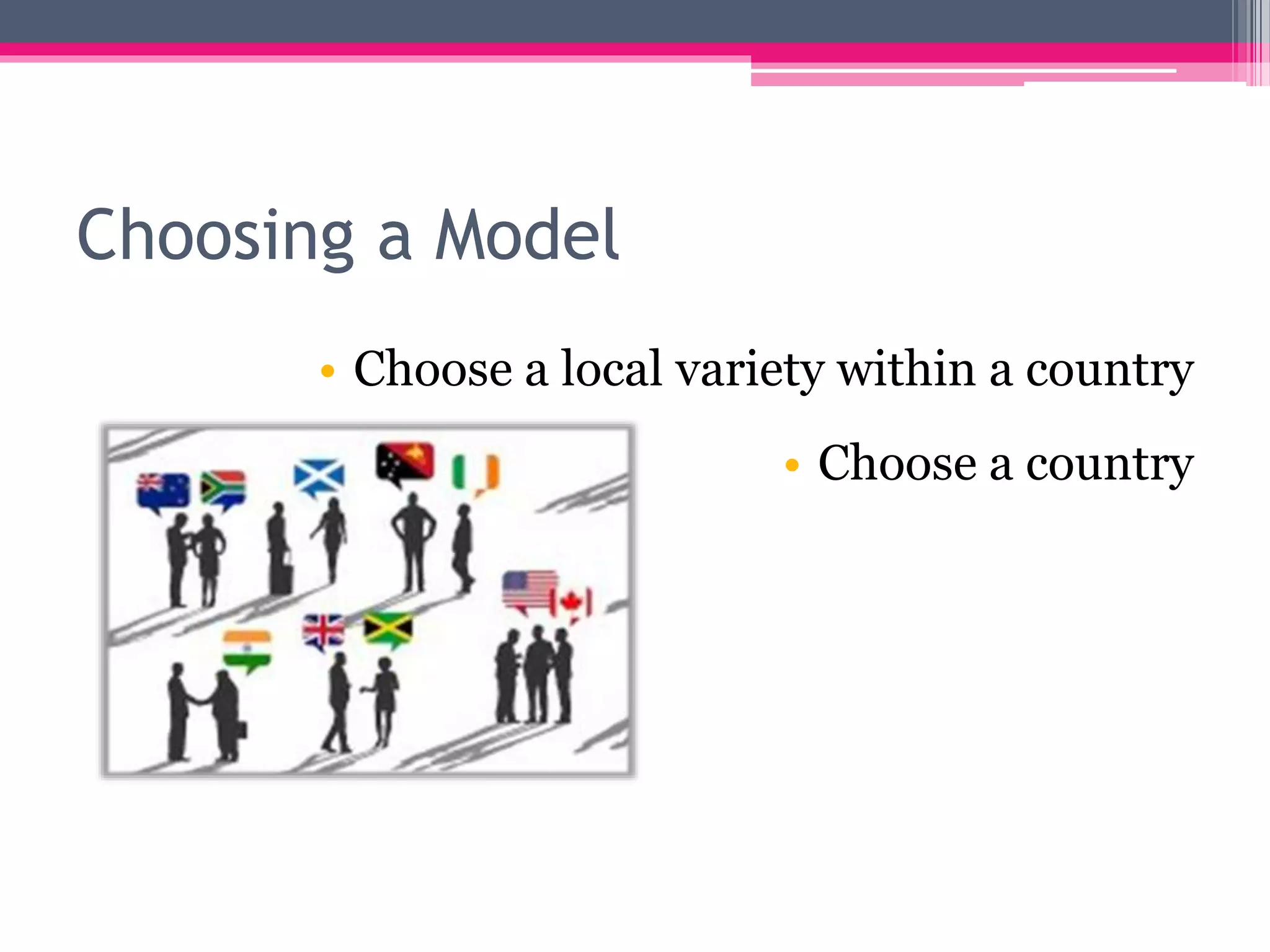
Choosing a Model 
• Choose a local variety within a country 
• Choose a country
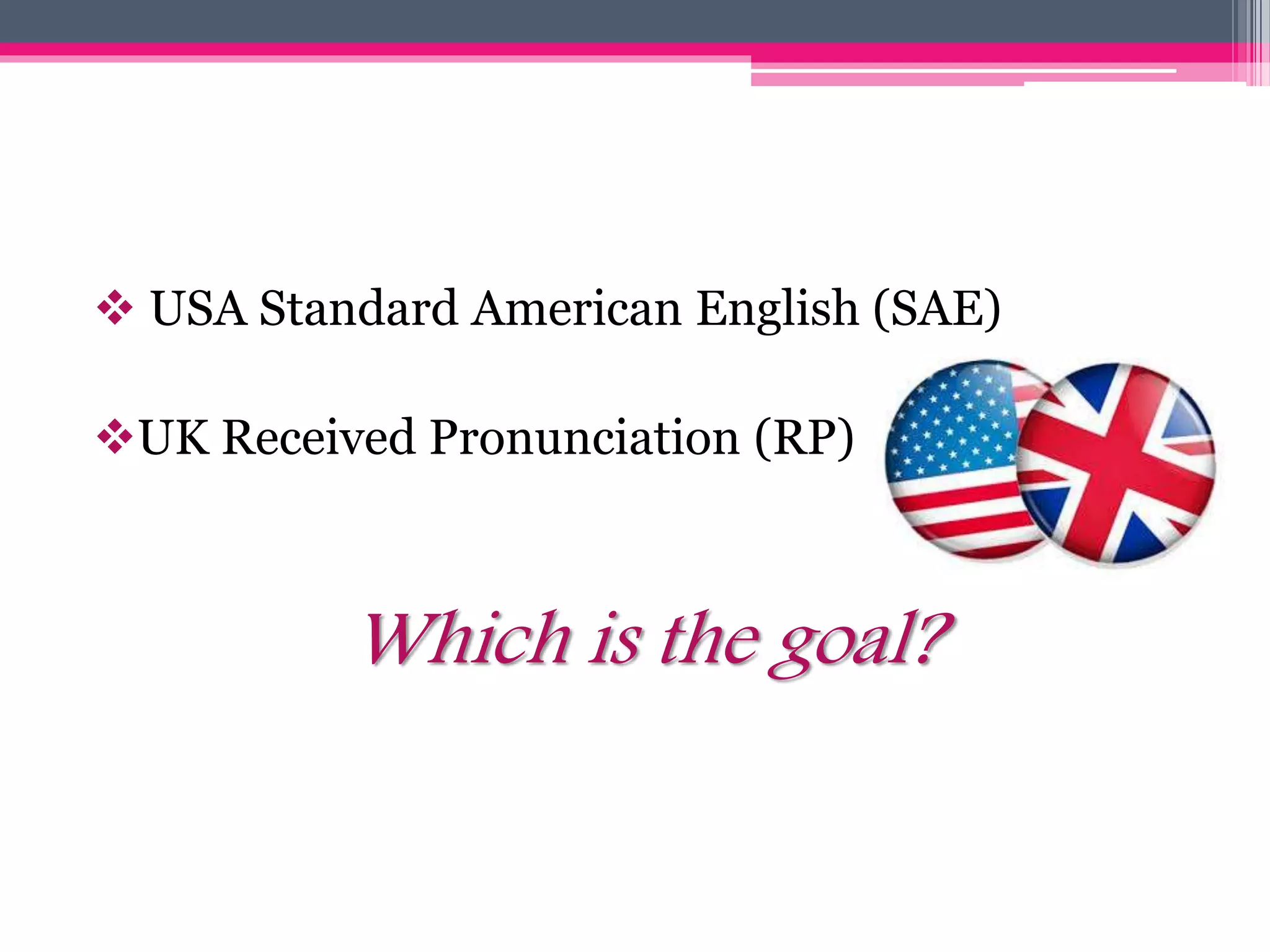
 USA Standard American English (SAE) 
UK Received Pronunciation (RP) 
Which is the goal?
Teachpron todo

Teachpron todo

  • 1.
    Teaching Pronunciation JulietaHernandez Carolina R Torres Cecilia Sosa Language and its Teaching III
  • 2.
    What does itinvolve? • Phonology , the sounds of the language • Stress and rhythm • Intonation
  • 3.
    Sounds • IPA:symbols for all the sounds in all the languages • Phoneme: a sound that is conventionally used to distinguish meaning in a particular language son– sun - sin • Allophones: variation of a phoneme depending on the context ▫ Leaf - Feel
  • 4.
  • 6.
    SPANISH • poderbajar [po̞ˈðe̞ɾ βaˈxaɾ], • el delfín [e̞l de̞lˈfin] • Alveolar trill [r] and the alveolar tap [ɾ] are in phonemic contrast word-internally between vowels carro 'car' [r] caro 'expensive‘[ɾ] • In final position the rothic will usually be [ɾ]
  • 7.
    GERMAN German consonant–d- At the start or in the middle /d/ In final position /t/ Cluster –dt- /t/
  • 8.
    JAPANESE Japanese possessesone liquid consonant: A flap that varies between /r/ to /l/ Right Light Red Led Crime Climb Froze Flows Arrive Alive
  • 9.
  • 10.
    Rhythm and stress English is a very rhythmical language. The two components of the system which have the greatest influence on rhythm are: • sentence stress and • the various features of connected speech
  • 11.
    Teachers should: •Provide natural models of new target language before introducing the written form. • Use natural language themselves in the classroom. • Encourage learners to listen carefully to authentic speech. • Teach recognition before production. • Integrate rhythm and other aspects of phonology into grammar, vocabulary and functional language lessons as well as listening and speaking activities.
  • 12.
    Intonation • Thesystematic rise and fall in the pitch of the voice during speech (the way that the pitch of the voice goes up and down during speech).
  • 13.
    You´re coming todinner tonight.
  • 14.
    INTONATION LANGUAGE (showsgrammar, attitude and so on) OR TONE LANGUAGE (intonation shows difference in lexical meaning)
  • 15.
    Teaching pronunciation •Direct method: phonetic scripts – transcriptions Mainstream: symbols as a resource • Audiolingualism: minimal pairs Pronunciation ͢ set of habits
  • 16.
  • 18.
  • 19.
  • 20.
  • 21.
  • 22.
  • 23.
  • 24.
  • 26.
    • Consciousness raising • Communication
  • 27.
    Phoneme Learning 1)Presystemic : One word 2) Transfer: Equivalence- Variants 3) Approximative: Restructure Unique and temporary system: INTERLANGUAGE
  • 28.
    Phonemes: Crucial features  Fortis / Lenis  Voice /k-t/ /g-d/ /p-b/  Aspiration “Getting the distinctive features right or wrong can affect not just one phoneme but many”
  • 29.
    General ideas aboutphonology and learning I. L1 AND TRANSFER II. L2 AND UNIVERSAL PROCESS OF ACQUISITION
  • 30.
    L1 and Transfer  The first language has neither of the contrasting L2 sounds The second language has one of the L2 sounds The second language has both sounds as alophones of the same phoneme
  • 31.
    L2 and universalprocess of aqcuisition Learning pronunciation depends on... L1 TRANSFER UNIVERSAL PROCESS L2
  • 32.
    Choosing a Model • Choose a local variety within a country • Choose a country
  • 33.
     USA StandardAmerican English (SAE) UK Received Pronunciation (RP) Which is the goal?

Editor's Notes

  • #5 Every language has its own set of phonemes. No two languages have exactly the same system. Two sounds that are separate phonemes in one language might be heard as the same sound in another language–in that language, they’re just different allophones of the same phoneme. When we learn a new language, we have to learn a new set of phonemes. We can’t just keep using the phonemes of our own language