“Good LaboratoryPractice”
An ppt on
Good Laboratory Practice (GLP)
SUBMITTED BY:
NAME –DEEPAK KUMAR
ROLL – 1517050023 (4th YEAR /VIII SEM)
SESSION – 2015 -19
BATCH – A1
SUBMITTED TO
Faculty: Dr. PRAVEEN K. GAUR Designation: Associate. Prof.
Department: Pharmaceutics
ITS COLLEGE OF PHARMACY , MURADNAGER GHAZIABAD -201206 (UP)
1
Good LaboratoryPractice
 Scope of thissession
 GLP from a Regulatoryperspective
 GLP from a Quality Systemperspective
2
Introduction
3
What is Good LaboratoryPractice
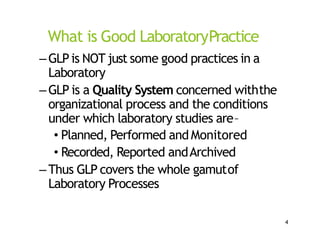
–GLPis NOT just some good practices in a
Laboratory
–GLP is a Quality System concerned withthe
organizational process and the conditions
under which laboratory studies are–
• Planned, Performed and Monitored
• Recorded, Reported andArchived
–Thus GLP covers the whole gamutof
Laboratory Processes
4
Why Good LaboratoryPractice
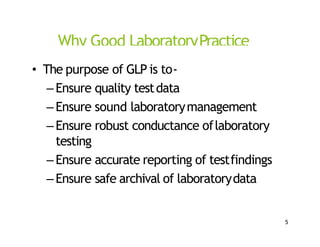
• The purpose of GLP is to‐
–Ensure quality testdata
–Ensure sound laboratorymanagement
–Ensure robust conductance oflaboratory
testing
–Ensure accurate reporting of testfindings
–Ensure safe archival of laboratorydata
5
Laboratory Data Integrity
Data integrity is very critical ‐Analyticalresults
should
 Accurately describe the properties ofthe
samples assessed
 Permit correct conclusions to be drawnabout
the quality of thesamples
 Form the basis for anysubsequent
administrative and legalactions
 Form the basis for any customerresponses
6
7
Laboratory Data
GlobalAcceptance
•Laboratory data integrity has animportant
international dimension
 Global acceptance of C ofA
 Duplicative testing can beavoided
 Costs saved to nation andindustry
 Faster disposal of registrationsubmissions
8
GLP
Compliance Perspective
Good LaboratoryPractice
Compliance requirements
• The Drugs and Cosmetics Act,1940
–Schedule L‐1 on GLP effective Nov2010
–Schedule M ‐ Section 14 on QualityAssurance
and Section 16 on Quality Control mentions
about GLP
–Schedule U Part III – Particulars to be recorded
in Analytical Records pertains toGLP
9
Good LaboratoryPractice
Compliance requirements
• 21 CFR Part 211, USFDA cGMP
– Subpart I, Laboratory Control – stipulates
detailed laboratory controls to befollowed
10
Good LaboratoryPractice
Compliance requirements
• EU GMPEudraLex Volume 4, Part 1, updated
version effectiveOctb2014
–Chapter 6 – Quality Control
–Mentions Good QC LaboratoryPractice,
stipulates detailed control measures
• Recent Guideline from MHRAon Data
Integrity essentially deals withGLP
11
Good LaboratoryPractice
Compliance requirements
• WHO GMP Guidelines
–TRS 957Annex 1 – WHO Good Practices for
Pharmaceutical QC Laboratories
–TRS 961Annex 2 – WHO Good Practices for
Pharmaceutical Microbiology Laboratories
• Other statutes and Guidelines like ICHQ7
12
Good LaboratoryPractice
Compliance requirements
• Thus compliance ismandated
• Compliance is essential‐
–For patient safetyprimarily
–Meeting regulatoryexpectations
–For high level of customerconfidence
–In dealing with any futurelitigations
13
14
GLP
Quality SystemPerspective
15
Organization
Organization
• Management responsibility
–Defining Laboratory manager’s roleand
responsibilities
–Independence of laboratory function(QC&QA)
–GLPcompliance must be referred to in the
Quality Manual
–Making resourcesavailable
–Controls on external testing labs ifany
–Use of metrics related to laboratoryoperations
16
Laboratory Facilities(1)
17
Laboratory Facilities(1)
• Afactorthatisoverlookedinmanyorganizations
• Effectiveand accuratelaboratoryactivities possible only if
adequatespaceisprovided
• Adequate spaceincludes – sample receiving and storage areas,
testing areas,chemicalstorage areas,glassware washing areas,
officeareas, retention samplestorage areas,document storage
areas,training roometc.
18
Laboratory Facilities(2)
19
• Logical workflow to avoid crisscrossmovements
• Crisscross movements kills productiveman‐
hours in thelaboratory
• Consider space requirements 10 yearsahead
and makeprovisions
• Apply principles of LeanLab
Personnel and training(1)
20
Personnel and training(1)
21
• People make or break theGLP systems
• Getting qualified and experiencedanalysts
with the right attitude isa challenge today
• Responsibilities should be defined,
communicated and documented toavoid
overlapping
Personnel and training(2)
22
• Mere training is notenough
• Organizations should have developmentplans
for the laboratory staff – that only can help
retain them
• Talent identification and development plans
• Succession plans should be inplace
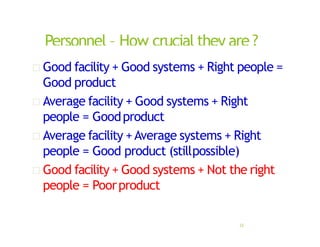
Personnel – How crucial they are ?
23
 Good facility + Good systems + Right people =
Good product
 Average facility + Good systems + Right
people = Goodproduct
 Average facility +Average systems + Right
people = Good product (stillpossible)
 Good facility + Good systems + Not the right
people = Poorproduct
Laboratory Equipment(1)
24
Laboratory Equipment(1)
25
• Science and technology progressedseveral
folds during the lastdecades
• Automation is the answer for many of the
laboratory illness
• Ideally all needed equipment shouldbe
available
• Outsourcing any tests only ifjustified
Laboratory Equipment(2)
• Equipment qualification, calibration and
maintenance
• Controls on computerized systems in linewith
21CFR Part 11 and EU GMP Annex 11
• Avoid data integrity breaches involving
computerized systems in the laboratoryby
having robust controls
26
Chemicals andreagents
27
Chemicals andreagents
• Chemicals, reagents and reference substances
pay a vital role in the correctness of laboratory
results
• Microbiological cultures andmedia
• Traceability in allrecords
• Uncontrolled cost cutting in this areacould
lead to increased number of laboratory
deviations and OOS results
28
Sampling andTesting
29
Sampling andTesting
• Sampling is a criticalactivity
• Sampling should be done bytrained personnel
• Sample identification, samples controls and
sample disposition should be as per written
procedures
• Sampling of stability samples asper written
procedures for stabilitytesting
30
Sampling andTesting
• Pharmacopoeial test procedures shouldbe
verified
• Other test procedures should bevalidated
• Concurrent recording of testresults
• Trending of testresults
• Stability testing as per writtenprocedures
31
32
Laboratory Documentation (1)
• Documentation is key to thelaboratory
process
• Laboratory documentation – Manual system,
electronic system or a hybridsystem
• Robust controls for original raw dataand
traceability
• Secured storage ofdocuments
33
Laboratory Documentation (2)
• Equipment qualification documents
• Method validationdocuments
• Method transfer documents fromR&D
• Methodtransfer documents from other labs
• Testreports and Certificates ofAnalysis
34
35
Out of Specification Investigations(1)
• Management of OOSresults need special
mention
• OOS and atypical results arise dueto
–Laboratory error
–Operator error
–Process related error (usually inmfg.)
–Material relatederrors
–Environment relatedfactors
36
Out of Specification Investigations(2)
• Robust investigations process
• Identification of rootcause
• Trending of OOS results
• CAPAprocess
37
38
SelfInspection
SelfInspection
• Oneof the strongest tools for continual
improvement if done diligently
–Cover all laboratory areas andsystems
–Issue report as soon as possible
Get CAPAcommitments and putCAPA
tracking system inplace
–Findings discussed in managementreview
meetings
39
Self Inspection
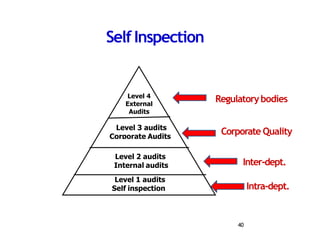
40
Regulatorybodies
Level 3 audits
Corporate Audits
Level 4
External
Audits
Corporate Quality
Level 2 audits
Internal audits Inter‐dept.
Level 1 audits
Self inspection Intra‐dept.
Good housekeeping&
41
Laboratory Safety
Good housekeeping&
LaboratorySafety
42
• Good Housekeeping and safety go hand in hand
• Employee safety, personnel protective
equipment
• Laboratory garment regime andcontamination
control
• Equipment and facility safety; firehazards
RiskAssessment inLaboratory
43
RiskAssessment in Laboratory
44
• Identifying risks in laboratory operationsis
business critical
• Still this is an area seldom addressed by the
industry
• Lack of knowledge and /or lackof
commitment
• Many a problem could have been avoided if a
robust RiskAssessment process was in place
• Patient safety and regulatory complianceare
of paramount importance for pharma
laboratory operations
• Key decisions about the product are made in
the Laboratory
• Without robust laboratory controls thepatient
and business both willsuffer
Safety
45
Message
46
So as anAnalyst you have a dual role
• Help thepatient
• Help thebusiness
• Then only youcan help yourself
• Good luck toyou!
1
47

Ppt on glp by deepak kumar

  • 1.
    “Good LaboratoryPractice” An ppton Good Laboratory Practice (GLP) SUBMITTED BY: NAME –DEEPAK KUMAR ROLL – 1517050023 (4th YEAR /VIII SEM) SESSION – 2015 -19 BATCH – A1 SUBMITTED TO Faculty: Dr. PRAVEEN K. GAUR Designation: Associate. Prof. Department: Pharmaceutics ITS COLLEGE OF PHARMACY , MURADNAGER GHAZIABAD -201206 (UP) 1
  • 2.
    Good LaboratoryPractice  Scopeof thissession  GLP from a Regulatoryperspective  GLP from a Quality Systemperspective 2
  • 3.
  • 4.
    What is GoodLaboratoryPractice –GLPis NOT just some good practices in a Laboratory –GLP is a Quality System concerned withthe organizational process and the conditions under which laboratory studies are– • Planned, Performed and Monitored • Recorded, Reported andArchived –Thus GLP covers the whole gamutof Laboratory Processes 4
  • 5.
    Why Good LaboratoryPractice •The purpose of GLP is to‐ –Ensure quality testdata –Ensure sound laboratorymanagement –Ensure robust conductance oflaboratory testing –Ensure accurate reporting of testfindings –Ensure safe archival of laboratorydata 5
  • 6.
    Laboratory Data Integrity Dataintegrity is very critical ‐Analyticalresults should  Accurately describe the properties ofthe samples assessed  Permit correct conclusions to be drawnabout the quality of thesamples  Form the basis for anysubsequent administrative and legalactions  Form the basis for any customerresponses 6
  • 7.
    7 Laboratory Data GlobalAcceptance •Laboratory dataintegrity has animportant international dimension  Global acceptance of C ofA  Duplicative testing can beavoided  Costs saved to nation andindustry  Faster disposal of registrationsubmissions
  • 8.
  • 9.
    Good LaboratoryPractice Compliance requirements •The Drugs and Cosmetics Act,1940 –Schedule L‐1 on GLP effective Nov2010 –Schedule M ‐ Section 14 on QualityAssurance and Section 16 on Quality Control mentions about GLP –Schedule U Part III – Particulars to be recorded in Analytical Records pertains toGLP 9
  • 10.
    Good LaboratoryPractice Compliance requirements •21 CFR Part 211, USFDA cGMP – Subpart I, Laboratory Control – stipulates detailed laboratory controls to befollowed 10
  • 11.
    Good LaboratoryPractice Compliance requirements •EU GMPEudraLex Volume 4, Part 1, updated version effectiveOctb2014 –Chapter 6 – Quality Control –Mentions Good QC LaboratoryPractice, stipulates detailed control measures • Recent Guideline from MHRAon Data Integrity essentially deals withGLP 11
  • 12.
    Good LaboratoryPractice Compliance requirements •WHO GMP Guidelines –TRS 957Annex 1 – WHO Good Practices for Pharmaceutical QC Laboratories –TRS 961Annex 2 – WHO Good Practices for Pharmaceutical Microbiology Laboratories • Other statutes and Guidelines like ICHQ7 12
  • 13.
    Good LaboratoryPractice Compliance requirements •Thus compliance ismandated • Compliance is essential‐ –For patient safetyprimarily –Meeting regulatoryexpectations –For high level of customerconfidence –In dealing with any futurelitigations 13
  • 14.
  • 15.
  • 16.
    Organization • Management responsibility –DefiningLaboratory manager’s roleand responsibilities –Independence of laboratory function(QC&QA) –GLPcompliance must be referred to in the Quality Manual –Making resourcesavailable –Controls on external testing labs ifany –Use of metrics related to laboratoryoperations 16
  • 17.
  • 18.
    Laboratory Facilities(1) • Afactorthatisoverlookedinmanyorganizations •Effectiveand accuratelaboratoryactivities possible only if adequatespaceisprovided • Adequate spaceincludes – sample receiving and storage areas, testing areas,chemicalstorage areas,glassware washing areas, officeareas, retention samplestorage areas,document storage areas,training roometc. 18
  • 19.
    Laboratory Facilities(2) 19 • Logicalworkflow to avoid crisscrossmovements • Crisscross movements kills productiveman‐ hours in thelaboratory • Consider space requirements 10 yearsahead and makeprovisions • Apply principles of LeanLab
  • 20.
  • 21.
    Personnel and training(1) 21 •People make or break theGLP systems • Getting qualified and experiencedanalysts with the right attitude isa challenge today • Responsibilities should be defined, communicated and documented toavoid overlapping
  • 22.
    Personnel and training(2) 22 •Mere training is notenough • Organizations should have developmentplans for the laboratory staff – that only can help retain them • Talent identification and development plans • Succession plans should be inplace
  • 23.
    Personnel – Howcrucial they are ? 23  Good facility + Good systems + Right people = Good product  Average facility + Good systems + Right people = Goodproduct  Average facility +Average systems + Right people = Good product (stillpossible)  Good facility + Good systems + Not the right people = Poorproduct
  • 24.
  • 25.
    Laboratory Equipment(1) 25 • Scienceand technology progressedseveral folds during the lastdecades • Automation is the answer for many of the laboratory illness • Ideally all needed equipment shouldbe available • Outsourcing any tests only ifjustified
  • 26.
    Laboratory Equipment(2) • Equipmentqualification, calibration and maintenance • Controls on computerized systems in linewith 21CFR Part 11 and EU GMP Annex 11 • Avoid data integrity breaches involving computerized systems in the laboratoryby having robust controls 26
  • 27.
  • 28.
    Chemicals andreagents • Chemicals,reagents and reference substances pay a vital role in the correctness of laboratory results • Microbiological cultures andmedia • Traceability in allrecords • Uncontrolled cost cutting in this areacould lead to increased number of laboratory deviations and OOS results 28
  • 29.
  • 30.
    Sampling andTesting • Samplingis a criticalactivity • Sampling should be done bytrained personnel • Sample identification, samples controls and sample disposition should be as per written procedures • Sampling of stability samples asper written procedures for stabilitytesting 30
  • 31.
    Sampling andTesting • Pharmacopoeialtest procedures shouldbe verified • Other test procedures should bevalidated • Concurrent recording of testresults • Trending of testresults • Stability testing as per writtenprocedures 31
  • 32.
  • 33.
    Laboratory Documentation (1) •Documentation is key to thelaboratory process • Laboratory documentation – Manual system, electronic system or a hybridsystem • Robust controls for original raw dataand traceability • Secured storage ofdocuments 33
  • 34.
    Laboratory Documentation (2) •Equipment qualification documents • Method validationdocuments • Method transfer documents fromR&D • Methodtransfer documents from other labs • Testreports and Certificates ofAnalysis 34
  • 35.
    35 Out of SpecificationInvestigations(1)
  • 36.
    Out of SpecificationInvestigations(1) • Management of OOSresults need special mention • OOS and atypical results arise dueto –Laboratory error –Operator error –Process related error (usually inmfg.) –Material relatederrors –Environment relatedfactors 36
  • 37.
    Out of SpecificationInvestigations(2) • Robust investigations process • Identification of rootcause • Trending of OOS results • CAPAprocess 37
  • 38.
  • 39.
    SelfInspection • Oneof thestrongest tools for continual improvement if done diligently –Cover all laboratory areas andsystems –Issue report as soon as possible Get CAPAcommitments and putCAPA tracking system inplace –Findings discussed in managementreview meetings 39
  • 40.
    Self Inspection 40 Regulatorybodies Level 3audits Corporate Audits Level 4 External Audits Corporate Quality Level 2 audits Internal audits Inter‐dept. Level 1 audits Self inspection Intra‐dept.
  • 41.
  • 42.
    Good housekeeping& LaboratorySafety 42 • GoodHousekeeping and safety go hand in hand • Employee safety, personnel protective equipment • Laboratory garment regime andcontamination control • Equipment and facility safety; firehazards
  • 43.
  • 44.
    RiskAssessment in Laboratory 44 •Identifying risks in laboratory operationsis business critical • Still this is an area seldom addressed by the industry • Lack of knowledge and /or lackof commitment • Many a problem could have been avoided if a robust RiskAssessment process was in place
  • 45.
    • Patient safetyand regulatory complianceare of paramount importance for pharma laboratory operations • Key decisions about the product are made in the Laboratory • Without robust laboratory controls thepatient and business both willsuffer Safety 45
  • 46.
    Message 46 So as anAnalystyou have a dual role • Help thepatient • Help thebusiness • Then only youcan help yourself • Good luck toyou!
  • 47.