Structural Approach inELT
A foundational approach in English Language
Teaching.
Emphasizes mastery of grammatical
structures.
Based on linguistic patterns and behavioural
psychology.
Focuses on oral skills first before
reading/writing.
Ensures accuracy through repetition and habit
formation.
2.
Origin & Background
Developedby linguists C.C. Fries and Robert
Lado.
Influenced by structural linguistics (240–250
structures identified).
Promoted by Palmer, Hornby, and Madras
ELT Campaign.
Introduced in India for systematic, graded
language learning.
Supported behaviourist theory—learning
through conditioning.
3.
Core Philosophy &Principles
Language is primarily speech, not writing.
Learning a language = forming habits.
Teach language directly, not about the
language.
Mastery of structures enables fluent
communication.
Structures must be taught in meaningful
situations.
Correct responses reinforced through
practice.
4.
Definition & Purpose
Amethod of presenting graded grammatical
patterns.
First taught orally, later reinforced through
reading/writing.
Ensures systematic exposure to essential
structures.
Aims to help learners internalize correct
patterns.
Encourages practical use through controlled
environments.
5.
Selection & Gradationof Structures
Based on criteria: Usefulness, Frequency,
Teachability, Productivity.
Simple → complex progression.
High-frequency items taught early.
•Structures that generate more sentences
prioritized.
Forms the ‘Structural Syllabus’ of about 100
key patterns.
6.
Types of Structuresin ELT
Sentence Patterns: e.g., ‘She is reading.’
Phrase Patterns: e.g., ‘In the garden.’
Formulas: e.g., Greetings, requests.
Idioms: e.g., ‘At the eleventh hour.’
Verb Patterns identified by Hornby (25
patterns).
Each type supports functional language use.
7.
Role of Teacherin Structural
Approach
Acts as MODEL—provides accurate examples.
DIRECTOR—guides drill-based learning.
CONTROLLER—monitors errors strictly.
Provides maximum speaking opportunities.
Ensures correct pronunciation and structure
use.
Uses minimal mother tongue and maximum
target language.
8.
Drills & PracticeTechniques
Repetition Drills: Repeat teacher model.
Substitution Drills: Replace words to form
new sentences.
Chain Drills: Each learner responds in
sequence.
Expansion Drills: Add elements to base
sentence.
Memorization of dialogues for fluency.
Useful for accuracy and habit-building.
9.
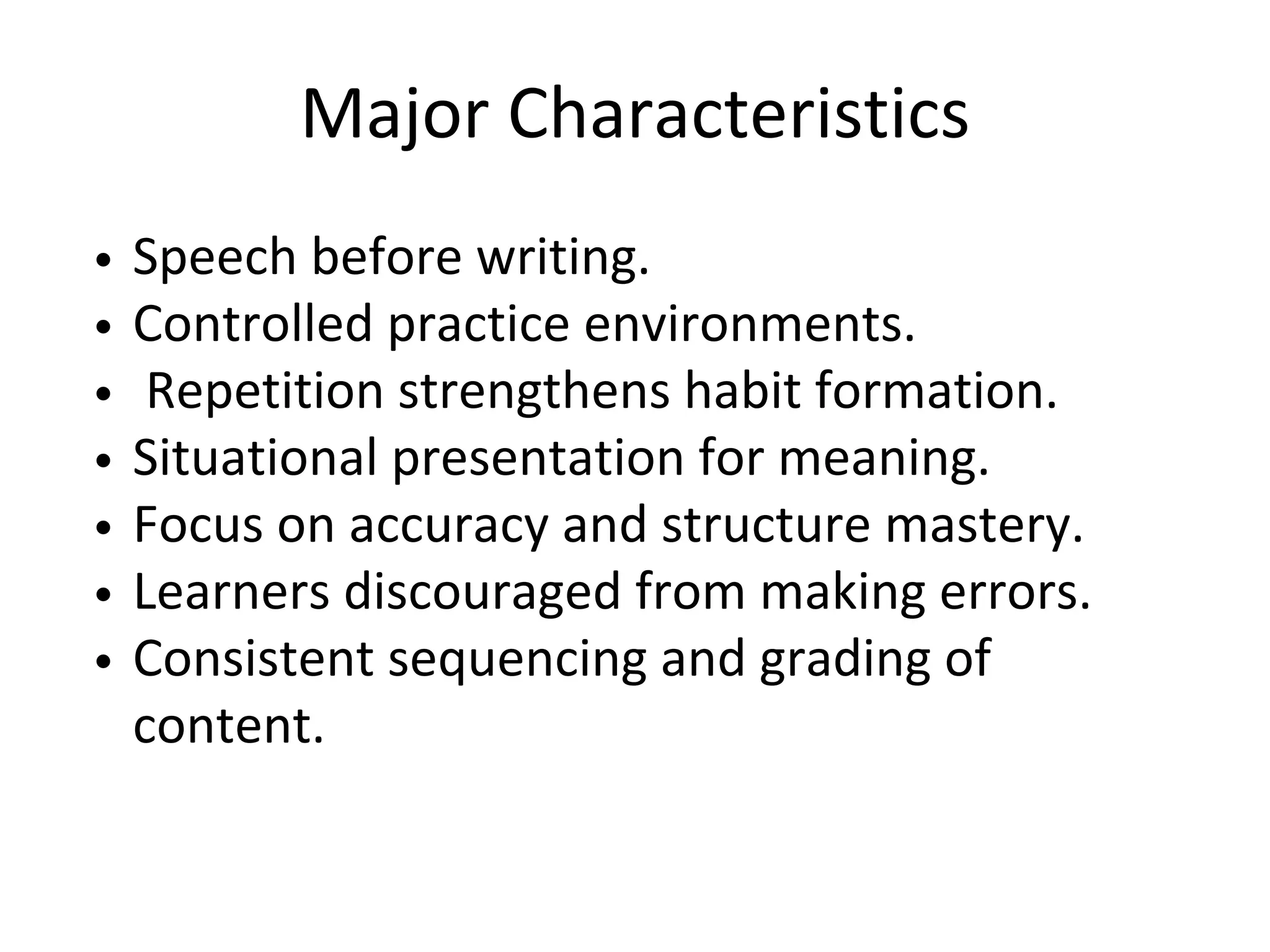
Major Characteristics
Speech beforewriting.
Controlled practice environments.
Repetition strengthens habit formation.
Situational presentation for meaning.
Focus on accuracy and structure mastery.
Learners discouraged from making errors.
Consistent sequencing and grading of
content.
10.
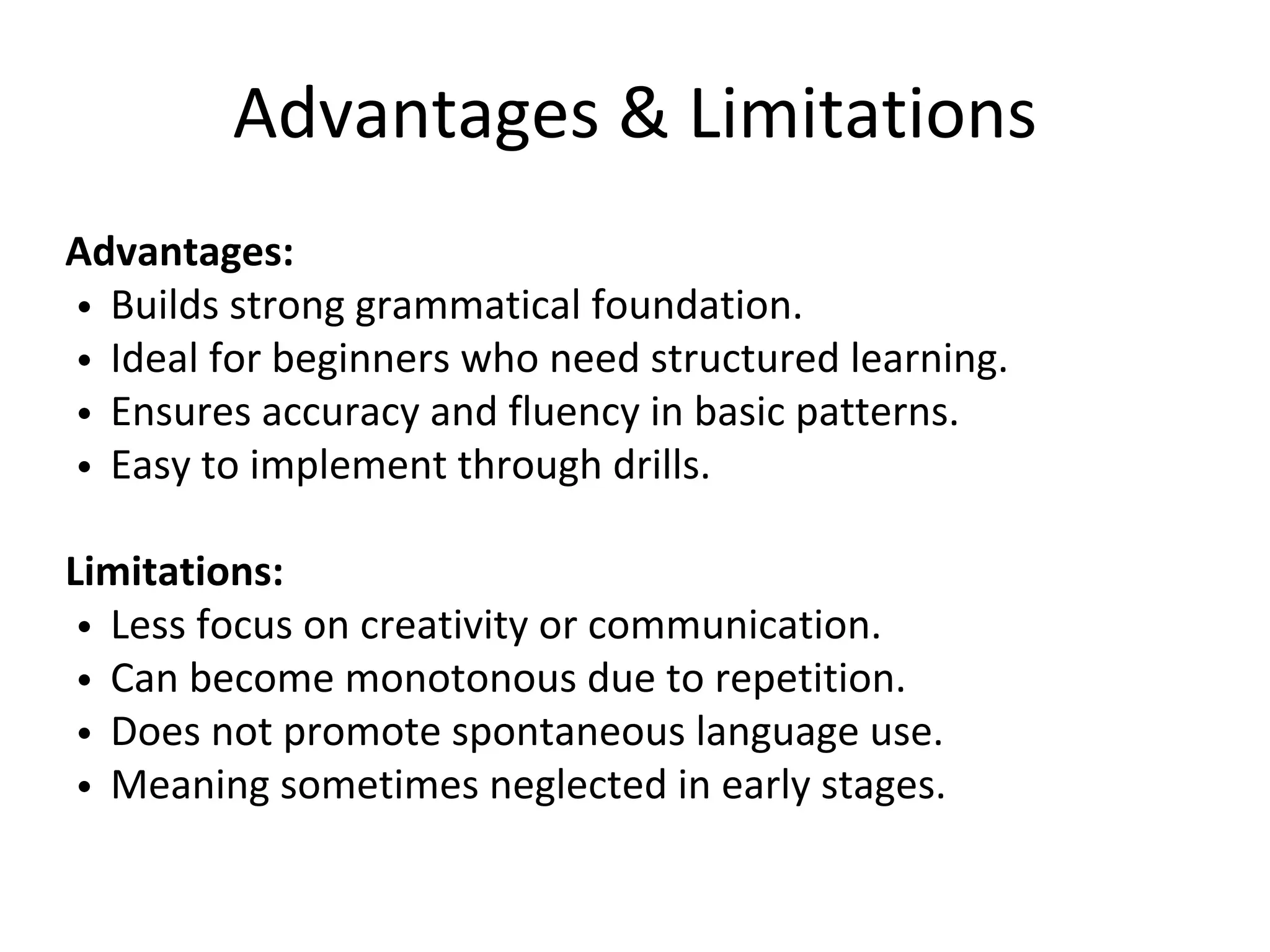
Advantages & Limitations
Advantages:
Buildsstrong grammatical foundation.
Ideal for beginners who need structured learning.
Ensures accuracy and fluency in basic patterns.
Easy to implement through drills.
Limitations:
Less focus on creativity or communication.
Can become monotonous due to repetition.
Does not promote spontaneous language use.
Meaning sometimes neglected in early stages.